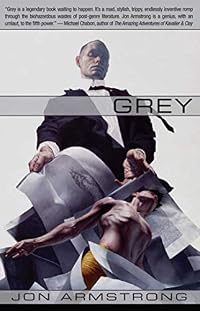
Grey
by Jon Armstrong
On This Page
Description
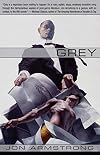
For Michael Rivers, life is perfect. He is tall, handsome and worshipped by billions of fans around the globe. He is wealthy beyond measure, the heir apparent to one of the high-tech corporations that controls the world. He is fashionable, setting trends with his wardrobe of immaculate designer suits. And Michael is in love with Nora, his beautiful, witty and equally perfect fiancée. When an assassin's bullets pierce Michael's body before the cameras at a press junket, everything changes. show more Forcibly separated from Nora, his illusions shattered, Michael seeks to uncover the reasons behind the attempted assassination. Michael delves deep into his past, finding that all paths lead to a time when he was the golden boy, dancing furiously to the beat of notorious all-night Rage parties thrown by his father. show lessTags
Recommendations




Member Reviews
Grey by Jon Armstrong is a Romeo and Juliet tale set in a hypersensitive, almost synesthetic world. The story is “sensual” in the most literal meaning of the word. Colors, tastes, textures and smells are all described in great detail and juxtaposed in discordant manners. It’s a technicolor phantasmagoria.
Michael and Nora are initially brought together in the hopes of merging the companies of their families. The attempted murder of 19 year old Michael results in the cancellation of the marriage under the belief that Nora’s family was behind the attempt. However, Michael still loves Nora and evades his father’s maneuverings for new matches. Just like the classic tale, Michael and Nora form a suicide pact to be together “in the show more end.” As part of his demise, Michael plans on also killing his father with his explosive nitrocellulose suit. The author brings the story to a satisfying conclusion in the epilogue.
Throughout the story are continual references to various fashion magazines by which characters live their lives and are identified. Michael and Nora both live for “Pure H.” From descriptions of the layouts and advertisements, this would be similar to a very dark (almost sadistic) version of GQ or Vogue. All of the fashion is neutral and based on shades of grey. Michael is so devoted that he had a surgical procedure to destroy all of the color sensing cones in one eye so that it can only perceive gray tones.
The book also speaks to the insanity of today’s celebrity glorification and commercialization. Every detail of the Michael’s life is broadcast and used to benefit the family business. The portrayal of the media is a caricature of what we might consider to be the worst examples of journalism.
I found Armstrong’s writing to be both unsettling and appealing at the same time. The richness of language overlays the dark subject matter. The reader wants to look away, but can’t. A word of warning that this story is not for the squeamish. It is both violent and gruesome. The Ultra (both a sub-culture and music style that makes punk-rock seem like NPR) performance by Aluminum Anus during the RiverGroup product launch is simply revolting.
This was so different from anything else I’ve read recently that I’m looking forward to investigating Armstrong further in his second novel, Yarn. show less
Michael and Nora are initially brought together in the hopes of merging the companies of their families. The attempted murder of 19 year old Michael results in the cancellation of the marriage under the belief that Nora’s family was behind the attempt. However, Michael still loves Nora and evades his father’s maneuverings for new matches. Just like the classic tale, Michael and Nora form a suicide pact to be together “in the show more end.” As part of his demise, Michael plans on also killing his father with his explosive nitrocellulose suit. The author brings the story to a satisfying conclusion in the epilogue.
Throughout the story are continual references to various fashion magazines by which characters live their lives and are identified. Michael and Nora both live for “Pure H.” From descriptions of the layouts and advertisements, this would be similar to a very dark (almost sadistic) version of GQ or Vogue. All of the fashion is neutral and based on shades of grey. Michael is so devoted that he had a surgical procedure to destroy all of the color sensing cones in one eye so that it can only perceive gray tones.
The book also speaks to the insanity of today’s celebrity glorification and commercialization. Every detail of the Michael’s life is broadcast and used to benefit the family business. The portrayal of the media is a caricature of what we might consider to be the worst examples of journalism.
I found Armstrong’s writing to be both unsettling and appealing at the same time. The richness of language overlays the dark subject matter. The reader wants to look away, but can’t. A word of warning that this story is not for the squeamish. It is both violent and gruesome. The Ultra (both a sub-culture and music style that makes punk-rock seem like NPR) performance by Aluminum Anus during the RiverGroup product launch is simply revolting.
This was so different from anything else I’ve read recently that I’m looking forward to investigating Armstrong further in his second novel, Yarn. show less
Grey is a far-future dystopia where you don't get to explore too much of the future and the narrator doesn't seem to care about the dystopia. It moves quickly and is very visual. The book begs to be made into a movie or miniseries as the rich descriptions of future fashion and music are a director's dream come true. On the other hand, the narrator is unlikable by virtue of being a cad, a twit, a bit of a rich prick and utterly useless in every situation.
You have no stake in the climax of the book or in the movements of any protagonist because they are all alien, and the only inner life you have access to is a barren wasteland of fashion commentary.
All that criticism aside, the journey to the unsatisfying climax is a satisfying show more journey. The world is interesting, intriguing and you always want to look around it more. Worth a read on the subway. show less
You have no stake in the climax of the book or in the movements of any protagonist because they are all alien, and the only inner life you have access to is a barren wasteland of fashion commentary.
All that criticism aside, the journey to the unsatisfying climax is a satisfying show more journey. The world is interesting, intriguing and you always want to look around it more. Worth a read on the subway. show less
Michael Chabon blurbed, but I didn’t like this theater-of-the-absurd if-this-goes-on YA-ish story about Michael Rivers, teenaged scion of one of the privileged corporate overlords who also happens to be a buffoonish sex-and-violence-crazed lout who’s constantly being filmed for a 500-hour documentary of his life. When Michael falls in love with the daughter of a corporate rival, his calm grey life (adopted in rebellion to his father’s color, but also in conformity with a privileged style that depends on massive amounts of resources) turns into Romeo-and-Juliet melodrama. The first sentence probably tells you whether you’d like it: “Nora and I finished our fried whale and plum sandwiches, our cream coffees, and the cocoa and show more coca pastries, and sat in a comfortable silence as the landscapes of buildings and millions of well-wishers whirred past the windows at six hundred kilometers per hour.” show less
This book was definitely not what I expected. I was expecting something with a more serious tone, but instead I found it to be quite bizarre. There was a glimmer of an interesting story in there somewhere, but the insane characters populating the story kept trampling over that glimmer and spitting on it with disdain.
The book started off ok. The main character, Michael, was somewhat likeable and his girlfriend Nora seemed interesting. But, as soon as other characters started entering the picture, things got really weird. Michael’s father had a tendency to start randomly singing and dancing mid-conversation and doing “pelvis thrusts”. Nearly everybody was obsessed with outrageous fashion trends and songs with violent, nasty lyrics. show more And most of the characters spoke as if their brain hadn’t developed past that of a five-year-old. They used an adult’s vocabulary, not to mention plenty of vulgarity and adult themes, but their actual attitude and their way of expressing themselves was that of young children.
A story about self-absorbed people with weird interests and messed-up priorities could have been interesting to me, but the characters were just so over-the-top that I couldn’t take the story seriously. I also felt like this was practically a romance novel disguised as science fiction. Michael is constantly obsessing over Nora. He’s crazy about her even though they’ve only had four dates, all of which were conducted on camera for public viewing. This book has some unique (if not to my tastes) world building and there was a bit of a mystery in there regarding who was responsible for the incident that occurred at the beginning of the book. There was also an unexpected (and rather disturbing) twist toward the end. However, despite the fact that the book had some different elements to it, it mostly just felt like a romance novel because Michael was so obsessed with Nora that his determination to be with her overshadowed anything else that was going on.
Despite the fact that I didn’t care for the book, I did finish it within a reasonable time frame so I guess somehow it held my interest. But I was definitely rolling my eyes a lot, especially when I got to the final sentence in the book. show less
The book started off ok. The main character, Michael, was somewhat likeable and his girlfriend Nora seemed interesting. But, as soon as other characters started entering the picture, things got really weird. Michael’s father had a tendency to start randomly singing and dancing mid-conversation and doing “pelvis thrusts”. Nearly everybody was obsessed with outrageous fashion trends and songs with violent, nasty lyrics. show more And most of the characters spoke as if their brain hadn’t developed past that of a five-year-old. They used an adult’s vocabulary, not to mention plenty of vulgarity and adult themes, but their actual attitude and their way of expressing themselves was that of young children.
A story about self-absorbed people with weird interests and messed-up priorities could have been interesting to me, but the characters were just so over-the-top that I couldn’t take the story seriously. I also felt like this was practically a romance novel disguised as science fiction. Michael is constantly obsessing over Nora. He’s crazy about her even though they’ve only had four dates, all of which were conducted on camera for public viewing. This book has some unique (if not to my tastes) world building and there was a bit of a mystery in there regarding who was responsible for the incident that occurred at the beginning of the book. There was also an unexpected (and rather disturbing) twist toward the end. However, despite the fact that the book had some different elements to it, it mostly just felt like a romance novel because Michael was so obsessed with Nora that his determination to be with her overshadowed anything else that was going on.
Despite the fact that I didn’t care for the book, I did finish it within a reasonable time frame so I guess somehow it held my interest. But I was definitely rolling my eyes a lot, especially when I got to the final sentence in the book. show less
What if the gap between the rich and the average opened to a gulf too wide to bridge? What if megafamily corporations had every resource in a media saturated world?
This is the story of Michael of RiverGroup family. He has had every need taken care of since he was born. But recently he changed from a dancer and image obsessed fashion plate (of truly horrible fashions) like his father to a somber young adult so addicted to a black and white fashion magazine, Pure H, that he has the rods removed from one eye so that he can see the world in black and white. He is engaged to the scion, Nora, of another megafamily who is also an enthusiast of Pure H. Together they "date" in the media drenched, publicity induced engagement arranged by their show more families, until Michael is injured by a sniper. Nora's father immediately revokes the engagement, making Michael and Nora the Romeo and Juliet of the far future. RiverGroup, once the top corporation for security is now spiraling down out of control. His father is too stupid to be able to save the family except by arranging a marriage to a grandniece of a once powerful family. Michael rejects this arrangement and does everything he can to get back to his love, Nora.
This is a first novel and has some of the structural problems and wording choices that would have been corrected by a more experienced writer. But this book does have a great sense of place and wonderful examination of a possible media/publicity filled future. I love Armstrong's energy and voice. show less
This is the story of Michael of RiverGroup family. He has had every need taken care of since he was born. But recently he changed from a dancer and image obsessed fashion plate (of truly horrible fashions) like his father to a somber young adult so addicted to a black and white fashion magazine, Pure H, that he has the rods removed from one eye so that he can see the world in black and white. He is engaged to the scion, Nora, of another megafamily who is also an enthusiast of Pure H. Together they "date" in the media drenched, publicity induced engagement arranged by their show more families, until Michael is injured by a sniper. Nora's father immediately revokes the engagement, making Michael and Nora the Romeo and Juliet of the far future. RiverGroup, once the top corporation for security is now spiraling down out of control. His father is too stupid to be able to save the family except by arranging a marriage to a grandniece of a once powerful family. Michael rejects this arrangement and does everything he can to get back to his love, Nora.
This is a first novel and has some of the structural problems and wording choices that would have been corrected by a more experienced writer. But this book does have a great sense of place and wonderful examination of a possible media/publicity filled future. I love Armstrong's energy and voice. show less
There was a lot to like in this story, particularly the naïve narrator and the fashion. Oh, the fashion.
However, the story itself seemed a tad ham-handed and the highly imaginative world just didn't ring true for me. It wasn't quite alien enough to be another civilization or alternate universe, but I just couldn't ever see a way for human beings to end up like this.
A fun read, but that's all.
However, the story itself seemed a tad ham-handed and the highly imaginative world just didn't ring true for me. It wasn't quite alien enough to be another civilization or alternate universe, but I just couldn't ever see a way for human beings to end up like this.
A fun read, but that's all.
(Reprinted from the Chicago Center for Literature and Photography [cclapcenter.com]. I am the original author of this essay, as well as the owner of CCLaP; it is not being reprinted here illegally.)
This is one of four books that recently came in and out of my life without me finishing, but with none of them particularly that terrible, one of two award-nominated science-fiction novels; and the award this one was nominated for is the Hugo, an award which supposedly reflects the best SF novel of the entire year, and is considered by many to be the most prestigious award in that entire industry. But, oh, I don't know -- I don't want to say that Jon Armstrong's Grey is out-and-out bad, because it isn't, just that it's got one of those show more storylines that sounds a whole lot better as a premise inside an author's brain, while not so great or even that compelling when actually committed to paper. In fact, my brain is already fuzzy about the plot's details, a mere week after putting the manuscript down: it's the future, I remember that, a future run by royal Shakespearean families of sorts, where decorum and protocol rule all and the subtleties of fashion and music have become an outrageous arena for displaying one's political opinions. Unfortunately, though, Armstrong uses such a milieu to tell a mostly forgettable story, something about the wealthy and good-looking son of one of these outrageously-dressed patriarchs, who is part of some sort of weird countercultural fashion movement to dress only in infinitely subtle shades of grey, and I guess belongs to a religion that worships advertisements or something like that, and who along with his true love is fighting the prearranged political marriages that are the norm for their society. Or...something.
Like I said, I can see how this might've seemed like a cool concept for a fantastical novel when Armstrong was first dreaming it up; a shiny surrealist world where private armies wear stylish bright-orange satin suits and have three-foot-high hairdos, and where the ultimate form of rebellion a fey young fashionista can partake in is to only eat tan foods. But see, once you start writing stuff like that down, you start realizing just how ridiculous a lot of it would actually look if seen in the real world, or at least you should; this is the same problem, for example, that leads to all the ridiculous things you see in SF movie adaptations, from Zardoz to Southland Tales, all those silly cartoonish details that make you scratch your head and go, "Who the hell ever thought this would be a good idea?" Grey is not necessarily a bad book, but is definitely only for the most hardcore SF junkies out there, the genre apologists who not only own the DVD box-sets of crappy 1970s obscure television space operas, but actually watch them on a regular basis. Again, it makes me wonder why it got nominated for a Hugo in the first place, when you would think that the award-givers would want to concentrate on the absolute best their industry had to offer that year. Approach with caution.
Out of 10: 5.3 show less
This is one of four books that recently came in and out of my life without me finishing, but with none of them particularly that terrible, one of two award-nominated science-fiction novels; and the award this one was nominated for is the Hugo, an award which supposedly reflects the best SF novel of the entire year, and is considered by many to be the most prestigious award in that entire industry. But, oh, I don't know -- I don't want to say that Jon Armstrong's Grey is out-and-out bad, because it isn't, just that it's got one of those show more storylines that sounds a whole lot better as a premise inside an author's brain, while not so great or even that compelling when actually committed to paper. In fact, my brain is already fuzzy about the plot's details, a mere week after putting the manuscript down: it's the future, I remember that, a future run by royal Shakespearean families of sorts, where decorum and protocol rule all and the subtleties of fashion and music have become an outrageous arena for displaying one's political opinions. Unfortunately, though, Armstrong uses such a milieu to tell a mostly forgettable story, something about the wealthy and good-looking son of one of these outrageously-dressed patriarchs, who is part of some sort of weird countercultural fashion movement to dress only in infinitely subtle shades of grey, and I guess belongs to a religion that worships advertisements or something like that, and who along with his true love is fighting the prearranged political marriages that are the norm for their society. Or...something.
Like I said, I can see how this might've seemed like a cool concept for a fantastical novel when Armstrong was first dreaming it up; a shiny surrealist world where private armies wear stylish bright-orange satin suits and have three-foot-high hairdos, and where the ultimate form of rebellion a fey young fashionista can partake in is to only eat tan foods. But see, once you start writing stuff like that down, you start realizing just how ridiculous a lot of it would actually look if seen in the real world, or at least you should; this is the same problem, for example, that leads to all the ridiculous things you see in SF movie adaptations, from Zardoz to Southland Tales, all those silly cartoonish details that make you scratch your head and go, "Who the hell ever thought this would be a good idea?" Grey is not necessarily a bad book, but is definitely only for the most hardcore SF junkies out there, the genre apologists who not only own the DVD box-sets of crappy 1970s obscure television space operas, but actually watch them on a regular basis. Again, it makes me wonder why it got nominated for a Hugo in the first place, when you would think that the award-givers would want to concentrate on the absolute best their industry had to offer that year. Approach with caution.
Out of 10: 5.3 show less
Members
- Recently Added By
Author Information

7+ Works 310 Members
Some Editions
Awards and Honors
Awards
Work Relationships
Has the (non-series) prequel
Classifications
Statistics
- Members
- 192
- Popularity
- 169,921
- Reviews
- 10
- Rating
- (3.12)
- Languages
- English
- Media
- Paper, Ebook
- ISBNs
- 2
- ASINs
- 4