
Hal Duncan
Author of Vellum
About the Author
Image credit: taleswapper
Series
Works by Hal Duncan
Judgement 2 copies
Whatever the Fuck You Want 1 copy
Sonnets for Orpheus 1 copy
The Angel of Gamblers 1 copy
Golden Lads All Must 1 copy
The Tower Of Morning's Bones 1 copy
The City of Rotted Names 1 copy
The Beast of Buskerville 1 copy
Jack Scallywag 1 copy
Scruffians Stamp 1 copy
The Chiaroscurist 1 copy
The Toymaker's Grief 1 copy
The Fool 1 copy
Associated Works
Lightspeed Magazine, Issue 61 • June 2015 (Queers Destroy Science Fiction! special issue) (2015) — Contributor — 112 copies, 3 reviews
Queers Dig Time Lords: A Celebration of Doctor Who by the LGBTQ Fans Who Love It (2013) — Contributor — 81 copies, 2 reviews
Glorifying Terrorism, Manufacturing Contempt: An Anthology (2006) — Contributor — 69 copies, 3 reviews
Dislocations: Nine Stories of Speculation and Imagination (2007) — Contributor — 38 copies, 2 reviews
Sunspot Jungle: The Ever Expanding Universe of Fantasy and Science Fiction (2018) — Contributor — 38 copies, 1 review
Last Drink Bird Head : A Flash Fiction Anthology for Charity (2009) — Contributor — 33 copies, 1 review
Wilde Stories 2011: The Year's Best Gay Speculative Fiction (2011) — Contributor — 29 copies, 1 review
Wilde Stories 2009: The Year's Best Gay Speculative Fiction (2009) — Contributor — 25 copies, 2 reviews
GALLUS: A Glasgow SF Writers' Circle Anthology — Contributor — 3 copies
Tagged
Common Knowledge
- Legal name
- Duncan, Alistair
- Birthdate
- 1971
- Gender
- male
- Nationality
- Scotland
- Places of residence
- Ayrshire, Scotland, UK
Glasgow, Scotland, UK - Map Location
- UK
Members
Reviews
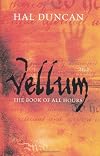
Vellum is a real rarity - a genuinely stunning first novel, built by a superb writer, on a wildly imaginative concept.
Duncan's book is dense, with a complex, non-linear plot, and a mass of slightly obscure external and intenal references. There's nothing that I spotted that will baffle Google though.
His style, while lucid is quite dense, and lyrical. He resembles in tone some of the earlier fantasy writers, Dunsany, Morris, McDonald and sometimes even Lovecraft, but his voice is his own, show more and is worth listening to.
This is fantasy as a powerful novel, written by someone who has clearly read a lot of other novels. Unlike many recent fantasy writers, who only grasp the surface of what Tolkien tried to do, Ducnan understands what he really meant by 'Fairie' and goes there. If you find people like Eddings, Brooks and Feist a bit tedious, and a bit repetitive, as I do, try Duncan - fantasy writing for grown-ups.
Summary :- This is the best fantasy novel I've read this century. Do yourself a favour and read it too. show less
Duncan's book is dense, with a complex, non-linear plot, and a mass of slightly obscure external and intenal references. There's nothing that I spotted that will baffle Google though.
His style, while lucid is quite dense, and lyrical. He resembles in tone some of the earlier fantasy writers, Dunsany, Morris, McDonald and sometimes even Lovecraft, but his voice is his own, show more and is worth listening to.
This is fantasy as a powerful novel, written by someone who has clearly read a lot of other novels. Unlike many recent fantasy writers, who only grasp the surface of what Tolkien tried to do, Ducnan understands what he really meant by 'Fairie' and goes there. If you find people like Eddings, Brooks and Feist a bit tedious, and a bit repetitive, as I do, try Duncan - fantasy writing for grown-ups.
Summary :- This is the best fantasy novel I've read this century. Do yourself a favour and read it too. show less
dense and chewy, multi-layered, fractured and disorienting at first - if I hadn't already read and adored some of his short stories I might have given up, but I'm so glad that I stuck with it long enough for the patterns to start coming together, the structures and stories to emerge, or possibly just long enough for my head to click into the right gear. Once I'd hit that point though - wow!
Might as well talk about 'Ink' and 'Vellum' together, since they're really one work.
Conveniently, Duncan describes his work himself, within the text of the book:
"...the Book has as many histories as the world itself, and it contains them all in its Moebius loop of time and space, of contradicting stories somehow fused as one confused and rambling tale, a sort of truth but full of inconsistencies and digressions, spurious interpolations and interpretations, fiction told as fact, fact told as show more fiction..."
At least, that's the goal.
It starts off promisingly: a student seeks to steal a secret vellum manuscript - the Book of All Hours - a book which determines and reflects reality, which contains all possible realities... a book written in the language of angels, upon the skin of angels, which contains the entirety of the time-space continuum. This is connected to a War in Heaven, agents of the angels that walk upon the earth, and a lot of Sumerian mythology. It began by reminding me of Storm Constantine's Grigori books, and Catherynne Valente's Palimpsest. Neither of those is a bad thing.
However, there's a problem with writing a book about a book that is supposed to contain all things, when you intend the format of your book to reflect that of your fictional book. How do you edit it? What should go in, and what shouldn't? I would have had trouble editing this book, I have to admit. And, in the end, I don't think it worked.
It's obvious that Duncan wrote several reasonably coherent narratives, then chopped them up at mostly-random, and mixed them together. He also wrote a lot of random Other Stuff (thoughts in his head that day?) and stuck those in too. (It reminded me of doing college creative writing assignments, when I sometimes pieced disparate pieces of my writing together in order to make up a page count by a deadline.)
Yes, the reader can piece the narratives together as s/he goes along, but do the "inconsistencies and digressions, spurious interpolations and interpretations" serve a purpose? I kept hoping that they would. I have to admit that my interest was waning by the end of the first book, but I read the whole second book with the hope that it would all get pulled together. I don't feel that that happened.
Duncan is obviously a smart guy. He's very obviously well and widely educated. There are a lot of interesting ideas in these books, and many of the small vignettes are expertly and beautifully written. He has a nice command of the English language. However, I couldn't help feeling that he might be more suited to writing essays than novels. I bet he's good at academic papers, too.
About halfway through the second book, I was thinking about why I really wasn't enjoying it, and I realized that all of the characters, no matter which reality they're currently in, whether they speak in a broadly-written accent, are young or old, or even (in one case) female, seem like they're actually the same person: Hal Duncan(?)
I kid you not, after I realized that, on the very next page, I came across this quote: "there's a deeper connection between them - Jack, Puck, Anna, Joey, Don and himself...Finnan too, wherever he is. The seven of them, seven souls, but maybe really only one...identity."
Yep. They're all the same person. And they're too busy being archetypes, metaphors or mouthpieces most of the time, to be convincing characters.
Duncan says, "Let us consider reality itself as a palimpsest." OK, consider that considered. I even really like the idea. I like a LOT of the ideas in this book. But I feel that those idea would have come through better through the use of a more consistent format - not even necessarily a traditional format, but just a more consistent one. For example, part 3 (the first half of 'Ink') is largely taken up by the characters putting on a performance of a version of 'The Bacchae.' However, Greek drama plays little part in any of the other sections of the book. It feels out-of-place. As do many of the other "spurious interpolations" within the text.
I feel like Duncan said, "well, it's inconsistent because I want it to be inconsistent." But I still prefer consistency. And characters with individual identities.
I often really like things that others describe, negatively, as "pretentious." But this is one of those rare occasions where I am feeling moved to use "pretentious" in a negative sense. This book is pretentious. show less
Conveniently, Duncan describes his work himself, within the text of the book:
"...the Book has as many histories as the world itself, and it contains them all in its Moebius loop of time and space, of contradicting stories somehow fused as one confused and rambling tale, a sort of truth but full of inconsistencies and digressions, spurious interpolations and interpretations, fiction told as fact, fact told as show more fiction..."
At least, that's the goal.
It starts off promisingly: a student seeks to steal a secret vellum manuscript - the Book of All Hours - a book which determines and reflects reality, which contains all possible realities... a book written in the language of angels, upon the skin of angels, which contains the entirety of the time-space continuum. This is connected to a War in Heaven, agents of the angels that walk upon the earth, and a lot of Sumerian mythology. It began by reminding me of Storm Constantine's Grigori books, and Catherynne Valente's Palimpsest. Neither of those is a bad thing.
However, there's a problem with writing a book about a book that is supposed to contain all things, when you intend the format of your book to reflect that of your fictional book. How do you edit it? What should go in, and what shouldn't? I would have had trouble editing this book, I have to admit. And, in the end, I don't think it worked.
It's obvious that Duncan wrote several reasonably coherent narratives, then chopped them up at mostly-random, and mixed them together. He also wrote a lot of random Other Stuff (thoughts in his head that day?) and stuck those in too. (It reminded me of doing college creative writing assignments, when I sometimes pieced disparate pieces of my writing together in order to make up a page count by a deadline.)
Yes, the reader can piece the narratives together as s/he goes along, but do the "inconsistencies and digressions, spurious interpolations and interpretations" serve a purpose? I kept hoping that they would. I have to admit that my interest was waning by the end of the first book, but I read the whole second book with the hope that it would all get pulled together. I don't feel that that happened.
Duncan is obviously a smart guy. He's very obviously well and widely educated. There are a lot of interesting ideas in these books, and many of the small vignettes are expertly and beautifully written. He has a nice command of the English language. However, I couldn't help feeling that he might be more suited to writing essays than novels. I bet he's good at academic papers, too.
About halfway through the second book, I was thinking about why I really wasn't enjoying it, and I realized that all of the characters, no matter which reality they're currently in, whether they speak in a broadly-written accent, are young or old, or even (in one case) female, seem like they're actually the same person: Hal Duncan(?)
I kid you not, after I realized that, on the very next page, I came across this quote: "there's a deeper connection between them - Jack, Puck, Anna, Joey, Don and himself...Finnan too, wherever he is. The seven of them, seven souls, but maybe really only one...identity."
Yep. They're all the same person. And they're too busy being archetypes, metaphors or mouthpieces most of the time, to be convincing characters.
Duncan says, "Let us consider reality itself as a palimpsest." OK, consider that considered. I even really like the idea. I like a LOT of the ideas in this book. But I feel that those idea would have come through better through the use of a more consistent format - not even necessarily a traditional format, but just a more consistent one. For example, part 3 (the first half of 'Ink') is largely taken up by the characters putting on a performance of a version of 'The Bacchae.' However, Greek drama plays little part in any of the other sections of the book. It feels out-of-place. As do many of the other "spurious interpolations" within the text.
I feel like Duncan said, "well, it's inconsistent because I want it to be inconsistent." But I still prefer consistency. And characters with individual identities.
I often really like things that others describe, negatively, as "pretentious." But this is one of those rare occasions where I am feeling moved to use "pretentious" in a negative sense. This book is pretentious. show less
Might as well talk about 'Ink' and 'Vellum' together, since they're really one work.
Conveniently, Duncan describes his work himself, within the text of the book:
"...the Book has as many histories as the world itself, and it contains them all in its Moebius loop of time and space, of contradicting stories somehow fused as one confused and rambling tale, a sort of truth but full of inconsistencies and digressions, spurious interpolations and interpretations, fiction told as fact, fact told as show more fiction..."
At least, that's the goal.
It starts off promisingly: a student seeks to steal a secret vellum manuscript - the Book of All Hours - a book which determines and reflects reality, which contains all possible realities... a book written in the language of angels, upon the skin of angels, which contains the entirety of the time-space continuum. This is connected to a War in Heaven, agents of the angels that walk upon the earth, and a lot of Sumerian mythology. It began by reminding me of Storm Constantine's Grigori books, and Catherynne Valente's Palimpsest. Neither of those is a bad thing.
However, there's a problem with writing a book about a book that is supposed to contain all things, when you intend the format of your book to reflect that of your fictional book. How do you edit it? What should go in, and what shouldn't? I would have had trouble editing this book, I have to admit. And, in the end, I don't think it worked.
It's obvious that Duncan wrote several reasonably coherent narratives, then chopped them up at mostly-random, and mixed them together. He also wrote a lot of random Other Stuff (thoughts in his head that day?) and stuck those in too. (It reminded me of doing college creative writing assignments, when I sometimes pieced disparate pieces of my writing together in order to make up a page count by a deadline.)
Yes, the reader can piece the narratives together as s/he goes along, but do the "inconsistencies and digressions, spurious interpolations and interpretations" serve a purpose? I kept hoping that they would. I have to admit that my interest was waning by the end of the first book, but I read the whole second book with the hope that it would all get pulled together. I don't feel that that happened.
Duncan is obviously a smart guy. He's very obviously well and widely educated. There are a lot of interesting ideas in these books, and many of the small vignettes are expertly and beautifully written. He has a nice command of the English language. However, I couldn't help feeling that he might be more suited to writing essays than novels. I bet he's good at academic papers, too.
About halfway through the second book, I was thinking about why I really wasn't enjoying it, and I realized that all of the characters, no matter which reality they're currently in, whether they speak in a broadly-written accent, are young or old, or even (in one case) female, seem like they're actually the same person: Hal Duncan(?)
I kid you not, after I realized that, on the very next page, I came across this quote: "there's a deeper connection between them - Jack, Puck, Anna, Joey, Don and himself...Finnan too, wherever he is. The seven of them, seven souls, but maybe really only one...identity."
Yep. They're all the same person. And they're too busy being archetypes, metaphors or mouthpieces most of the time, to be convincing characters.
Duncan says, "Let us consider reality itself as a palimpsest." OK, consider that considered. I even really like the idea. I like a LOT of the ideas in this book. But I feel that those idea would have come through better through the use of a more consistent format - not even necessarily a traditional format, but just a more consistent one. For example, part 3 (the first half of 'Ink') is largely taken up by the characters putting on a performance of a version of 'The Bacchae.' However, Greek drama plays little part in any of the other sections of the book. It feels out-of-place. As do many of the other "spurious interpolations" within the text.
I feel like Duncan said, "well, it's inconsistent because I want it to be inconsistent." But I still prefer consistency. And characters with individual identities.
I often really like things that others describe, negatively, as "pretentious." But this is one of those rare occasions where I am feeling moved to use "pretentious" in a negative sense. This book is pretentious. show less
Conveniently, Duncan describes his work himself, within the text of the book:
"...the Book has as many histories as the world itself, and it contains them all in its Moebius loop of time and space, of contradicting stories somehow fused as one confused and rambling tale, a sort of truth but full of inconsistencies and digressions, spurious interpolations and interpretations, fiction told as fact, fact told as show more fiction..."
At least, that's the goal.
It starts off promisingly: a student seeks to steal a secret vellum manuscript - the Book of All Hours - a book which determines and reflects reality, which contains all possible realities... a book written in the language of angels, upon the skin of angels, which contains the entirety of the time-space continuum. This is connected to a War in Heaven, agents of the angels that walk upon the earth, and a lot of Sumerian mythology. It began by reminding me of Storm Constantine's Grigori books, and Catherynne Valente's Palimpsest. Neither of those is a bad thing.
However, there's a problem with writing a book about a book that is supposed to contain all things, when you intend the format of your book to reflect that of your fictional book. How do you edit it? What should go in, and what shouldn't? I would have had trouble editing this book, I have to admit. And, in the end, I don't think it worked.
It's obvious that Duncan wrote several reasonably coherent narratives, then chopped them up at mostly-random, and mixed them together. He also wrote a lot of random Other Stuff (thoughts in his head that day?) and stuck those in too. (It reminded me of doing college creative writing assignments, when I sometimes pieced disparate pieces of my writing together in order to make up a page count by a deadline.)
Yes, the reader can piece the narratives together as s/he goes along, but do the "inconsistencies and digressions, spurious interpolations and interpretations" serve a purpose? I kept hoping that they would. I have to admit that my interest was waning by the end of the first book, but I read the whole second book with the hope that it would all get pulled together. I don't feel that that happened.
Duncan is obviously a smart guy. He's very obviously well and widely educated. There are a lot of interesting ideas in these books, and many of the small vignettes are expertly and beautifully written. He has a nice command of the English language. However, I couldn't help feeling that he might be more suited to writing essays than novels. I bet he's good at academic papers, too.
About halfway through the second book, I was thinking about why I really wasn't enjoying it, and I realized that all of the characters, no matter which reality they're currently in, whether they speak in a broadly-written accent, are young or old, or even (in one case) female, seem like they're actually the same person: Hal Duncan(?)
I kid you not, after I realized that, on the very next page, I came across this quote: "there's a deeper connection between them - Jack, Puck, Anna, Joey, Don and himself...Finnan too, wherever he is. The seven of them, seven souls, but maybe really only one...identity."
Yep. They're all the same person. And they're too busy being archetypes, metaphors or mouthpieces most of the time, to be convincing characters.
Duncan says, "Let us consider reality itself as a palimpsest." OK, consider that considered. I even really like the idea. I like a LOT of the ideas in this book. But I feel that those idea would have come through better through the use of a more consistent format - not even necessarily a traditional format, but just a more consistent one. For example, part 3 (the first half of 'Ink') is largely taken up by the characters putting on a performance of a version of 'The Bacchae.' However, Greek drama plays little part in any of the other sections of the book. It feels out-of-place. As do many of the other "spurious interpolations" within the text.
I feel like Duncan said, "well, it's inconsistent because I want it to be inconsistent." But I still prefer consistency. And characters with individual identities.
I often really like things that others describe, negatively, as "pretentious." But this is one of those rare occasions where I am feeling moved to use "pretentious" in a negative sense. This book is pretentious. show less
Lists
Awards


You May Also Like


Associated Authors
Statistics
- Works
- 42
- Also by
- 31
- Members
- 2,148
- Popularity
- #11,970
- Rating
- 3.5
- Reviews
- 71
- ISBNs
- 59
- Languages
- 7
- Favorited
- 8
