On This Page
Description
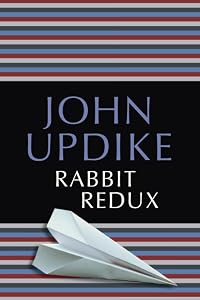
In this sequel to Rabbit, Run, it is 1969 and the times are changing in America. Things just aren't as simple as they used to be for Rabbit Angstrom. His wife leaves him, and suddenly, into his confused life comes Jill, a runaway who becomes his lover. But when she invites her friend to stay, a young black radical named Skeeter, the pair's fragile harmony soon begins to fail.Tags
Recommendations






















Member Reviews
This is the second in the Updike series about Harry 'Rabbit' Angstrom and his life has moved on ten years. Rabbit appears to have made his peace with the world and has settled down. He works as a typesetter in the same print-shop where his father has worked for more than thirty years (a trade that will soon to be replaced by new technology.) Rabbit is much more passive than in the first book settling for ordinary rather than going out and grabbing adventure against the backdrop of the first landing on the moon, racial unrest back at home and protests against the Vietnam War. Rabbit is out of time, as a new age of space exploration begins. The astronauts become a metaphor for this more dynamic era.
In Rabbit, Run, Rabbit left Janice for a show more mistress. In Rabbit Redux, Janice leaves Rabbit to live with her lover, Stavros. Rabbit acquiesces to this affair and stays home to care for his son, Nelson. Rabbit becomes a figure of jest and is seen as backward. When he accepts an invitation from a work colleague to visit a black frequented bar Rabbit ends up taking in Jill, a runaway flower child, and Skeeter, a bail-jumping Vietnam War veteran and black radical.
The rival claims of freedom and responsibility are explored from several different points of view. After twice deserting his wife in the earlier novel Rabbit is now trying to maintain a home in the face of increasing odds. This time his wife experiments with freedom by having an affair. Harry learns about this at a bar where the television repeatedly shows Apollo 11 blasting off to the moon revealing the emptiness in his life at the very moment that America is ready to explore far off horizons.
The drug-crazed Jill and Skeeter offer two more examples of the contest between freedom and responsibility. Both think of themselves as being free from the rules of convention. Skeeter's experience in Vietnam he believes that America is morally bankrupt and instead offers a mad vision of himself as a black Messiah. Whilst Jill expects to find love and freedom by rejecting the materialism, but instead she is sexually exploited and left to die in a burning house.
In the first book I found Rabbit to be selfish and arrogant and as such found it hard to empathise with but I found it much more likeable in this book. In Rabbit Run Harry felt that as a former local basketball star he was owed something by society and had a standing within it. Ten years later he has learnt that past glories count for nothing and that he has virtually been forgotten. He is rarely called Rabbit any more. I found it much easier to imagine a man trying to knuckle down,plod along and do the best he can by his family unable to keep pace with the ever increasing pace of technology. Harry still believes in the American way but America has little need for him and he loses virtually everything his wife, job and house forcing him to return to his parents home to live. A rather bleak outlook on modern American society.
After reading the first book I was unsure whether or not I really wanted to revisit Rabbit but having read this one am now quite keen to read more about him although it may be a while. show less
In Rabbit, Run, Rabbit left Janice for a show more mistress. In Rabbit Redux, Janice leaves Rabbit to live with her lover, Stavros. Rabbit acquiesces to this affair and stays home to care for his son, Nelson. Rabbit becomes a figure of jest and is seen as backward. When he accepts an invitation from a work colleague to visit a black frequented bar Rabbit ends up taking in Jill, a runaway flower child, and Skeeter, a bail-jumping Vietnam War veteran and black radical.
The rival claims of freedom and responsibility are explored from several different points of view. After twice deserting his wife in the earlier novel Rabbit is now trying to maintain a home in the face of increasing odds. This time his wife experiments with freedom by having an affair. Harry learns about this at a bar where the television repeatedly shows Apollo 11 blasting off to the moon revealing the emptiness in his life at the very moment that America is ready to explore far off horizons.
The drug-crazed Jill and Skeeter offer two more examples of the contest between freedom and responsibility. Both think of themselves as being free from the rules of convention. Skeeter's experience in Vietnam he believes that America is morally bankrupt and instead offers a mad vision of himself as a black Messiah. Whilst Jill expects to find love and freedom by rejecting the materialism, but instead she is sexually exploited and left to die in a burning house.
In the first book I found Rabbit to be selfish and arrogant and as such found it hard to empathise with but I found it much more likeable in this book. In Rabbit Run Harry felt that as a former local basketball star he was owed something by society and had a standing within it. Ten years later he has learnt that past glories count for nothing and that he has virtually been forgotten. He is rarely called Rabbit any more. I found it much easier to imagine a man trying to knuckle down,plod along and do the best he can by his family unable to keep pace with the ever increasing pace of technology. Harry still believes in the American way but America has little need for him and he loses virtually everything his wife, job and house forcing him to return to his parents home to live. A rather bleak outlook on modern American society.
After reading the first book I was unsure whether or not I really wanted to revisit Rabbit but having read this one am now quite keen to read more about him although it may be a while. show less
As much as I wish I was French, I’ve got to admit these anglophone writers really know what they’re doing.
Updike manages to pull off a Heart of Darkness set within a 60’s suburb, with all of the racially based tumult that is part and parcel of that kind of thing. Colonel Kurtz is now a black man on the run, convinced he is Jesus and liberator, lodged like an enigmatic tumour in Rabbit’s home. The blind vitality of a Lolita is exploited and pilfered by both white colonisers and dispossessed black men. The open sore of Vietnam and the sterile exploration of the Moon don the role of catalysts for religious fervour and naive optimism. All of these factors, as well as a ‘fucked out cunt’ (one of my favourite Millerism’s) of a show more marriage, just go to demonstrate the state of the cogs of the American machine of the 60’s. As the spectacle of a black man fucking a white young girl with the windows wide open shows, the artifice of those repugnant ‘well-to-do white neighbourhoods’ has been dashed. The eyes may be the window to the soul, but now one must wonder what these suburban windows now point to. No one can keep up appearances any longer, the cat’s outta the bag.
This book is great.
P.S. don’t read on the train, got a lot of concerted looks for reading a book laden so heavily with n bombs. show less
Updike manages to pull off a Heart of Darkness set within a 60’s suburb, with all of the racially based tumult that is part and parcel of that kind of thing. Colonel Kurtz is now a black man on the run, convinced he is Jesus and liberator, lodged like an enigmatic tumour in Rabbit’s home. The blind vitality of a Lolita is exploited and pilfered by both white colonisers and dispossessed black men. The open sore of Vietnam and the sterile exploration of the Moon don the role of catalysts for religious fervour and naive optimism. All of these factors, as well as a ‘fucked out cunt’ (one of my favourite Millerism’s) of a show more marriage, just go to demonstrate the state of the cogs of the American machine of the 60’s. As the spectacle of a black man fucking a white young girl with the windows wide open shows, the artifice of those repugnant ‘well-to-do white neighbourhoods’ has been dashed. The eyes may be the window to the soul, but now one must wonder what these suburban windows now point to. No one can keep up appearances any longer, the cat’s outta the bag.
This book is great.
P.S. don’t read on the train, got a lot of concerted looks for reading a book laden so heavily with n bombs. show less
Rabbit Redux is a continuation of the story of Harry 'Rabbit' Angstrom, first introduced in Updike's novel, Rabbit, Run. In the first book, set in the 1950's, Rabbit, feeling trapped in his marriage, leaves his wife. In this 2nd novel, Rabbit and his wife, Janice, are back together, but the setting is 12 years later, during the turbulent and free 60's. This time, Janice is fed up with Rabbit and starts an affair with a co-worker. Rabbit is aware of Janice's affair and going with the 'free love' attitude of the times, accepts the relationship and doesn't push for her to end it. This time, Janice moves out and Rabbit is left to negotiate being alone as a single father.
I have to admit that there is not a single character in these books show more that I like. Rabbit is obsessed with sex, treats women poorly, and never thinks about the consequences of his actions. But, I really enjoy the brutal honesty of the characters. Reading both books was especially interesting to see how much our society changed in just a decade. In Rabbit, Run, Janice was the typical American housewife of the 50's. Rabbit Redux is filled with the unrest of the 60's - Vietnam, the Civil Rights movement, Black Militants - much more strife than simple Rabbit Angstrom is equipped to handle. There are two more books to this series each jumping another decade in Rabbit's life. Although I can't stand the guy, I am tempted to find out what happens to him. show less
I have to admit that there is not a single character in these books show more that I like. Rabbit is obsessed with sex, treats women poorly, and never thinks about the consequences of his actions. But, I really enjoy the brutal honesty of the characters. Reading both books was especially interesting to see how much our society changed in just a decade. In Rabbit, Run, Janice was the typical American housewife of the 50's. Rabbit Redux is filled with the unrest of the 60's - Vietnam, the Civil Rights movement, Black Militants - much more strife than simple Rabbit Angstrom is equipped to handle. There are two more books to this series each jumping another decade in Rabbit's life. Although I can't stand the guy, I am tempted to find out what happens to him. show less
Rabbit, Run is one of the best books I've ever read. So it is disappointing to report that Redux (though pretty solid for the first 100 pages) drops off precipitously once the second chapter starts. Rabbit's visit to a 'black' club and the introduction of a group of pot smoking, jazz-listening African American characters really shows the limitations of his imagination. Every cliché about jazz musicians and the hilariously bad use of patois takes the reader out of the reality of the situation. Also, I must say: Updike's use of the "c" word is excessive and a little nauseating. And don't get me started on the hilariously awful sex scenes. Read Rabbit, Run and be done.
Oh my goodness... book two of Updike’s Rabbit series is all about sex and drugs… somber, dark, and ugly. And though Updike tries hard to provide a snapshot of the hippie era from the perspective of the working class urban neighborhood, the plot turns out to be a bit preposterous.
It is now 1970. Ten years have passed since the conclusion of Rabbit Run and if you expected Harry (Rabbit) Angstrom to have learned any valuable lessons from his earlier life, you are sorely mistaken. Gone are the influences of the family elders and the local church minister. Closing in on 40 years old, Janice and Harry Angstrom are in a panic and struggling with their broken marriage. Janice discovers good sex and moves out to live with her Greek lover. show more Harry- now abandoned along with 13 year old Nelson- invites an 18 year old spoiled hippie runaway named Jill to move in. She gets food and a warm bed. He gets sex and housekeeping services. So far the plot is feasible, but from this point on it gets a bit farfetched.
Next, Harry gives refuge to a crazy, radical black drug dealer who is running from the law. Why is this improbable? Because Updike made a point of explicitly demonstrating that Rabbit has a deeply ingrained racist attitude. He is a red-neck, bigoted white man from an all white upbringing in a white racist neighborhood. He can barely stand to ride on a bus with blacks. He is even appalled by the dark hairiness of Janice’s Greek boyfriend. Yet, Skeeter- the penniless, homeless, rude, arrogant, drug pushing crazy black guy with a volatile temper who preaches he is the next messiah- moves in with Harry, Jill and Nelson. Needless to say, things quickly get out of control.
Amidst analytical debates about the value of space exploration, the controversy of the Vietnam War, civil rights, and generalities about the hippie era, John Updike once again demonstrates his wry humor. Rabbit seems to be obsessed with sex. In this new era of “free” sex, Rabbit wants in on it, but the women he has a chance at are physically unattractive or downright repulsive. Most of the time, after great anticipation, he can’t get aroused and if he does, the outcome is dull and hideous.
Updike is renowned for his sex scenes- winning the Literary Review’s Lifetime Achievement Award for “bad sex in fiction”… and not without reason. He makes sex seem dirty, ugly, degrading- meaningless except for the primal desire of instant gratification. I like to think that most readers prefer lovemaking scenes to be beautiful, romantic, physically and emotionally fulfilling for the participants.
And once again the reader is faced with Updike’s flowery prose juxtaposed with a crude and nasty plot. Harry’s insipid behavior once again (hence the ‘redux’) leads to depravity and tragedy. show less
It is now 1970. Ten years have passed since the conclusion of Rabbit Run and if you expected Harry (Rabbit) Angstrom to have learned any valuable lessons from his earlier life, you are sorely mistaken. Gone are the influences of the family elders and the local church minister. Closing in on 40 years old, Janice and Harry Angstrom are in a panic and struggling with their broken marriage. Janice discovers good sex and moves out to live with her Greek lover. show more Harry- now abandoned along with 13 year old Nelson- invites an 18 year old spoiled hippie runaway named Jill to move in. She gets food and a warm bed. He gets sex and housekeeping services. So far the plot is feasible, but from this point on it gets a bit farfetched.
Next, Harry gives refuge to a crazy, radical black drug dealer who is running from the law. Why is this improbable? Because Updike made a point of explicitly demonstrating that Rabbit has a deeply ingrained racist attitude. He is a red-neck, bigoted white man from an all white upbringing in a white racist neighborhood. He can barely stand to ride on a bus with blacks. He is even appalled by the dark hairiness of Janice’s Greek boyfriend. Yet, Skeeter- the penniless, homeless, rude, arrogant, drug pushing crazy black guy with a volatile temper who preaches he is the next messiah- moves in with Harry, Jill and Nelson. Needless to say, things quickly get out of control.
Amidst analytical debates about the value of space exploration, the controversy of the Vietnam War, civil rights, and generalities about the hippie era, John Updike once again demonstrates his wry humor. Rabbit seems to be obsessed with sex. In this new era of “free” sex, Rabbit wants in on it, but the women he has a chance at are physically unattractive or downright repulsive. Most of the time, after great anticipation, he can’t get aroused and if he does, the outcome is dull and hideous.
Updike is renowned for his sex scenes- winning the Literary Review’s Lifetime Achievement Award for “bad sex in fiction”… and not without reason. He makes sex seem dirty, ugly, degrading- meaningless except for the primal desire of instant gratification. I like to think that most readers prefer lovemaking scenes to be beautiful, romantic, physically and emotionally fulfilling for the participants.
And once again the reader is faced with Updike’s flowery prose juxtaposed with a crude and nasty plot. Harry’s insipid behavior once again (hence the ‘redux’) leads to depravity and tragedy. show less
Let's face it, Harry "Rabbit" Angstrom is not a very likable person. And he has a tendency to let life happen around him. Even when it looks like he will take action, the action actually seems to take him. (Yes, I know that is a rather blithe statement, but it is true for this character.) He is a lug, but not a loveable lug. And it is far too easy to condemn almost every move he makes. However, the story wrapped around this unlikable individual is too compelling to be ignored. And it is easy to see, after having read just two of the books, how this character was the basis for a tetralogy.
In the second book of the Rabbit series, we join Rabbit ten plus years after the events of the first novel. He has become what might be thought of as show more the typical 50s/60s blue-collar drone. His life begins to fall apart (again – it did a bit of falling in the first book) shortly after the novel starts. His mother is going into dementia, his job is going nowhere, and his wife has (gasp) her own job.
Remember, this is the 60s, and women in some workplaces - particularly married women in the workplace - was still a novel idea. It was a disturbing and fearful thought. In particular, people were facing the fear that, as women gained new freedom, they might take new liberties. And so it happens in this novel. While on the job, Rabbit's wife finds another man, leaving him and their 13-year-old boy on their own. This allows life to take Rabbit by the hand and run him through its wringer.
As Rabbit gets drug along, this novel explores many of the fears of the times. And, really, all those fears have to do with change. Beyond the explosion of women in the workplace and the associated new freedoms they were experiencing, the novel also brushes against (and sometimes runs smack into) the expanding freedoms for minorities, the threat of Communism, the influence of neighborhood solidarity on maintaining the status quo, seismic scientific discoveries and explorations, and the fear that everything we believed for our entire lives might turn out to not be true.
Although I was only in my early teens at the time this book was written, I remember many of these aspects very well. And that, then, speaks to a very important, unnamed character in this book – the zeitgeist (yes, I hate that word, too – but it works here) in which these individuals live. We all know the 60s were a tumultuous time that was shaking the foundations of what many believed. As shown above, the characters within this book are being assaulted by those changes. And the times they live in permeate everything that is said and done. In fact, Updike has specifically chosen to embed current events in a way that ensures the reader never forgets what is going on in the broader world while the protagonists live their smaller lives.
At the time this book was published (1971), I am sure this represented both an eye-opener to some who did not realize the full ramifications of what was going on around them, and a validation to those who did. What this means is that, for today's reader, the book is a time capsule of what it was like for one small portion of the populace to live in that time.
But, let's get back to the character of Rabbit. I do not like Rabbit. I do not like the kind of person he is. I do not like the way he treats other people. I do not like his approach to life. I do not like his acceptance of things that happen. I do not like being in his company. But, because this book speaks to so many important ideas, and because the story itself is compelling, I can get past my inherent dislike of Rabbit. And, while I may not cheer for Rabbit, I do want to know what will happen next. show less
In the second book of the Rabbit series, we join Rabbit ten plus years after the events of the first novel. He has become what might be thought of as show more the typical 50s/60s blue-collar drone. His life begins to fall apart (again – it did a bit of falling in the first book) shortly after the novel starts. His mother is going into dementia, his job is going nowhere, and his wife has (gasp) her own job.
Remember, this is the 60s, and women in some workplaces - particularly married women in the workplace - was still a novel idea. It was a disturbing and fearful thought. In particular, people were facing the fear that, as women gained new freedom, they might take new liberties. And so it happens in this novel. While on the job, Rabbit's wife finds another man, leaving him and their 13-year-old boy on their own. This allows life to take Rabbit by the hand and run him through its wringer.
As Rabbit gets drug along, this novel explores many of the fears of the times. And, really, all those fears have to do with change. Beyond the explosion of women in the workplace and the associated new freedoms they were experiencing, the novel also brushes against (and sometimes runs smack into) the expanding freedoms for minorities, the threat of Communism, the influence of neighborhood solidarity on maintaining the status quo, seismic scientific discoveries and explorations, and the fear that everything we believed for our entire lives might turn out to not be true.
Although I was only in my early teens at the time this book was written, I remember many of these aspects very well. And that, then, speaks to a very important, unnamed character in this book – the zeitgeist (yes, I hate that word, too – but it works here) in which these individuals live. We all know the 60s were a tumultuous time that was shaking the foundations of what many believed. As shown above, the characters within this book are being assaulted by those changes. And the times they live in permeate everything that is said and done. In fact, Updike has specifically chosen to embed current events in a way that ensures the reader never forgets what is going on in the broader world while the protagonists live their smaller lives.
At the time this book was published (1971), I am sure this represented both an eye-opener to some who did not realize the full ramifications of what was going on around them, and a validation to those who did. What this means is that, for today's reader, the book is a time capsule of what it was like for one small portion of the populace to live in that time.
But, let's get back to the character of Rabbit. I do not like Rabbit. I do not like the kind of person he is. I do not like the way he treats other people. I do not like his approach to life. I do not like his acceptance of things that happen. I do not like being in his company. But, because this book speaks to so many important ideas, and because the story itself is compelling, I can get past my inherent dislike of Rabbit. And, while I may not cheer for Rabbit, I do want to know what will happen next. show less
After Rabbit, Run comes this. Rabbit’s now settled down but he’s definitely not put the past behind him. He’s in a real dead end job instead of a pretend one, and the woman he felt he couldn’t face in the first book is tired of facing him and gives him some of his own medicine. His son is old enough to know but not old enough to understand.
Once she’s left him, Rabbit starts hanging out with pretty much anyone, and this results in him inviting a couple of strangers to live with him. At this point, Updike finds his philosophical muse in the character of Skeeter and the novel started to bog down a bit for me.
It all comes crashing down in misery towards the end before coming to what, for Rabbit, is something of a happy ending, show more i.e. mediocrity resumed.
What I became more convinced of through this novel (and the third novel only cemented my opinion) was that here we have people whose existence is entirely pointless. They fulfill no useful function in their society, love only themselves, are entirely self-absorbed, and no one misses them when they’re gone. It’s absolutely miserable.
In every nation, there are communities made up of people like this, and why Updike wrote this is beyond me, although he wrote it very well. The people who are like this won’t read it, and the ones who aren’t hardly need reminding. show less
Once she’s left him, Rabbit starts hanging out with pretty much anyone, and this results in him inviting a couple of strangers to live with him. At this point, Updike finds his philosophical muse in the character of Skeeter and the novel started to bog down a bit for me.
It all comes crashing down in misery towards the end before coming to what, for Rabbit, is something of a happy ending, show more i.e. mediocrity resumed.
What I became more convinced of through this novel (and the third novel only cemented my opinion) was that here we have people whose existence is entirely pointless. They fulfill no useful function in their society, love only themselves, are entirely self-absorbed, and no one misses them when they’re gone. It’s absolutely miserable.
In every nation, there are communities made up of people like this, and why Updike wrote this is beyond me, although he wrote it very well. The people who are like this won’t read it, and the ones who aren’t hardly need reminding. show less
Members
- Recently Added By
Lists

1001 Books You Must Read Before You Die
1,448 works; 1,134 members

Novels from The Guardian's Great American Novelist Tournament
148 works; 24 members

Great American Novels
158 works; 40 members

20th Century Literature
1,161 works; 54 members

National Book Award Finalists - Fiction
377 works; 12 members

1970s
657 works; 23 members
1,001 BYMRBYD Concensus
723 works; 27 members

The Guardian's 100 Best Novels Written in English
105 works; 13 members

Books Read in 2017
4,249 works; 129 members

Publisher's Weekly Bestsellers - Part II - 1940 - 1979
355 works; 5 members

Swinging Seventies
255 works; 18 members

Lucy's Long List
69 works; 1 member

DigitalDreamDoor top 300
300 works; 4 members

Personal 2025 reads
18 works; 1 member
Author Information

341+ Works 53,437 Members
American novelist, poet, and critic John Updike was born in Reading, Pennsylvania on March 18, 1932. He received an A.B. degree from Harvard University, which he attended on a scholarship, in 1954. After graduation, he accepted a one-year fellowship to study painting at the Ruskin School of Drawing and Fine Art in Oxford, England. After returning show more from England in 1955, he worked for two years on the staff of The New Yorker. This marked the beginning of a long relationship with the magazine, during which he has contributed numerous short stories, poems, and book reviews. Although Updike's first published book was a collection of verse, The Carpentered Hen and Other Tame Creatures (1958), his renown as a writer is based on his fiction, beginning with The Poorhouse Fair (1959). During his lifetime, he wrote more than 50 books and primarily focused on middle-class America and their major concerns---marriage, divorce, religion, materialism, and sex. Among his best-known works are the Rabbit tetrology---Rabbit, Run (1960), Rabbit Redux (1971), Rabbit Is Rich (1981), and Rabbit at Rest (1988). Rabbit, Run introduces Harry "Rabbit" Angstrom as a 26-year-old salesman of dime-store gadgets trapped in an unhappy marriage in a dismal Pennsylvania town, looking back wistfully on his days as a high school basketball star. Rabbit Redux takes up the story 10 years later, and Rabbit's relationship with representative figures of the 1960s enables Updike to provide social commentary in a story marked by mellow wisdom and compassion in spite of some shocking jolts. In Rabbit Is Rich, Harry is comfortably middle-aged and complacent, and much of the book seems to satirize the country-club set and the swinging sexual/social life of Rabbit and his friends. Finally, in Rabbit at Rest, Harry arrives at the age where he must confront his mortality. Updike won the Pulitzer Prize for both Rabbit Is Rich and Rabbit at Rest. Updike's other novels range widely in subject and locale, from The Poorhouse Fair, about a home for the aged that seems to be a microcosm for society as a whole, through The Court (1978), about a revolution in Africa, to The Witches of Eastwick (1984), in which Updike tries to write from inside the sensibilities of three witches in contemporary New England. The Centaur (1963) is a subtle, complicated allegorical novel that won Updike the National Book Award in 1964. In addition to his novels, Updike also has written short stories, poems, critical essays, and reviews. Self-Consciousness (1989) is a memoir of his early life, his thoughts on issues such as the Vietnam War, and his attitude toward religion. He was elected to the American Academy of Arts and Letters in 1977. He died of lung cancer on January 27, 2009 at the age of 76. (Bowker Author Biography) John Updike was born in 1932, in Shillington, Pennsylvania. Since 1957 he has lived in Massachusetts. His novels have won the Pulitzer Prize, the National Book Award, the National Book Critics Circle Award, & the Howells Medal. (Publisher Provided) John Updike was born in 1932 and attended Harvard College and the Ruskin School of Drawing and Fine Art in Oxford, England. Form 1955 to 1957 he was a staff member of The New Yorker, which he contributed numerous writings. Updike's art criticism has appeared in publications including Arts and Antiques, The New Republic, The New York Times Book Review, and Realites, among many others. He is the author of such best-selling novels as Rabbit Run and Rabbit is Rich. His many works of fiction, poetry and criticism have been awarded the Pulitzer Prize, the National Book Award, the American Book Award, and the National Book Critics Circle Award. For the past 40 years he has lived in Massachusetts. (Publisher Provided) John Updike is the author of some 50 books, including collections of short stories, poems, & criticism. His novels have won the Pulitzer Prize, the National Book Award, the National Book Critics Circle Award, & the Howells Medal. Born in Shillington, Pennsylvania, in 1932, he has lived in Massachusetts since 1957. (Publisher Provided) show less
Some Editions
Awards and Honors
Awards
Distinctions
Notable Lists
Series

Belongs to Publisher Series
Work Relationships
Is contained in
Has as a student's study guide
Common Knowledge
- Canonical title
- Rabbit Redux
- Original title
- Rabbit Redux
- Alternate titles*
- Rabbit geremd
- Original publication date
- 1971
- People/Characters
- Harry "Rabbit" Angstrom
- First words
- Men emerge pale from the little printing plant at four sharp, ghosts for an instant, blinking, until the outdoor light overcomes the look of constant indoor light clinging to them.
- Last words
- (Click to show. Warning: May contain spoilers.)He.She.Sleeps. O.K?
- Publisher's editor
- Jones, Judith
*Some information comes from Common Knowledge in other languages. Click "Edit" for more information.
Classifications
Statistics
- Members
- 2,677
- Popularity
- 6,931
- Reviews
- 44
- Rating
- (3.70)
- Languages
- 13 — Danish, Dutch, English, Finnish, French, German, Hungarian, Italian, Norwegian (Bokmål), Portuguese, Romanian, Spanish, Swedish
- Media
- Paper, Audiobook, Ebook
- ISBNs
- 41
- ASINs
- 30