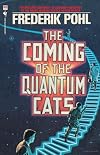
The Coming of the Quantum Cats
by Frederik Pohl
There is 1 current discussion about this work.
On This Page
Description
A brilliant novel of alternate universes by an award-winning science fiction master A breakthrough in quantum physics has shattered the boundaries between alternate worlds. History is in chaos as billions of possible futures collide. As a conquering army mounts an invasion of neighboring realities, a handful of men and women from a dozen different timelines risk their lives to safeguard an infinity of worlds. Blending thrilling suspense with brilliant scientific speculation, Frederik show more Pohl's The Coming of the Quantum Cats is a triumph of the imagination by a Hugo and Nebula-winning master of science fiction. "A powerful novel of parallel worlds and might-have-beens, with an eerie, amazing finish!"--David Brin show lessTags
Recommendations




















Member Reviews
The problem with having written as many great works of science fiction as Frederick Pohl has is that sometimes that opus can overshadow a title or two. While not entirely neglected, this novel is usually not ranked alongside such classics as The Space Merchants, Gateway, and Jem. Perhaps it does not measure up to these works, but it is nonetheless an enormously enjoyable book.
Set in the then-contemporary world of 1983, the novel follows the different incarnations of three characters – Dominic DeSota, Nyla Christophe, and Larry Douglas – as they deal with their counterparts from alternate worlds. Pohl uses the premise to posit some very different Americas, but the real focus is on the very different people these characters became show more within these worlds – one Dominic is a senator, for example, while another is a meek mortgage broker and a third a major commanding an assault force. These characters confront each other as their different timelines clash – and face the increasing danger posed by the unintended consequences of travel between their worlds.
The greatest strength of the book is not in the alternate worlds Pohl describes (many of which are satirical takes on the America of his day) or in his use of historical personages, but in the characters he creates. Though his premise is based on developing different permutations of just a few individuals, he nonetheless makes each of them distinct and interesting. Through them the reader is offered an interesting mediation on how different circumstances can shape character – all within the context of a novel that ranks with the best works of alternate history. show less
Set in the then-contemporary world of 1983, the novel follows the different incarnations of three characters – Dominic DeSota, Nyla Christophe, and Larry Douglas – as they deal with their counterparts from alternate worlds. Pohl uses the premise to posit some very different Americas, but the real focus is on the very different people these characters became show more within these worlds – one Dominic is a senator, for example, while another is a meek mortgage broker and a third a major commanding an assault force. These characters confront each other as their different timelines clash – and face the increasing danger posed by the unintended consequences of travel between their worlds.
The greatest strength of the book is not in the alternate worlds Pohl describes (many of which are satirical takes on the America of his day) or in his use of historical personages, but in the characters he creates. Though his premise is based on developing different permutations of just a few individuals, he nonetheless makes each of them distinct and interesting. Through them the reader is offered an interesting mediation on how different circumstances can shape character – all within the context of a novel that ranks with the best works of alternate history. show less
Tight science fiction, fast-paced. Lean, very little fat.
The author begins by telling you the story of a man in a world that subtly isn't our own, and it is enjoyable to realize that concept as little details are dripped out to you.
The 'concept' driving the store is dealt you you really enjoyably as well, and while I don't know science, I thought it was used effectively.
--
The characters, in 'classic' scifi tradition, are rather thin. You won't find much there to identify with or enjoy. There's a film-noire thinness to them, but it's embedded in so much machismo that our world as probably moved on from it being something that doesn't grate.
There are weird hints of recognitions that this isn't a world of straight white manly men, but show more they're played off in a way which I can't tell if its for laughs, in mockery, or understanding them to be valid while sneaking them into a readership that is probably hostile to them.
It's a quick read, and even if you don't like the content, it's worth appreciating its style and form for what it is. Also the concept and what Pohl does with the concept is worth some thought and musing. show less
The author begins by telling you the story of a man in a world that subtly isn't our own, and it is enjoyable to realize that concept as little details are dripped out to you.
The 'concept' driving the store is dealt you you really enjoyably as well, and while I don't know science, I thought it was used effectively.
--
The characters, in 'classic' scifi tradition, are rather thin. You won't find much there to identify with or enjoy. There's a film-noire thinness to them, but it's embedded in so much machismo that our world as probably moved on from it being something that doesn't grate.
There are weird hints of recognitions that this isn't a world of straight white manly men, but show more they're played off in a way which I can't tell if its for laughs, in mockery, or understanding them to be valid while sneaking them into a readership that is probably hostile to them.
It's a quick read, and even if you don't like the content, it's worth appreciating its style and form for what it is. Also the concept and what Pohl does with the concept is worth some thought and musing. show less
I haven’t read any Frederik Pohl, which is a little embarrassing as he won several Nebulas, a Hugo, and the National Book Award. SFWA named him as their 12th Grand Master and placed him in the Science Fiction and Fantasy Hall of Fame in 1998. He passed away in 2013.
I’m not sure “The Coming of the Quantum Cats” was the best choice as my first Pohl novel. I chose it because it was standalone, explored parallel worlds theory and I thought it would be a quick read. While there is certainly some value and enjoyment to take from this novel, I ultimately found it to be a clunky, slow read that didn’t age well.
Let’s start with what I liked. It was fun to see Pohl explore other possible worlds with both big and small implications. show more While there are an infinite number of parallel worlds, we largely get to explore four or five. In one, there is a fascist America with religious persecution controlled by distant rich Arab power brokers. In another, another Nancy Regan is president, governing a highly militaristic society. The politics seem cynically exaggerated. In some worlds, technology is far behind while others are more advanced. Pohl explores multiple versions of the same characters and shows how they can become totally different people with unique politics and morals due to their environment. I also like the continuously change in direction of the plot, because frankly, some of the plot lines were getting boring. It’s the big implications of parallel worlds that is the strongest part of this book.
So what was my issues with it? Well, the book jumps around to different parallel worlds – that’s not a major issue, but then it also changes character perspective every chapter. It wasn’t that I couldn’t follow the plot, but I just found it jarring and awkward. Anytime I was drawn into a character or plotline, we skipped off somewhere else. I also found the work to be dated – not Pohl’s fault, but to me the culture references came across as antiquated instead of nostalgic. In the end, I never really cared for the characters and the ultimate plotline was underwhelming and pessimistic. It wasn’t exactly groundbreaking either, with H.G. Well’s “Men Like Gods” in 1923, Phillip K. Dick’s “The Man in the High Castle” in 1962, and David Gerrold’s “The Man Who Folded Himself” in 1973, among many others.
I’m not giving up on Pohl’s work based on the accolades and recommendations of many others. However, I’m rating this novel three stars as an interesting, but dated and poorly executed exploration of the discovery of parallel world travel in the 1980’s. show less
I’m not sure “The Coming of the Quantum Cats” was the best choice as my first Pohl novel. I chose it because it was standalone, explored parallel worlds theory and I thought it would be a quick read. While there is certainly some value and enjoyment to take from this novel, I ultimately found it to be a clunky, slow read that didn’t age well.
Let’s start with what I liked. It was fun to see Pohl explore other possible worlds with both big and small implications. show more While there are an infinite number of parallel worlds, we largely get to explore four or five. In one, there is a fascist America with religious persecution controlled by distant rich Arab power brokers. In another, another Nancy Regan is president, governing a highly militaristic society. The politics seem cynically exaggerated. In some worlds, technology is far behind while others are more advanced. Pohl explores multiple versions of the same characters and shows how they can become totally different people with unique politics and morals due to their environment. I also like the continuously change in direction of the plot, because frankly, some of the plot lines were getting boring. It’s the big implications of parallel worlds that is the strongest part of this book.
So what was my issues with it? Well, the book jumps around to different parallel worlds – that’s not a major issue, but then it also changes character perspective every chapter. It wasn’t that I couldn’t follow the plot, but I just found it jarring and awkward. Anytime I was drawn into a character or plotline, we skipped off somewhere else. I also found the work to be dated – not Pohl’s fault, but to me the culture references came across as antiquated instead of nostalgic. In the end, I never really cared for the characters and the ultimate plotline was underwhelming and pessimistic. It wasn’t exactly groundbreaking either, with H.G. Well’s “Men Like Gods” in 1923, Phillip K. Dick’s “The Man in the High Castle” in 1962, and David Gerrold’s “The Man Who Folded Himself” in 1973, among many others.
I’m not giving up on Pohl’s work based on the accolades and recommendations of many others. However, I’m rating this novel three stars as an interesting, but dated and poorly executed exploration of the discovery of parallel world travel in the 1980’s. show less
An fairly short parallel universe novel. It reads as if it is older than the published date, 1986, more like a 50's or 60's novel. That may be deliberate, as several of the universes portrayed are behind ours in technology, but it still feels like 'old' science fiction. Interesting, but not great.
Una novela de ciencia ficción especulativa con sello clásico. «La llegada de los gatos cuánticos» es una de las obras más ingeniosas y juguetonas del maestro estadounidense de la ciencia ficción Frederik Pohl (1919‑2013). Publicada en español por Ediciones B en 1987, esta novela explora, con humor ácido y una imaginación desbordante, las posibilidades del multiverso y las consecuencias políticas, sociales y personales de los mundos paralelos.
Pohl combina sátira, aventura y especulación científica para construir una historia donde múltiples versiones de los mismos personajes —y del propio planeta— colisionan, se infiltran y se enfrentan en una trama tan vertiginosa como divertida.
La novela destaca por:
- Uso brillante show more del concepto de universos paralelos, tratado con ligereza narrativa pero con profundidad conceptual.
- Sátira política y social, marca de la casa en Pohl, que aprovecha el multiverso para criticar sistemas de gobierno, ideologías y comportamientos humanos.
- Ritmo ágil, con capítulos breves y cambios constantes de escenario.
- Personajes múltiples y variantes, que permiten explorar identidades alternativas sin perder coherencia interna.
Es una obra que combina entretenimiento y reflexión, ideal para lectores que disfrutan de la ciencia ficción especulativa con un toque irónico.
La colección «Libro amigo» fue una de las líneas más populares de Ediciones B en los años 80, con tiradas amplias y buena distribución, lo que explica la relativa disponibilidad de esta edición en el mercado de segunda mano.
Interés para el lector actual.- Esta novela es especialmente recomendable para:
- Lectores de ciencia ficción clásica interesados en el multiverso antes de que fuera tendencia.
- Aficionados a la obra de Pohl y la tradición satírica estadounidense.
- Coleccionistas de Ediciones B y de la serie «Libro Amigo».
- Lectores que buscan una obra accesible, divertida y con ideas estimulantes.
Valoración global.- «La llegada de los gatos cuánticos» es una novela inteligente, ágil y sorprendentemente actual en su tratamiento del multiverso. La edición de Ediciones B, aunque modesta en presentación, ofrece una traducción sólida y un formato manejable. El ejemplar descrito conserva su interés como pieza de lectura y como testimonio de la difusión de la ciencia ficción en España durante los años 80. show less
Pohl combina sátira, aventura y especulación científica para construir una historia donde múltiples versiones de los mismos personajes —y del propio planeta— colisionan, se infiltran y se enfrentan en una trama tan vertiginosa como divertida.
La novela destaca por:
- Uso brillante show more del concepto de universos paralelos, tratado con ligereza narrativa pero con profundidad conceptual.
- Sátira política y social, marca de la casa en Pohl, que aprovecha el multiverso para criticar sistemas de gobierno, ideologías y comportamientos humanos.
- Ritmo ágil, con capítulos breves y cambios constantes de escenario.
- Personajes múltiples y variantes, que permiten explorar identidades alternativas sin perder coherencia interna.
Es una obra que combina entretenimiento y reflexión, ideal para lectores que disfrutan de la ciencia ficción especulativa con un toque irónico.
La colección «Libro amigo» fue una de las líneas más populares de Ediciones B en los años 80, con tiradas amplias y buena distribución, lo que explica la relativa disponibilidad de esta edición en el mercado de segunda mano.
Interés para el lector actual.- Esta novela es especialmente recomendable para:
- Lectores de ciencia ficción clásica interesados en el multiverso antes de que fuera tendencia.
- Aficionados a la obra de Pohl y la tradición satírica estadounidense.
- Coleccionistas de Ediciones B y de la serie «Libro Amigo».
- Lectores que buscan una obra accesible, divertida y con ideas estimulantes.
Valoración global.- «La llegada de los gatos cuánticos» es una novela inteligente, ágil y sorprendentemente actual en su tratamiento del multiverso. La edición de Ediciones B, aunque modesta en presentación, ofrece una traducción sólida y un formato manejable. El ejemplar descrito conserva su interés como pieza de lectura y como testimonio de la difusión de la ciencia ficción en España durante los años 80. show less
Apr 17, 2026Spanish
Un avance sorprendente de la física cuántica ha hecho pedazos las fronteras entre los universos paralelos y la historia se convierte en un caos en que diversos mundos alternativos entran en colisión.
Feb 3, 2023Spanish
Ratings
Members
- Recently Added By
Lists

Books Read in 2025
4,090 works; 97 members
Talk Discussions
Current Discussions
The coming of the quantum cats in Good Show Sir! — bad science fiction and fantasy covers (April 24)
Author Information

638+ Works 42,778 Members
Frederik Pohl was born in New York City on November 26, 1919. More interested in writing than in school, he dropped out of high school in his senior year and took a job with a publishing company. After serving as a public relations officer in the United States Army from 1943 to 1945, he returned to publishing as copywriter for Popular Science, a show more literary agent for several sci-fi writers, and the editor for the magazines Galaxy and If from 1959 until 1969, with If winning three successive Hugo awards. His first published work, a poem entitled Elegy to a Dead Satellite: Luna, was printed in Amazing Stories magazine in 1937 under the pen name Elton Andrews. His first science fiction novels were published in the mid 1960's, some written in collaboration with other writers, others created alone. During his lifetime, he won over 16 major awards for his writing (much of which was published pseudonymously) including six Hugo Awards and three Nebula Awards. His works include Gateway, which won the Campbell Memorial, Hugo, Locus SF, and Nebula Awards, Beyond the Blue Event Horizon, and Jem, which won the National Book Award in 1979. He also embraced blogging in his later years, using his online journal as an ongoing sequel to his autobiography, The Way the Future Was. He died on September 2, 2013 at the age 93. (Bowker Author Biography) show less
Some Editions
Series
Belongs to Publisher Series
Work Relationships
Is contained in
Common Knowledge
- Canonical title*
- La Llegada de los Gatos Cuánticos
- Original title
- The Coming of the Quantum Cats
- Original publication date
- 1986
- People/Characters
- Dominic "Nicky" DeSota; Greta; Senator Dom DeSota; Nyla Christophe Bowquest; Sergeant Nyla Christophe Sambok; Major Dominic DeSota
- Important places
- Albuquerque, New Mexico, USA
- First words
- 16 August 1983 8:20 P.M. Nicky DeSota When my beeper sounded I had one hand on the gearshift, ready to jump into second, and the other sticking out the window to signal a left turn.
- Last words
- (Click to show. Warning: May contain spoilers.)"But was there ever one that wasn't?"
- Original language*
- Inglés
*Some information comes from Common Knowledge in other languages. Click "Edit" for more information.
Classifications
Statistics
- Members
- 620
- Popularity
- 46,798
- Reviews
- 6
- Rating
- (3.40)
- Languages
- English, French, Italian, Spanish
- Media
- Paper
- ISBNs
- 9
- ASINs
- 8