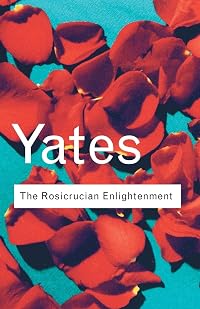
The Rosicrucian Enlightenment
by Frances A. Yates
On This Page
Description
A history of the role that the occult has played in the formation of modern science and medicine, The Rosicrucian Enlightenment has had a tremendous impact on our understanding of the western esoteric tradition. Beautifully illustrated, it remains one of those rare works of scholarship which the general reader simply cannot afford to ignore.Tags
Recommendations





Member Recommendations


Member Reviews
The suggestion of hidden knowledge, which all sorts of secret societies thrive on, is deeply fascinating to me. I am a perfect target for the suggestion of knowledge, the hints and cryptic allusions. And I'm an academic, an atheist, a sometime cynic. I know it is nonsense. But the fascination lies in the stories. And I'm a sucker for a good story.
At the centre of all the mystical posturing of the Freemasons, and all the others of the same ilk, is the myth of the Rosicrucian Society. It is tantalising in its vagueness and its reference to harmonies, orders and secret knowledge. But the trouble with allusions to vast secret knowledge is that when you look at it more closely it inevitably turns hollow, boring -- all silly ritual and show more vagueness.
This is where Frances A. Yates comes in. And I love her for it. She retains the excitement of finding out "what it is all about" by cutting through the high-flying nonsense and grounding it in real historical development. I am aware that the illusion of getting to the Truth of the matter is again illusory, but I much prefer this illusion to the intangible secret society one; and since I am not reading this academically but in order to learn something for fun, I am not unhappy with her turning the birth of the Scientific Revolution into a Grand Narrative. It is a much better one than the myth that Science grows whole and pure, based in Rationality alone, from the Deep Dark of the Middle Ages.
Yates' thesis is that the Rosicrucian Manifestos (which she analyses in some detail) are allegories about, or at the very least allude strongly towards, the Palgrave (or Elector Palatine) Fredrick V, based in Heidelberg, who married Elizabeth Stuart, the daughter of James I (and VI, mustn't forget Scotland), and made a bid for the throne of Bohemia (which he gained, and then lost again in 1620, which earned him the name of ``Winter King'', as that was how long he had reigned). Those vaguely familiar with the Thirty Years War will recognise the importance of this. It then goes further, and combines dynasty politics with intellectual history and scientific development. Heidelberg was, after all, once of the great centres of European learning.
I freely admit that part of the reason why I love this book is that it is based in precisely the type of history-writing I adore. I don't want to read about farmers and fishermen. I want kings and queens, dynasty politics, religious intrigue, great thinkers and stories. There are limits to the stories you can tell about the farmers and fishermen. And, perhaps more importantly, it is all about the pleasure of recognition. Part of the appeal is the connection made between two parts of history which I have always approached separately.
I tend to compartmentalise history. I think of James I/VI and I think Macbeth and Shakespeare, Gunpowder Plot, Francis Bacon and his position between Elizabeth I and Charles I. Thinking of the movements in Europe at the same time, my mind runs to the religious conflicts, the Habsburgs, Bohemia, the (second) Defenestration of Prague and the Thirty Years' War. Similarly, Scandinavian history in my mind has got its own separate box, and there is another for the Mediterranean. I always get a rush when I get to join them up and see how they fit together. I suppose that makes me a geek.
Yates envisions the Palatinate as a link between the developments in England and those in Bohemia. She makes a very convincing case for this link, basing much of it in the figure of John Dee, a major English mystic. This book is only one in a number of studies she has made of the esoteric tradition(s) in Europe in combination with the seeds of the Enlightenment. The weak point, I suppose, is that tendency to want to make the whole of it into one tradition. The influences she traces are very persuasive, and while I sometimes felt that she read too much into a detail, the thesis as a whole is terribly seductive. Certainly to me.
It could be that her way of writing appeals to me so much because it is reminiscent of literary interpretation. In fact, much of it is literary interpretation. She traces references to Spenser (after grounding him in the Order of St. George), and this mix of literature and history not only triggers a number of my intellectual pleasure points, it paints a delicious swirl of colour around what is too often presented as a black and white, dreary story of Progress of Mind, bringing Kepler, Newton, Descartes and the like down to history from the rarefied heights of scientific development. All the while tracing the development of the story of the Rosicrucian Order (or the Brotherhood of the Rosy Cross) in its changing manifestations.
I love it. show less
At the centre of all the mystical posturing of the Freemasons, and all the others of the same ilk, is the myth of the Rosicrucian Society. It is tantalising in its vagueness and its reference to harmonies, orders and secret knowledge. But the trouble with allusions to vast secret knowledge is that when you look at it more closely it inevitably turns hollow, boring -- all silly ritual and show more vagueness.
This is where Frances A. Yates comes in. And I love her for it. She retains the excitement of finding out "what it is all about" by cutting through the high-flying nonsense and grounding it in real historical development. I am aware that the illusion of getting to the Truth of the matter is again illusory, but I much prefer this illusion to the intangible secret society one; and since I am not reading this academically but in order to learn something for fun, I am not unhappy with her turning the birth of the Scientific Revolution into a Grand Narrative. It is a much better one than the myth that Science grows whole and pure, based in Rationality alone, from the Deep Dark of the Middle Ages.
Yates' thesis is that the Rosicrucian Manifestos (which she analyses in some detail) are allegories about, or at the very least allude strongly towards, the Palgrave (or Elector Palatine) Fredrick V, based in Heidelberg, who married Elizabeth Stuart, the daughter of James I (and VI, mustn't forget Scotland), and made a bid for the throne of Bohemia (which he gained, and then lost again in 1620, which earned him the name of ``Winter King'', as that was how long he had reigned). Those vaguely familiar with the Thirty Years War will recognise the importance of this. It then goes further, and combines dynasty politics with intellectual history and scientific development. Heidelberg was, after all, once of the great centres of European learning.
I freely admit that part of the reason why I love this book is that it is based in precisely the type of history-writing I adore. I don't want to read about farmers and fishermen. I want kings and queens, dynasty politics, religious intrigue, great thinkers and stories. There are limits to the stories you can tell about the farmers and fishermen. And, perhaps more importantly, it is all about the pleasure of recognition. Part of the appeal is the connection made between two parts of history which I have always approached separately.
I tend to compartmentalise history. I think of James I/VI and I think Macbeth and Shakespeare, Gunpowder Plot, Francis Bacon and his position between Elizabeth I and Charles I. Thinking of the movements in Europe at the same time, my mind runs to the religious conflicts, the Habsburgs, Bohemia, the (second) Defenestration of Prague and the Thirty Years' War. Similarly, Scandinavian history in my mind has got its own separate box, and there is another for the Mediterranean. I always get a rush when I get to join them up and see how they fit together. I suppose that makes me a geek.
Yates envisions the Palatinate as a link between the developments in England and those in Bohemia. She makes a very convincing case for this link, basing much of it in the figure of John Dee, a major English mystic. This book is only one in a number of studies she has made of the esoteric tradition(s) in Europe in combination with the seeds of the Enlightenment. The weak point, I suppose, is that tendency to want to make the whole of it into one tradition. The influences she traces are very persuasive, and while I sometimes felt that she read too much into a detail, the thesis as a whole is terribly seductive. Certainly to me.
It could be that her way of writing appeals to me so much because it is reminiscent of literary interpretation. In fact, much of it is literary interpretation. She traces references to Spenser (after grounding him in the Order of St. George), and this mix of literature and history not only triggers a number of my intellectual pleasure points, it paints a delicious swirl of colour around what is too often presented as a black and white, dreary story of Progress of Mind, bringing Kepler, Newton, Descartes and the like down to history from the rarefied heights of scientific development. All the while tracing the development of the story of the Rosicrucian Order (or the Brotherhood of the Rosy Cross) in its changing manifestations.
I love it. show less
The Rosicrucian mix of practical jokery, spiritual sincerity and willing secrecy reminds me a little of the KLF.
My copy found a place on the shelves of Hounslow Library in January of 1973. 25 years later its plastic cover was covered with rings of chocolately vomit when I bought it from one of our contemporary magic dealers, the charity shop volunteer. She was obese, couldn't stand up properly and slightly off-orbit, mentally.
"What's that about," she asked, shifting her weight on her high stool.
I told her, as best I could.
"You don't want to read that," she said, "I'm not selling you that, my brother" - I think it was her brother - "he got obsessed with that stuff. It overtook him, he couldn't think of anything else."
"I still want it, I show more think."
"Be careful," warned a regular customer, browsing the jigsaws.
They sold this dangerous drug to me, and I left that dark, overfilled shop feeling that I'd found something worthwhile and powerful. But whenever I tried to read it I was put-off by the chocolatety vomit, and when I finally cleaned that off I somehow felt I'd moved on from the book. Now and again I might read a sentence or two, and toy with the idea of setting up some secret and most noble order of my own. show less
My copy found a place on the shelves of Hounslow Library in January of 1973. 25 years later its plastic cover was covered with rings of chocolately vomit when I bought it from one of our contemporary magic dealers, the charity shop volunteer. She was obese, couldn't stand up properly and slightly off-orbit, mentally.
"What's that about," she asked, shifting her weight on her high stool.
I told her, as best I could.
"You don't want to read that," she said, "I'm not selling you that, my brother" - I think it was her brother - "he got obsessed with that stuff. It overtook him, he couldn't think of anything else."
"I still want it, I show more think."
"Be careful," warned a regular customer, browsing the jigsaws.
They sold this dangerous drug to me, and I left that dark, overfilled shop feeling that I'd found something worthwhile and powerful. But whenever I tried to read it I was put-off by the chocolatety vomit, and when I finally cleaned that off I somehow felt I'd moved on from the book. Now and again I might read a sentence or two, and toy with the idea of setting up some secret and most noble order of my own. show less
It's difficult to find a trustworthy, scholarly work on Rosicrucianism, but here it is for those who are interested. Frances Yates spent her career studying occult philosophy with the aim of improving our understanding of the intellectual climate of the Renaissance. She was ahead of her time in seeing the Rosicrucian craze as an intellectual movement of a sort, instead of simply a weird conspiracy theory.
Incidentally, anyone interested in fiction that is heavily influenced by Yates' work should find John Crowley's AEgypt series very interesting.
Incidentally, anyone interested in fiction that is heavily influenced by Yates' work should find John Crowley's AEgypt series very interesting.
I cannot recommend a better, more balanced look at the historical origins of the legendary Rosicrucian Brotherhood. While I'm a big fan of conspiracy theories and folklore, this book presents what is probably a fairly accurate history of the movement, as well as fascinating hints as to the continuation of the tradition in Francis Bacon and Freemasonry. Further, the writing style is easy going and entertaining.
For someone seeking to understand both the concepts and the transmission of symbolism, this is an excellent primer. For those with black and white mirrors, it's a bit of tough sledding at times but Yates ties things together quite nicely to give a well-reasoned explanation for so many things that we don't understand today. For the symbolically uninitiated, there will be a lot of "Aha!" moments.
While I learned bits of history that I had been unaware of it is difficult to fully comprehend this work without more background in the traditions referenced.
A small gem of a work on a cloudy historical period in Europe.
Members
- Recently Added By
Lists

The ESOTERICA Library by Dr. Justin Sledge (Rosicrucianism)
3 works; 1 member
Author Information

29+ Works 4,585 Members
Awards and Honors
Awards
Series
Belongs to Publisher Series
Common Knowledge
- Canonical title
- The Rosicrucian Enlightenment
- Original title
- The Rosicrucian Enlightenment
- Original publication date
- 1972
- Original language
- English
Classifications
- Genres
- Nonfiction, History, Religion & Spirituality, General Nonfiction, Philosophy
- DDC/MDS
- 135.43094 — Philosophy & psychology Parapsychology & occultism Dreams and mysteries Rosicrucianism, Hermetism, cabala Rosicrucianism
- LCC
- BF1623 .R7 .Y38 — Philosophy, Psychology and Religion Psychology Occult sciences Magic. Hermetics. Necromancy
- BISAC
Statistics
- Members
- 784
- Popularity
- 35,682
- Reviews
- 14
- Rating
- (4.23)
- Languages
- 8 — Dutch, English, French, German, Italian, Romanian, Spanish, Turkish
- Media
- Paper, Ebook
- ISBNs
- 26
- UPCs
- 1
- ASINs
- 9