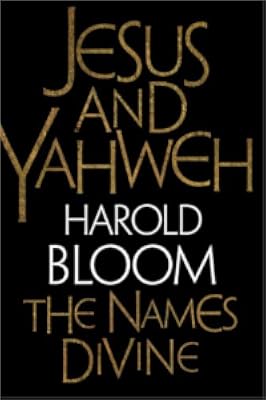
Jesus and Yahweh: The Names Divine
by Harold Bloom
On This Page
Description
There is very little evidence of the historical Jesus--who he was, what he said. As Bloom writes, "There is not a sentence concerning Jesus in the entire New Testament composed by anyone who ever had met the unwilling King of the Jews." Bloom has used his unsurpassed skills as a literary critic to examine the character of Jesus, noting the inconsistencies, contradictions, and logical flaws throughout the Gospels. He also examines the character of Yahweh, who he finds has more in common with show more Mark's Jesus than he does with God the Father of the Christian and later rabbinic Jewish traditions. At a time when religion has come to take center stage in our political arena, Bloom's shocking conclusion, that there is no Judeo-Christian tradition--that the two histories, Gods, and even Bibles, are not compatible--may make readers rethink everything we take for granted about what we believed was a shared heritage.--From publisher description. show lessTags
Recommendations





Member Reviews
Bloom (The Book of J) here tackles the characters of the Jewish and Christian gods: what god do we meet in Hebrew Scripture? Who is the Jesus of the New Testament, and does he bear any relation to the Jesus most Americans worship? Does, for that matter, the Hebrew Yahweh resemble the first person of contemporary Christians' Trinity? Bloom, as usual, skewers quite a few sacred cows: for example, he dismisses the quest for the historical Jesus as a waste of time, and says that Jewish-Christian dialogue is a "farce." Bloom's major points include his assertion that the Christian reading of Hebrew Scripture laid the groundwork for Christian anti-Semitism. and a nuanced discussion of the different ways Matthew, Mark and Luke present Jesus, show more his assertion that Bible translator William Tyndale anticipated Shakespeare, and his observation that, contra Marx, religion is not the opiate of the people but their "poetry, both bad and good." show less
We all know my stance on Christianity, right? Although I was raised Roman Catholic, I am not religious, and I think it is irresponsible and childish to believe in an all-powerful entity that has a personal relationship with everyone. Harold Bloom is a prolific writer and critic. In the book Jesus and Yahweh, Bloom explores the characterizations of three characters from the Bible. These are Yeshua of Nazareth, Jesus Christ the Theological God, and Yahweh, the God who shows human traits. In this text, Bloom argues that Yeshua, Jesus Christ, and Yahweh are incompatible with one another. In personality and in how they are characterized, they do not meld together into one being.
Bloom begins his study by stating eight preliminary musings that show more will help you through. First off, the New Testament generally follows the Old Testament except when it comes to Jesus’ aphorisms, wise sayings, and parables. Second, Jesus had an internal monologue that eventually allowed for the development of Shakespeare’s characters like Falstaff and Hamlet. Third, the Jesus Christ present in Mark’s Gospel is probably the closest to the original Yeshua, Matthew softens Mark, Luke makes a strange tangent and has more of a darkness to his Jesus. Fourth, the historical Jesus existed, but it is impossible to glean his entire personality from the Bible considering how fragmented it is. Modern Christianity is no better, making a Jesus for everyone. He is an empty shell, a faceless husk that becomes what the reader or believer wants. Fifth, the Gospels were not intended to be a Biography, but rather a sort of tract to make people convert. Sixth, people have searched for a Historical Jesus, but again, no one has been successful in finding him, instead finding their own biases and beliefs at the end. Seventh, the relationship between Love and the Law was central to Jesus and his ministry. Paul is the one who popularized his teachings with the non-Jew, Jesus did not feel it necessary to extend to them apparently. Finally, the Old Testament is better since Yahweh is more interesting as a character.
Bloom begins his exploration by discussing what is agreed upon by scholars, turning first to Jesus. For instance, it is generally thought that the same author wrote The Acts of the Apostles and The Gospel According to St Luke. This is due to the similar writing styles. There are a number of revelations in this book that are quite interesting. Bloom offers his opinion on a number of writings and works of other authors. So although some of this information is stuff I have heard before, this is all presented in an accessible manner. Even things I never scrutinized before, like the order of books in the Bible are discussed at length. I know that there are non-canonical texts that were not included in the Bible for some reason, but I am not a scholar and don’t know the whys and wherefores. Mark’s Gospel is the oldest of the four, but it is not the oldest extant piece of writing on the early Christians. The oldest pieces of writing we have are from Paul of Tarsus with his letters. Surprisingly, while Mark’s Gospel is the most original of the four it is thought that it was based on an earlier work that is now lost. Yeshua and Jesus are also explored through the lens of St John’s Gospel and through the story of how the Trinity came to be a thing. In the sense of the Trinity, it is argued that Christianity is not monotheistic, but rather polytheistic and it is difficult to argue against this. So some Greek Church Fathers came up with a counter-argument to all of this. This mainly relies on saying that our minds cannot grasp the truth, but it is better than the 'take it or leave it' stance of Augustine.
With the opening of the second part of this book, we focus on Yahweh. There is no way to know how to actually pronounce his name since it was a closely guarded secret in the Oral Tradition. Most of Bloom’s coverage involves the Old Testament since that is where Yahweh is focused. It discusses his name being sacred and how he was more often referred to as Adonai or Elohim, which makes sense to me. It goes in depth into Yahweh’s covenant, discussing his powers and separation from us.
Anyway, this book is enthralling. I found it to be enjoyable and interesting all at once. Unfortunately, I usually read books I enjoy so this does lose a bit in being a review. show less
Bloom begins his study by stating eight preliminary musings that show more will help you through. First off, the New Testament generally follows the Old Testament except when it comes to Jesus’ aphorisms, wise sayings, and parables. Second, Jesus had an internal monologue that eventually allowed for the development of Shakespeare’s characters like Falstaff and Hamlet. Third, the Jesus Christ present in Mark’s Gospel is probably the closest to the original Yeshua, Matthew softens Mark, Luke makes a strange tangent and has more of a darkness to his Jesus. Fourth, the historical Jesus existed, but it is impossible to glean his entire personality from the Bible considering how fragmented it is. Modern Christianity is no better, making a Jesus for everyone. He is an empty shell, a faceless husk that becomes what the reader or believer wants. Fifth, the Gospels were not intended to be a Biography, but rather a sort of tract to make people convert. Sixth, people have searched for a Historical Jesus, but again, no one has been successful in finding him, instead finding their own biases and beliefs at the end. Seventh, the relationship between Love and the Law was central to Jesus and his ministry. Paul is the one who popularized his teachings with the non-Jew, Jesus did not feel it necessary to extend to them apparently. Finally, the Old Testament is better since Yahweh is more interesting as a character.
Bloom begins his exploration by discussing what is agreed upon by scholars, turning first to Jesus. For instance, it is generally thought that the same author wrote The Acts of the Apostles and The Gospel According to St Luke. This is due to the similar writing styles. There are a number of revelations in this book that are quite interesting. Bloom offers his opinion on a number of writings and works of other authors. So although some of this information is stuff I have heard before, this is all presented in an accessible manner. Even things I never scrutinized before, like the order of books in the Bible are discussed at length. I know that there are non-canonical texts that were not included in the Bible for some reason, but I am not a scholar and don’t know the whys and wherefores. Mark’s Gospel is the oldest of the four, but it is not the oldest extant piece of writing on the early Christians. The oldest pieces of writing we have are from Paul of Tarsus with his letters. Surprisingly, while Mark’s Gospel is the most original of the four it is thought that it was based on an earlier work that is now lost. Yeshua and Jesus are also explored through the lens of St John’s Gospel and through the story of how the Trinity came to be a thing. In the sense of the Trinity, it is argued that Christianity is not monotheistic, but rather polytheistic and it is difficult to argue against this. So some Greek Church Fathers came up with a counter-argument to all of this. This mainly relies on saying that our minds cannot grasp the truth, but it is better than the 'take it or leave it' stance of Augustine.
With the opening of the second part of this book, we focus on Yahweh. There is no way to know how to actually pronounce his name since it was a closely guarded secret in the Oral Tradition. Most of Bloom’s coverage involves the Old Testament since that is where Yahweh is focused. It discusses his name being sacred and how he was more often referred to as Adonai or Elohim, which makes sense to me. It goes in depth into Yahweh’s covenant, discussing his powers and separation from us.
Anyway, this book is enthralling. I found it to be enjoyable and interesting all at once. Unfortunately, I usually read books I enjoy so this does lose a bit in being a review. show less
I am a big fan of Harold Bloom's 'Book of J' in addition to this book 'Jesus and Yahweh: The Names Divine'. I find it fascinating when the sacred writings of the three monotheistic religions are analyzed as works of literature. Some of Bloom's conclusions regarding the Christian Bible (e.g. Yahweh is essentially a literary Man-God who had to be redacted; Jesus and Jesus Christ are two different literary characters) must be reconciled with the doctrine of biblical inerrancy, in my opinion. Throughout this book, Bloom honestly presents his beliefs and biases so that the reader may deduce the effects of these biases on his conclusions. It is somehow reassuring to this Protestant that Bloom's favorite literary characters are Yahweh, Jesus, show more and Hamlet. show less
This a provocative book. Bloom wants to look at Jesus and Yahweh, as lieterature personalities of the New and Old Testaments. The results are inconsistnt, but worth reading to see a different cast on the divine. Bloom is not sure of many theologians, but does quote extensively from some of them. He does dismiss Northrop Frye, who also took on a literary analysis in a typological way. But he admires the "biographies" of God and Jesus done by Jack Miles. He admires the Gospel of John, but is angry with the anti-semticism of The Gospel of John. He admires the inscrutability and personality of the Hebrew Scripture Yahweh, who is primarily the J God. So, this is a book to tackle with reservations.
Beautiful passages describing the god of the old testament, who is very human. Marred by Bloom's egotism and paranoid politics.
Jonathan Rosen writes in his 11/27/05 NYTBR piece: "this is not a big book, but it is bursting with ideas and contradictions, discussions (and dismissals) of New Testament scholarship, accounts of Lurianic kabbalah, gnomic Nietzschean utterances and brilliant asides about the essence of American religion ... Bloom writes as if all Western literature were his private Talmud, turning and turning it to reveal hidden meaning, and taking the whole of it personally: the author of the gospel of John 'hates me and I respond in kind.'"
A provocative character study of the historical Jesus and Yahweh is presented from the perspective of a literary critic, citing inconsistencies and logical flaws throughout the gospels while arguing that the Hebrew Bible and Christian Old Testament are incompatible texts that reflect differing political and religious purposes. - from Amazon
Members
- Recently Added By
Published Reviews
ThingScore 100
There is not a sentence concerning Jesus in the entire New Testament composed by anyone who ever had met the unwilling King of the Jews." This did not prevent Christians from turning him into a theological entity: Jesus Christ, the Son of God, is according to Bloom "totally smothered beneath the massive superstructure of historical theology."
added by danielx
For Bloom, Jesus and Jesus Christ are two entirely unrelated figures, and Bloom spends the first half of the book exploring their incompatibility. Jesus is the Jew Yeshua about whom no verifiable facts are knowable. What we do know, aside from a few scraps from Josephus ("wonderful writer and non-stop liar"), is contained in unreliable works written "almost entirely by Jews in flight from show more themselves, and desperate to ingratiate themselves with their Roman overlords and exploiters." By this Bloom means the New Testament, which he also refers to as "the Belated Testament." show less
added by danielx
Author Information

1,221+ Works 38,005 Members
Harold Bloom was born on July 11, 1930 in New York City. He earned his Bachelor of Arts from Cornell in 1951 and his Doctorate from Yale in 1955. After graduating from Yale, Bloom remained there as a teacher, and was made Sterling Professor of Humanities in 1983. Bloom's theories have changed the way that critics think of literary tradition and show more has also focused his attentions on history and the Bible. He has written over twenty books and edited countless others. He is one of the most famous critics in the world and considered an expert in many fields. In 2010 he became a founding patron of Ralston College, a new institution in Savannah, Georgia, that focuses on primary texts. His works include Fallen Angels, Till I End My Song: A Gathering of Last Poems, Anatomy of Influence: Literature as a Way of Life and The Shadow of a Great Rock: A Literary Appreciation of The King James Bible. Harold Bloom passed away on October 14, 2019 in New Haven, at the age of 89. (Bowker Author Biography) show less
Classifications
- Genres
- Religion & Spirituality, Nonfiction, Literature Studies and Criticism, General Nonfiction, History, Philosophy
- DDC/MDS
- 232.906 — Religion Christianity Jesus Christ and his family Family and life of Jesus
- LCC
- BT198 .B555 — Philosophy, Psychology and Religion Doctrinal Theology Doctrinal Theology Christology
- BISAC
Statistics
- Members
- 564
- Popularity
- 52,355
- Reviews
- 10
- Rating
- (3.26)
- Languages
- English, Italian, Portuguese, Spanish
- Media
- Paper
- ISBNs
- 9
- ASINs
- 1