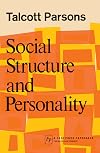
Social Structure and Personality
by Talcott Parsons
28 Members (3.00)
On This Page
Description
A Collection of essays which studies the theoretical problem of relationships between social structure and personality, and how these different relationships merit distinct treatment for particular purposes. Parsons concludes that in the larger picture, their interdependencies are so intimate that bringing them together in an interpretive synthesis is imperative if a balanced understanding of the complex as a whole is to be attained.Tags
Recommendations
































Member Reviews
Members
- Recently Added By
Author Information

71+ Works 991 Members
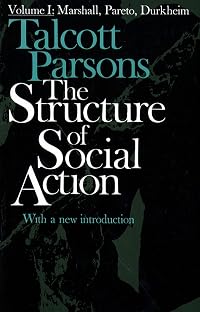
Talcott Parsons, an American sociologist, introduced Max Weber to American sociology and became himself the leading theorist of American sociology after World War II. His Structure of Social Action (1937) is a detailed comparison of Alfred Marshall, Emile Durkheim, Max Weber, and Vilfredo Pareto. Parsons concluded that these four scholars, coming show more from contrasting backgrounds and from four different countries, converged, without their knowing of the others, on a common theoretical and methodological position that he called "the voluntaristic theory of action." Subsequently, Parsons worked closely with the anthropologists Clyde Kluckhohn, Elton Mayo, and W. Lloyd Warner, and the psychologists Gordon W. Allport and Henry A. Murray, to define social, cultural, and personality systems as the three main interpenetrative types of action organization. He is widely known for his use of four pattern variables for characterizing social relationships:affectivity versus neutrality, diffuseness versus specificity, particularism versus universalism, and ascription versus achievement. (Bowker Author Biography) show less
Classifications
Statistics
- Members
- 28
- Popularity
- 983,271
- Rating
- (3.00)
- Languages
- English, German
- Media
- Paper, Ebook
- ISBNs
- 5