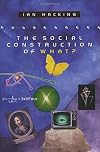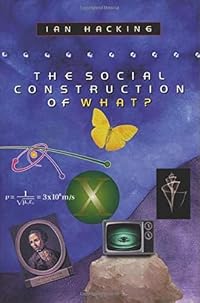
The Social Construction of What?
by Ian Hacking
On This Page
Description
Lost in the raging debate over the validity of social construction is the question of what, precisely, is being constructed. Facts, gender, quarks, reality? Is it a person? An object? An idea? A theory? Each entails a different notion of social construction, Ian Hacking reminds us. His book explores an array of examples to reveal the deep issues underlying contentious accounts of reality. Especially troublesome in this dispute is the status of the natural sciences, and this is where Hacking show more finds some of his most telling cases, from the conflict between biological and social approaches to mental illness to vying accounts of current research in sedimentary geology. He looks at the issue of child abuse--very much a reality, though the idea of child abuse is a social product. He also cautiously examines the ways in which advanced research on new weapons influences not the content but the form of science. In conclusion, Hacking comments on the "culture wars" in anthropology, in particular a spat between leading ethnographers over Hawaii and Captain Cook. Written with generosity and gentle wit by one of our most distinguished philosophers of science, this wise book brings a much needed measure of clarity to current arguments about the nature of knowledge. show lessTags
Recommendations


































Member Reviews
Social Construction is a specter haunting research. Or at least it is one of the focal points of the Science Wars, between figures arguing the objectivity and integrity of science (usually particle physicists) and those arguing the opposite (usually sociologists or historians or anthropologists or some such). Certainly, Hacking was able to find 25 books of the form 'the Social Construction of X", (one for every letter of the alphabet, bar X), but what is socially construction and why does it matter?
As a philosopher of science, Hacking has a broader view than many of us in the trenches. His discussion of major arguments by Latour, Pickering, Kuhn, Lakatos, Quine, and Popper, to name a few of the protagonists is clear and enjoyable. This show more is a first rate literature review! I think that Hacking is on to something when he points out that this argument is in fact very old, stretching back to Aristotle and Plato, and more commonly invoked in arguments between Nominalists and Realists. The arguments over whether names and categories are arbitrary and human-imposed, or whether they parallel some deeper structure of the universe, are long-standing and likely unresolvable.
Hackings's major contributions in the book are an analysis of the whys and hows of Social Construction. He identifies a six point scale of construction, from least to most radical: historical, ironic, reformist, unmasking, rebellious, and revolutionary. Social construction tends towards radical formulations because it argues against the inevitability of what is, and that the world as we understand it would be better (more just, less oppressive, more joyful) if we rearranged society. A second part are criterion for judging how constructivist an argument is on scales of contingency--could it have developed differently, nominalism, and the importance of internal or external explanations for the stability of a fact.
Unfortunately, Hacking's own work, when it departs from a review of the literature, is far less compelling. He develops a theory of interactive and indifferent kinds. Interactive kinds are exemplified by mental disorders, and their presence in the world changes in accord with our knowledge of the kind. Indifference kinds are like fundamental particles, and do not care what we know of them. Kinds are probably the least rigorous categorizing schema imaginable, nothing more than "things that are alike, somehow." It is no mere linguistic coincidence that the psuedoscience of Genesis-inspired species is called Baraminology, the study of created kinds. Interactive kinds are trivially socially constructed; Hacking is less vocal on the social construction of the scientific objects of indifferent kinds. I'd judge "kinds" to be too floppy of a concept to do philosophy with.
The four case studies, on mental illness, child abuse, weapons, dolomite, and Captain Cook's death, are recycled from other work and not particularly well suited to philosophic theories in Chapters 1 & 3.
One big question, that is not adequately answered, is 'is social construction a worthwhile approach.' Hacking makes a compelling case that some of the leading theorists classified as 'social constructionists', such as Latour and Bloor, are no such thing. Social constructionist research is mostly based on shoddy readings of theories which say no such things, and therefore should be avoided as bad work. However, by linking things, the idea of things, and the social and material matrix in which the thing and its ideas are embedded, social construction opens an immense scope of potential questions and common conversations for scholars. As a research program (in Lakatos's terminology), social construction has been immensely successful. We should know how to use it more precisely. show less
As a philosopher of science, Hacking has a broader view than many of us in the trenches. His discussion of major arguments by Latour, Pickering, Kuhn, Lakatos, Quine, and Popper, to name a few of the protagonists is clear and enjoyable. This show more is a first rate literature review! I think that Hacking is on to something when he points out that this argument is in fact very old, stretching back to Aristotle and Plato, and more commonly invoked in arguments between Nominalists and Realists. The arguments over whether names and categories are arbitrary and human-imposed, or whether they parallel some deeper structure of the universe, are long-standing and likely unresolvable.
Hackings's major contributions in the book are an analysis of the whys and hows of Social Construction. He identifies a six point scale of construction, from least to most radical: historical, ironic, reformist, unmasking, rebellious, and revolutionary. Social construction tends towards radical formulations because it argues against the inevitability of what is, and that the world as we understand it would be better (more just, less oppressive, more joyful) if we rearranged society. A second part are criterion for judging how constructivist an argument is on scales of contingency--could it have developed differently, nominalism, and the importance of internal or external explanations for the stability of a fact.
Unfortunately, Hacking's own work, when it departs from a review of the literature, is far less compelling. He develops a theory of interactive and indifferent kinds. Interactive kinds are exemplified by mental disorders, and their presence in the world changes in accord with our knowledge of the kind. Indifference kinds are like fundamental particles, and do not care what we know of them. Kinds are probably the least rigorous categorizing schema imaginable, nothing more than "things that are alike, somehow." It is no mere linguistic coincidence that the psuedoscience of Genesis-inspired species is called Baraminology, the study of created kinds. Interactive kinds are trivially socially constructed; Hacking is less vocal on the social construction of the scientific objects of indifferent kinds. I'd judge "kinds" to be too floppy of a concept to do philosophy with.
The four case studies, on mental illness, child abuse, weapons, dolomite, and Captain Cook's death, are recycled from other work and not particularly well suited to philosophic theories in Chapters 1 & 3.
One big question, that is not adequately answered, is 'is social construction a worthwhile approach.' Hacking makes a compelling case that some of the leading theorists classified as 'social constructionists', such as Latour and Bloor, are no such thing. Social constructionist research is mostly based on shoddy readings of theories which say no such things, and therefore should be avoided as bad work. However, by linking things, the idea of things, and the social and material matrix in which the thing and its ideas are embedded, social construction opens an immense scope of potential questions and common conversations for scholars. As a research program (in Lakatos's terminology), social construction has been immensely successful. We should know how to use it more precisely. show less
For as much as "social construction" appears to be a term of art, it is often used in imprecise and slippery ways. Typically, "social construction" is used to describe how phenomena around us are real in the sense and to the degree that they are mutually-held social phenomena (e.g., justice, art). But the term is also used, more problematically (for some), to describe phenomena that are simply built up socially (i.e., literally constructed) through beliefs, documents, technologies, and institutions. And this broader definition implicates an equally broader range of phenomena under the title of "social construction," such as property, national identities, scientific facts, mental illness, etc. As Hacking points out, these are all very show more different "what's," and what is meant by saying they are "socially constructed" is quite different. As the term is used by scholars, "socially constructed" means that the object is contingent on human observation/interaction, or sometimes it means that the thing exists only because it is named and thereby distinguished from the background of stuff around it. Likewise, the methodology of doing "social construction" is equally muddled: it is at times retrospective and at times forward-looking and action-oriented. This book is Hacking's attempt to find some commonalities across these uses of "social construction," in order to have a stable sense of the "what's" to which the phrase is attached. The various "how's" are the subject of other books, which Hacking does address. Overall, this book is good. I found chapters 1-3 to be the most useful for laying out the central argument. Chapter 5 was the clearest case study (on child abuse) through which to present his argument.
This is the first book by Hacking that I have read, so I have nothing to compare it with, but I found the tone to be oddly snarky in a way that I did not like. The arguments are sound, but the argumentation comes across as, at times, dismissive and I think I would say paternalistic in that Hacking (a senior scholar) is talking to his largely younger contemporaries. show less
This is the first book by Hacking that I have read, so I have nothing to compare it with, but I found the tone to be oddly snarky in a way that I did not like. The arguments are sound, but the argumentation comes across as, at times, dismissive and I think I would say paternalistic in that Hacking (a senior scholar) is talking to his largely younger contemporaries. show less
Ratings
Members
- Recently Added By
Lists

The (So-Called) Canada Pill
150 works; 1 member

Books in the Bibliography of The Mind in the Cave by David Lewis-Williams
257 works; 1 member
Author Information

34+ Works 2,452 Members
Ian Hacking holds the chair of philosophy and history of scientific concepts at the College de France
Common Knowledge
- Canonical title
- The Social Construction of What?
- Original publication date
- 1999; 2001 [French translation]
Classifications
- Genres
- Philosophy, Sociology, Nonfiction, Science & Nature, General Nonfiction
- DDC/MDS
- 121 — Philosophy and Psychology Epistemology (how do you know what you know?) Epistemology (Theory of knowledge)
- LCC
- BD175 .H29 — Philosophy, Psychology and Religion Speculative philosophy Speculative philosophy Epistemology. Theory of knowledge
- BISAC
Statistics
- Members
- 459
- Popularity
- 66,119
- Reviews
- 2
- Rating
- (3.85)
- Languages
- 7 — English, Finnish, French, German, Italian, Spanish, Swedish
- Media
- Paper, Ebook
- ISBNs
- 11
- ASINs
- 2