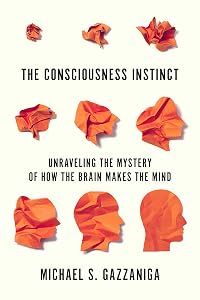
The Consciousness Instinct: Unraveling the Mystery of How the Brain Makes the Mind
by Michael S. Gazzaniga
On This Page
Description
"The father of cognitive neuroscience" illuminates the past, present, and future of the mind-brain problem How do neurons turn into minds? How does physical "stuff"-atoms, molecules, chemicals, and cells-create the vivid and various worlds inside our heads? The problem of consciousness has gnawed at us for millennia. In the last century there have been massive breakthroughs that have rewritten the science of the brain, and yet the puzzles faced by the ancient Greeks are still present. In The show more Consciousness Instinct, the neuroscience pioneer Michael S. Gazzaniga puts the latest research in conversation with the history of human thinking about the mind, giving a big-picture view of what science has revealed about consciousness. The idea of the brain as a machine, first proposed centuries ago, has led to assumptions about the relationship between mind and brain that dog scientists and philosophers to this day. Gazzaniga asserts that this model has it backward-brains make machines, but they cannot be reduced to one. New research suggests the brain is actually a confederation of independent modules working together. Understanding how consciousness could emanate from such an organization will help define the future of brain science and artificial intelligence, and close the gap between brain and mind. Captivating and accessible, with insights drawn from a lifetime at the forefront of the field, The Consciousness Instinct sets the course for the neuroscience of tomorrow. show lessTags
Recommendations
Member Reviews
Viewing consciousness as a biologically evolved instinct, neuroscientist Gazzaniga makes a tortuous intellectual journey to a point where one opinion he states is that artificial consciousness will always be impossible. (He never mentions mind uploading or Giulio Tononi's integrated information theory, but presumably these would be ruled out too.) Some of the major stretches of the journey eluded good understanding on my part -- about all I can say is that heavy use is made of quantum-mechanics pioneer Niels Bohr's concept of complementarity and theoretical biologist Howard Pattee's concept of semiotic closure.
One of the most groundbreaking and inspiring books I ever read.
Ratings
Members
- Recently Added By
Published Reviews
Properly, an excerpt from the published book, not a separate review of that book:
HOW DOES CONSCIOUSNESS WORK?
A LOOK AT THE COMPLEX NEURAL NETWORK THAT CREATES OUR UNIFIED SENSE OF REALITY
HOW DOES CONSCIOUSNESS WORK?
A LOOK AT THE COMPLEX NEURAL NETWORK THAT CREATES OUR UNIFIED SENSE OF REALITY
added by elenchus
Lists

Big History
72 works; 1 member
Author Information

41 Works 2,866 Members
Michael S. Gazzaniga, one of the premiere doctors of neuroscience, was born on December 12, 1939 in Los Angeles. Educated at Dartmouth College and California Institute of Technology, he has been on the faculty of the Center for Neuroscience, University of California, Davis. His early research examined the subject of epileptics who had undergone show more surgery to control seizures. He has also studied Alzheimer's and Parkinson's patients and reveals important findings in books such as Cognitive Neuroscience: The Biology of the Mind. While many of his writings are technical, he also educates and stimulates readers with discussions about the fascinating and mysterious workings of the brain. Books such as The Social Brain and The Mind's Past bring forth new information and theories regarding how the brain functions, interacts, and responds with the body and the environment. (Bowker Author Biography) show less
Awards and Honors
Distinctions
Classifications
Statistics
- Members
- 177
- Popularity
- 185,425
- Reviews
- 2
- Rating
- (3.37)
- Languages
- English, Italian, Spanish
- Media
- Paper, Audiobook, Ebook
- ISBNs
- 9
- ASINs
- 3