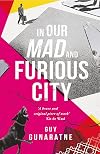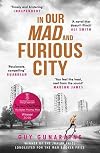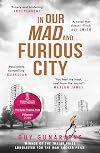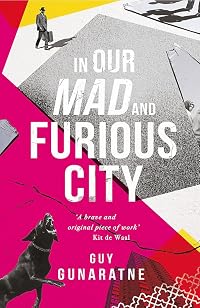
In Our Mad and Furious City
by Guy Gunaratne
On This Page
Description
"Narrators Ben Bailey Smith and Lou Marie Kerr expertly intertwine multiple first-person points of view in this gritty debut audiobook...Listeners unfamiliar with the dialects — Irish, Jamaican, and British among them — will be especially buoyed by the power of the performances." — AudioFile Magazine, Earphones Award winner Long-listed for the 2018 Man Booker Prize Short-listed for the 2018 Gordon Burn Prize Inspired by the real-life murder of a British army soldier by religious show more fanatics, and the rampant burning of mosques that followed, Guy Gunaratne’s In Our Mad and Furious City is a snapshot of the diverse, frenzied edges of modern-day London. A crackling debut from a vital new voice, it pulses with the frantic energy of the city’s homegrown grime music and is animated by the youthful rage of a dispossessed, overlooked, and often misrepresented generation. While Selvon, Ardan, and Yusuf organize their lives around soccer, girls, and grime, Caroline and Nelson struggle to overcome pasts that haunt them. Each voice is uniquely insightful, impassioned, and unforgettable, and when stitched together, they trace a brutal and vibrant tapestry of today’s London. In a forty-eight-hour surge of extremism and violence, their lives are inexorably drawn together in the lead-up to an explosive, tragic climax. In Our Mad and Furious City documents the stark disparities and bubbling fury coursing beneath the prosperous surface of a city uniquely on the brink. Written and read in the distinctive vernaculars of contemporary London, the audiobook challenges the ways in which we coexist now—and, more important, the ways in which we often fail to do so. show lessTags
Recommendations









Member Reviews
I grabbed 'In Our Mad and Furious City' during my final pre-lockdown library expedition, because I recalled seeing a good review somewhere. On goodreads, probably. It did indeed prove to be a striking and powerful snapshot of poverty, racism, and immigrant experience in a specific corner of London. The split narration is deployed effectively to contrast the daily experience of teenage boys and their parents. Although the narrative builds to a violent climax, I found the little details and dialogue more memorable than the most dramatic scenes. Gunaratne evokes an excellent sense of place and convincing family and friendship dynamics. The gap between the experiences of different generations is highlighted by the flashback sequences show more narrated by adult characters. These have plenty of impact, although they interrupt the book's momentum a little. While the plot and themes are too depressing to be called enjoyable, the writing has a lovely rhythm that makes it a pleasure to read. Overall an insightful and distinctive portrait of London's social fractures. It would read well with [b:Natives: Race and Class in the Ruins of Empire|36352480|Natives Race and Class in the Ruins of Empire|Akala|https://i.gr-assets.com/images/S/compressed.photo.goodreads.com/books/1577923588l/36352480._SY75_.jpg|58034799] and [b:Poverty Safari|36317638|Poverty Safari|Darren McGarvey|https://i.gr-assets.com/images/S/compressed.photo.goodreads.com/books/1506592247l/36317638._SY75_.jpg|57992152]. show less
It was supposed to be like every summer they could remember, hanging out, football, freedom and music. But an off duty soldier has just been murdered and the tension in the air is palpable. The anger in the area is spilling over into riots. Selvon and Ardan are wary of what is going on around them, but their friend, Yusuf, is starting to get caught up in the rise of radicalism in his own mosque. Worryingly, his brother is falling for the rhetoric from the Imam. Watching from the sidelines are the emigres, Caroline from Ireland and Nelson from West India. They and their children, Arden an aspiring rapper and Selvon who is trying to run his way out of the estate.
The bonds that have been forged between the youngsters as they played show more football and grew up together are going to be stretched to the maximum as the tension builds in the community. A march has been arranged by a right-wing group through the estate, something is going to snap soon, who will survive the coming maelstrom.
Gunaratne’s debut novel has drawn on recent and past events from London’s story of immigration and inner-city estates and is both raw and simmering with tension. It pulses with the language from the street, which did take a while to get the hang of, but added authenticity that fits the backdrop perfectly. Setting the plot over the course of two days works really well too, the pace is relentless with short chapters as the story is told from multiple perspectives. He holds a mirror up to recent events, not to criticise our modern society, but to ask searching questions about why the tensions are there in the first place. Well worth reading as a sparkling contemporary novel. show less
The bonds that have been forged between the youngsters as they played show more football and grew up together are going to be stretched to the maximum as the tension builds in the community. A march has been arranged by a right-wing group through the estate, something is going to snap soon, who will survive the coming maelstrom.
Gunaratne’s debut novel has drawn on recent and past events from London’s story of immigration and inner-city estates and is both raw and simmering with tension. It pulses with the language from the street, which did take a while to get the hang of, but added authenticity that fits the backdrop perfectly. Setting the plot over the course of two days works really well too, the pace is relentless with short chapters as the story is told from multiple perspectives. He holds a mirror up to recent events, not to criticise our modern society, but to ask searching questions about why the tensions are there in the first place. Well worth reading as a sparkling contemporary novel. show less
This book tells the story of two days on a South London housing estate, as tensions rise in the summer heat after the Islamist-inspired murder of a soldier on a nearby street. What happens is told through the eyes of five narrators, three young men (Selvon, Ardan and Yusuf) and two older characters, Nelson and Caroline, who counterpoint the modern story, thinking about tensions and conflicts from different places and times (Nelson, from the Windrush generation, remembers Teddy boys and Enoch Powell - Caroline is from an IRA family who made her move to London for her own safety after they started a feud with soldiers from a nearby base).
The male characters' chapters are read by Ben Bailey Smith, aka rapper Doc Brown, who is brilliant at show more capturing the swing and rhythm of the prose. And that's the best thing about this book, along with the well-observed little details of everyday life for the young men, and the way that the different tribes on the estate form and mix. All of that I thought was great.
What worked less well for me was the overall story - I guess you need some 'drama' in the book but I would have been happy to follow these guys across the course of a normal week (or year) and I think a good writer can do a lot with apparently trivial ups and downs. Also, the character of Caroline seems to be there because otherwise the story wouldn't pass the Bechdel test. Full marks to Gunaratne for recognising that his narrative was short on a female perspective, but Caroline just is not convincing as a character, particularly compared to how real the other narrators feel.
Despite these critiques, I do think the book is worth reading and would particularly recommend listening to the audiobook. show less
The male characters' chapters are read by Ben Bailey Smith, aka rapper Doc Brown, who is brilliant at show more capturing the swing and rhythm of the prose. And that's the best thing about this book, along with the well-observed little details of everyday life for the young men, and the way that the different tribes on the estate form and mix. All of that I thought was great.
What worked less well for me was the overall story - I guess you need some 'drama' in the book but I would have been happy to follow these guys across the course of a normal week (or year) and I think a good writer can do a lot with apparently trivial ups and downs. Also, the character of Caroline seems to be there because otherwise the story wouldn't pass the Bechdel test. Full marks to Gunaratne for recognising that his narrative was short on a female perspective, but Caroline just is not convincing as a character, particularly compared to how real the other narrators feel.
Despite these critiques, I do think the book is worth reading and would particularly recommend listening to the audiobook. show less
In less than two months ago I had read about the LA Watts riot in Ryan Gattia's novel All Involved and ,now, by chance, I have just finished Guy Gunaratne's In Our Mad and Furious City about riotous London. Both authors display empathy and sharp knowledge about their subject matter. These writers make you care about these vast complex cities and those people living there who are so poor and vulnerable in so many ways. The chance to survive, to be somebody, from these mostly young is horribly constricted. Our authors both shine in giving us great local customs and dialect. Gunaratne narrows his focus on these increasingly volatile and increasingly dangerous souls while Gattis expands the horizon by including those who have to immediately show more deal with them. Gattia has given us the stronger story but Gunaratne gives us plenty to consider and from a useful different perspective.
Quotes: (page 106) “Nelson...There is always a spark that begin it. A aimless brawl what spill over, two words overheard what pinch ataman's pride, a bloody face what not relent, a soldier-boy or some other body for a people to pitch up as a martyr. All the will in the world will not stop the bad tide from forming thereafter. Is like a red sky or moon-mad cry at night. A thing that pull down a place with it. So the day I seen one of my friends head bloodied up, everything what come after t was no shock.”
(page 236) “Was I lonely? Man, but of course. I walk past them Neasden nobles daily, never a greeting or a smile, just a nod like we living off the same sad passage. They was immigrant too mostly, all a similar shade from Punjabi Indian, Nigerian, Zairean, them Ghanian young ones, and old Irish some of them and a few Jamaican and St. Lucian too. But not many English. They was all walking alone with a heavy breath toward no brighter thing. I feel a kinship with them. A closeness that I never have with Jimbroad or Claude or whoever. Neasden natives, them who accept the tide as it come instead of some further battle.”
(page 288) “ But in this city, to be a younger is to survive the hard knocks, survive only. A place that you can love, make rhymes out of pyres and a romance of the colours, talk gladly of the changes and the flux and the rise and the fall without feeling its storm rain on your skin and its bone-scarring winds, a city that won't love you back unless you become insoluble to the fury, the madness of bound and unbound peoples and the immovables of the place. The joy. The light lies in the armoured few, those willing to run, run on and run forever just to prove it possible. The only ones that can save us in the end are the heroes.” show less
Quotes: (page 106) “Nelson...There is always a spark that begin it. A aimless brawl what spill over, two words overheard what pinch ataman's pride, a bloody face what not relent, a soldier-boy or some other body for a people to pitch up as a martyr. All the will in the world will not stop the bad tide from forming thereafter. Is like a red sky or moon-mad cry at night. A thing that pull down a place with it. So the day I seen one of my friends head bloodied up, everything what come after t was no shock.”
(page 236) “Was I lonely? Man, but of course. I walk past them Neasden nobles daily, never a greeting or a smile, just a nod like we living off the same sad passage. They was immigrant too mostly, all a similar shade from Punjabi Indian, Nigerian, Zairean, them Ghanian young ones, and old Irish some of them and a few Jamaican and St. Lucian too. But not many English. They was all walking alone with a heavy breath toward no brighter thing. I feel a kinship with them. A closeness that I never have with Jimbroad or Claude or whoever. Neasden natives, them who accept the tide as it come instead of some further battle.”
(page 288) “ But in this city, to be a younger is to survive the hard knocks, survive only. A place that you can love, make rhymes out of pyres and a romance of the colours, talk gladly of the changes and the flux and the rise and the fall without feeling its storm rain on your skin and its bone-scarring winds, a city that won't love you back unless you become insoluble to the fury, the madness of bound and unbound peoples and the immovables of the place. The joy. The light lies in the armoured few, those willing to run, run on and run forever just to prove it possible. The only ones that can save us in the end are the heroes.” show less
Set in London, this book follows five characters: Three friends (Yusuf, Selvon, and Ardan) and two of their parents (Caroline and Nelson). Each of them relates the tale in the first person with alternating chapters. The friends, each from different backgrounds, are bonding by football (soccer to us U.S. folks) and music. Each is facing serious familial challenges that further bind them together. An incident where an Islamic young man murders a soldier has set off a spate of escalating riots and racial tensions.
First, let me say that even though I didn't personally love this book, I am very surprised it wasn't shortlisted for the Man Booker. I read four of the shortlisted titles, and I think this book is more innovative and powerful (and show more frankly, interesting) than any of the four I read.
Putting that to the side, I will say that I felt the book took its time getting its footing. For the first half, I had two issues. Each person speaks in their own vernacular, and honestly I find it exhausting to try to decipher these dialects while following the story. None of them were especially hard (the Milkman it was not), and I do think it was a defensible choice . . .but what it really meant was that I took about a third of the book to really find my reading rhythm.
The latter half was excellent. Characters begin to truly reveal themselves and there were some plot points that had me gasping. I thought it was very clever of the author to demonstrate how violence escalates on the basis of untruths and innuendo. But he also had hopeful moments and left the door open for happiness for some of the characters. It was an excellent balance, and when I closed the book, I was satisfied and happy I had read it. This book is a debut novel, so I expect to see great things from this author going forward. show less
First, let me say that even though I didn't personally love this book, I am very surprised it wasn't shortlisted for the Man Booker. I read four of the shortlisted titles, and I think this book is more innovative and powerful (and show more frankly, interesting) than any of the four I read.
Putting that to the side, I will say that I felt the book took its time getting its footing. For the first half, I had two issues. Each person speaks in their own vernacular, and honestly I find it exhausting to try to decipher these dialects while following the story. None of them were especially hard (the Milkman it was not), and I do think it was a defensible choice . . .but what it really meant was that I took about a third of the book to really find my reading rhythm.
The latter half was excellent. Characters begin to truly reveal themselves and there were some plot points that had me gasping. I thought it was very clever of the author to demonstrate how violence escalates on the basis of untruths and innuendo. But he also had hopeful moments and left the door open for happiness for some of the characters. It was an excellent balance, and when I closed the book, I was satisfied and happy I had read it. This book is a debut novel, so I expect to see great things from this author going forward. show less
This book buzzes with energy and street slang. The 3 main young characters come from different cultural backgrounds and as they reach adulthood these differences are becoming more important, to the world around them if not to them. We also get some back story of their parents which gives some context on how London has gained its cultural mix, and how racism has always been present alongside it. I'm not sure it's entirely successful, but its a good and thought-provoking read, which gives a voice to marginalised groups, and feels very timely.
This is an ambitious debut novel, polyvocal and steeped in different dialects, slang, and patois. There are five POV characters and the chapters alternate among them. The reader is thrust into a London setting that isn't likely to be familiar to most: a housing estate in Neasden. We read the internal monologues of two middle-aged characters, Caroline from Northern Ireland and Nelson from Monserrat, and three young men: Ardan, Selvon, and Yusuf (we also read brief chapters from Yusuf's brother Irfan's perspective). We know that the three are friends, but their relationships to the older characters are revealed more slowly.
From the title and the prologue it is clear that the novel will be building toward something that is violent, and show more both the background chapters and the present-day setting lay the groundwork for that. Ardan, Selvon, and Yusuf are all caught up in the group conflict and small-scale violence that characterizes their neighborhood, try as they might to avoid it. Selvon runs and trains, Ardan makes street music, and Yusuf tries to navigate between his friends and his Muslim community. All of these are difficult because no one in the area can escape the "which side are you on" question, no matter how hard they may try.
Much of the novel is taken up with the rotating perspectives of the characters, and we see events from multiple points of view. Over time we get a rich sense of this world and how they navigate it, but for readers who want plot, there isn't much until the end. The story definitely builds over time, and it's quite carefully constructed, but when the inevitable climactic scenes occur, they take place very rapidly and the book basically ends.
Gunaratne does an admirable job with the different patterns of speech, although it can be disconcerting to switch from one to another. Caroline is perhaps the least convincing, but that could be because I had just finished Anna Burns' Milkman and that set such a high bar. Nevertheless, the register changes, which also have to include generational shifts, are mostly very effective.
Yusuf's storyline provides the fulcrum, and while this makes sense within the context of the novel, he is a character to whom things happen rather than one who acts. As a result, his and his family's story feels the most familiar and the least intrinsically motivated. By contrast, Ardan's and Selvon's trajectories are more interesting and their interactions with the previous generations feel thicker and more nuanced.
The final scenes, where the violence comes to a head, are well done, as are the smaller flashpoints that precede and shape them. The novel captures the way in which violence can shape so many aspects of personal and impersonal relationships in distressed communities, and how hard it is to avoid or overcome. show less
From the title and the prologue it is clear that the novel will be building toward something that is violent, and show more both the background chapters and the present-day setting lay the groundwork for that. Ardan, Selvon, and Yusuf are all caught up in the group conflict and small-scale violence that characterizes their neighborhood, try as they might to avoid it. Selvon runs and trains, Ardan makes street music, and Yusuf tries to navigate between his friends and his Muslim community. All of these are difficult because no one in the area can escape the "which side are you on" question, no matter how hard they may try.
Much of the novel is taken up with the rotating perspectives of the characters, and we see events from multiple points of view. Over time we get a rich sense of this world and how they navigate it, but for readers who want plot, there isn't much until the end. The story definitely builds over time, and it's quite carefully constructed, but when the inevitable climactic scenes occur, they take place very rapidly and the book basically ends.
Gunaratne does an admirable job with the different patterns of speech, although it can be disconcerting to switch from one to another. Caroline is perhaps the least convincing, but that could be because I had just finished Anna Burns' Milkman and that set such a high bar. Nevertheless, the register changes, which also have to include generational shifts, are mostly very effective.
Yusuf's storyline provides the fulcrum, and while this makes sense within the context of the novel, he is a character to whom things happen rather than one who acts. As a result, his and his family's story feels the most familiar and the least intrinsically motivated. By contrast, Ardan's and Selvon's trajectories are more interesting and their interactions with the previous generations feel thicker and more nuanced.
The final scenes, where the violence comes to a head, are well done, as are the smaller flashpoints that precede and shape them. The novel captures the way in which violence can shape so many aspects of personal and impersonal relationships in distressed communities, and how hard it is to avoid or overcome. show less
Members
- Recently Added By
Lists

Booker Prize
491 works; 62 members

Best books set in London
26 works; 1 member
Author Information
3 Works 258 Members
Awards and Honors
Awards
Distinctions
The Guardian Book of the Day (2018-04-13)
Common Knowledge
- Canonical title
- In Our Mad and Furious City
- Original publication date
- 2018
- People/Characters
- Ardan; Caroline Colgan; Nelson; Yusuf Sammo; Selvan; Abba (show all 47); Abdullah; Mike Akers; Amma; Agnes Black; Charles; Claude; Clive; Brian Colgan; Damian Colgan; Don Colgan; Liam Colgan; Dan; Freshie Dave; Dicky Boy; Eily; Abu Farouk; Keith Jacob; Jimbroad; Curtis John; Kassim; Laura; Derrick Lawrie; Marc; Mary; Max; Mrs McGinty; Missy; Muna; Murtaza; Niall; Nico; Riaf; Ruben; Irfan Sammo; Shirley; Maisie Stewart; Teju; Varda; Yasir; Yassin Muhammad; Zaine
- Important places
- London, England, UK; Belfast, Northern Ireland, UK
- Blurbers
- James, Marlon; Tobar, Hector; Smith, Ali; Hawkins, Paula; Malkani, Gautam; de Waal, Kit (show all 9); Bola, J. J.; Wroe, Simon; Kelman, Stephen
- Original language
- English
Classifications
Statistics
- Members
- 231
- Popularity
- 141,293
- Reviews
- 16
- Rating
- (3.85)
- Languages
- English, Swedish
- Media
- Paper, Audiobook, Ebook
- ISBNs
- 10
- ASINs
- 4