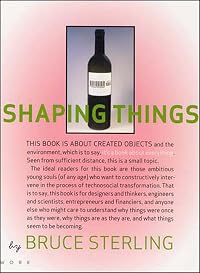
Shaping Things (Mediaworks Pamphlets)
by Bruce Sterling
On This Page
Description
A guide to the next great wave of technology -- an era of objects so programmable that they can be regarded as material instantiations of an immaterial system. " Shaping Things is about created objects and the environment, which is to say, it's about everything," writes Bruce Sterling in this addition to the Mediawork Pamphlet series. He adds: "Seen from sufficient distance, this is a small topic." Sterling offers a brilliant, often hilarious history of shaped things. We have moved from an show more age of artifacts, made by hand, through complex machines, to the current era of "gizmos." New forms of design and manufacture are appearing that lack historical precedent, he writes; but the production methods, using archaic forms of energy and materials that are finite and toxic, are not sustainable. The future will see a new kind of object; we have the primitive forms of them now in our pockets and briefcases: user-alterable, baroquely multi-featured, and programmable, that will be sustainable, enhanceable, and uniquely identifiable. Sterling coins the term "spime" for them, these future-manufactured objects with informational support so extensive and rich that they are regarded as material instantiations of an immaterial system. Spimes are designed on screens, fabricated by digital means, and precisely tracked through space and time. They are made of substances that can be folded back into the production stream of future spimes, challenging all of us to become involved in their production. Spimes are coming, says Sterling. We will need these objects in order to live; we won't be able to surrender their advantages without awful consequences. The vision of Shaping Things is given material form by the intricate design of Lorraine Wild. Shaping Things is for designers and thinkers, engineers and scientists, entrepreneurs and financiers; and anyone who wants to understand and be part of the process of technosocial transformation. show lessTags
Recommendations











Member Reviews
I ordered this little book after an enthusiastic recommendation from Charlie Stross. Shaping Things is where Bruce Sterling lays out his idea for what some futurists are calling the Bright Spime Future (in contrast to Joshua Ellis’ Grim Meathook Future). He discusses the progress of technocultures, from handcrafted items to mass production, and coins a neologism, “spime”, to describe “manufactured objects whose informational support is so overwhelmingly extensive and rich that they are regarded as material instantiations of an immaterial system.” The book then explores how this will be necessary in order to create a sustainable technoculture that can handle reuse and recycling, and the technological underpinnings of that show more technoculture. (He rejects the hair-shirt greens; we need to go forward, not backward.)
The book is an excellent starting point for thinking about our next technological steps. Sterling is up front that the book is a signpost, not a roadmap, but I like the way it’s pointing.
The book itself is about design, and has a great deal more design than most books; its layout is much like I would imagine Wired Magazine to look like if it grew up. The use of color and font changes is surprising to someone used to ordinary text, but it supports the text rather than distracting from it. show less
The book is an excellent starting point for thinking about our next technological steps. Sterling is up front that the book is a signpost, not a roadmap, but I like the way it’s pointing.
The book itself is about design, and has a great deal more design than most books; its layout is much like I would imagine Wired Magazine to look like if it grew up. The use of color and font changes is surprising to someone used to ordinary text, but it supports the text rather than distracting from it. show less
Internet of Things contrarian views from Bruce Sterling are more than a warning about the issues we open by transforming everyday objects into sensing machines. The book should shape the base criticism of IoT for any analysis of society and technology use in the future. The book is basically somewhere between a philosophical text and a manifesto, where the format can actually lead to confusion and makes some of the content easy to misunderstand.
In this book we miss the positive dream of IoT which is easy enough to access from popular culture, or many other texts.
In this book we miss the positive dream of IoT which is easy enough to access from popular culture, or many other texts.
Manifesto for now. Hugely important book, very short and readable. If you're a designer, you need to read this to understand any modern or otherwise material context you might seek to explore.
Sterling sketches a historical perspective on our lives with artifacts, from craft society and industrialism to consumerism and beyond. More specifically, the beyond that is envisioned is a world in which the material and the virtual blend together in manufactured objects that Sterling calls "spimes." Primitive spime precursors are RFID-enhanced objects, where the key element is that each entity has a unique identity. Sterling discusses the designer’s role as well as the economy and sustainablility of a possible technosocial future of ubiquitous spimes. The ideas are generally bold, inspirational and give me the sense of capturing something vital in design even though they are painted with a broad brush. My main disappointment is the show more graphic design, which is unusually self-conscious and apparently aims to highlight the ideas but in my opinion rather works to distract me from the author’s voice. show less
This is a tough read. On first pass, I wasn't quite getting it. After several conversations and sifting thru it again, I'm locking onto Bruce's story.
You can feel spimes coming. They're damn close.
Manage your life with spimes... all on your celltop, desktop, mindtop.
Rock on Bruce. Maybe I still don't get quite everything in the short book but this much I do get: spimes are a bunch of services that surround other services... which in turn will help us see, manage, and define our lives. Your financial life has 30+ services surrounding it... banking, saving, checking, mortgages, retirement, stocks, micro investments, spending sprees, etc. I want to see my LifeSpimeDashboard.
Shaping things is a lovely mind screw.
You can feel spimes coming. They're damn close.
Manage your life with spimes... all on your celltop, desktop, mindtop.
Rock on Bruce. Maybe I still don't get quite everything in the short book but this much I do get: spimes are a bunch of services that surround other services... which in turn will help us see, manage, and define our lives. Your financial life has 30+ services surrounding it... banking, saving, checking, mortgages, retirement, stocks, micro investments, spending sprees, etc. I want to see my LifeSpimeDashboard.
Shaping things is a lovely mind screw.
Bruce Sterling is a science-fiction writer and he should stay that way. I still cannot understand why he was commisioned to write this book. He doesn't really seem to grasp what design really entails. Rather, he speaks about it like an outsider would speak. His comments are often unsubstantial--lacking much relevance. However, he does make some interesting insights into a future world of spimes and bots. And, on some level, I did appreciate his matter-of-fact way of discussing the field.
In general I was confused what his point is. He makes some vague statement that the book is about 'everything' but to me it just amounted to nothing. My views are subjective as I've heard him in interviews talking on these subjects previously. show more Nonetheless he himself seems too technologically-centered and misses many philosophical points of design (or, over-simplifies them). Specifically, I do not understand his fascination with RFID (or arphid as he calls it). In the book he basically constructs a world centered around these types of things and proposes hypothetical questions about how this will affect design.
I have problems with people who forecast in almost any field--especially technology. Predictions and models for the future can be useful in terms of creating scenarios for use (as he mentions well) but this book goes beyond into the realm of science-fiction. He creates a world that is based on too many assumptions (such as the pervasiveness and ubiquity of arphids). I suppose if I am to read futurist perspectives I like to buy what I'm being sold and Sterling did not sell me on his construction. show less
In general I was confused what his point is. He makes some vague statement that the book is about 'everything' but to me it just amounted to nothing. My views are subjective as I've heard him in interviews talking on these subjects previously. show more Nonetheless he himself seems too technologically-centered and misses many philosophical points of design (or, over-simplifies them). Specifically, I do not understand his fascination with RFID (or arphid as he calls it). In the book he basically constructs a world centered around these types of things and proposes hypothetical questions about how this will affect design.
I have problems with people who forecast in almost any field--especially technology. Predictions and models for the future can be useful in terms of creating scenarios for use (as he mentions well) but this book goes beyond into the realm of science-fiction. He creates a world that is based on too many assumptions (such as the pervasiveness and ubiquity of arphids). I suppose if I am to read futurist perspectives I like to buy what I'm being sold and Sterling did not sell me on his construction. show less
Was disappointed by the book. Either I did not get it - I guess all opinions are timely and I might find myself to love the book if I read it again in a couple of year - or it is made of too many non-proven/documented/backed-up assertions. Too many neologisms also, which would just demonstrate that Bruce Sterling needs to create his own alternative reality separate from this world and this is for me bad futurology.
The "spime" theory were all objects are communication hubs and the "biot" society based on biotechnologic/sustainable objects are both relevant but still too obvious given todays technological trends to make this book groundbreaking.
The "spime" theory were all objects are communication hubs and the "biot" society based on biotechnologic/sustainable objects are both relevant but still too obvious given todays technological trends to make this book groundbreaking.
Members
- Recently Added By
Author Information

131+ Works 20,997 Members
Bruce Sterling is a recent winner of the Nebula Award and the author of the nonfiction book "The Hacker Crackdown" as well as novels and short story collections. He co-authored, with William Gibson, the critically acclaimed novel "The Difference Engine." He lives in Austin, Texas, with his wife and daughter. (Publisher Provided)
Series
Belongs to Publisher Series
Classifications
Statistics
- Members
- 431
- Popularity
- 71,781
- Reviews
- 11
- Rating
- (3.71)
- Languages
- English, French, Italian
- Media
- Paper
- ISBNs
- 4
- ASINs
- 1