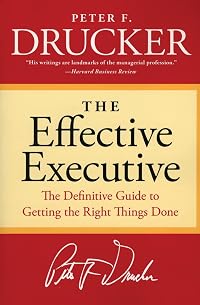
The Effective Executive: The Definitive Guide to Getting the Right Things Done
by Peter F. Drucker
On This Page
Description
A handsome, commemorative edition of Peter F. Drucker's timeless classic work on leadership and management, with a foreword by Jim Collins. What makes an effective executive? In this concise and brilliant work, he looks to the most influential position in management-the executive. The measure of the executive, Drucker reminds us, is the ability to "get the right things done." This usually involves doing what other people have overlooked as well as avoiding what is unproductive. Intelligence, show more imagination, and knowledge may all be wasted in an executive job without the acquired habits of mind that mold them into results. Drucker identifies five practices essential to business effectiveness that can-and must-be mastered: Managing time; Choosing what to contribute to the organization; Knowing where and how to mobilize strength for best effect; Setting the right priorities; Knitting all of them together with effective decision-making Ranging across the annals of business and government, Drucker demonstrates the distinctive skill of the executive and offers fresh insights into old and seemingly obvious business situations. show lessTags
Recommendations

Member Reviews
A very practical read that remains relevant, despite being written in 1966. Drucker premises the book about maximizing the effectiveness (getting the right things done) of a new class of 'knowledge workers' -- what strikes me as particularly relevant is the these lessons can be applied beyond the stereotypical white collar office worker, particularly in service and light manufacturing.
Today, I don't think there is as clear of a dichotomy as Drucker proposes. All workers would benefit from:
-Reducing the non-value add work that wastes their time and energy (Know Thy Time)
-Focusing their efforts on high-contribution initiatives (What Can I Contribute?)
-Having jobs that are designed to be demanding and big, so as to be engaged to grow show more personally and professionally (Making Strength Productive)
-Communicate what parts of their role could be abandoned or de-prioritized (First Things First)
The book can lose your attention a bit in written form, so I particularly enjoyed the free audiobook version available as a podcast: https://podcasts.google.com/feed/aHR0cHM6Ly9hbmNob3IuZm0vcy8xMjI1ZDRkMC9wb2RjYXN... show less
Today, I don't think there is as clear of a dichotomy as Drucker proposes. All workers would benefit from:
-Reducing the non-value add work that wastes their time and energy (Know Thy Time)
-Focusing their efforts on high-contribution initiatives (What Can I Contribute?)
-Having jobs that are designed to be demanding and big, so as to be engaged to grow show more personally and professionally (Making Strength Productive)
-Communicate what parts of their role could be abandoned or de-prioritized (First Things First)
The book can lose your attention a bit in written form, so I particularly enjoyed the free audiobook version available as a podcast: https://podcasts.google.com/feed/aHR0cHM6Ly9hbmNob3IuZm0vcy8xMjI1ZDRkMC9wb2RjYXN... show less
Yes, this is a business book, but one of the rare good business books that I can see myself re-reading periodically into the future. Most business books are such fluff, with so little content, that I feel sorry for all the trees that sacrificed themselves to make what is essentially blank paper. The Effective Executive, on the other hand, is pretty dense. The book is short (174 pages, plus an index). And while many of the points it makes are obvious, they're the types of obvious points that people still miss. At the current stage of my career, there are three points this book made that I'm going to pay close attention to. The first is to continue to manage my time carefully. The second is to focus on the right results I should be show more achieving: this is something I haven't done enough of. I've been caught in fire-fighting mode. Finally, I'm going to pay more attention to my decision-making. Drucker makes an interesting point, one that I don't have enough experience to agree or disagree with yet. He argues that an effective executive doesn't make many decisions, and he doesn't make them quickly. Instead, he makes a few important decisions. One thing I haven't been asking myself: Am I making the important decisions? show less
Really fine work here. The chapters, Know Thy Time and The Elements of Decision-making were especially good and warrant a regular re-read. It is hard to find the really good business books, the ones that speak to the heart of the matter in a concise and clear manner. This book transcends the modern squishy business book genre and speaks to a larger audience, those that want to be more effective. It does this while providing solid business advice that any serious student of the corporate world will appreciate.
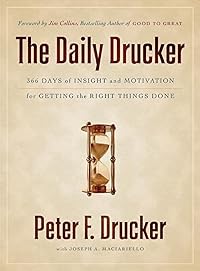
This one's sure dated. Drucker writes clean, assertive prose. The book is very quotable and also full of useful info, but so much of it references case studies from 50 - 100 years ago that it's hard today to feel like I'm able to extract as much meaning out of the case studies as somebody might have in 1966. I'm simultaneously reading The Daily Drucker and for the moment am inclined to think that reading a summary of the high points of The Effective Executive book and maybe thumbing through a copy of The Daily Drucker would be a useful exercise for most anybody in a lead or management role. I'm not sure I'd recommend a full read of The Effective Executive for most, though.
(Side note -- the more I read this book, the more, for some show more reason, I had trouble not hearing it in my head in the voice of Droop Dog.)
I've written a slightly more comprehensive review here. show less
(Side note -- the more I read this book, the more, for some show more reason, I had trouble not hearing it in my head in the voice of Droop Dog.)
I've written a slightly more comprehensive review here. show less
Solid ideas and a few good insights, particularly Drucker's definition of what an executive even is (a person that must independently make decisions and take responsibility for those decisions), as well as the idea that with any good decision there will be disagreement. However, I found some anecdotes to be difficult to relate back to the point being made. Many of the topics also seem to be common sense, though perhaps this is a testament to the success of the book and the permeation of its ideas today.
Wasn’t the easiest bedside reading, but important read. Similar to The One Thing, 7 habits, how to win friends, in that it’s from a different era and some of the man focused language is outdated. Would be good to have a even more condensed version with contemporary examples but I appreciated learning about McNamara, Alfred Sloan and the like. Important decision making rubric and self management ideas.
Originally written in 1967 by the father of business management, this book will help any business person journey towards greater responsibility and success. Having defined what an "Effective Executive" is, Drucker emphasizes that effectiveness is a learned skill. By examining what one can contribute to the success of the enterprise, and thus one's personal success, he stresses the importance of managing one's time, priorities, and playing to your strengths. A key part of business success is effective decision-making and Drucker breaks down the decision-making process and how to make effective decisions. Much of Drucker's wisdom is identifying personal and business processes that are dysfunctional and fixing, changing, or abandoning show more them. The book is filled with key questions that a business person must ask themselves to shed light on the path to choose and what to avoid. It is the most concise book of organizational management and professional development I have read and the principles are timeless. show less
Members
- Recently Added By
Lists

My List
302 works; 1 member
Author Information

258+ Works 12,451 Members
Peter F. Drucker has been Clarke Professor of Social Science and Management at Claremont Graduate School in California since 1971.
Awards and Honors
Notable Lists
Series
Belongs to Publisher Series
Common Knowledge
- Canonical title
- The Effective Executive: The Definitive Guide to Getting the Right Things Done
- Original publication date
- 1967
- First words
- Managing books usually deal with managing other people.
- Last words
- (Click to show. Warning: May contain spoilers.)Effectiveness must be learned.
Classifications
Statistics
- Members
- 2,266
- Popularity
- 8,836
- Reviews
- 21
- Rating
- (4.06)
- Languages
- 11 — Chinese, English, French, German, Hungarian, Japanese, Norwegian (Bokmål), Norwegian, Portuguese, Russian, Spanish
- Media
- Paper, Audiobook, Ebook
- ISBNs
- 53
- ASINs
- 25