
About the Author
Dr. Neil Fiore is the bestselling author of The Now Habit and Coping with the Emotional Impact of Cancer. He has worked as a psychologist at the Counseling Center of the University of California, Berkeley, and now conducts seminars and lectures at major schools and businesses. He lives in the show more greater San Francisco Bay Area. show less
Image credit: Neil Fiore
Works by Neil Fiore
The Now Habit: A Strategic Program for Overcoming Procrastination and Enjoying Guilt-Free Play (2007) 1,625 copies, 20 reviews
Awaken Your Strongest Self: Break Free of Stress, Inner Conflict, and Self-Sabotage (2006) 83 copies
The Now Habit at Work: Perform Optimally, Maintain Focus, and Ignite Motivation in Yourself and Others (2010) 51 copies
Coping with the Emotional Impact of Cancer: Become an Active Patient and Take Charge of Your Treatment (2009) 5 copies, 1 review
The Now Habit 1 copy
Mental Toughness 1 copy
Tagged
Common Knowledge
- Canonical name
- Fiore, Neil
- Gender
- male
- Education
- St. Peter's College (BA|Economics)
University of Maryland (MS|Counseling/Psychology)
University of Maryland (PhD|Counseling/Psychology) - Occupations
- psychologist
instructor
manager - Organizations
- National Speakers Association
American Society for Training & Development
International Coach Federation
American Psychological Association
Alameda County Psychological Association
American Society of Clinical Hypnosis (show all 9)
Northern California Society of Clinical Hypnosis
International Society of Clinical Hypnosis
National Coalition for Cancer Survivorship - Nationality
- USA
- Associated Place (for map)
- USA
Members
Reviews
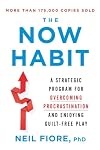
Now Habit: A Strategic Program for Overcoming Procrastination and Enjoying Guilt-free Play by Neil Fiore
I'm not usually one to read a bunch of self help sort of books, though I occasionally will run through one on a recommendation, such as the odd finance book about getting debt under control. But, despite other problems that I have in life the single biggest, hands down, is procrastination.
People who don't procrastinate will look at a procrastinator and see only that that person is either not working hard enough or putting off work. They don't procrastinate and as such don't understand the show more motivations and reasons behind why someone would. So they demand "get to work" and "just do it" and "work harder" which more often than not will just cause more procrastination.
This book is the first I've ever come across that actually understands procrastination. Reading through its pages I found myself nodding my head a lot because it described my internal struggle with work almost perfectly. And more importantly, the methods and exercises it provides for battling procrastination seem perfectly valid and easily doable. I've already started changing my habits by simply recognizing when I'm headed toward procrastination and being able to head it off before it happens.
And most importantly, this book isn't just about working harder. It's about working better and integrating play into your schedule because it recognizes the single most important element to procrastination - the reason we get bummed out and piddle around is the prospect that work is going to take away time from play. So by putting play on your schedule first and building work around play, you flip the whole thing on its head.
The only hesitation I had in giving this 5 stars is that the last couple of chapters delve into the sort of hippy zen breathing chanting mantra type stuff that I tend to loath in self help books. But up until that point it was an excellent book, and really you can ignore that part and still get a lot out of it. show less
People who don't procrastinate will look at a procrastinator and see only that that person is either not working hard enough or putting off work. They don't procrastinate and as such don't understand the show more motivations and reasons behind why someone would. So they demand "get to work" and "just do it" and "work harder" which more often than not will just cause more procrastination.
This book is the first I've ever come across that actually understands procrastination. Reading through its pages I found myself nodding my head a lot because it described my internal struggle with work almost perfectly. And more importantly, the methods and exercises it provides for battling procrastination seem perfectly valid and easily doable. I've already started changing my habits by simply recognizing when I'm headed toward procrastination and being able to head it off before it happens.
And most importantly, this book isn't just about working harder. It's about working better and integrating play into your schedule because it recognizes the single most important element to procrastination - the reason we get bummed out and piddle around is the prospect that work is going to take away time from play. So by putting play on your schedule first and building work around play, you flip the whole thing on its head.
The only hesitation I had in giving this 5 stars is that the last couple of chapters delve into the sort of hippy zen breathing chanting mantra type stuff that I tend to loath in self help books. But up until that point it was an excellent book, and really you can ignore that part and still get a lot out of it. show less
The Now Habit: A Strategic Program for Overcoming Procrastination and Enjoying Guilt-Free Play by Neil Fiore
How do you overcome procrastination? It may seem counterintuitive to start with play, but that is what Neil Fiore recommends. If you approach a task feeling like you "have to" do it, you'll be naturally resistant. But if you put guilt-free play onto your "un-schedule" first, and then freely make the choice to start a task in the remaining time, procrastination may become a thing of the past. I read a lot of time management books (usually while procrastinating), and this one reiterates much show more common advice. Break tasks into small pieces. Just get started. But Fiore is unusual in his focus on the importance of play. He advocates being realistic about how much time you actually have for project-based work, setting realistic goals, and making sure you make time for enjoyable activities too. It was somewhat serendipitous that I finished this one right before finals week! show less
The Now Habit: A Strategic Program for Overcoming Procrastination and Enjoying Guilt-Free Play by Neil Fiore
This is a book I wish I'd read at eighteen; it probably could have saved me more than a few years of painfully figuring out the right habits to deal with anxiety-driven procrastination. Having taken the long road to the same conclusions, however, I didn't find myself picking up many new ideas here.
I did take away a good reminder about the importance of making time for real play and relaxation without guilt (something I'm super bad at), though I didn't find the ideas of scheduling play very show more appealing.
As with most psych/self-help books, it could probably be a third of its length and not lose much. show less
I did take away a good reminder about the importance of making time for real play and relaxation without guilt (something I'm super bad at), though I didn't find the ideas of scheduling play very show more appealing.
As with most psych/self-help books, it could probably be a third of its length and not lose much. show less
The Now Habit: A Strategic Program for Overcoming Procrastination and Enjoying Guilt-Free Play by Neil Fiore
Self help books tend to disappoint me. This was OK.
Helpful:
- The idea that procrastination can come from anxiety over failure and from rebellion against authority. My dad was never impressed by anything I did; and while not relentlessly critical, he let me know I wasn't up to standard. When I think about tasks I avoid now that influence is visible. i like to fix things and tinker, but I avoid any task where someone might see me working.
- The idea that procrastinating sets up some perverse show more reward loops in your brain
- The idea that focusing on starting, rather than finishing the whole task, can be helpful
- That prioritizing guilt free play and relaxation can help reduce procrastinating
- Thoughts that start with 'should do,' might not be things I need to do. Are they really important to me?
Not-helpful
- There is an overlong section where the author walks readers through relaxing and meditating. It was too much and too painful. It might have been better as an appendix. show less
Helpful:
- The idea that procrastination can come from anxiety over failure and from rebellion against authority. My dad was never impressed by anything I did; and while not relentlessly critical, he let me know I wasn't up to standard. When I think about tasks I avoid now that influence is visible. i like to fix things and tinker, but I avoid any task where someone might see me working.
- The idea that procrastinating sets up some perverse show more reward loops in your brain
- The idea that focusing on starting, rather than finishing the whole task, can be helpful
- That prioritizing guilt free play and relaxation can help reduce procrastinating
- Thoughts that start with 'should do,' might not be things I need to do. Are they really important to me?
Not-helpful
- There is an overlong section where the author walks readers through relaxing and meditating. It was too much and too painful. It might have been better as an appendix. show less
Lists
You May Also Like


Statistics
- Works
- 15
- Members
- 1,888
- Popularity
- #13,619
- Rating
- 3.6
- Reviews
- 22
- ISBNs
- 40
- Languages
- 4