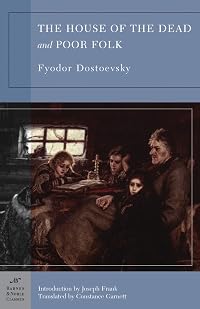
The House of the Dead and Poor Folk
by Fyodor Dostoyevsky 
On This Page
Description
"Arrested in 1849 for belonging to a secret group of radical utopians, Fyodor Dostoevsky was sentenced to four years in a Siberian labor camp--a terrible mental, spiritual, and physical ordeal that inspired him to write The House of the Dead. Told from the point of view of a fictitious narrator--a convict serving a ten year sentence for murdering his wife--The House of the Dead describes in vivid detail the horrors that Dostoevsky himself witnessed while in prison: the brutality of the show more guards who relished cruelty for its own sake; the evil of criminals who enjoy murdering children; and the existence of decent souls amid filth and degradation. Also included in this volume is Dostoevsky's first published work, Poor Folk, a novel written in the form of letters that brought Dostoevsky immediate critical and public recognition." --From cover. show lessTags
Recommendations


Member Reviews
The Short and Sweet of It
The House of the Dead is a semi-autobiographical accounting of his time in the Siberian prison. While many of the stories, experiences, and even the people are true-to-life, Dostoevsky created a fictional narrator, Alexandr Petrovich, who is serving ten years for murdering his wife. By creating a fictional character, Dostoevsky was able to insert biting political and social commentary into his writing; quite the brave thing to do after he had already been imprisoned for disagreeing with the government. Reading like a well-lived man recounting memories, The House of the Dead is a beauteous philosophical ramble that will stay with me for a long time.
A Bit of a Ramble
There is beauty in language, and I must admit show more that sometimes I forget this as I read less literary books. Let me be clear, I love a wide variety of books, and I feel no shame in reading works which are written in simple terms with standard cadence, no shame in the guilty pleasures. And yet, when I pick up a book like this, a classic novel that creates a unique rhythm and high-style to the language, I am moved. In this instance, that is in part due to the translation; after all, I'm not reading this in Russian. But I find that classic works have a greater likelihood of complex prose than modern novels. Literature became standardized for the masses, and the language of literature became more normalized, more like everyday speech. Sometimes I miss the nuanced language of the classics, the artful and articulate weaving of words, that can be lacking in popular contemporary novels.
Outside of the language, The House of the Dead also places a feast of philosophical dishes before readers:
the relationship between character and freedom, the necessity of purpose, the difficulties in assessing and punishing crimes, the importance of choice, appearance versus reality, the gap between the classes, the strength of hope, and the list goes on and on.
He reflects through anecdotes, not abstract thought, relating specific events, causes and effects, that happened before his eyes. These are not the musings of an intellectual constructing theories while reclining in his armchair or beside a flowing stream. These are the reasoned observations of one who is living it, and yet partially removed by his difference from the masses. Dostoevsky entered prison a gentleman, a leisured thinker, and found himself surrounded by criminals of the lower class. His inclusion in the life of the prison did not transcend the class difference, and so Dostoevsky and the narrator he constructed for the novel are at once participant and observer.
I find myself rambling here, mixing the book and reality in much the same way Dostoevsky has, but in my defense, I can not review in a normal fashion. The plot is nonexistent, the characters many and sporadic, the themes varied, etc. While the story is told chronologically from Petrovich's first day in prison through to his last, there is no real conflict. What Dostoevsky has done is create a portrait, a multidimensional complex image of life in prison. He moves from event to event from person to person, offering a snapshot of individual instances and inmates, that when combined, form a comprehensive whole that is rather powerful.
I could relate for you the myriad scenes and quotes that captured my mind, the stories that moved me or challenged me, for there were many. But instead I am going to implore you to pick this book up, to read for yourself the stories of the eccentric, unique, and oddly charming convicts that peppered Dostoevsky / Petrovich's life while he was in prison. show less
The House of the Dead is a semi-autobiographical accounting of his time in the Siberian prison. While many of the stories, experiences, and even the people are true-to-life, Dostoevsky created a fictional narrator, Alexandr Petrovich, who is serving ten years for murdering his wife. By creating a fictional character, Dostoevsky was able to insert biting political and social commentary into his writing; quite the brave thing to do after he had already been imprisoned for disagreeing with the government. Reading like a well-lived man recounting memories, The House of the Dead is a beauteous philosophical ramble that will stay with me for a long time.
A Bit of a Ramble
There is beauty in language, and I must admit show more that sometimes I forget this as I read less literary books. Let me be clear, I love a wide variety of books, and I feel no shame in reading works which are written in simple terms with standard cadence, no shame in the guilty pleasures. And yet, when I pick up a book like this, a classic novel that creates a unique rhythm and high-style to the language, I am moved. In this instance, that is in part due to the translation; after all, I'm not reading this in Russian. But I find that classic works have a greater likelihood of complex prose than modern novels. Literature became standardized for the masses, and the language of literature became more normalized, more like everyday speech. Sometimes I miss the nuanced language of the classics, the artful and articulate weaving of words, that can be lacking in popular contemporary novels.
Outside of the language, The House of the Dead also places a feast of philosophical dishes before readers:
the relationship between character and freedom, the necessity of purpose, the difficulties in assessing and punishing crimes, the importance of choice, appearance versus reality, the gap between the classes, the strength of hope, and the list goes on and on.
He reflects through anecdotes, not abstract thought, relating specific events, causes and effects, that happened before his eyes. These are not the musings of an intellectual constructing theories while reclining in his armchair or beside a flowing stream. These are the reasoned observations of one who is living it, and yet partially removed by his difference from the masses. Dostoevsky entered prison a gentleman, a leisured thinker, and found himself surrounded by criminals of the lower class. His inclusion in the life of the prison did not transcend the class difference, and so Dostoevsky and the narrator he constructed for the novel are at once participant and observer.
I find myself rambling here, mixing the book and reality in much the same way Dostoevsky has, but in my defense, I can not review in a normal fashion. The plot is nonexistent, the characters many and sporadic, the themes varied, etc. While the story is told chronologically from Petrovich's first day in prison through to his last, there is no real conflict. What Dostoevsky has done is create a portrait, a multidimensional complex image of life in prison. He moves from event to event from person to person, offering a snapshot of individual instances and inmates, that when combined, form a comprehensive whole that is rather powerful.
I could relate for you the myriad scenes and quotes that captured my mind, the stories that moved me or challenged me, for there were many. But instead I am going to implore you to pick this book up, to read for yourself the stories of the eccentric, unique, and oddly charming convicts that peppered Dostoevsky / Petrovich's life while he was in prison. show less
Two novels in one book. The first, The House of the Dead, is a semi-autobiographical retelling of Dostoevsky's time in a Siberian prison camp. This novel is not plot driven and is populated by numerous minor characters who mostly tend to blur together. There are some interesting stories told, especially toward the end of the book in my opinion, and there are a few interesting characterizations and philosophical insights about the nature of freedom, power, hope, suffering, the differences between classes, and the human condition. Ultimately this is probably my least favorite novel by Dostoevsky due to the lack of a plot and the lack of memorable characters, but I would still give it 3.5 stars.
I much preferred Poor Folk. Dostoevsky's show more premier novel is almost completely told through letters exchanged between the two destitute main characters, Makar Alexyevitch Devushkin and Varvara Alexyevna Dobroselova. It tells of the plight of the very poor; their struggle merely to survive combined with their desire to remain respectable and at times forget their problems. I really liked this short novel (120 pages) and read it very quickly. The characters, especially Makar Devushkin, were very real and memorable for me. I would give this novel a 4.5 or 5 star rating. show less
I much preferred Poor Folk. Dostoevsky's show more premier novel is almost completely told through letters exchanged between the two destitute main characters, Makar Alexyevitch Devushkin and Varvara Alexyevna Dobroselova. It tells of the plight of the very poor; their struggle merely to survive combined with their desire to remain respectable and at times forget their problems. I really liked this short novel (120 pages) and read it very quickly. The characters, especially Makar Devushkin, were very real and memorable for me. I would give this novel a 4.5 or 5 star rating. show less
The accounts in this piece are supposedly based on Dostoevsky's own experience as a prisoner.
Ratings
Members
- Recently Added By
Author Information

1,441+ Works 179,919 Members
One of the most powerful and significant authors in all modern fiction, Fyodor Dostoevsky was the son of a harsh and domineering army surgeon who was murdered by his own serfs (slaves), an event that was extremely important in shaping Dostoevsky's view of social and economic issues. He studied to be an engineer and began work as a draftsman. show more However, his first novel, Poor Folk (1846), was so well received that he abandoned engineering for writing. In 1849, Dostoevsky was arrested for being a part of a revolutionary group that owned an illegal printing press. He was sentenced to be executed, but the sentence was changed at the last minute, and he was sent to a prison camp in Siberia instead. By the time he was released in 1854, he had become a devout believer in both Christianity and Russia - although not in its ruler, the Czar. During the 1860's, Dostoevsky's personal life was in constant turmoil as the result of financial problems, a gambling addiction, and the deaths of his wife and brother. His second marriage in 1887 provided him with a stable home life and personal contentment, and during the years that followed he produced his great novels: Crime and Punishment (1886), the story of Rodya Raskolnikov, who kills two old women in the belief that he is beyond the bounds of good and evil; The Idiots (1868), the story of an epileptic who tragically affects the lives of those around him; The Possessed (1872), the story of the effect of revolutionary thought on the members of one Russian community; A Raw Youth (1875), which focuses on the disintegration and decay of family relationships and life; and The Brothers Karamazov (1880), which centers on the murder of Fyodor Karamazov and the effect the murder has on each of his four sons. These works have placed Dostoevsky in the front rank of the world's great novelists. Dostoevsky was an innovator, bringing new depth and meaning to the psychological novel and combining realism and philosophical speculation in his complex studies of the human condition. (Bowker Author Biography) show less
Fyodor Dostoyevsky has a Legacy Library. Legacy libraries are the personal libraries of famous readers, entered by LibraryThing members from the Legacy Libraries group.
Series
Belongs to Publisher Series
Work Relationships
Common Knowledge
- Canonical title
- The House of the Dead and Poor Folk
Classifications
- Genres
- General Fiction, Fiction and Literature
- DDC/MDS
- 813 — Literature & rhetoric American literature in English American fiction in English
- LCC
- PG3326 .Z3 — Language and Literature Slavic languages and literatures. Baltic languages. Albanian language Slavic. Baltic. Albanian Russian literature Individual authors and works 1800-1870 Dostoyevsky
- BISAC
Statistics
- Members
- 338
- Popularity
- 93,506
- Reviews
- 3
- Rating
- (3.80)
- Languages
- English
- Media
- Paper, Ebook
- ISBNs
- 2