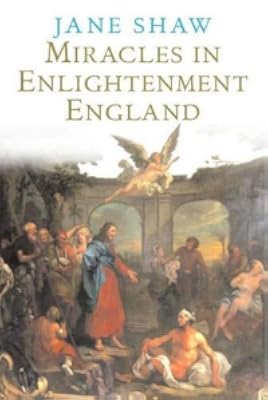
Miracles in Enlightenment England
by Dr. Jane Shaw
On This Page
Description
The Enlightenment, considered an age of rationalism, is not normally associated with miracles. In this intriguing book, however, Jane Shaw presents accounts of inscrutable miracles that occurred to ordinary worshippers in early modern England. She considers the reactions of intellectuals, scientists, and physicians to these miraculous events and through them explores the relations between popular and elite culture of the time. Miraculous events in England between the 1650s and the 1750s were show more experienced mainly not by Catholics, but by Protestants. The book looks at the political and social context of these events as well as interpretations and explanations of them by scientists, the Court, and the Church, as well as by preachers, pamphleteers, friends, and neighbors. Shaw links the lived religion of the time to intellectual history and amends the hitherto received view. The religious practice of ordinary people was as crucial to the development of Enlightenment thought as the philosophical and theological writings of the elite. show lessTags
Recommendations












Member Reviews
Jane Shaw's new book Miracles in Enlightenment England (Yale University Press) is an important new survey of the debate over miracles in England during the seventeenth and eighteenth centuries. She argues that what this debate shows is not a measured, steady trend toward skepticism, but rather a broad, wide-ranging discussion over the potentiality of miracles within the Protestant religious culture of post-Restoration England.
Shaw discusses three different streams of thought which arose regarding miracles: first, the doctrine of the cessation of miracles, which argued that miracles as such did not happen after the first few years of the Christian church, and that unexplained occurrences of contemporary times could be explained instead show more by the imposition of divine "providence" (in effect replacing the miraculous with the providential); second, the re-emergence of miracles or similar events among various Protestant sects (i.e. the Quakers, the Baptists) and in the monarch's "healing touch"; and thirdly the development of a "middle way," as early scientists and clerics sought a way to explain or prove the existence of miracles in some empirical way based on evidence and probability.
These three developments came under fire from the deists in the late seventeenth century, an attack which culminated in Hume's 1748 essay On Miracles (in which he declares them impossible). This debate between deists and what Shaw terms apologists is examined closely, and what Shaw finds is that in the end, even in the middle of the eighteenth century, a huge range of opinions regarding the plausibility of miracles continued to exist.
Shaw offers an excellent scholarly treatment of the works of Valentine Greatrakes, who was the subject of A Small Moment of Great Illumination (review) which I read recently. Her commentary on the role of the Royal Society (Boyle, Oldenburg, &c.) as important arbiters of the miraculous as well as the discussion of some of the leading divines of the day (Stillingfleet, Burnet) is most interesting and well done.
This book is well researched (witness the copious notes and excellent bibliography), well written, and clearly argued. I recommend it highly to anyone interested in the beginnings of the Enlightenment and/or English social-religious-political culture in the Restoration period.
http://philobiblos.blogspot.com/2007/01/book-review-miracles-in-enlightenment.ht... show less
Shaw discusses three different streams of thought which arose regarding miracles: first, the doctrine of the cessation of miracles, which argued that miracles as such did not happen after the first few years of the Christian church, and that unexplained occurrences of contemporary times could be explained instead show more by the imposition of divine "providence" (in effect replacing the miraculous with the providential); second, the re-emergence of miracles or similar events among various Protestant sects (i.e. the Quakers, the Baptists) and in the monarch's "healing touch"; and thirdly the development of a "middle way," as early scientists and clerics sought a way to explain or prove the existence of miracles in some empirical way based on evidence and probability.
These three developments came under fire from the deists in the late seventeenth century, an attack which culminated in Hume's 1748 essay On Miracles (in which he declares them impossible). This debate between deists and what Shaw terms apologists is examined closely, and what Shaw finds is that in the end, even in the middle of the eighteenth century, a huge range of opinions regarding the plausibility of miracles continued to exist.
Shaw offers an excellent scholarly treatment of the works of Valentine Greatrakes, who was the subject of A Small Moment of Great Illumination (review) which I read recently. Her commentary on the role of the Royal Society (Boyle, Oldenburg, &c.) as important arbiters of the miraculous as well as the discussion of some of the leading divines of the day (Stillingfleet, Burnet) is most interesting and well done.
This book is well researched (witness the copious notes and excellent bibliography), well written, and clearly argued. I recommend it highly to anyone interested in the beginnings of the Enlightenment and/or English social-religious-political culture in the Restoration period.
http://philobiblos.blogspot.com/2007/01/book-review-miracles-in-enlightenment.ht... show less
Ratings
Members
- Recently Added By
Lists

Ideas for "Science, Religion, and History" group reads
29 works; 9 members
Author Information

5+ Works 114 Members
Jane Shaw is Dean of Divinity, Chaplain, and Fellow of New College, Oxford.
Classifications
Statistics
- Members
- 20
- Popularity
- 1,280,060
- Reviews
- 1
- Rating
- (3.63)
- Languages
- English
- Media
- Paper
- ISBNs
- 2