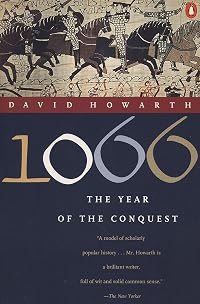
1066
by David Howarth
On This Page
Description
Examines chronologically the events of the year during which the Normans invaded and conquered England, discusses the leading personalities of that time, and describes the everyday life of the common Englishman.Tags
Recommendations













Member Reviews
This is not a comprehensive history of the Battle of Hastings, and it is not meant to be. It is a great storyteller's version of events as he understands them.
Howarth uses mostly contemporaneous writings (17 of his 20 sources are within 100 years of the Battle of Hastings) to decipher and tell the history of the battle between King Harold of England and William the Conqueror of Normandy. He infuses the book with his own point of view, which at times can be borderline Francophobic. "[William] was a more barbarous primitive man than either Edward or Harold, but he is not to be blamed: he came from a more barbarous primitive country."
But it is this point of view, and this conversational tone that makes this book so enjoyable. You might not show more agree with his point of view, but it sure is fun to listen to. "Obviously, nobody could really make a speech to an army, and the chaplain rather gave the game away. He wrote: 'Nobody has reported to us in detail the short harangue with which on this occasion the Duke increased the courage of his troops...' - and he went straight on to quote the speech at great length word for word."
I'll definitely be looking out for Howarth's other books. show less
Howarth uses mostly contemporaneous writings (17 of his 20 sources are within 100 years of the Battle of Hastings) to decipher and tell the history of the battle between King Harold of England and William the Conqueror of Normandy. He infuses the book with his own point of view, which at times can be borderline Francophobic. "[William] was a more barbarous primitive man than either Edward or Harold, but he is not to be blamed: he came from a more barbarous primitive country."
But it is this point of view, and this conversational tone that makes this book so enjoyable. You might not show more agree with his point of view, but it sure is fun to listen to. "Obviously, nobody could really make a speech to an army, and the chaplain rather gave the game away. He wrote: 'Nobody has reported to us in detail the short harangue with which on this occasion the Duke increased the courage of his troops...' - and he went straight on to quote the speech at great length word for word."
I'll definitely be looking out for Howarth's other books. show less
A terrific and concise narrative about the Norman Invasion, written in prose so clear that Strunk and White would say, "I don't know how he could have made it any better." Howarth presents the major figures of the Invasion as complicated people, and the Invasion itself as an example of what happens when luck intervenes in the best-laid plans. I woke up early to read it each day: is there a better endorsement?
The events of 1066 AD cast a big shadow over the past 1000 years. It's easy to mythologize it, to portray the actors and period as heroic. In this popular history, Howarth resists the heroic tendency and rather brings it down to a personal scale in a believable way, sticking to the facts without going to the other extreme of academic dullness. The simplicity and directness of the people he writes about matches his writing style. Howarth has the feel of an amateur historian, but in the best sense, mixing professional practices with colorful narrative stories. Although the analysis often feels simple, it is expedient and reasonable given the lack of sources. History here has no overarching theory or grand design, it is a series of show more contingencies, one thing influencing the next. In the end, it was mostly "luck" that made William the Conqueror, according to Howarth. Although this is the most detailed account of 1066 I have read, some aspects Howarth missed entirely. For example, an arrow in the eye is medieval iconography for someone who has lied under oath. Howarth doesn't mention that Harolds death by arrow was probably apocryphal Norman propaganda. But it just underscores the question, what is better about 1066? The amazing things we know happened, or the myths and legends surrounding it. show less
As the title suggests, this relatively short nonfiction work describes life in England in the year 1066, both before and after the invasion of William, Duke of Normandy. The year began with the death of King Edward III of England, whom Howarth describes in some depth. He then shows the difficulties the English faced in selecting a new king, since Edward had not clearly announced a successor. Howarth discusses how Harold came to be the next English king and reveals the quarrel that erupted between him and Duke William of Normandy, both of whom believed they had the rightful claim to the throne. Overall, the book seeks to give the average reader a general idea of the causes and immediate consequences of the Norman conquest.
I was show more recommended this book by a friend who studied medieval history in college and who vouched for its respectability. I found it a very readable and interesting account of the Norman conquest and the major players involved. It doesn't look like a scholarly work in the contemporary sense; there aren't many footnotes or endnotes, and Howarth simply lists his sources in a very short bibliography at the end of the book. However, all of his sources are original documents from the time period, and he very clearly tells the reader when he is guessing about something. So I was convinced of the author's overall trustworthiness, and I also really enjoyed the book. I feel like I learned a lot about the Norman conquest, and I had no idea that King Harold could easily have defeated William the Conqueror if just a few things had turned out differently. I would definitely recommend this book as an overview of the Norman conquest, and it would be a great read for lovers of medieval history as well. show less
I was show more recommended this book by a friend who studied medieval history in college and who vouched for its respectability. I found it a very readable and interesting account of the Norman conquest and the major players involved. It doesn't look like a scholarly work in the contemporary sense; there aren't many footnotes or endnotes, and Howarth simply lists his sources in a very short bibliography at the end of the book. However, all of his sources are original documents from the time period, and he very clearly tells the reader when he is guessing about something. So I was convinced of the author's overall trustworthiness, and I also really enjoyed the book. I feel like I learned a lot about the Norman conquest, and I had no idea that King Harold could easily have defeated William the Conqueror if just a few things had turned out differently. I would definitely recommend this book as an overview of the Norman conquest, and it would be a great read for lovers of medieval history as well. show less
In many ways David Howarth has done what other historical texts has not. Howarth admits his slight bias beforehand, and then does all he can throughout the text to present a balanced view - he quotes primary sources, and then explains why they are or are not accurate. In short, Howarth has done everything that makes a good historian good, or even great - he has tried to present the truest picture possible, with what scant evidence there is.
While the year 1066 immediately brings to mind the Battle of Hastings, the book itself details what life was like before, during, and after that time. He presents the historical context necessary to try to understand why Norway, Normandy, and England all acted in the manner in which they did. His show more overview is both in depth and concise, bound together by an unerringly accessible and direct prose.
I would highly recommend this book to just about anyone interested in this time period. Howarth is definitely a master at his trade. There is much to be admired in this book. show less
While the year 1066 immediately brings to mind the Battle of Hastings, the book itself details what life was like before, during, and after that time. He presents the historical context necessary to try to understand why Norway, Normandy, and England all acted in the manner in which they did. His show more overview is both in depth and concise, bound together by an unerringly accessible and direct prose.
I would highly recommend this book to just about anyone interested in this time period. Howarth is definitely a master at his trade. There is much to be admired in this book. show less
The year 1066 is so important, so vital to the course of European history, but somehow we manage to reduce it to “the Battle of Hastings.” That is largely what I was expecting with this short history by David Howarth, a popular historian better known for his takes on more recent history, including World War II and the Battle of Trafalgar. But the most popular battle of the Norman invasion takes up only one chapter of the book, with much of the rest providing a cultural and social history within which you can get a better understanding of the historical arc of the entire year.
Before Howarth jumps into any history, however, he gives sets up a picture of daily life in a village called Horstede, which happens to be where King Harold show more first learned about William’s invasion across the English Channel. A rudimentary description of the feudal system is given in the first few chapters replete with earls and thanes. We get a discussion of English and Norman politics, including William’s motive to invade in the first place, a topic which requires some psychological second-guessing. Howarth seems to think that Edward had somehow promised William the throne in the last years of his life, and was nonplussed when Harold was immediately selected by the Witenagemot, the Anglo-Saxon advisory council that served the king.
And to confuse political matters even more, there is another Harald – Harald Hardrada, King of Norway (but note the difference in spelling) – who also thought that he had a solid claim to the throne, and was invited to invade English by Harold’s estranged brother Tostig, earl of Northumbria. Harald Hardrada and Tostig both die in what is maybe the penultimate battle of the Norman invasion, the Battle of Stamford Bridge.
I said “historical arc” above because in the year 1066, Edward the Confessor dies (January 5th), Harold takes the thrown on the very same day, the Norman invasion is won and lost, and William “the Conqueror” takes the thrown again on December 25th. That’s three monarchs in one year – and four if you count the fifteen-year-old Edgar the Aetheling, who held the throne for about two months before being forced to remit it to William. That’s a busy year.
This isn’t model academic history. There are no footnotes, and there is a lot more conjecture – sometimes couched in the language of verifiable historical record – than I am usually comfortable with. I would approach this as I would any book of popular history: take it with a grain of salt and depending on how interested you are in the subject, consult more scholarly sources. My only complaint about the book is that there is quite a bit of detailed battle strategy (this flank was left exposed, a certain person went Berserk at Stamford Bridge) which I think could have been put to better use in explaining the politics or cultural life; these parts didn’t hold my interest as much. But for all of that, it is engagingly written, and serves as a nice foot in the door for those who want to learn about the major events and the important near-contemporary historians (like William of Malmesbury) through which we know much of what happened that year. show less
Before Howarth jumps into any history, however, he gives sets up a picture of daily life in a village called Horstede, which happens to be where King Harold show more first learned about William’s invasion across the English Channel. A rudimentary description of the feudal system is given in the first few chapters replete with earls and thanes. We get a discussion of English and Norman politics, including William’s motive to invade in the first place, a topic which requires some psychological second-guessing. Howarth seems to think that Edward had somehow promised William the throne in the last years of his life, and was nonplussed when Harold was immediately selected by the Witenagemot, the Anglo-Saxon advisory council that served the king.
And to confuse political matters even more, there is another Harald – Harald Hardrada, King of Norway (but note the difference in spelling) – who also thought that he had a solid claim to the throne, and was invited to invade English by Harold’s estranged brother Tostig, earl of Northumbria. Harald Hardrada and Tostig both die in what is maybe the penultimate battle of the Norman invasion, the Battle of Stamford Bridge.
I said “historical arc” above because in the year 1066, Edward the Confessor dies (January 5th), Harold takes the thrown on the very same day, the Norman invasion is won and lost, and William “the Conqueror” takes the thrown again on December 25th. That’s three monarchs in one year – and four if you count the fifteen-year-old Edgar the Aetheling, who held the throne for about two months before being forced to remit it to William. That’s a busy year.
This isn’t model academic history. There are no footnotes, and there is a lot more conjecture – sometimes couched in the language of verifiable historical record – than I am usually comfortable with. I would approach this as I would any book of popular history: take it with a grain of salt and depending on how interested you are in the subject, consult more scholarly sources. My only complaint about the book is that there is quite a bit of detailed battle strategy (this flank was left exposed, a certain person went Berserk at Stamford Bridge) which I think could have been put to better use in explaining the politics or cultural life; these parts didn’t hold my interest as much. But for all of that, it is engagingly written, and serves as a nice foot in the door for those who want to learn about the major events and the important near-contemporary historians (like William of Malmesbury) through which we know much of what happened that year. show less
This excellent book tells of a very turbulent year during which Harold II ascended to the throne of England, defeated a pretender to his kingdom, Harald Hardrada of Norway at the Battle of Stamford Bridge and was in turn defeated by another pretender to his throne, William the Conqueror of Normandy at the Battle of Hastings. The author invites us to imagine the life of a peasant in southern England describing their life, universe and aspirations while also provides us with insights into the political considerations at the highest levels of the various kingdoms involved in this account. I felt that this top and bottom approach worked quite well, with the point of view of the common man grounding and framing the story and giving it show more substance. I also enjoyed the political elements – from the consolidation of Harold’s power, to the justification of the conquest, including the buy-in from the Pope. The contention that the reason for the invasion hinges on a promise made in a time of despair when Harold was shipwrecked in Ponthieu is amazing if true – but it is a conjecture, as rightly pointed out by the author. This book was short and sweet – offering a riveting account of a seminal year in England’s history. show less
Members
- Recently Added By
Lists

Top Five Books of 2016
795 works; 229 members

al.vick-wishlist-history
70 works; 2 members

The Works of David Howarth
24 works; 1 member

My Wishlist
40 works; 1 member

What A Year: Books titled with a particular year
147 works; 2 members
Author Information

35+ Works 5,607 Members
Some Editions
Common Knowledge
- Canonical title
- 1066
- Alternate titles
- The year of the conquest
- Original publication date
- 1977
- People/Characters
- William the Conqueror; Edward the Confessor; Henry I, King of England; Harald Hardrada; Harold II Godwinson; Aldred, Archbishop of York (show all 19); Edgar the Atheling; Edwin, Earl of Mercia; Edith of Wessex (Queen of Edward the Confessor); Godwin, Earl of Wessex; Gyrth Godwinson, Earl of East Anglia; Leofwine Godwinson, Earl of Kent; Morcar, Earl of Northumbria; Odo, Bishop of Bayeux; Stigand, Archbishop of Canterbury; Tostig Godwinson; William of Poitiers; Lanfranc of Canterbury (c. 1005-1089); Gregory VII, Pope (Saint, Hildebrand of Sovana, c.1015/1020-1085, Gregorian Reform)
- Important places
- Hastings, East Sussex, England, UK; Normandy, France; York, North Yorkshire, England, UK; East Sussex, England, UK; Stamford Bridge, East Riding of Yorkshire, England, UK
- Important events
- Norman Conquest of England (1066); Battle of Stamford Bridge (1066-09-26); Battle of Hastings (1066-10-14)
- First words
- A few years ago I wrote a book about Waterloo and one about Trafalgar, and tried to describe those battles from the points of view of men who fought in them. (Introduction)
It was not a bad life to be English when the year began; it was the kind of life that many modern people vainly envy. - Quotations
- There is no end to the arguments about the ultimate merits of the Norman Conquest. It must always be hypothetical to compare the England of the following centuries with what it might have become if the English had been left ... (show all)to develop their own way of life. The consensus is that it was beneficial in the long run. But its benefits were no comfort to the people of 1066 because none of them lived long enough to see them. All they saw was a cruel foreign tyranny. It is reckoned that in the next twenty years two hundred thousand Normans and Frenchmen settled in the country, while at least three hundred thousand English people, one in five of the native population, were killed in William's ravages or starved by the seizure of their farm stock and their land. ("England : New Year's Eve" [last chapter])
- Last words
- (Click to show. Warning: May contain spoilers.)They never became Norman, they remained most stubbornly English, absorbed the invaders and made of the mixture a new kind of Englishness.
Classifications
- Genres
- History, Nonfiction, General Nonfiction
- DDC/MDS
- 942.021 — History & geography History of Europe England and Wales England Norman 1066-1154 William I 1066-87
- LCC
- DA195 .H69 — History of Europe, Asia, Africa and Oceania Great Britain History of Great Britain England History By period Early and medieval to 1485 Celts. Romans. Saxons. Danes. Normans
- BISAC
Statistics
- Members
- 1,675
- Popularity
- 13,345
- Reviews
- 29
- Rating
- (3.91)
- Languages
- English
- Media
- Paper, Audiobook
- ISBNs
- 10
- ASINs
- 13