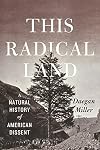
This Radical Land: A Natural History of American Dissent
by Daegan Miller
On This Page
Description
?The American people sees itself advance across the wilderness, draining swamps, straightening rivers, peopling the solitude, and subduing nature, ? wrote Alexis de Tocqueville in 1835. That ?s largely how we still think of nineteenth-century America today: a country expanding unstoppably, bending the continent ?s natural bounty to the national will, heedless of consequence. A country of slavery and of Indian wars. There ?s much truth in that vision. But if you know where to look, you can show more uncover a different history, one of vibrant resistance, one that ?s been mostly forgotten. This Radical Land recovers that story. Daegan Miller is our guide on a beautifully written, revelatory trip across the continent during which we encounter radical thinkers, settlers, and artists who grounded their ideas of freedom, justice, and progress in the very landscapes around them, even as the runaway engine of capitalism sought to steamroll everything in its path. Here we meet Thoreau, the expert surveyor, drawing anticapitalist property maps. We visit a black antislavery community in the Adirondack wilderness of upstate New York. We discover how seemingly commercial photographs of the transcontinental railroad secretly sent subversive messages, and how a band of utopian anarchists among California ?s sequoias imagined a greener, freer future. At every turn, everyday radicals looked to landscape for the language of their dissent ?drawing crucial early links between the environment and social justice, links we ?re still struggling to strengthen today. Working in a tradition that stretches from Thoreau to Rebecca Solnit, Miller offers nothing less than a new way of seeing the American past ?and of understanding what it can offer us for the present . . . and the future. show lessTags
Recommendations















































Member Reviews
This "four act play" by Daegan Miller, an academic, covers historical events not typically includes in the evolution of environmentalism in the United States. For instance, one of the acts is about an African American settlement in the Adirondack mountains of New York that did not persist, with another chapter on a Marxist colony in the Sierra Nevada mountains in the shadow of giant sequoias. While interesting, the writing can be dense at times and the conclusion is somewhat nebulous. I would recommend it to students of conservation and environmentalism.
Members
- Recently Added By
Lists

Climate Change
39 works; 2 members

LIT - Il Bookclub Della McMusa
47 works; 1 member
Author Information
3 Works 79 Members
Classifications
- Genres
- Nonfiction, Science & Nature, History, General Nonfiction
- DDC/MDS
- 304.20973 — Society, Government, and Culture Social sciences, sociology & anthropology Factors affecting social behavior Human ecology
- LCC
- GE150 .M55 — Geography, Anthropology and Recreation Environmental Sciences Environmental sciences
- BISAC
Statistics
- Members
- 76
- Popularity
- 409,461
- Reviews
- 1
- Rating
- (3.00)
- Languages
- English
- Media
- Paper, Ebook
- ISBNs
- 3
- ASINs
- 1