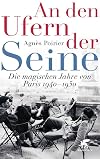
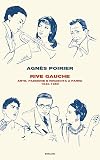
Left Bank: Art, Passion, and the Rebirth of Paris, 1940-50
by Agnès Catherine Poirier
On This Page
Description
An incandescent group portrait of the midcentury artists and thinkers whose lives, loves, collaborations, and passions were forged against the wartime destruction and postwar rebirth of Paris In this fascinating tour of a celebrated city during one of its most trying, significant, and ultimately triumphant eras, Agnes Poirier unspools the stories of the poets, writers, painters, and philosophers whose lives collided to extraordinary effect between 1940 and 1950. She gives us the human drama show more behind some of the most celebrated works of the 20th century, from Richard Wright's Native Son, Simone de Beauvoir's The Second Sex, and James Baldwin's Giovanni's Room to Samuel Beckett's Waiting for Godot and Saul Bellow's Augie March, along with the origin stories of now legendary movements, from Existentialism to the Theatre of the Absurd, New Journalism, bebop, and French feminism.We follow Arthur Koestler and Norman Mailer as young men, peek inside Picasso's studio, and trail the twists of Camus's Sartre's, and Beauvoir's epic love stories. We witness the births and deaths of newspapers and literary journals and peer through keyholes to see the first kisses and last nights of many ill-advised bedfellows. At every turn, Poirier deftly hones in on the most compelling and colorful history, without undermining the crucial significance of the era. She brings to life the flawed, visionary Parisians who fell in love and out of it, who infuriated and inspired one another, all while reconfiguring the world's political, intellectual, and creative landscapes. With its balance of clear-eyed historical narrative and irresistible anecdotal charm, Left Bank transports readers to a Paris teeming with passion, drama, and life. show lessTags
Recommendations










Member Reviews
It had me hooked. This is a wonderful piece of non-fiction that chronicles the development of the Paris Left-Bank intellectuals. The author explains how the second world war was a prime influence in shaping the minds and attitudes of Parisians and how, in the time after the war, the intellectuals and artists influenced the public and government through publications, demonstrations and debate. All this is played out on the world's political, artistic and intellectual stage. The author's style draws the reader in as she uses source material to extrapolate the personal and emotional events of her subjects. This is an accessible history of a fascinating time.
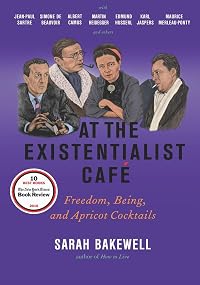
This book could be seen as a complement to Sarah Bakewell's seminal [b:At the Existentialist Café: Freedom, Being, and Apricot Cocktails|25658482|At the Existentialist Café Freedom, Being, and Apricot Cocktails|Sarah Bakewell|https://images.gr-assets.com/books/1456742264s/25658482.jpg|45480464], where Poiriér has collected a lot of background and information on what some truly exciting persons thought of, did, and how they performed both during and after the Second World War.
Even though it's interesting to hear anecdotes and tidbits, e.g. this one:
...the book is a bit more ephemeral than Bakewell's book for just that reason. The book does, however, weave different kinds of resistance against the Nazis together in a very satisfying and informative way, e.g. how people did all they could to hide art from the Nazis:
It was also exciting to hear of how writers joined to resist:
Not that the end of the war meant that wars were over. Communists and existentialists were fighting, the US disliked Richard Wright so he went to France, and...things were generally a lot more do or die then:
I dig how the philosophers mostly practiced what they preached:
Also:
One of the main strengths of this book is how it contrasts the mundane—if anything was indeed mundane—with the extraordinary. For example, de Beauvoir's endeavour to write what was initially thought to become a neat text:
It's also interesting to read some of de Beauvoir's initial thoughts of Northern America, which subsequently changed, especially with her falling in love with Nelson Algren, which happened later:
The book is like a cut into a decade of a time when many generational and revolutionary ideas and changes occurred within a very short space of time, not least the sexual; bar the feministic movements that were (and are) ongoing at the time, sexuality was not a very locked-down and conservative concept.
All in all, this book is a welcome one if you want to have a good glance into a decade of changes. Still, I cannot help but think of Bakewell's excellent book. They complement each other in a way. show less
Together, in Paris, our band of brothers and sisters created new codes. They founded the New Journalism, which got its official name a decade later but was born then, in the smoky hotel rooms of the Left Bank, and forever blurred the lines between literature andshow more
reportage. Poets and playwrights slowly buried Surrealism and invented the Theater of the Absurd; budding painters transcended Socialist Realism, pushed Geometric Abstraction to its limits, and fostered Action Painting. Philosophers founded new schools of thought such as Existentialism while setting up political parties. Aspiring writers found their voices in Paris’s gutters and the decrepit student rooms of Saint-Germain-des-Prés, while others invented the nouveau roman. Photographers reclaimed their authorship through photojournalism agencies such as Magnum; censored American writers such as Henry Miller published their work first in French; black jazz musicians, fleeing segregation at home, found consecration in the concert halls and jazz clubs of Paris, where New Orleans jazz received its long-overdue appreciation while bebop was bubbling up. Some in the Catholic Church experimented with Marxism, while a colorist and former art gallery owner turned couturier named Christian Dior intoxicated the world with the New Look in fashion design.
Even though it's interesting to hear anecdotes and tidbits, e.g. this one:
La nausée was dedicated to “The Beaver,” a word play in English on the name of his best friend, sparring partner, and lover, Simone de Beauvoir. “Beauvoir” sounds like “beaver” in English pronunciation, which is castor in French. In other words, Simone de Beauvoir became for her close friends “Le Castor” by way of English. Le Castor was, just like Sartre, a brilliant thirty-year-old philosophy teacher, though rather more beautiful. They lived together—that is, they lived in the same shabby hotel, the Hôtel Mistral, 24 rue de Cels, just behind Montparnasse Cemetery, though not in the same room.
...the book is a bit more ephemeral than Bakewell's book for just that reason. The book does, however, weave different kinds of resistance against the Nazis together in a very satisfying and informative way, e.g. how people did all they could to hide art from the Nazis:
Every museum in the country used the plan of evacuation Jaujard had used for the Louvre, each work being treated in order of artistic and historical importance. By autumn 1939, every single artwork of significance had been put in safekeeping. The news, quite inevitably, filtered out. Raymond Lécuyer, in Le Figaro, wrote of “the exodus of paintings,” praised the dedication of the national museums’ keepers, many of them retired veterans from the Great War, and apologized to his readers for being elusive about the whole operation. He could not be specific, nor could he give names, dates, or places, but he wrote: “May [it] be, however, a comfort for you to know that the world’s art heritage is safe from the scientific enterprises of German barbarism.” Having fulfilled his duty to history, Jaujard retreated to his office in the Louvre overlooking the Tuileries Gardens. He was now bracing himself for the inevitable. It might take months, but the Germans would soon be in Paris, he was certain of that. Jaujard may have been ready but, unfortunately, the French army was not.
It was also exciting to hear of how writers joined to resist:
One evening at the end of March 1941, Simone de Beauvoir found a note slipped under the door of her hotel room, in Sartre’s handwriting: “I’m at the Café des Trois Mousquetaires.” Beauvoir ran into the street toward the café. Sartre had tricked the camp’s authorities and had been released under a fake identity. He was changed, he could not stop talking. It was not the kind of romantic reunion she had dreamed of. On learning that Simone had signed an affidavit declaring she was not a Jew, he gave her a stern look. And how could she buy food on the black market? Action was the only word he now cared for. Their friend the philosopher Maurice Merleau-Ponty was also back in Paris. Together, they organized themselves and federated other writers into a resistance group, Socialisme et Liberté. Simone was surprised at Sartre’s vehemence. During the summer of 1941, they cycled together into Vichy France to establish contacts with potential members south of the Occupation line. However, it seemed that the sticking point was the nature of the resistance action the group would carry out. Sartre favored words over bombs.
Not that the end of the war meant that wars were over. Communists and existentialists were fighting, the US disliked Richard Wright so he went to France, and...things were generally a lot more do or die then:
That week, Gallimard’s house fascist, Drieu La Rochelle, bumping into a friend on the avenue de Breteuil, near the Invalides, said: “I’ve made my decision, I’m leaving.” A few hours later he was attempting suicide. Gerhard Heller leaped on his bicycle, arrived at his bedside, and whispered in Drieu’s ear: “I’m slipping a passport for you under your pillow.” The passport had a visa for Spain and Switzerland. But Drieu was fixed on a one-way journey to hell. That night, Gerhard Heller packed his Paris diaries of the last four years, together with a manuscript entrusted to him by Ernst Jünger titled “Peace.” He put the documents in a small tin suitcase and set off toward the Invalides, a small shovel in his hand. The air was muggy; Heller could feel the sweat pearling down his brow. He spotted a tree on the esplanade, looked at the distance and angle between the rue de Constantine, rue Saint-Dominique, and rue de Talleyrand, made a mental note, counted his steps, and started digging discreetly. He felt the urge to—literally—bury his Paris life in order to save himself.
I dig how the philosophers mostly practiced what they preached:
Sartre was known for spending his money freely. Insisting on being paid cash for his work, he liked carrying huge wads of banknotes and always paid at restaurants and cafés, never letting anyone else foot the bill, and left huge tips for the waiters. His generosity was astounding and attracted many friends in temporary or chronic financial difficulty. Sartre would discreetly pay for former students’ abortions, cover the rent of his past and present lovers, make loans to impoverished writers—the people indebted to him were legion. In fact, Sartre had no desire to own anything and, true to his word, never would. Cau quickly realized that his main activity would be to free Sartre from his increasingly busy social life and from all the profiteurs so that he could have long stretches of time during the day to concentrate on his writing.
Also:
However, for her American tour, and to avoid the humiliation of being taken to a tailor as soon as she stepped off the plane at LaGuardia, as had happened to Sartre, whose threadbare clothes had horrified his American hosts, she needed at least one new dress. She bought one in a little maison de couture, a finely knitted black dress, for the exorbitant price of 25,000 francs (the equivalent of about $1,650 today). She walked back to Sartre’s flat and told him, pointing to her shopping bag: “This is my first concession,” and burst into tears.
One of the main strengths of this book is how it contrasts the mundane—if anything was indeed mundane—with the extraordinary. For example, de Beauvoir's endeavour to write what was initially thought to become a neat text:
This was not going to be a short and quick essay. She had started researching The Second Sex, a book that would shake the world. Simone had so far lived her life as she pleased by breaking social conventions, so researching this subject was also a journey of self-discovery. She would understand in the process why she fascinated younger women. Her life was a model of emancipation, one that the younger generation aspired to and one that she was going to analyze in great detail, not shying away from sexually explicit content.
It's also interesting to read some of de Beauvoir's initial thoughts of Northern America, which subsequently changed, especially with her falling in love with Nelson Algren, which happened later:
Talking, drinking, smoking cannabis in Greenwich Village with Wright’s friends, Beauvoir was amazed to discover the chauvinism of the New York intellectuals she met. “Their chauvinism reminded me of my father’s. As for their anti-Communism, it verges on neurosis.” She could not resist taking notes on all the details, the differences, the feelings she experienced. On January 31, 1947, she wrote: “Americans’ politeness and good humor make life so much easier and nicer.” However, she could not help looking beyond the façade: “Yet, I’m starting to find annoying all those imperious invitations to ‘take life on the bright side.’ On every poster, everyone shows their white teeth in a grin that seems to me like tetanus. On the subway, in the streets, in every magazine, those obsessive smiles are chasing me. It is a system. Optimism is necessary to social peace and economic prosperity based on consumption and credit.”
The book is like a cut into a decade of a time when many generational and revolutionary ideas and changes occurred within a very short space of time, not least the sexual; bar the feministic movements that were (and are) ongoing at the time, sexuality was not a very locked-down and conservative concept.
All in all, this book is a welcome one if you want to have a good glance into a decade of changes. Still, I cannot help but think of Bakewell's excellent book. They complement each other in a way. show less
Poirier's book is an exhaustive (and exhausting) cultural history of the Left Bank during the 1940s, from the German occupation of World War II through liberation and the birth of existentialism and the Fourth Republic, told chronologically through the eyes of its denizens both famous (Sartre and Beauvoir, Hemingway, Picasso, Beckett, Wright, Mailer) and less well-known (Jacques Jaujard, who arranged to hide French art masterworks throughout the country during the war, deserves to be better known). The second half of the decade was a heady time when the world looked to Paris for cutting edge ideas in art, literature, journalism, cinema, philosophy, and politics, and Poirer vividly captures the spirit and dynamics of the time and place. show more In short, thanks to Poirier's account, you get what all the fuss was about. Though not a political history, her account of the politics of the time is more cogent than the tales of sex, drugs, and jazz, which (appropriately, perhaps) tend to be more gossipy in tone. If there's a flaw, it's that all the drinking, the bed-hopping, the partner-swapping, the leaving the country and coming back lend an inevitable sameness to the narrative. (Poirier's footnotes are extensive, though, so there's no doubt it all happened as she reports.) As such, this nevertheless fascinating and valuable book is perhaps best read in short bursts. show less
 This review was written for LibraryThing Early Reviewers.
A Not-So-Lost Generation
There is such a gust of positive energy in this terrific overview of the artists and writers who either lived in or visited Paris during the years 1939 to 1949. Agnès Poirier makes it all come alive with a thoroughly researched history of these figures of whom many created or received the inspiration for their greatest works during this decade that was spent half in the depths of World War II and half in its post-war recovery.
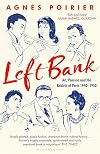
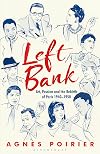
The caricature sketches on the cover give an idea of the variety of persons included: everyone (starting 1pm and going clockwise) from Simone de Beauvoir, Jean Cocteau, Janet Flanner, Miles Davis (who only appears for 2 pages, but still dramatic ones), Juliette Gréco, Albert Camus, Arthur show more Koestler, Saul Bellow, James Baldwin and Jean-Paul Sartre. Not pictured, but also making prominent appearances are Nelson Algren, Dominique Aury, Samuel Beckett, Art Buchwald, Edith Thomas, Theodore H. White, Richard Wright and many more.
One of the best inspirations from this book is the impetus to read many of the fiction, non-fiction, and/or theatrical classics which are written about, which include everything from Algren's "The Man With the Golden Arm", de Beauvoir's "The Second Sex", Beckett's "Waiting for Godot" (not published until 1953, but written in 1949), Bellow's "The Adventures of Augie March", Camus' "The Stranger" (surprisingly passed by the German censors for publication in 1942), Koestler's "Darkness at Noon", and many others.
Highly recommended for fans of Paris and the literature and art inspired by it!
Music Links
The Best of Juliette Greco (which includes "La rue des blancs-manteaux" (The Street of White Coats) with lyrics by Sartre & "Si tu t'imagines" (If You Imagine) with lyrics by Raymond Queneau, both as referenced in "Left Bank") https://www.youtube.com/watch?v=wjHlZkusVFc
The popularity of the "Jazz Hot" and "Bebop" jazz music styles is often referenced in the book and several of the prominent concerts mentioned are available on recordings and (perhaps temporarily) on YouTube including:
Louis Armstrong and his Hot Five Live in Paris at Salle Pleyel 1948 https://www.youtube.com/watch?v=wsp0t8xVQoU&list=PLG-N0xfojjNqLc3uEhya30PLNK...
Dizzy Gillespie Live in Paris at Salle Pleyel February 28, 1948 https://www.youtube.com/watch?v=5CKSVsK0oyI
Miles Davis & Tadd Dameron Quintet Live at Salle Pleyel, Paris International Jazz Festival May 8, 1949 https://www.youtube.com/watch?v=DL_Sqwkbys8
Further Book Link
The recent "At the Existentialist Café: Freedom, Being, and Apricot Cocktails" by Sarah Bakewell is a superb companion book to this current volume as it covers Sartre and de Beauvoir in even further detail.
#ThereIsAlwaysOne
pg. 231 "In January 1948, Elio Vittorini... a well known Fascist (sic) intellectual, ..." This is a copy editing error in the description of anti-Fascist writer Elio Vittorini, writer of "Conversations in Sicily" (1941) who was jailed for his writings by Italian authorities during World War II. show less
There is such a gust of positive energy in this terrific overview of the artists and writers who either lived in or visited Paris during the years 1939 to 1949. Agnès Poirier makes it all come alive with a thoroughly researched history of these figures of whom many created or received the inspiration for their greatest works during this decade that was spent half in the depths of World War II and half in its post-war recovery.
The caricature sketches on the cover give an idea of the variety of persons included: everyone (starting 1pm and going clockwise) from Simone de Beauvoir, Jean Cocteau, Janet Flanner, Miles Davis (who only appears for 2 pages, but still dramatic ones), Juliette Gréco, Albert Camus, Arthur show more Koestler, Saul Bellow, James Baldwin and Jean-Paul Sartre. Not pictured, but also making prominent appearances are Nelson Algren, Dominique Aury, Samuel Beckett, Art Buchwald, Edith Thomas, Theodore H. White, Richard Wright and many more.
One of the best inspirations from this book is the impetus to read many of the fiction, non-fiction, and/or theatrical classics which are written about, which include everything from Algren's "The Man With the Golden Arm", de Beauvoir's "The Second Sex", Beckett's "Waiting for Godot" (not published until 1953, but written in 1949), Bellow's "The Adventures of Augie March", Camus' "The Stranger" (surprisingly passed by the German censors for publication in 1942), Koestler's "Darkness at Noon", and many others.
Highly recommended for fans of Paris and the literature and art inspired by it!
Music Links
The Best of Juliette Greco (which includes "La rue des blancs-manteaux" (The Street of White Coats) with lyrics by Sartre & "Si tu t'imagines" (If You Imagine) with lyrics by Raymond Queneau, both as referenced in "Left Bank") https://www.youtube.com/watch?v=wjHlZkusVFc
The popularity of the "Jazz Hot" and "Bebop" jazz music styles is often referenced in the book and several of the prominent concerts mentioned are available on recordings and (perhaps temporarily) on YouTube including:
Louis Armstrong and his Hot Five Live in Paris at Salle Pleyel 1948 https://www.youtube.com/watch?v=wsp0t8xVQoU&list=PLG-N0xfojjNqLc3uEhya30PLNK...
Dizzy Gillespie Live in Paris at Salle Pleyel February 28, 1948 https://www.youtube.com/watch?v=5CKSVsK0oyI
Miles Davis & Tadd Dameron Quintet Live at Salle Pleyel, Paris International Jazz Festival May 8, 1949 https://www.youtube.com/watch?v=DL_Sqwkbys8
Further Book Link
The recent "At the Existentialist Café: Freedom, Being, and Apricot Cocktails" by Sarah Bakewell is a superb companion book to this current volume as it covers Sartre and de Beauvoir in even further detail.
#ThereIsAlwaysOne
pg. 231 "In January 1948, Elio Vittorini... a well known Fascist (sic) intellectual, ..." This is a copy editing error in the description of anti-Fascist writer Elio Vittorini, writer of "Conversations in Sicily" (1941) who was jailed for his writings by Italian authorities during World War II. show less
Enjoyable, well-researched cultural history of Paris from 1940-1950. The book is smoothly written -- easy to digest and written with a good eye for the telling moments and details of its dozens of characters. The book tells of the doings of a truly rich group of thinkers and artists gathered in Paris -- though it is more a description of how did what when, with whom, than it is any kind of analysis of what the work meant. This is not criticism, it is light cultural history focused on personalities.
De Bouvier and Sartre are at the center of the book, but it ranges widely. Poirier makes a shrewd choice in beginning in 1940, and thus including the occupation in her story. Most histories of this sort I have read either tell the story of the show more occupation, or of the years that followed. Poirier is convincing that the story of the years that follow depends on the experience of the years before.
The book provides a real sense of what it was to live in Paris in the post-war years if you were of a certain artistic bent with certain ambitions. It won't tell you in any depth what existentialism is, for example, but it will tell you the way of life and the milieu of those thinking about existentialism. show less
De Bouvier and Sartre are at the center of the book, but it ranges widely. Poirier makes a shrewd choice in beginning in 1940, and thus including the occupation in her story. Most histories of this sort I have read either tell the story of the show more occupation, or of the years that followed. Poirier is convincing that the story of the years that follow depends on the experience of the years before.
The book provides a real sense of what it was to live in Paris in the post-war years if you were of a certain artistic bent with certain ambitions. It won't tell you in any depth what existentialism is, for example, but it will tell you the way of life and the milieu of those thinking about existentialism. show less
This review was written for LibraryThing Early Reviewers.(book #63 from 2022):
Left Bank : Art, Passion, and the Rebirth of Paris, 1940-1950 by Agnès Poirier
reader: Christa Lewis
published: 2018
format: 13:49 audible audiobook (352 pages in hardcover)
acquired: December 11, 2022 listened: Dec 11-30, 2022
rating: 2½
genre/style: cultural history theme: Richard Wright
locations: Paris
about the author: French journalist working in London, born 1975
My Litsy post:
Poirier‘s fact-dump on post-war Paris - 1945-1949 - is more like a biography on Simone de Beauvoir and Jean-Paul Sartre, but without getting too close. It‘s so fact dense, that it practically lacks a narrative. Unfortunately it‘s compromised on audio by a terrible effort that make no distinction of tone or subject changes. It becomes show more monotonous facts. They‘re deadening at their worst, but hit strides of fascination. My last audiobook for 2022.
---
Fact-wise there is a lot of interesting stuff here. She begins with an effort to capture the WWII occupied France experience, especially for Sartre (who was imprisoned), Beauvoir, Picasso & Camus, Hungarian-born, Jewish Arthur Koestler, and the Irish Samuel Beckett. Then after the war ends in Europe, as Paris lives in a state of shortages, rationing & rebuilding, and remaking its Republic, and when the WWII resistance Communist heroes were politically prominent, tilting France ever so close towards that direction, then she brings in both the intellectual explosion and international visitors. I can't capture all the names, but they include Canadian-born Chicago author Saul Bellow, Richard Wright, James Baldwin, Nelson Algren, actor Marlon Brando (who I didn't know was gay), Norman Mailer and many more.
The five-year post-war period she covers was unique in France in that the leading intellectuals, like Sartre and Koestler, had political impact, and influenced the direction of the Republic. Their support for Communism helped encourage its spread, and when they later pulled away, it helped defeat it. Sartre eventually created his own party, and its rather pathetic failure is presented here as eclipsing much of how he saw the purpose of his life. A non-violent resister during the war, unlike, say Camus, who was in the action, his philosophical ways had influence, but not as much as he imagined, unless that's just Poirier's spin. I don't really know. Beauvoir, his non-exclusive partner, did not eclipse. She published [The Second Sex] during this period, a book Poirier makes almost the high point of her book. She left me wanting to read it.
So, this has the information to make a good book. But is tries to cover so much, switches topics so fast, that I was really left feeling like I just took in a fact dump, without atmosphere and without any true sense of what all these artists were actually creating. So, ultimately, not recommended for anyone who is looking for atmosphere in their literature.
2022
https://www.librarything.com/topic/347061#8028907 show less
Left Bank : Art, Passion, and the Rebirth of Paris, 1940-1950 by Agnès Poirier
reader: Christa Lewis
published: 2018
format: 13:49 audible audiobook (352 pages in hardcover)
acquired: December 11, 2022 listened: Dec 11-30, 2022
rating: 2½
genre/style: cultural history theme: Richard Wright
locations: Paris
about the author: French journalist working in London, born 1975
My Litsy post:
Poirier‘s fact-dump on post-war Paris - 1945-1949 - is more like a biography on Simone de Beauvoir and Jean-Paul Sartre, but without getting too close. It‘s so fact dense, that it practically lacks a narrative. Unfortunately it‘s compromised on audio by a terrible effort that make no distinction of tone or subject changes. It becomes show more monotonous facts. They‘re deadening at their worst, but hit strides of fascination. My last audiobook for 2022.
---
Fact-wise there is a lot of interesting stuff here. She begins with an effort to capture the WWII occupied France experience, especially for Sartre (who was imprisoned), Beauvoir, Picasso & Camus, Hungarian-born, Jewish Arthur Koestler, and the Irish Samuel Beckett. Then after the war ends in Europe, as Paris lives in a state of shortages, rationing & rebuilding, and remaking its Republic, and when the WWII resistance Communist heroes were politically prominent, tilting France ever so close towards that direction, then she brings in both the intellectual explosion and international visitors. I can't capture all the names, but they include Canadian-born Chicago author Saul Bellow, Richard Wright, James Baldwin, Nelson Algren, actor Marlon Brando (who I didn't know was gay), Norman Mailer and many more.
The five-year post-war period she covers was unique in France in that the leading intellectuals, like Sartre and Koestler, had political impact, and influenced the direction of the Republic. Their support for Communism helped encourage its spread, and when they later pulled away, it helped defeat it. Sartre eventually created his own party, and its rather pathetic failure is presented here as eclipsing much of how he saw the purpose of his life. A non-violent resister during the war, unlike, say Camus, who was in the action, his philosophical ways had influence, but not as much as he imagined, unless that's just Poirier's spin. I don't really know. Beauvoir, his non-exclusive partner, did not eclipse. She published [The Second Sex] during this period, a book Poirier makes almost the high point of her book. She left me wanting to read it.
So, this has the information to make a good book. But is tries to cover so much, switches topics so fast, that I was really left feeling like I just took in a fact dump, without atmosphere and without any true sense of what all these artists were actually creating. So, ultimately, not recommended for anyone who is looking for atmosphere in their literature.
2022
https://www.librarything.com/topic/347061#8028907 show less
Poirier follows the same formula as Mary McAuliffe, that is, going year by year and within each year, discussing all those who were relevant. I don't know if McAuliffe is the first to construct a history this way, but she's the first author I've read who does it. And I must say, she does it much better than Poirier. The method gives you a running history of the place, but a disjointed history of each of the subjects. I found this to be the case in McAuliffe's writing, but I thought it was effective in that it gave you a good idea of how they all fit in together into the history of Paris at the time. When one was doing this, another was doing that, etc. But with Poirier it is far more disjointed, so much so that it gave me the feeling of show more when your car jerks back and forth because the fuel pump or spark plugs aren't working properly, and I didn't find it a pleasure to read. Thus I would say that this book is on a very interesting subject, but it is not very well written. show less
Members
- Recently Added By
Lists

Books Read in 2025
4,128 works; 98 members
Author Information

6+ Works 331 Members
Some Editions
Awards and Honors
Common Knowledge
- Original title
- Left Bank
- Original publication date
- 2018
- People/Characters
- Simone de Beauvoir; Jean-Paul Sartre; Albert Camus
- Important places
- Paris, France
- Important events
- World War II; Fall of Paris (1940-06-14); Liberation of Paris (1944-08)
- Original language
- English
Classifications
- Genres
- History, Nonfiction, Art & Design, Literature Studies and Criticism, Biography & Memoir
- DDC/MDS
- 944.361 — History & geography History of Europe France and Monaco Champagne; Ile de France; Lorraine Île-de-France Paris
- LCC
- DC752 .R52 .P65 — History of Europe, Asia, Africa and Oceania France – Andorra – Monaco History of France Local history and description Paris
- BISAC
Statistics
- Members
- 219
- Popularity
- 149,553
- Reviews
- 10
- Rating
- (3.88)
- Languages
- English, German, Italian, Spanish
- Media
- Paper, Audiobook, Ebook
- ISBNs
- 13
- ASINs
- 6