On This Page
Description
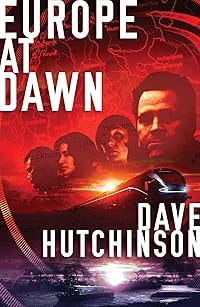
The phenomenal conclusion to the Fractured Europe sequence. Alice works at the Scottish Embassy in Tallinn in Estonia as a member of the Cultural Section. When two men bring her the jewelled skull of a Scottish saint her world gets turned on its head, and she becomes the latest recruit to Les Coureurs des Bois. On a Greek island Benno is just one of hundreds of refuges dreaming of a new life in Continental Europe. After hatching an audacious escape plan, he may just get his dream, but at the show more price of serving some powerful mysterious new masters. Rudi and Rupert, the seasoned Coureur and the scientist in exile from a pocket universe, discover that someone they thought long dead is very much still alive. Not only that, but the now defunct Line - the railway that once bisected the European continent - may be being used for nefarious means. Proudly presenting the final chapter in the Fractured Europe sequence. show lessTags
Recommendations




























Member Reviews
Old friends make reappearances...old problems need solutions again, the only ones at hand are the ones that didn't work before...new faces wear old clothes and frighten us out of our sleep because the monsters under the bed never left.
An island in the Aegean Sea, the Scottish Embassy in Tallinn, a folk duo of no discernible talent but a huge reputation, and a pair of refugee teenagers tear through the pages trailing clouds of story as Author Hutchinson makes his last scheduled stop in hideously Fractured Europe.
So let me start with this. You're not going to make this your first stop on the route of the Coureurs des Bois. It would be a serious error of judgment to jump in any old how. It is necessary to read EUROPE IN AUTUMN first show more because so many things that happen in each book suddenly make sense in light of remembering events from the ones before; and starting from the first story helps make the experience of reading the fourth richly textured and satisfying.
The multiverse that Author Hutchinson posits, with its pocket universes and its bizarre cartographic secrets and its stunningly amoral and conscienceless elite, doesn't suddenly make sense in this book's denouement. It doesn't really ever make sense. It all—all the books, all the maps you hear about, all the baggy, wrinkled bits of story-cloth left on bushes here and there drying at their own pace—makes perfect sense as soon as you realize that. I'm not trying to be sibylline or obfuscatory. I'm giving you the effect of reading Author Hutchinson's deeply sculpted, complex story. What vistas open to you are important, but not decisive and defining. They're fractal artifacts of a universe possessed of no higher law than randomness. Remembering the things in your subjective past isn't always helpful, though it's always a good idea to rattle the dice in the brain-cup and see if boxcars or snakeyes come up. Either roll can be the winner because, like the real universe, shit just happens, what the hell. (Yes yes, it's a Terry Pratchett line, but believe me when I tell you that Author Hutchinson has a similarly depraved sense of humor to Sir Terry's.)
What you need to know about this book in particular is that Rudi coming back into focus, Rudi from the Krakow restaurant who really never wanted too much of what happened on his watch to happen...Rudi snaps the pieces of this shattered place's soul into focus as only he could. He still wants to feed people and be a cog in a machine that lacks malevolence for its constituent parts. And he is the reader in that sense, he is the character who does what he must but wants some of his work to matter in a simple way without Overtones.
He wants to live a boring life in boring times. The opposite of the "ancient Chinese curse" we've grown up hearing about. Europe's fracture due to the hideous plague of dubious origins is irreparable. The world cannot be put back together again. I think the Western Romans, especially the Britannians, of 500CE must have felt this way. It look the same. The sky's the same. The birds didn't change. But nothing will ever work again so what shall we do now?
Then there are those alternate places that aren't a thing like Fractured Europe...do they fit together better, are they functional societies, and what are we all going to use as glue to hold all the truly jagged pieces in place? There are no answers. There are no better-framed questions. There are a lot of smug bastards pretending they're on top of stuff. They're not. And you know what? Since no one is, since there's no top to be on, the world will sail on. Over the falls. Off the edge. Into safe harbor. Simultaneously.
This, my friends, is why I read Author Dave Hutchinson's books. Do not kid yourself. He sees reality, he tells you what's happening in eleventeen voices, he weaves disparate strands of story together and snips others without warning. This is what life actually is without the comforting lie of linear time to soothe our monkeybrains with story. Author Hutchinson tells us the story but unwraps it so we can get down in the gearbox that only quantum mechanics know how to grok.
I want you to read these novels. Don't start here. This is your reward for making a turbulent and beautiful journey. This is the final cataract on the river. You're prepared for it. And it's a great sense of understanding and accomplishment as you finish this book. For this is what it means to be awake and alive and fully present in a unique place. Control? None. Power? Illusion. A good dinner, some wine, and companions to enjoy. Do what it takes to keep that safe for the greatest number of people.
Happen I agree. show less
An island in the Aegean Sea, the Scottish Embassy in Tallinn, a folk duo of no discernible talent but a huge reputation, and a pair of refugee teenagers tear through the pages trailing clouds of story as Author Hutchinson makes his last scheduled stop in hideously Fractured Europe.
So let me start with this. You're not going to make this your first stop on the route of the Coureurs des Bois. It would be a serious error of judgment to jump in any old how. It is necessary to read EUROPE IN AUTUMN first show more because so many things that happen in each book suddenly make sense in light of remembering events from the ones before; and starting from the first story helps make the experience of reading the fourth richly textured and satisfying.
The multiverse that Author Hutchinson posits, with its pocket universes and its bizarre cartographic secrets and its stunningly amoral and conscienceless elite, doesn't suddenly make sense in this book's denouement. It doesn't really ever make sense. It all—all the books, all the maps you hear about, all the baggy, wrinkled bits of story-cloth left on bushes here and there drying at their own pace—makes perfect sense as soon as you realize that. I'm not trying to be sibylline or obfuscatory. I'm giving you the effect of reading Author Hutchinson's deeply sculpted, complex story. What vistas open to you are important, but not decisive and defining. They're fractal artifacts of a universe possessed of no higher law than randomness. Remembering the things in your subjective past isn't always helpful, though it's always a good idea to rattle the dice in the brain-cup and see if boxcars or snakeyes come up. Either roll can be the winner because, like the real universe, shit just happens, what the hell. (Yes yes, it's a Terry Pratchett line, but believe me when I tell you that Author Hutchinson has a similarly depraved sense of humor to Sir Terry's.)
What you need to know about this book in particular is that Rudi coming back into focus, Rudi from the Krakow restaurant who really never wanted too much of what happened on his watch to happen...Rudi snaps the pieces of this shattered place's soul into focus as only he could. He still wants to feed people and be a cog in a machine that lacks malevolence for its constituent parts. And he is the reader in that sense, he is the character who does what he must but wants some of his work to matter in a simple way without Overtones.
He wants to live a boring life in boring times. The opposite of the "ancient Chinese curse" we've grown up hearing about. Europe's fracture due to the hideous plague of dubious origins is irreparable. The world cannot be put back together again. I think the Western Romans, especially the Britannians, of 500CE must have felt this way. It look the same. The sky's the same. The birds didn't change. But nothing will ever work again so what shall we do now?
Then there are those alternate places that aren't a thing like Fractured Europe...do they fit together better, are they functional societies, and what are we all going to use as glue to hold all the truly jagged pieces in place? There are no answers. There are no better-framed questions. There are a lot of smug bastards pretending they're on top of stuff. They're not. And you know what? Since no one is, since there's no top to be on, the world will sail on. Over the falls. Off the edge. Into safe harbor. Simultaneously.
This, my friends, is why I read Author Dave Hutchinson's books. Do not kid yourself. He sees reality, he tells you what's happening in eleventeen voices, he weaves disparate strands of story together and snips others without warning. This is what life actually is without the comforting lie of linear time to soothe our monkeybrains with story. Author Hutchinson tells us the story but unwraps it so we can get down in the gearbox that only quantum mechanics know how to grok.
I want you to read these novels. Don't start here. This is your reward for making a turbulent and beautiful journey. This is the final cataract on the river. You're prepared for it. And it's a great sense of understanding and accomplishment as you finish this book. For this is what it means to be awake and alive and fully present in a unique place. Control? None. Power? Illusion. A good dinner, some wine, and companions to enjoy. Do what it takes to keep that safe for the greatest number of people.
Happen I agree. show less
So the trilogy becomes a quartet, and it’s an odd book that rounds off the three-book story. It’s sort of an extension, but it’s also a recapitulation of the previous three books. It tells their story – or rather, the story actually begun in the second novel, Europe at Midnight – but from perspectives, and featuring some characters, that weren’t in the preceding novels, but in a way that sort of weaves its narrative in and around their narratives. Rudi, who is perhaps the chief protagonist of the series, is definitely front and centre in Europe at Dawn, although he takes a while to appear, something that’s seems to be a stylistic tic of the quartet. Initially, Europe at Dawn is about a flunky in the Scottish Embassy in show more Tallinn, who finds herself on the run thanks to events of which she understands nothing. And it all sort of goes round in circles, although perhaps more like a Slinky than just a plain circle, and it takes a while before the novel’s direction truly becomes apparent. Essentially, there is someone else out there, not just the fractured EU and the Community, or indeed the Line, which may not be as simple as presented in earlier novels. There’s always been something of the spy novel to this series, the way the stories are constructed: firmly bedded on a science-fictional conceit, but the various misdirections of the plot are not from the genre kicked into life in 1926 by Amazing Stories. It makes of the central conceit something more than is usual, something more than just near-future science fiction. These books are masterful at narrative sleight of hand, and Europe at Dawn does this more than the others – it’s not until the final chapter that the purpose of the various narratives is revealed. That Hutchinson manages to do this by keeping the individual narrative tense but not the underlying story-arc is perhaps what’s most impressive. The end comes into shape, and it’s neither expected nor completely out of left field. These are excellent books. I suspect Europe at Dawn may not be the actual end, but you won’t hear me complaining if it isn’t… show less
Having fnished Europe In Winter I dived in to Europe At Dawn without pause. Rudi has stopped being exasperated, now he's angry. Angry Rudi doesn't get even want revenge. Angry Rudi is trying to Sort It Out. But first, a Scottish diplomatic aide has her life derailed by a folk group and a martyr's head, and a young refugee on a crowded Mediterrannean island fishes something out of the sea that will change his life. Long boats set sail down the canals of England, Heathrow airport gets stranded in another dimension, almost sparking a war and causing numerous logistical headaches, and two guards on a deserted railway line see wolves in the trees, even though a disease wiped out all the wolves years ago. The final volume of the series show more delivers on expectations. Quotidian lives slipping into strangeness and falling apart. Unconnected events and stories sit enigmatially side by side until the end draws them all together to make a sort of sense of them all. And Rudi just tries to do his best to make sure it doesn't all go horribly wrong. Wronger. An excellent ending to an excellent series. show less
This fourth book in the Fractured Europe Sequence defintely needs the prior three to follow it with any kind of authority, but I can honestly say that if you're a fan of modern spycraft, SFnal post-bioweapon-devastation, high-tech, and old-world stories, then these books are right up your alley.
Yes, Rudi is back and it's a treat, his world-weariness, food smarts, and ex-courier status showing up one last time, but this book is not all about him.
It's about the milieu, modern Europe, and the deeply wearying sensation that no one is in control of anything. Despite all the spycraft and the plots or the elites or the runners, there is no real sense of order. Indeed, there never could be.
That doesn't stop all kinds of people from trying, show more however.
This book feels like a series of many short stories with all kinds of different characters. Some of them return from previous books. There's wry and dry humor, a shocking amount of odd grifts, and a few riots to contend with.
But more than anything, the biggest joy we'll glean from these is within the world. Observations are everything.
Quite enjoyable. show less
Yes, Rudi is back and it's a treat, his world-weariness, food smarts, and ex-courier status showing up one last time, but this book is not all about him.
It's about the milieu, modern Europe, and the deeply wearying sensation that no one is in control of anything. Despite all the spycraft and the plots or the elites or the runners, there is no real sense of order. Indeed, there never could be.
That doesn't stop all kinds of people from trying, show more however.
This book feels like a series of many short stories with all kinds of different characters. Some of them return from previous books. There's wry and dry humor, a shocking amount of odd grifts, and a few riots to contend with.
But more than anything, the biggest joy we'll glean from these is within the world. Observations are everything.
Quite enjoyable. show less
This fourth volume of the fractured Europe series wraps up a number of the story lines from earlier volumes and brings the series to a satisfying conclusion - I assume although it is less a resolution than a recalibration. Hutchinson's combination of near-future alternate universe (acting as it does as a mirror held up to our current and recent society) and Le Carre type spy thriller works well for him, combined as it is with well-paced plotting and interesting characterisation. January 2021.
https://nwhyte.livejournal.com/3183836.html
Hugely enjoyable and ties up the threads of the previous three books in the Fractured Europe series. Doesn't really stand on its own to the extent that its predecessors did, but I found it very a satisfying conclusion.
Hugely enjoyable and ties up the threads of the previous three books in the Fractured Europe series. Doesn't really stand on its own to the extent that its predecessors did, but I found it very a satisfying conclusion.
Members
- Recently Added By
Lists

2019 Hugo Eligible Novels
40 works; 12 members

2018 New SF Releases
24 works; 1 member

Books Read in 2019
4,052 works; 110 members
Author Information
46+ Works 1,540 Members
Dave Hutchinson was born in Sheffield in 1960. After reading American Studies at the University of Nottingham, he became a journalist. He's the author of five collections of short stories and one novel, and his novella "The Push" was shortlisted for the 2010 BSFA award for short fiction. He has also edited two anthologies and co-edited a third. show more His short story 'The Incredible Exploding Man' was featured in the first 'Solaris Rising' anthology, and appeared in the 29th Year's Best Science Fiction collection. In 2015 his title Europe in Autumn made the shortlist for the Arthur C Clarke Award for science-fiction. (Bowker Author Biography) show less
Some Editions
Awards and Honors
Series

Common Knowledge
- Original publication date
- 2018
- People/Characters
- Alice
- Important places
- Tallinn, Estonia; Dortmund, North Rhine-Westphalia, Germany; Amsterdam, The Netherlands
- First words
- Every couple of years, Pete and Angie did the whole of the Staffordshire and Worcestershire, from the Great Haywood junction with the Trent and Mersey to the staircase and lock that opened into the Severn.
- Publisher's editor
- Oliver, Jonathan
Classifications
Statistics
- Members
- 130
- Popularity
- 250,138
- Reviews
- 7
- Rating
- (4.15)
- Languages
- English
- Media
- Paper, Audiobook, Ebook
- ISBNs
- 3
- ASINs
- 2