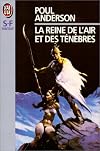
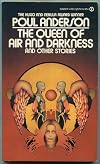
The Queen of Air and Darkness and Other Stories
by Poul Anderson
On This Page
Description
Classics from the golden age of science fiction and beyond. A master storyteller, Anderson wrote tales ranging from the immediate to the distant future, from Earth to far-flung galaxies, from hard science fiction to fantasy - all the elements stirred and blended as only Anderson could! THE QUEEN OF AIR AND DARKNESS is the second volume of The Collected Works of Poul Anderson and collects his best works from a writing career that spans over 50 years.Tags
Recommendations










Member Reviews
This Hugo-winning novella is self-consciously and self-referentially archetypal, making a thoroughly SF story include an alien species waging war through our fears of the Fae. Of course the aliens fight against the humans for the sake of their homeworld. Humans are damn interlopers.
Hopelessly outnumbered and outclassed, the aliens tried to understand our fears and superstitions to play upon them and defeat us.
What can I say? That I think the premise is awesome, and that I really enjoyed the Sherlock riff butting pure logic and observation against the deepest of humanity's fears? That the worldbuilding was pretty damn good for such a short novella? Of course.
But what I really wanted after finishing it was a continuation. I wanted Poul show more Anderson to put that big brain of his to the task of developing the same world and situation beyond a simple resolved kidnapping case and turn it into a fully realized conflict on these archetypal terms, not just a drawing out of this tale, but one that picks up exactly where this leaves off.
I feel a bit cheated, or perhaps I'm a bit spoiled by today's grand SF and Fantasy. Maybe I ought to be thankful that such trailblazers such as Poul Anderson were able to seed our minds with such wonderful beginnings, even if the flame is taken up more firmly in other hands later.
I can still be very impressed.
I love it when Sci-Fi explains Fantasy's deep mythos. I love it even more when its done as well as this. Full props for what it does and when it was done! show less
Hopelessly outnumbered and outclassed, the aliens tried to understand our fears and superstitions to play upon them and defeat us.
What can I say? That I think the premise is awesome, and that I really enjoyed the Sherlock riff butting pure logic and observation against the deepest of humanity's fears? That the worldbuilding was pretty damn good for such a short novella? Of course.
But what I really wanted after finishing it was a continuation. I wanted Poul show more Anderson to put that big brain of his to the task of developing the same world and situation beyond a simple resolved kidnapping case and turn it into a fully realized conflict on these archetypal terms, not just a drawing out of this tale, but one that picks up exactly where this leaves off.
I feel a bit cheated, or perhaps I'm a bit spoiled by today's grand SF and Fantasy. Maybe I ought to be thankful that such trailblazers such as Poul Anderson were able to seed our minds with such wonderful beginnings, even if the flame is taken up more firmly in other hands later.
I can still be very impressed.
I love it when Sci-Fi explains Fantasy's deep mythos. I love it even more when its done as well as this. Full props for what it does and when it was done! show less
https://nwhyte.livejournal.com/3154214.html
This is a planetary romance, where a distraught mother whose son has been kidnapped by the natives hires the human colony's only private eye to retrieve him. It's a rather uncomfortable mingling of several tropes. The PI hero is part Philip Marlowe, part Sherlock Holmes (his name is Eric Sherrinford) and part Science Genius. It's quite difficult to do noir and aliens together, and Anderson doesn't really succeed. Although the child's captors seem to have magical powers, our hero proves that he can Defeat Them With Science (which however I note is itself sufficiently advanced to be indistinguishable from magic). There is a lot of Jungian banter, and very little characterisation. Today's reader show more will wonder how the Earth people feel that they have the right to take ownership of the planet from its original inhabitants; this question is not asked in the story (or rather the answer is presupposed). show less
This is a planetary romance, where a distraught mother whose son has been kidnapped by the natives hires the human colony's only private eye to retrieve him. It's a rather uncomfortable mingling of several tropes. The PI hero is part Philip Marlowe, part Sherlock Holmes (his name is Eric Sherrinford) and part Science Genius. It's quite difficult to do noir and aliens together, and Anderson doesn't really succeed. Although the child's captors seem to have magical powers, our hero proves that he can Defeat Them With Science (which however I note is itself sufficiently advanced to be indistinguishable from magic). There is a lot of Jungian banter, and very little characterisation. Today's reader show more will wonder how the Earth people feel that they have the right to take ownership of the planet from its original inhabitants; this question is not asked in the story (or rather the answer is presupposed). show less
The title story is one of Anderson's most famous, winner of the Hugo, Locus and Nebula Awards. The first time I read it, I was disappointed. The solution seemed absurdly simplistic --the detective flips a switch, the "bad guys" are revealed in their true natures, and that is that. Rereading it, I liked it better. Though the scientific rationalism of the Holmsian detective does triumph over the mythic imagery of the aliens, there is some sympathy for them too. Rereading it jut now after reading The Peregrine, and then reading Time Lag in the same collection as Q of A&D, I realized that Anderson has played out this conflict several times in different ways, and the "good guys" and the winners can vary. My rather low rating for the show more collection headed by Q of A&D is not so much for that story as for the dark tone of several of the others. Several are set in a dystopian future in which an oppressive, vaguely socialist, world government is in power and hostile to space exploration. Sometimes there are hints, or more than hints, that science and freedom will win, but they tend to be grim nonetheless. show less
This slim paperback of 144 pages contains 6 short works. In his introduction Anderson says the stories "are not related in the sense of projecting a single history of the future." They could be though--they read as fairly consistent with each other, projecting space-faring humans and colonies--but within relativistic limits. No faster-than-life-travel here, and more than one story refers to an Earth "Directorate" ordering global affairs. The first, the title story "The Queen of Air and Darkness" is the longest and arguably Anderson's most famous short work, and my favorite in the anthology. It won the Hugo Award for Best Novella in 1972, and the Nebula Award for Best Novelette in 1971. It reworks the old Celtic legends of faery into a show more science fiction story, and quite cleverly. It's protagonist investigator is obviously modeled on Sherlock Holmes. "Home" is a moving short story that asks some interesting questions about forces of history and definitions of home. Another short story, "The Alien Enemy," like several stories here suffers from infodump--too much exposition given too artificially--but it has a neat twist. I thought the novelette "In the Shadow" also suffered from infodump, but did appreciate the hard science premises you find in classic science fiction. I didn't care for the short story, "The Faun" which I thought the weakest work in the collection. I did very much like the novelettte "Time Lag"--every bit as much as the more celebrated opening story. Anderson uses the time lag of relativistic space travel to good effect there. All in all, an enjoyable book that begins and ends strongly even if it sags a bit in the middle. show less
This book is comprised of six short stories by Poul Anderson - the common thread between them being the ability (or lack thereof) for mankind to exist in harmony with other cultures. This is a fairly dense book overall. There's a lot more meat on them bones than the 144 pages might normally indicate.
The first and longest story gives the title to the volume. It is a telling of a kidnapping mystery set on a colonized planet. Out in the boonies, the human pioneers live in fear/awe/dread of the Queen of Air and Darkness and her magical minions. These minions are aliens that have developed an ability to place a glamour on humans making them see what the aliens wish them to see. The question that arises is whether or not the native aliens can show more ever truly coexist in harmony with men once men have figured out their nature and the nature of their only weapon.
The second story, entitle 'Home' is about an Earth colony that is forced to return home. The economic situation back on the home world makes the continuation of the colony infeasible. Couple that with a pliant native culture and a small breeding stock and you've got a no-win situation across the board. The colonists don't want to leave and the natives are more than willing to let them stay. It's tough job, but they apparently sent the right man to do it.
The third story, entitled 'The Alien Enemy', is about an Earth colony settled on a harsh, barren world. Things were tough even before an alien star fleet swooped in a incinerated several towns. Finally their distress signal was answered and the colonists are headed home. But some questions remain and the answers are ones that the colonists don't want to reveal.
The fourth story is a very short, five page story called 'The Faun'. This story asks the question of loyalty. Where do colonists' loyalties lie? With man or with their adopted planet?
The fifth story called 'In the Shadow' describes a scientific expedition whose mission was to explore a strange phenomena that ripped through the solar system wreaking havoc. It took a special kind of genius to understand what the scientists were dealing with. It took quite a different personality to ensure that the most was made of the discovery.
The final story entitled 'Time Lag' describes war with a 30 year round trip time. This one intrigued me the most and shows what can happen when you give an enemy a generation to prepare for your assault. show less
The first and longest story gives the title to the volume. It is a telling of a kidnapping mystery set on a colonized planet. Out in the boonies, the human pioneers live in fear/awe/dread of the Queen of Air and Darkness and her magical minions. These minions are aliens that have developed an ability to place a glamour on humans making them see what the aliens wish them to see. The question that arises is whether or not the native aliens can show more ever truly coexist in harmony with men once men have figured out their nature and the nature of their only weapon.
The second story, entitle 'Home' is about an Earth colony that is forced to return home. The economic situation back on the home world makes the continuation of the colony infeasible. Couple that with a pliant native culture and a small breeding stock and you've got a no-win situation across the board. The colonists don't want to leave and the natives are more than willing to let them stay. It's tough job, but they apparently sent the right man to do it.
The third story, entitled 'The Alien Enemy', is about an Earth colony settled on a harsh, barren world. Things were tough even before an alien star fleet swooped in a incinerated several towns. Finally their distress signal was answered and the colonists are headed home. But some questions remain and the answers are ones that the colonists don't want to reveal.
The fourth story is a very short, five page story called 'The Faun'. This story asks the question of loyalty. Where do colonists' loyalties lie? With man or with their adopted planet?
The fifth story called 'In the Shadow' describes a scientific expedition whose mission was to explore a strange phenomena that ripped through the solar system wreaking havoc. It took a special kind of genius to understand what the scientists were dealing with. It took quite a different personality to ensure that the most was made of the discovery.
The final story entitled 'Time Lag' describes war with a 30 year round trip time. This one intrigued me the most and shows what can happen when you give an enemy a generation to prepare for your assault. show less
Ratings
Members
- Recently Added By
Author Information

693+ Works 53,583 Members
Poul Anderson, November 25, 1926 - July 31, 2001 Poul Anderson was born on November 25, 1926 in Bristol, Pennsylvania to parents Anton and Astrid. After his father's death, Poul's mother took them first to Denmark and then to Maryland and Minnesota. He earned his degree in Physics from the University of Minnesota, but chose instead to write show more stories for science fiction magazines, such as "Astounding." Anderson is considered a "hard science fiction" writer, meaning that his books have a basis in scientific fact. To attain this high level of scientific realism, Anderson spent many hours researching his topics with scientists and professors. He liked to write about individual liberty and free will, which was a well known theme in many of his books. He also liked to incorporate his love of Norse mythology into his stories, sometimes causing his modern day characters to find themselves in fantastical worlds, such as in "Three Hearts and Three Lions," published in 1961. Anderson has written over a hundred books, his last novel, "Genesis" won the John W. Campbell Award, one of the three major science fiction awards. He is a former president of the Science Fiction and Fantasy Writers of America and won three Nebula awards and nine Hugo Awards. In 1997, Anderson was named a Grandmaster by the Science Fiction and Fantasy Writers of America and was also inducted into the Science Fiction Fantasy Hall of Fame. Poul Anderson died on July 31, 2001 at the age of 74. (Bowker Author Biography) show less
All Editions
Some Editions
Series
Belongs to Publisher Series
Work Relationships
Is contained in
Common Knowledge
- Canonical title
- The Queen of Air and Darkness and Other Stories
- Original title
- The Queen of Air and Darkness and Other Stories
- Original publication date
- 1973
- Disambiguation notice
- Two collections of Poul Anderson's short fiction have been published under the title The Queen of Air and Darkness, one in 1973, the other by NESFA Press in 2009. They have very different contents and should not be c... (show all)ombined. This work is not the NESFA Press collection.
Classifications
Statistics
- Members
- 300
- Popularity
- 107,441
- Reviews
- 5
- Rating
- (3.39)
- Languages
- 6 — Czech, English, French, German, Polish, Russian
- Media
- Paper, Audiobook
- ISBNs
- 11
- ASINs
- 5