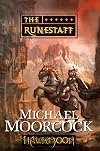
The Runestaff
by Michael Moorcock
Hawkmoon (4), The History of the Runestaff (4), The Eternal Champion (Hawkmoon novel 4)
On This Page
Description
In Michael Moorcock's vast and imaginative multiverse, Law and Chaos wage war in a never-ending struggle over the fundamental rules of existence. Here, in this universe, Dorian Hawkmoon traverses a world of antique cities, scientific sorcery, and crystalline machines as he pulled unwillingly into a war that pits him against the ruthless and dominating armies of Granbretan.Tags
Recommendations
















Member Reviews
The fourth and final volume of The History of the Runestaff. This is mostly a parallel narrative, chronicling the further adventures of Dorian Hawkmoon (the hero) in America in one thread and showing how Baron Meliadus (the villain) makes a bid for power in the centre of the Granbretan Empire, until both threads converge in an epic battle where the final confrontation takes place. There is little doubt of course that the hero will prevail in the end, but even so, the ending is not entirely happy – the final image of the novel is that of a woman weeping…
The Runestaff pretty much continues in the same vein as the previous three instalments of the series, and everything I said about those applies to this novel as well. One thing that show more is not so much fundamentally different but more in the foreground than in previous volumes is Moorcock satirizing British society of the 1960s, like in this passage where he lists
“… the terrifying ancient gods of Granbretan – Jhone, Jhorg, Phowl, Rhunga, who were said to have ruled the land before the Tragic Millennium – Chirshil, the Howling God; Bjrin Adass, the Singing God; Jeajee Blad, the Groaning God; Jh’Im Slas, the Weeping God and Aral Vilsn, the Roaring God, Supreme God, father of Skvese and Blansacredid the Gods of Doom and Chaos.”
I admit that I didn’t get most of the references here on my own (only Churchill and Harold Wilson, to my embarrassment) but he is poking fun at various politicians and other public figures of the period the novel was originally written in – Wikipedia has the details, if you’re curious. I would not be at all surprised if there were more, less obvious satiric references to all kinds of British customs – the wearing of masks, for example, and the pathological fright of all Granbretans to take them off and show their faces is almost certainly a comment on the famous “stiff upper lip.”
Moorcock deftly mixes satire, grotesque and tragedy here, and all by using a pulp adventure plot as his vessel. Like the other novels in The History of the Runestaff tetralogy, this concluding volume never aims to be anything but fun and entertainment, but like the rest of the series succeeds in that without insulting the reader’s intelligence, because it never relies simply on repeating familiar clichés but uses them to do all kinds of interesting things and thus ensuring that the novels are still fun even if read with a somewhat more sophisticated attitudes decades after one first devoured them as a teenager. show less
The Runestaff pretty much continues in the same vein as the previous three instalments of the series, and everything I said about those applies to this novel as well. One thing that show more is not so much fundamentally different but more in the foreground than in previous volumes is Moorcock satirizing British society of the 1960s, like in this passage where he lists
“… the terrifying ancient gods of Granbretan – Jhone, Jhorg, Phowl, Rhunga, who were said to have ruled the land before the Tragic Millennium – Chirshil, the Howling God; Bjrin Adass, the Singing God; Jeajee Blad, the Groaning God; Jh’Im Slas, the Weeping God and Aral Vilsn, the Roaring God, Supreme God, father of Skvese and Blansacredid the Gods of Doom and Chaos.”
I admit that I didn’t get most of the references here on my own (only Churchill and Harold Wilson, to my embarrassment) but he is poking fun at various politicians and other public figures of the period the novel was originally written in – Wikipedia has the details, if you’re curious. I would not be at all surprised if there were more, less obvious satiric references to all kinds of British customs – the wearing of masks, for example, and the pathological fright of all Granbretans to take them off and show their faces is almost certainly a comment on the famous “stiff upper lip.”
Moorcock deftly mixes satire, grotesque and tragedy here, and all by using a pulp adventure plot as his vessel. Like the other novels in The History of the Runestaff tetralogy, this concluding volume never aims to be anything but fun and entertainment, but like the rest of the series succeeds in that without insulting the reader’s intelligence, because it never relies simply on repeating familiar clichés but uses them to do all kinds of interesting things and thus ensuring that the novels are still fun even if read with a somewhat more sophisticated attitudes decades after one first devoured them as a teenager. show less
Hawkmoon and D'Averc protect the Runestaff from the forces of the Dark Empire of Granbretan and return to the dimension-shifted sanctuary of Castle Brass. Unfortunately, their solace is short-lived, as the scientists of Granbretan figure out a way to send a shattering sound wave through the dimensions to destroy the device that keeps Castle Brass out of the normal world. This return to their original plane of existence forces Hawkmoon, Count Brass and the rest to undertake a desperate attempt to storm the heart of the Dark Empire - with only 500 men.
A solid conclusion to the quartet. I'm definitely looking forward to reading more about Count Brass. I'm also wondering how the different timelines weave together, seeing as how we witness show more the death of the Warrior in Jet and Gold. I still wouldn't put Hawkmoon up as the best of the Eternal Champion's incarnations, but I'm sure there's more to read yet. show less
A solid conclusion to the quartet. I'm definitely looking forward to reading more about Count Brass. I'm also wondering how the different timelines weave together, seeing as how we witness show more the death of the Warrior in Jet and Gold. I still wouldn't put Hawkmoon up as the best of the Eternal Champion's incarnations, but I'm sure there's more to read yet. show less
Moorcock's demented imagination for baroque insanity, rather than his hand with theme or character, makes these Hawkmoon books stand out.
Just as volume 3 wandered away from the general theme of the first book, this one continues that trend. I didn't care for it as much as the first 2.
Ratings
Members
- Recently Added By
Lists

Books Read in 2022
5,168 works; 111 members

Les 100 principaux titres de la science-fiction (1981)
126 works; 3 members
Author Information

659+ Works 65,141 Members
Michael Moorcock, 1939 - Writer Michael Moorcock was born December 18, 1939 in Mitcham, Surrey, England. Moorcock was the editor of the juvenile magazine Tarzan Adventures from 1956-58, an editor and writer for the Sexton Blake Library and for comic strips and children's annuals from 1959-61, an editor and pamphleteer for Liberal Party in 1962, show more and became editor and publisher for the science fiction magazine New Worlds in 1964. He has worked as a singer-guitarist, has worked with the rock bands Hawkwind and Blue Oyster Cult and is a member of the rock band Michael Moorcock and the Deep Fix. Moorcock's writing covers a wide range of science fiction and fantasy genres. "The Chronicles of Castle Brass" was a sword and sorcery novel, and "Breakfast in the Ruins: A Novel of Inhumanity" uses the character Karl Glogauer as a different person in different times. Karl participates in the political violence of the French Revolution, the Paris Commune, and a Nazi concentration camp. Moorcock also wrote books and stories that featured the character Jerry Cornelius, who had no consistent character or appearance. "The Condition of Muzak" completed the initial Jerry Cornelius tetralogy and won Guardian Literary Prize in 1977. "Byzantium Endures" and "The Laughter of Carthage" are two autobiographical novels of the Russian emigre Colonel Pyat and were the closest Moorcock came to conventional literary fiction. "Byzantium Endures" focuses on the first twenty years of Pyat's life and tells of his role in the Russian revolution. Pyat survives the revolution and the subsequent civil war by working first for one side and then another. "The Laughter of Carthage" covers Pyat's life from 1920-1924 telling of his escape from Communist Russia and his travels in Europe and America. It's a sweeping picture of the world during the 1920's because it takes the character from living in Constantinople to Hollywood. Moorcock returned to the New Wave style in "Blood: A Southern Fantasy" (1994) and combined mainstream fiction with fantasy in "The Brothel of Rosenstrasse," which is set in the imaginary city of Mirenburg. MoorCock won the 1967 Nebula Award for Behold the Man and the 1979 World Fantasy Award for his novel, Gloriana. (Bowker Author Biography) show less
Some Editions
Series

Hawkmoon
7 works (4)

The History of the Runestaff
4 works (4)

The Eternal Champion
63 works (Hawkmoon novel 4)
Belongs to Publisher Series
Work Relationships
Common Knowledge
- Canonical title
- The Runestaff
- Original title
- The Runestaff
- Original publication date
- 1969
- People/Characters
- Dorian Hawkmoon; King-Emperor Huon; Baron Meliadus; Flana Mikosevaar (Countess of Kanbery); Huillam D'Averc; Orland Fank (show all 19); Jehemia Cohnahlias; Shenegar Trott; The Warrior in Jet and Gold; Kalan of Vitall; Yisselda; Count Brass; Oladahn; Bowgentle; Elvereza Tozer; Vrasla Beli; Adaz Promp; Mygel Holst; Saka Gerden
- Important places
- Amarekh; Dnark, Amarekh; Londra, Granbretan; Castle Brass, Kamarg; Dark Empire of Granbretan; Deau-Vere, Granbretan (show all 7); Kamarg
- Dedication
- To Jim Cawthorn, who helped create these
- First words
- Tacticians and warriors of ferocious courage and skill; careless of their own lives; corrupt of soul and mad of brain; haters of all that was not in decay; wielders of power without morality-force without justice; the Ba... (show all)rons of Granbretan carried the standard of their King-Emperor Huon across the continent of Europe and made that continent their property; carried the banner to West and East to other continents to which they also laid claim.
- Quotations
- And would you all unite with me in an insane adventure such as those embarked upon by Aral Vilsn and his peers?
- Last words
- (Click to show. Warning: May contain spoilers.)Flana watched them leave and she was weeping.
- Blurbers
- Williams, Tad; Chabon, Michael; Finlayson, Iain; Scott, Michael Maxwell, Sir; Shaw, Bob
- Original language
- English
Classifications
Statistics
- Members
- 787
- Popularity
- 35,424
- Reviews
- 5
- Rating
- (3.77)
- Languages
- 9 — Czech, English, French, German, Italian, Russian, Spanish, Swedish, Turkish
- Media
- Paper, Ebook
- ISBNs
- 24
- ASINs
- 31