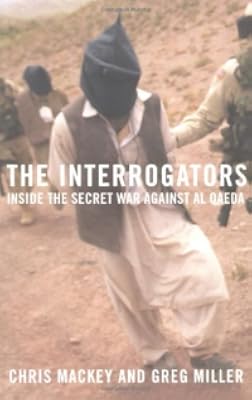
The Interrogators : Task Force 500 and America's Secret War against Al Qaeda
by Chris Mackey
On This Page
Description
Shares the stories of five American interrogators at the front lines of the war against terror, revealing the mental and psychological battles waged between the soldiers and their al Qaeda and Taliban prisoners.Tags
Recommendations


Member Reviews
THE INTERROGATORS: INSIDE THE SECRET WAR AGAINST AL QAEDA (2004), at 500 pages, became something of a slog for me after nearly a week of reading. I think if I had read it when it was new, more than twenty years ago, it would have been less so. Because so much has been written about the war in Afghanistan since then (and I've read a lot of it), Chris Mackey's account of his months-long tour in first Kandahar and then Bagram seems quite dated and less immediate that it would have been in 2004. Because this is a very personal look at his early years as an Army reservist fresh out of high school in Connecticut who went off to the Defense Language Institute (DLI) in sunny California to study German, (and later Russian), and after that to show more Fort Huachuca in Arizona to Interrogator school, while studying finance and business at Fordham in between. It all seemed something of a lark and privileged existence to him. But some years into all this, after 9/11, he was called back to active duty frim his job in London and deployed to Afghanistan as part of the first wave of Military Intelligence types to join the hunt for bin Laden and the war against Al Qaeda. A senior NCO by then, Mackey was technically an administrator, but managed to also do plenty of interrogations himself, working closely with skilled Arabic, Dari and Pashtun linguists. The work was grueling and non-stop much of the time, resulting in periodic burnout for all concerned.
Mackey is a good writer with a wry, self-deprecating sense of humor that often made me chuckle. He also shows himself an honorable man who would not allow any cruelty in his interrogations and expresses his disgust with the atrocities committed by the Abu Grahib prison guards. (Mackey attended Catholic schools and college and even mentions his regular attendance at Mass while in Afghanistan.) There is abundant detail here about the detainees and marathon questioning sessions and methods employed, so much so that it almost became too much. But I was determined to finish the book and I did.
There is no obvious personal input here from Mackey's co-author, Greg Miller, a journalist who, I assume, was instrumental mostly as a researcher and fact checker in a complex subject.
If you want to know about the early days of the Global War on Terror and the MI role in it, here's a pretty good place to start. Adding this book to my war lit collection.
- Tim Bazzett, author of the Cold War memoir, SOLDIER BOY: AT PLAY IN THE ASA show less
Mackey is a good writer with a wry, self-deprecating sense of humor that often made me chuckle. He also shows himself an honorable man who would not allow any cruelty in his interrogations and expresses his disgust with the atrocities committed by the Abu Grahib prison guards. (Mackey attended Catholic schools and college and even mentions his regular attendance at Mass while in Afghanistan.) There is abundant detail here about the detainees and marathon questioning sessions and methods employed, so much so that it almost became too much. But I was determined to finish the book and I did.
There is no obvious personal input here from Mackey's co-author, Greg Miller, a journalist who, I assume, was instrumental mostly as a researcher and fact checker in a complex subject.
If you want to know about the early days of the Global War on Terror and the MI role in it, here's a pretty good place to start. Adding this book to my war lit collection.
- Tim Bazzett, author of the Cold War memoir, SOLDIER BOY: AT PLAY IN THE ASA show less
Reading this almost a decade after the anonymous author described his 3 months questioning the first prisoners captured after the US entered Afghanistan, with a background of what went on at GITMO the entire prison situation begins to fall into place.
There is an excellent paragraph on page 172 that explains why prisoners from so many different countries were captured. It appears that the Talban was not only host to Al Quade, but to other rebels who hoped to overthrow their own governments.
"Vighurs, North Africans, Indonesians, Filipnos. " Before the attacks in September the TGaliban were coming under pressure frtom the West ab out allwing training camps in their own countries. The Taliban at first ignored the demands but eventually show more started to restrict operatgions at camps across the country. Finally in the spring of 2001 the ruling council run by Mullah Omar made the decision to ban all terrorist organizasiont except Al Queda.
On another level this is an excellent career book for any young person planning to pursue military or civil interrogation as a future job. The author explains how his father steered him into this choice of army speciality, and describes his training, first at language schools then in a specialized setting in Arizona.
There is a well organized Appendix on interrogating approaches. show less
There is an excellent paragraph on page 172 that explains why prisoners from so many different countries were captured. It appears that the Talban was not only host to Al Quade, but to other rebels who hoped to overthrow their own governments.
"Vighurs, North Africans, Indonesians, Filipnos. " Before the attacks in September the TGaliban were coming under pressure frtom the West ab out allwing training camps in their own countries. The Taliban at first ignored the demands but eventually show more started to restrict operatgions at camps across the country. Finally in the spring of 2001 the ruling council run by Mullah Omar made the decision to ban all terrorist organizasiont except Al Queda.
On another level this is an excellent career book for any young person planning to pursue military or civil interrogation as a future job. The author explains how his father steered him into this choice of army speciality, and describes his training, first at language schools then in a specialized setting in Arizona.
There is a well organized Appendix on interrogating approaches. show less
An interesting read; more interesting still when I read the story of the teenager detainee from Indonesia. Although I do not know about the accuracy of the events depicted.
Memoir of seven months working in a military prisoner interrogation unit in Kandahar, Afghanistan. Discusses Abu Ghraib. Author went on to supervise all theater-wide military interrogations from Bagram Arfield. Appendix p. 479, His recommended 16 interrogating approaches.
the inside story of six American interrogators, thousands of prisioners, and the race for the truth.
Ratings
Members
- Recently Added By
Author Information
5 Works 227 Members
Common Knowledge
- Canonical title
- The Interrogators : Task Force 500 and America's Secret War against Al Qaeda
- Original publication date
- 2004-07
- Dedication
- To the memory of Sgt. David Travis Friedrich,
who fell fighting for his country in Iraq and never failed to
Put New England First
And to Kerri Miller, for her patience and unwavering support
Classifications
Statistics
- Members
- 205
- Popularity
- 160,208
- Reviews
- 5
- Rating
- (4.07)
- Languages
- Dutch, English
- Media
- Paper, Ebook
- ISBNs
- 10
- ASINs
- 2