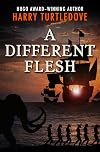
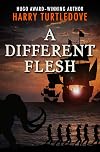
A Different Flesh
by Harry Turtledove
On This Page
Description
This novel by the New York Times-bestselling "master of alternate history" explores an America reshaped by a twist in prehistoric evolution (Publishers Weekly). What if mankind's "missing link," the apelike Homo erectus, had survived to dominate a North American continent where woolly mammoths and saber-toothed tigers still prowled, while the more advanced Homo sapiens built their civilizations elsewhere? Now imagine that the Europeans arriving in the New World had chanced on these primitive show more creatures and seized the opportunity to establish a hierarchy in which the sapiens were masters and the "sims" were their slaves. This is the premise that drives the incomparable Harry Turtledove's A Different Flesh. The acclaimed Hugo Award winner creates an alternate America that spans three hundred years of invented history. From the Jamestown colonists' desperate hunt for a human infant kidnapped by a local sim tribe, to a late-eighteenth-century contest between a newfangled steam-engine train and the popular hairy-elephant-pulled model, to the sim-rights activists' daring 1988 rescue of an unfortunate biped named Matt who's being used for animal experimentation, Turtledove turns our world inside out in a remarkable science fiction masterwork that explores what it truly means to be human. show lessTags
Recommendations





































Member Reviews
I’ve read Harry Turtledove’s alternate history novels for years, and I consider him to be one of the masters of the genre – he’s certainly among the genre’s most prolific authors. Alternate history is defined by Wikipedia as “speculative fiction consisting of stories in which one or more historical events occur differently,” and I think that’s an accurate general description of the genre. The real fun in reading an alternate history comes from the “speculation” part of its definition, in tracking how one or two changes in historical fact can lead to massive changes in reality over the next decades or centuries.
That’s exactly the approach that Turtledove takes in A Different Flesh, a collection of seven loosely show more connected short stories that chronologically span over 300 years of American history. Turtledove’s basic premise is that the ancestors of the American Indian population that the colonists found upon their arrival in the New World never make it across the Behring Strait. Instead, the continent remains so isolated until the 1600s that it is still dominated by saber-toothed tigers, wooly mammoths, and Homo erectus, an upright species said to be the ancestor of several more advanced human species. Poor Homo erectus gets to stand in for the real-life abuse suffered by both the Native American population and most of what happened to the Africans who were imported to the colonies later on.
The first story, “Vilest Beast,” features the Jamestown colonists a few years after Captain John Smith has been killed and eaten by a group of wild “Sims” (the name universally applied to the Homo erectus species). By now, both the colonists and the Sims prefer to stay clear of each other, but after one bloody conflict, at least one of the colonists is starting to wonder just how “human” the Sims might be.
The next two stories, “And So to Bed” and “Around the Salt Lick” follow the evolving relationship between Sims and America’s settlers through the late 1600s, a period during which Sims are captured and sent back to Europe for study. The two species have even by now developed a sign language that allows them to communicate thoughts to each other, and in some cases they develop deeply binding friendships. Overall, however, Sims are still considered animals – and are treated as such.
“Though the Heavens Fall,” the book’s fourth story, is set on an 1804 plantation on which Sims are the slaves doing all the heavy field work and the few black slaves on the plantation are used inside the house. As portrayed in the story, there is a definite class hierarchy on the plantation, and the black slaves are very relieved not to be on the bottom of it. “The Iron Elephant,” set in 1781, is a fun story about the evolution of the steam locomotive and how it eventually would put out of business the wooly mammoth-pulled locomotives of the day.
My personal favorite, though, is “Trapping Run,” a long story set in 1812 about a trapper who has gone farther west than any other explorer of his day. That means that the trapping is excellent, but it also means that when the trapper suffers a devastating injury from a Grizzly, he’s is almost certainly going to die there all alone. And he would have if not for the band of wild Sims who befriend him. This is a touching story, but it illustrates the difficulty of the two species ever truly understanding each other on anything resembling equal terms.
“Freedom,” the last story in the book is set in 1988 (the year that A Different Flesh was published), and it’s the saddest and most disturbing story in the book. By this point Sims are being used in research labs around the world, a practice justified in the minds of researchers by the assumption that the Sims are no more human than any other animal species.
Bottom Line: Turtledove’s A Different Flesh is philosophically deeper than it might appear at first glance. The Sims are stand-ins for every racially dominated group in the history of the United States, and the author seamlessly slips his serious messages into the book’s seven stories. This one is probably underrated in part because of some of the awful covers the book has had over the decades. Don’t let that throw you off; this one is worth reading. show less
That’s exactly the approach that Turtledove takes in A Different Flesh, a collection of seven loosely show more connected short stories that chronologically span over 300 years of American history. Turtledove’s basic premise is that the ancestors of the American Indian population that the colonists found upon their arrival in the New World never make it across the Behring Strait. Instead, the continent remains so isolated until the 1600s that it is still dominated by saber-toothed tigers, wooly mammoths, and Homo erectus, an upright species said to be the ancestor of several more advanced human species. Poor Homo erectus gets to stand in for the real-life abuse suffered by both the Native American population and most of what happened to the Africans who were imported to the colonies later on.
The first story, “Vilest Beast,” features the Jamestown colonists a few years after Captain John Smith has been killed and eaten by a group of wild “Sims” (the name universally applied to the Homo erectus species). By now, both the colonists and the Sims prefer to stay clear of each other, but after one bloody conflict, at least one of the colonists is starting to wonder just how “human” the Sims might be.
The next two stories, “And So to Bed” and “Around the Salt Lick” follow the evolving relationship between Sims and America’s settlers through the late 1600s, a period during which Sims are captured and sent back to Europe for study. The two species have even by now developed a sign language that allows them to communicate thoughts to each other, and in some cases they develop deeply binding friendships. Overall, however, Sims are still considered animals – and are treated as such.
“Though the Heavens Fall,” the book’s fourth story, is set on an 1804 plantation on which Sims are the slaves doing all the heavy field work and the few black slaves on the plantation are used inside the house. As portrayed in the story, there is a definite class hierarchy on the plantation, and the black slaves are very relieved not to be on the bottom of it. “The Iron Elephant,” set in 1781, is a fun story about the evolution of the steam locomotive and how it eventually would put out of business the wooly mammoth-pulled locomotives of the day.
My personal favorite, though, is “Trapping Run,” a long story set in 1812 about a trapper who has gone farther west than any other explorer of his day. That means that the trapping is excellent, but it also means that when the trapper suffers a devastating injury from a Grizzly, he’s is almost certainly going to die there all alone. And he would have if not for the band of wild Sims who befriend him. This is a touching story, but it illustrates the difficulty of the two species ever truly understanding each other on anything resembling equal terms.
“Freedom,” the last story in the book is set in 1988 (the year that A Different Flesh was published), and it’s the saddest and most disturbing story in the book. By this point Sims are being used in research labs around the world, a practice justified in the minds of researchers by the assumption that the Sims are no more human than any other animal species.
Bottom Line: Turtledove’s A Different Flesh is philosophically deeper than it might appear at first glance. The Sims are stand-ins for every racially dominated group in the history of the United States, and the author seamlessly slips his serious messages into the book’s seven stories. This one is probably underrated in part because of some of the awful covers the book has had over the decades. Don’t let that throw you off; this one is worth reading. show less
I like hominids. When I was in college, I took a physical anthropology course to fulfill some of my natural science credit, and really enjoyed it. I even remember most of what I learned, which is a feat in and of itself. So I looked forward to reading A Different Flesh, which puts forth the question -- what if American Indians never settled the Americas, and instead Homo erectus (here called sims) was present when Columbus sailed?
Full review: http://libwen.wordpress.com/2010/06/28/a-different-flesh-by-harry-turtledove/
Full review: http://libwen.wordpress.com/2010/06/28/a-different-flesh-by-harry-turtledove/
Interesting twist that could been
An interesting twist on how it might have been if any of our precursors had not died out but had been still around in the world. Too bad it ended without humanity reaching where DNA would have eventually shown they were
Humanity's beginnings
An interesting twist on how it might have been if any of our precursors had not died out but had been still around in the world. Too bad it ended without humanity reaching where DNA would have eventually shown they were
Humanity's beginnings
Ratings
Members
- Recently Added By
Author Information

279+ Works 43,267 Members
Harry Turtledove was born in Los Angeles, California on June 14, 1949. He received a Ph.D. in Byzantine history from UCLA in 1977. From the late 1970's to the early 1980's, he worked as a technical writer for the Los Angeles County Office of Education. He left in 1991 to become full-time writer. His first two novels, Wereblood and Werenight, were show more published in 1979 under the pseudonym Eric G. Iverson because his editor did not think people would believe that Turtledove was his real name. He used this name until 1985 when he published Herbig-Haro and And So to Bed under his real name. He has received numerous awards including the Homer Award for Short Story for Designated Hitter in 1990, the John Esthen Cook Award for Southern Fiction for Guns of the Southand in 1993, and the Hugo Award for Novella for Down in the Bottomlands in 1994. (Bowker Author Biography) show less
Some Editions
Series
Belongs to Publisher Series
Work Relationships
Contains
Common Knowledge
- Canonical title
- A Different Flesh
- Original title
- A Different Flesh
- Original publication date
- 1989
- First words
- Europeans found the New World a very different land from the one they had left.
- Original language
- English
Classifications
Statistics
- Members
- 226
- Popularity
- 144,323
- Reviews
- 3
- Rating
- (3.69)
- Languages
- English
- Media
- Paper, Ebook
- ISBNs
- 8
- ASINs
- 3