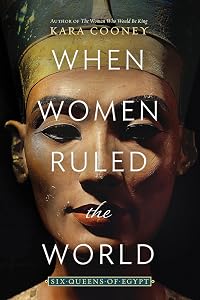
When Women Ruled the World: Six Queens of Egypt
by Kara Cooney
On This Page
Description
This riveting narrative explores the lives of six remarkable female pharaohs, from Hatshepsut to Cleopatra-women who ruled with real power-and shines a piercing light on our own perceptions of women in power today. Female rulers are a rare phenomenon-but thousands of years ago in ancient Egypt, women reigned supreme. Regularly, repeatedly, and with impunity, queens like Hatshepsut, Nefertiti, and Cleopatra controlled the totalitarian state as power-brokers and rulers. But throughout human show more history, women in positions of power were more often used as political pawns in a male-dominated society. What was so special about ancient Egypt that provided women this kind of access to the highest political office? What was it about these women that allowed them to transcend patriarchal obstacles? What did Egypt gain from its liberal reliance on female leadership, and could today's world learn from its example? Celebrated Egyptologist Kara Cooney delivers a fascinating tale of female power, exploring the reasons why it has seldom been allowed through the ages, and why we should care. show lessTags
Recommendations











Member Reviews
Six Queens who would be kings:
The backgrounds of what is known about each period are important and Dr. Cooney frames her narrative with much, as the information on some of these queens is sparser than historians would like. I do appreciate Dr. Cooney using the right language, too, when speculation is the only possible reconstruction: "probably", "may have", "would have".
And I like her grit.
I was curious about some conflicts in the text. Dr. Cooney talks briefly about Cleopatra having Mark Antony have her half-sister Arsinoe killed. But she says "Once the woman was dead - killed in her early thirties..." The information I found was that Arsinoe was 27 when killed. And "Indeed, Jesus of Galilee lived around the same time as Cleopatra and also fought the great Roman Empire in his own way—and he also lost, only to be martyred and later worshipped in his own popular mystery cult." ??? About sixty years later if the biblical stories are to be believed. show less
The women in these pages—Merneith, Neferusobek, Hatshepsut, Nefertiti, Tawosret, and Cleopatra—together form a mighty epic that ends in tragedy: not because they failed (in fact, some were extraordinarily successful, saving their land and their dynasty), but because they are remembered as failures or have been forgotten, expunged from reliefs and statues.Dr. Cooney writes a history that is pieced together from fragments, her work, speculation, for sure, and research of others - her Notes section is extensive, detailed, and she properly cites the end notes in her text (so refreshing to see proper annotation that isn't a surprise after the reading is done: oh look! some notes! oooh, and they have page show more numbers and paragraph fragments...a shame the author didn't see fit to let me know while I was reading that there were additional notes...yeah, she didn't do that; and the tiny superscripts didn't get in the way; anyway...)
The backgrounds of what is known about each period are important and Dr. Cooney frames her narrative with much, as the information on some of these queens is sparser than historians would like. I do appreciate Dr. Cooney using the right language, too, when speculation is the only possible reconstruction: "probably", "may have", "would have".
There must have been other sons of Thutmose I alive when Thutmose II died who could have served on the throne of their dead brother. Many other hereditary monarchies would have followed this course instead. But not the ancient Egyptians.
The Egyptians had already created a complicated set of mythologies to grapple with exactly this kind of succession problem. You will remember that Osiris, king of Egypt, was murdered by his brother Seth before his time. His young son Horus was not mature enough to take control of Egypt on his own. The dead king’s brother Seth made his claim to the throne, while Isis, the boy’s mother, retreated with Horus into the marshes, protecting him from the many assassination attempts launched against him.
And I like her grit.
Why are we so hostile to female rule yesterday and today, so rancorous to female ambition for power? How does that aversion take shape? Because we are not just talking about Cleopatra, Nefertiti, and Tawosret, but also Hillary Clinton, Angela Merkel, Margaret Thatcher, Theresa May, and Elizabeth Warren—all of whom have been discredited as erratic, drama-prone, inconstant, deceitful, opaque, flighty, illogical, even evil, ruled only by hot flashes and full moons.And
I have been teaching a class at UCLA called "Women and Power in the Ancient World" for four years. In 2017, for the first time, I didn’t have to convince my 200 undergraduate students of gender disparity. [...] But the 2016 U.S. presidential election revealed a visceral opposition toward women in power that did all the explaining for me. In 2017, the revelations of sexual harassment and sexual assault against women by scores of powerful men in America brought the imbalance of power between the sexes into even starker relief. It’s gotten personal. And nasty. Misogyny now has a face, but we avoid looking directly at its smudged, dirty visage as much as possible.
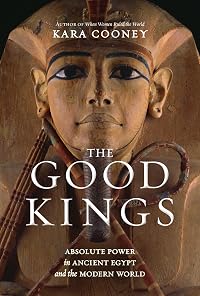
Men don’t suffer as many mood swings as women in a given day—but, then again, which gender commits the most violence and murder in human society? Which gender yields the most suicide bombers? Which gender is the most common serial killer? Which is more active in fomenting and continuing war? The answer is obvious and demands that we turn our perception of female emotionality on its head.Well, Dr. Cooney writes good books and I plan to check out her one on Hatshepsut (plus I pre-ordered "The Good Kings: Absolute Power in Ancient Egypt and the Modern World" coming in November.)
I was curious about some conflicts in the text. Dr. Cooney talks briefly about Cleopatra having Mark Antony have her half-sister Arsinoe killed. But she says "Once the woman was dead - killed in her early thirties..." The information I found was that Arsinoe was 27 when killed. And "Indeed, Jesus of Galilee lived around the same time as Cleopatra and also fought the great Roman Empire in his own way—and he also lost, only to be martyred and later worshipped in his own popular mystery cult." ??? About sixty years later if the biblical stories are to be believed. show less
I do not think I can adequately express my feelings for this book. I find Egypt fascinating and love to learn anything I can about its history. I also love women and stories of empowerment and the fight for that power. This encapsulates both. It was well researched, well written and the author did the narration herself and while it wasn't spectacular it was what I expected for something so academic.
When Women Ruled the World is not a terrible book as the author does make some solid points with regards to female rulership in Egypt, such as pointing out that female rulers are critiqued more often for their appearance than male rulers and that studies have shown that huge gender disparities existed even in ancient positions of power. Where I got stuck was the notion that women rulers were by far more nurturing than men, not as ambitious, nor were they as likely to go to war as men, preferring more peaceful solutions. So much of this is based on "suppositions" and "maybes" as opposed to research, and although I know the actual archives and documents about these queens are scant, speculation such as this, with no evidence, is actually show more detrimental to women. I understand that some leeway is necessary to try to fill in the gaps, but to assume, using stereotypes, that the queens did this or they did that based on gender stereotypes just makes it feel unprofessional and unscientific. I would have liked to have seen a more critical analysis and not just an acceptance of hypotheses as facts, sometimes based on a concept that the author prefers. It's not about preferences (objectivity being a whole other discussion), but about research, research that comes from a variety of professional sources. show less
My biggest complaint is the title of the book. Simply because women hold power occasionally doesn't mean they rule the world. They can't rule the world within a patriarchal society. They may rule for a short time using men's power, and using men's rules, but that doesn't mean they rule. I expected to find signs of matriarchy, or times when women worked to changed the rules, but no, they played within patriarchal rules. Women didn't rule Egypt, but I wish they had. As this book shows, when women rule, even within a patriarchal world, the world is a kinder place.
A fascinating look at the queens of ancient Egypt. The author really goes in depth as to how Egyptian society was set up, exactly how we think each person came to power, and how they managed to maintain their power. The redux treatment of Cleopatra is definitely well appreciated, given how slandered she had become in recent times. Interestingly, each female ruler was slandered or erased in turn by their society: for differing reasons each time, but connected by the taboo of the ruler stepping out of their gendered role (although that role was very different from gendered roles in modern society, we can see the same type of judgement in societal reactions to politicians who are women today).
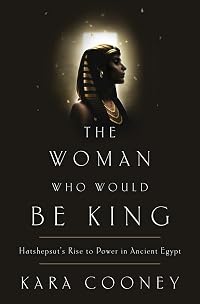
The author's book, The Woman Who Would Be King: show more Hatshepsut's Rise to Power in Ancient Egypt , is actually a great companion to this text, as they cleverly do not intersect as much as one might think. Each has information about Hatshepsut's reign and time period that the other does not go into.
The author is a tiny bit repetitive at times, but all in all, it was very readable for anyone interested in this time period, or interested in rulers who were also women in history. show less
The author's book, The Woman Who Would Be King: show more Hatshepsut's Rise to Power in Ancient Egypt , is actually a great companion to this text, as they cleverly do not intersect as much as one might think. Each has information about Hatshepsut's reign and time period that the other does not go into.
The author is a tiny bit repetitive at times, but all in all, it was very readable for anyone interested in this time period, or interested in rulers who were also women in history. show less
When Women Ruled the World provides an in-depth examination of six female Egyptian rulers who were able to take hold and keep power within Ancient Egypt. The reigns of Merneith, Neferusobek, Hatshepsut, Nefertiti, Tawosret and Cleopatra are investigated combining strong research and intricate story telling. Author Kara Cooney combines facts along with what was known about the political environment, climate and world affairs at the time to weave a plausible life story of each of these amazing women. With very little sources available, the conditions under which the six women were able to take hold and continue their rule are investigated and connected in many ways to our current political scene in the United States and the realities that show more women in politics face today. There were also many other comparisons to current life that made the world of the Ancient Egyptians easy to understand. I was very interested in the ways that these women were able to come to power, often at the end of a Dynasty when there was no other choice and when everything seemed to be falling apart, the women were there to pick the pieces up and put things back together. I am by no means an Egypt specialist, but I have always been intrigued by their way of life. The writing style and information was presented in an entertaining way and was easy to understand. Looking at Egypt through the eyes of these six extraordinary women gave a very different view to an often misunderstood and glamorized time of history as well as much insight into how women behave in roles that are still seen as masculine to this day.
This book was received for free in return for an honest review. show less
This book was received for free in return for an honest review. show less
Honestly, my expectations were not completely met with Kara Cooney’s new book, "When Women Ruled the World: Six Queens of Egypt.”
Overall, I really loved this book, and Cooney continues to fuel my love for Ancient Egypt — and history in general. Kara Cooney in no way disappointed me with this book. It is well written, very detailed and highly informative.
However, I did end up only giving this book a four out of 5 star rating only because of how she structured the book. There were parts of each chapter that could have been taken out of their respective chapters and collated into one chapter at the beginning (I don’t have any specific examples). I also feel that each chapter could have been made into two chapters solely based on show more how much information Cooney crams into each chapter. Also, on a slightly different note, I feel that the chapter on Hatshepsut could have been a little shorter — it was 61 pages in total — due to the fact that she has written an entire book on Hatshepsut.
Despite this, as I mentioned, this book was a well-written book despite not having, in my opinion, the greatest structure. show less
Overall, I really loved this book, and Cooney continues to fuel my love for Ancient Egypt — and history in general. Kara Cooney in no way disappointed me with this book. It is well written, very detailed and highly informative.
However, I did end up only giving this book a four out of 5 star rating only because of how she structured the book. There were parts of each chapter that could have been taken out of their respective chapters and collated into one chapter at the beginning (I don’t have any specific examples). I also feel that each chapter could have been made into two chapters solely based on show more how much information Cooney crams into each chapter. Also, on a slightly different note, I feel that the chapter on Hatshepsut could have been a little shorter — it was 61 pages in total — due to the fact that she has written an entire book on Hatshepsut.
Despite this, as I mentioned, this book was a well-written book despite not having, in my opinion, the greatest structure. show less
Members
- Recently Added By
Lists

Evan's Wish List
86 works; 2 members

Books Read in 2020
4,379 works; 123 members

Books Read in 2023
5,547 works; 145 members

Kindle Non-Fiction
221 works; 1 member
Author Information

8+ Works 1,495 Members
Kara Cooney is a professor of Egyptology at UCLA. Her academic work focuses on death preparations, afterlife beliefs, and gender studies. She lives in Los Angeles, California.
Awards and Honors
Awards
Common Knowledge
- Canonical title
- When Women Ruled the World: Six Queens of Egypt
- Original publication date
- 2018-11-06
- People/Characters
- Hatshepsut; Nefertiti; Cleopatra VII
- Important places
- Egypt
Classifications
- Genres
- History, General Nonfiction, Nonfiction, Sexuality and Gender Studies, Biography & Memoir
- DDC/MDS
- 932.01092 — History & geography History of ancient world (to ca. 499) Egypt to 640 Early history to 332 BC
- LCC
- DT83 .C66 — History of Europe, Asia, Africa and Oceania Africa History of Africa Egypt History
- BISAC
Statistics
- Members
- 550
- Popularity
- 53,916
- Reviews
- 9
- Rating
- (3.67)
- Languages
- English, Spanish
- Media
- Paper, Audiobook, Ebook
- ISBNs
- 11
- ASINs
- 3