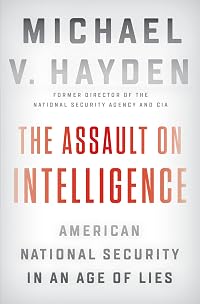
The Assault on Intelligence: American National Security in an Age of Lies
by Michael V. Hayden
On This Page
Description
"In the face of a President who lobs accusations without facts, evidence, or logic, truth tellers are under attack. Meanwhile, the world order is teetering on the brink. North Korea is on the verge of having a nuclear weapon that could reach the United States; Russians have mastered a new form of information warfare that undercuts democracy; and the role of China in the global community remains unclear. There will always be value to experience and expertise, devotion to facts, humility in show more the face of complexity, and a respect for ideas, but in this moment they seem both more important, and more endangered, than they've ever been. American intelligence--the ultimate truth teller--has a responsibility in a post-truth world beyond merely warning of external dangers, and in[this book], General Michael Hayden takes up that urgent work with profound passion, insight, and authority. It is a sobering vision. The American intelligence community is more at risk than is commonly understood, for every good reason. Civil war or societal collapse is not necessarily imminent or inevitable, but our democracy's core structures, processes, and attitudes are under great stress. Many of the premises on which we have based our understanding of governance are now challenged, eroded, or simply gone. And we have a President in office who responds to overwhelming evidence from the intelligence community that the Russians are, by all acceptable standards of cyber conflict, in a state of outright war against us, not by leading a strong response, but by shooting the messenger. There are fundamental changes afoot in the world and in this country. [This book] shows us what they are, reveals how crippled we've become in our capacity to address them, and points toward a series of effective responses. Because when we lose our intelligence, literally and figuratively, democracy dies."--Dust jacket. show lessTags
Recommendations




Member Reviews
Michael V. Hayden is a former Director of the National Security Agency and of the CIA, and he knows whereof he speaks. In The Assault on Intelligence, he expresses his deeply held concerns that the security of the United States is in jeopardy because of the (at best) cavalier or (at worst) treasonous attitude of the current President toward the interference of Russians and other foreigners in American affairs.
Hayden’s book recounts many of the Trump administration misdeeds and wrongdoings committed through the middle of 2018 as seen from the perspective of an intelligence professional. The two overriding themes of his presentation are that Trump seems unconcerned with what his intelligence agencies tell him, and that he is an show more outrageous liar. In fact, Hayden avers, the concept of objective truth seems foreign to Trump.
Thomas Jefferson wrote that an informed citizenry was the heart of a democracy; only when people are knowledgable can they be trusted with their own governance. But being correctly informed is not supported by either Trump or his administration, nor does Trump's solid base of unwavering supporters put much store in facts, research, science, or truth generally.
As those who follow the news are aware, Rudy Giuliani, Trump's attorney, famously averred that "truth isn't truth" when explaining that he wouldn't let special counsel Robert Mueller rush Trump into testifying, because he didn't want investigators to "trap" the President into a lie. [How can you be "trapped" into telling a lie unless you are lying?] Giuliani was right, though, in the sense that the danger of Trump lying to Mueller [or indeed, to anyone] was a credible risk. According to the Washington Post Fact Checker, as of March 31, 2019, Trump made 9,451 false or misleading claims over 801 days in office: "That’s a pace of 22 fishy claims a day over the past 200 days, a steep climb from the average of nearly 5.9 false or misleading claims a day in Trump’s first year in office." This figure is updated regularly.
In Hayden’s words:
“I think it fair to say that the Trump campaign normalized lying to an unprecedented degree, and when pressed on specifics it routinely tried to delegitimize those who would disagree with countercharges about the ‘lyin’ media,’ ‘intelligence’ [in accusatory quotation marks], ‘so-called judges,’ fake news, Washington insiders, and the deep state.”
After Trump labeled the mainstream media “the enemy of the people,” Hayden tweeted:
“If this is who we are or who we are becoming, I have wasted 40 years of my life. Until now it was not possible for me to conceive of an American President capable of such an outrageous assault on truth, a free press, or the First Amendment.”
In Hayden’s view, Trump is not merely untruthful, but his actions in contravention to the opinions of the intelligence agencies right from the outset have been very unwise. Variations of headlines like this one are constant: "Trump Calls Intelligence Officials 'Naive' After They Contradict Him." Just four days into his administration, Trump - apparently without consulting anyone in the intelligence community - had the US withdraw from the Trans-Pacific Partnership — a strategic arrangement masquerading as a trade deal. In Hayden’s opinion, this was “one of the most destructive steps taken by the administration so far.” Yet as far as anyone can tell, Trump’s main objection to the deal was that it was advocated by Obama, which made it anathema to him.
Other intelligence ignored by Trump has had even more devastating repercussions. Russia traditionally has been considered an American adversary, but not by our current president. In July, 2018, twelve Russian military intelligence officials were indicted as part of the Mueller investigation for hacking in connection with the 2016 election. This followed an indictment the previous February of thirteen Russians and three companies for a social media campaign dedicated to tampering with the 2016 electoral process. [This was far more extensive, it should be noted, than Russia buying "a few Facebook ads" as Trump's son-in-law Jared Kushner recently maintained.] The Mueller Report made clear, in concurrence with conclusions of multiple U.S. intelligence agencies, that these efforts were explicitly made to further the likelihood of Trump winning the presidency.
Russian interference with the 2016 election was not only serious, but it exposed a previously unimagined American vulnerability and required a unified American response. Trump, however, simply ignored the intelligence he received and has refused to confront the threat in any meaningful manner. (If the interference was intended to help him, what could be bad?) In fact, in May, 2017, Trump revealed highly classified information to the Russian foreign minister and ambassador in a White House meeting, dismaying intelligence officials by jeopardizing a critical source of intelligence on the Islamic State. And of course, his continued pandering to Russian President Putin raises concerns throughout the world. Trump has not only tried to ease sanctions on Russia, but parroted Putin's talking points on a number of issues. Does Trump consider himself indebted to Putin for helping him win the presidency? Or is there an even more sinister problem? We still don't know.
This is a disturbing book about a critical period of American history. Hayden contends that controversies over how intelligence acquires information have been superseded. Now the most important concern is whether intelligence will even be used anymore “in a world in which even a sophisticated society like our own is trending toward decision making . . . based on that which can be made popular or widely held rather than on that which is objectively true.” (Clearly, the title of the book is a double entendre.)
Hayden notes that both former CIA Director John Brennan and former Director of National Intelligence Jim Clapper warn that “in some respects we are a government in crisis.” He also cites legal scholar Ben Wittes, who runs the Lawfare blog, and who summed up the principal problem succinctly: “The President of the United States is a profoundly bad person.”
Evaluation: One tires of having to wade through the muck of all the unlawful, harmful, or ill-advised deeds perpetrated by the current administration. Yet awareness of the observations in this important book about the basis upon which foreign policy decisions are made is critical for all thinking and concerned Americans.
(JAB) show less
Hayden’s book recounts many of the Trump administration misdeeds and wrongdoings committed through the middle of 2018 as seen from the perspective of an intelligence professional. The two overriding themes of his presentation are that Trump seems unconcerned with what his intelligence agencies tell him, and that he is an show more outrageous liar. In fact, Hayden avers, the concept of objective truth seems foreign to Trump.
Thomas Jefferson wrote that an informed citizenry was the heart of a democracy; only when people are knowledgable can they be trusted with their own governance. But being correctly informed is not supported by either Trump or his administration, nor does Trump's solid base of unwavering supporters put much store in facts, research, science, or truth generally.
As those who follow the news are aware, Rudy Giuliani, Trump's attorney, famously averred that "truth isn't truth" when explaining that he wouldn't let special counsel Robert Mueller rush Trump into testifying, because he didn't want investigators to "trap" the President into a lie. [How can you be "trapped" into telling a lie unless you are lying?] Giuliani was right, though, in the sense that the danger of Trump lying to Mueller [or indeed, to anyone] was a credible risk. According to the Washington Post Fact Checker, as of March 31, 2019, Trump made 9,451 false or misleading claims over 801 days in office: "That’s a pace of 22 fishy claims a day over the past 200 days, a steep climb from the average of nearly 5.9 false or misleading claims a day in Trump’s first year in office." This figure is updated regularly.
In Hayden’s words:
“I think it fair to say that the Trump campaign normalized lying to an unprecedented degree, and when pressed on specifics it routinely tried to delegitimize those who would disagree with countercharges about the ‘lyin’ media,’ ‘intelligence’ [in accusatory quotation marks], ‘so-called judges,’ fake news, Washington insiders, and the deep state.”
After Trump labeled the mainstream media “the enemy of the people,” Hayden tweeted:
“If this is who we are or who we are becoming, I have wasted 40 years of my life. Until now it was not possible for me to conceive of an American President capable of such an outrageous assault on truth, a free press, or the First Amendment.”
In Hayden’s view, Trump is not merely untruthful, but his actions in contravention to the opinions of the intelligence agencies right from the outset have been very unwise. Variations of headlines like this one are constant: "Trump Calls Intelligence Officials 'Naive' After They Contradict Him." Just four days into his administration, Trump - apparently without consulting anyone in the intelligence community - had the US withdraw from the Trans-Pacific Partnership — a strategic arrangement masquerading as a trade deal. In Hayden’s opinion, this was “one of the most destructive steps taken by the administration so far.” Yet as far as anyone can tell, Trump’s main objection to the deal was that it was advocated by Obama, which made it anathema to him.
Other intelligence ignored by Trump has had even more devastating repercussions. Russia traditionally has been considered an American adversary, but not by our current president. In July, 2018, twelve Russian military intelligence officials were indicted as part of the Mueller investigation for hacking in connection with the 2016 election. This followed an indictment the previous February of thirteen Russians and three companies for a social media campaign dedicated to tampering with the 2016 electoral process. [This was far more extensive, it should be noted, than Russia buying "a few Facebook ads" as Trump's son-in-law Jared Kushner recently maintained.] The Mueller Report made clear, in concurrence with conclusions of multiple U.S. intelligence agencies, that these efforts were explicitly made to further the likelihood of Trump winning the presidency.
Russian interference with the 2016 election was not only serious, but it exposed a previously unimagined American vulnerability and required a unified American response. Trump, however, simply ignored the intelligence he received and has refused to confront the threat in any meaningful manner. (If the interference was intended to help him, what could be bad?) In fact, in May, 2017, Trump revealed highly classified information to the Russian foreign minister and ambassador in a White House meeting, dismaying intelligence officials by jeopardizing a critical source of intelligence on the Islamic State. And of course, his continued pandering to Russian President Putin raises concerns throughout the world. Trump has not only tried to ease sanctions on Russia, but parroted Putin's talking points on a number of issues. Does Trump consider himself indebted to Putin for helping him win the presidency? Or is there an even more sinister problem? We still don't know.
This is a disturbing book about a critical period of American history. Hayden contends that controversies over how intelligence acquires information have been superseded. Now the most important concern is whether intelligence will even be used anymore “in a world in which even a sophisticated society like our own is trending toward decision making . . . based on that which can be made popular or widely held rather than on that which is objectively true.” (Clearly, the title of the book is a double entendre.)
Hayden notes that both former CIA Director John Brennan and former Director of National Intelligence Jim Clapper warn that “in some respects we are a government in crisis.” He also cites legal scholar Ben Wittes, who runs the Lawfare blog, and who summed up the principal problem succinctly: “The President of the United States is a profoundly bad person.”
Evaluation: One tires of having to wade through the muck of all the unlawful, harmful, or ill-advised deeds perpetrated by the current administration. Yet awareness of the observations in this important book about the basis upon which foreign policy decisions are made is critical for all thinking and concerned Americans.
(JAB) show less
The role of the intelligence community is to inform the President of potential and actual threats to the United States. There needs to be trust, respect, and honesty between any given president and the intelligence community. The intelligence community and the President's team must function seamlessly during the transition between administrations. The intelligence community in many ways represents the cadre career professionals that remain in place while Presidents and their administrators change every 4 to 8 years. As a group the intelligence community take an international -ist view of the world. After explaining this in detail, Hayden examines how the Bush, Obama, and Trump administrations have worked with the intelligence community. show more Hayden is an equal opportunity critic. Each president is subjected a withering attack on the decisions they made. His arguments changed my opinion of effective the Obama administration foreign policy was.
The majority of the book is dedicated to the deconstruction of the Trump administration. Hayden starts with Trump's candidacy and walks the reader through his current actions as President in detail.
I think the book does a good job of examining the contrasting needs of the intelligence community with the peculiar personalities of the various office holders. In a lot of ways Hayden portrays the intelligence community as the secret heroes of the nation. He demonstrates how they are the whipping boys subject to each President's view , and uses of the truth the community presents to them. Overall this is a scary book. show less
Really good book with a perspective and side of the Trump administration that I didn't even consider. After reading this, I can add our intelligence agencies as one more thing Trump is royally fucking up.
Really good book with a perspective and side of the Trump administration that I didn't even consider. After reading this, I can add our intelligence agencies as one more thing Trump is royally fucking up.
The author Michael V. Hayden brings a great deal of personal experience as a former head of the CIA and NSA to this discussion on the state of our intelligence today. He discusses how two important factors are affecting the gathering and use of intelligence, especially in the age of Trump. The first important concern is the lack of importance given to the "truth" based on facts and not "truth" based on feelings, a wish for things to be a certain way or simply just lying - the preference to the Trump White House and its followers. He discusses how this lack of enthusiasm for fact based truths are affecting our intelligence collection and our standing in the world. He goes on to discuss how Russia interference in our elections, both past show more and in the future, benefits from this lack of belief in facts and resulting distrust of competent intelligence gathering. We will see what happens when Mueller ends his search for the truth but regardless, this is an important look at where we are today as well as how our intelligence organizations work to try to find the truths based on objective facts. Our democracy and freedom depends on this process so we as citizens need to understood and support these entities. show less
"The Assault on Intelligence: American National Security in an Age of Lies," covers the American intelligence community in the first two years of the Trump administration. Written by General (retired) Michael Hayden, former director of the National Security Agency and former director of the CIA, the author's bona fides are above reproach. He has shed light on many aspects of the intelligence community, of American international standing, and of American politics in general from just before Trump took office through the first couple of years of his administration. The book cites numerous specifics -- as specific as non-classified information can be -- lending tremendously to its credibility. Having read several other books that touch on show more some of the same events and activities, they seem to corroborate this book.
I strongly recommend this book to anyone who's interested in American history, politics, or international relations during the period covered by this book. Any reader will find it enlightening. show less
I strongly recommend this book to anyone who's interested in American history, politics, or international relations during the period covered by this book. Any reader will find it enlightening. show less
It's not difficult to take the moral high-ground or criticise Donald Trump - possibly the least courageous thing you can do. Admitting mistakes or writing about all the "unsavoury" (I can't remember the exact word the author used for these "necessary" operations) things CIA does around the world would be brave but the author is not.
Members
- Recently Added By
Author Information

3+ Works 558 Members
Michael Vincent Hayden was born in 1945, in Pittsbugh, Pennsylvania. He received his bachelor's and master's degrees from Duquesne University (McAnulty College and Graduate School of Liberal Arts). He went to have a career in the U.S. Air Force and intelligence. Today he is a retired United States Air Force four-star general and former Director of show more the National Security Agency, Principal Deputy Director of National Intelligence, and Director of the Central Intelligence Agency. Currently he is a Principal at The Chertoff Group and a distinguished visiting professor at the George Mason University Schar School of Policy and Government. He is the author of Playing to the Edge: American Intelligence in the Age of Terror and The Assault on Intelligence: American National Security in an Age of Lies. (Bowker Author Biography) show less
Awards and Honors
Common Knowledge
- People/Characters
- Donald Trump
Classifications
- Genres
- Politics and Government, Nonfiction, General Nonfiction, History
- DDC/MDS
- 327.1273 — Society, government, & culture Political science International Relations: Spies Foreign policy and specific topics in international relations Espionage and subversion North America United States
- LCC
- JK468 .I6 .H388 — Political Science Political institutions and public administration (United States) Political institutions and public administration United States Government. Public administration
- BISAC
Statistics
- Members
- 221
- Popularity
- 145,485
- Reviews
- 8
- Rating
- (4.21)
- Languages
- English
- Media
- Paper, Audiobook, Ebook
- ISBNs
- 7
- ASINs
- 2