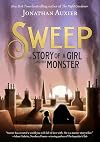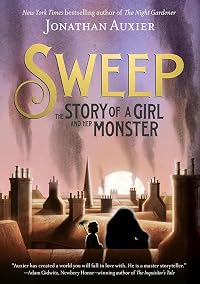
Sweep: The Story of a Girl and Her Monster
by Jonathan Auxier
On This Page
Description
In nineteenth-century England, after her father's disappearance Nan Sparrow, ten, works as a "climbing boy," aiding chimney sweeps, but when her most treasured possessions end up in a fireplace, she unwittingly creates a golem.Tags
Recommendations





Member Reviews
Wonderful story, firing on all cylinders, and moving me to tears (and then following up with an almost-as-moving author's afterward). Yes, it's a bit manipulative (want to make your audience weep? Have their characters get married, or die, or achieve their life's ambition, or fail miserably to achieve their life's ambition) but it only works if you have also made your audience fall in love with your characters, and that's the tricky part, which Auxier manages nicely.
(Note: 5 stars = amazing, wonderful, 4 = very good book, 3 = decent read, 2 = disappointing, 1 = awful, just awful. I'm fairly good at picking for myself so end up with a lot of 4s).
(Note: 5 stars = amazing, wonderful, 4 = very good book, 3 = decent read, 2 = disappointing, 1 = awful, just awful. I'm fairly good at picking for myself so end up with a lot of 4s).
If you have never climbed inside a chimney, perhaps you are wondering what it's like. Imagine holding an open book. Maybe you are holding one right now? Imagine a black tunnel exactly that size - an endless, winding tunnel with no light at the end.
Imagine that the walls of the tunnel are sharp enough to cut your skin bloody. Imagine some of the walls will crush you if you touch them wrong. Imagine some of the walls are on fire.
Now imagine placing a cloth over your head.
Take a deep breath, if you still can.
And crawl inside.
Little Nan Sparrow lived a hard but charmed life with the Sweep. He cared for her, kept her safe, shared their paltry food, and told her stories, including Story Soup, which they had on nights there was nothing to eat, show more but was somehow comforting and nourishing. But one day the Sweep disappeared, leaving Nan with nothing but a little bit of char, mysteriously warm. Nan at 6 years old becomes indentured to a brutal master and is a climber - a child that climbs from a hearth through to the chimney on the roof, cleaning while he goes - a very real and very dangerous job for poor and orphaned children in Victorian times. Nan becomes stuck in a chimney fire and is saved by her little piece of char, which comes to life when it catches fire. Nan and Charlie - her bit of char fashions a body for himself - make a life together. Nan scours storybooks to see if she can find anything like Charlie, and comes across a golem - monsters and protectors formed of clay and designed for obsolescence. The obsolescence part worries Nan - the idea that Charlie exists to fulfill a purpose and will die when he does fills her with fear and dread, and she devotes her life and energies to protecting her protector.
"That's what it is to care for a person," Toby said. There was not even a hint of mocking in his voice. "If you're not afraid, you're not doing it right."
Love and friendship is woven throughout the book, a heartwarming counterpoint to the bleakness of Nan's life on the streets of Victorian London. The book is pretty much perfect - adventure, harrowing danger, historical setting, and love. Like Mr. Auxier's other novels, it celebrates stories and their power, and has references to Dickens, Tolkein, Shelley (Frankenstein), William Blake, The Water Babies, and more. I loved it. show less
The real world offered no miracles.
No “once upon a time. No “happily ever after.
And yet, here in this dusty crawl space, she held a miracle in her hands. A miracle with eyes and a heartbeat and a crumbly gray body.
This is an amazing middle grade book.
It doesn’t shy away from grim realities of victorian London and the many different ways children had to survive. I loved the way Nan’s own history with The Sweep and her friendships with Toby and Charlie mirrored each other.
I also liked how the scope of things became bigger. Saving one child is great, but there will be a dozen others just like them. Children look up to adults the way birds take to Golems, and one day those children will be adults themselves and someone will look up show more to them. show less
No “once upon a time. No “happily ever after.
And yet, here in this dusty crawl space, she held a miracle in her hands. A miracle with eyes and a heartbeat and a crumbly gray body.
This is an amazing middle grade book.
It doesn’t shy away from grim realities of victorian London and the many different ways children had to survive. I loved the way Nan’s own history with The Sweep and her friendships with Toby and Charlie mirrored each other.
I also liked how the scope of things became bigger. Saving one child is great, but there will be a dozen others just like them. Children look up to adults the way birds take to Golems, and one day those children will be adults themselves and someone will look up show more to them. show less
I almost had to stop reading this because it was making me so uncomfortable. To think of a small child climbing inside a narrow chimney, a bag over their head to keep dust out of their eyes, squeezing up through layers of coal soot. I'm shuddering even now.
Good thing I powered through some awfully tough scenes because in the end this is a beautiful book. I'm partial to British historical fiction already, but it wasn't just that. It's a magical story with very real historical detail. And, as the author points out in an afterword, "Poverty, child labor, and anti-Semitism continue to this day, no matter how much we would prefer to ignore them." I loved discovering how much of the book was real. The fantastical parts served to enhance the show more story for sure, but the parts based in reality were my favorite.
Since Mary Poppins Returns is in theaters now, I think that might be how I'd start to book talk this. On the rooftops of London, chim chiree chim chiroo... we may think of a chimney sweep as Bert from Mary Poppins, but did you know it was really little kids who used to clean chimneys? Thank goodness for child labor laws, may they spread to every country on Earth.
Edited to add:
A comment on SLJ's Heavy Medal blog has really made me stop and think about how Jewish culture is handled in this book (the comment is by Sarah H. and can be found here: http://blogs.slj.com/heavymedal/2019/01/23/heavy-medal-finalist-sweep-by-jonatha....
We all have blind spots as readers, and I must admit that I was not paying particular attention to the way the author incorporated Judaism into the story (even in the way I phrased that you can tell I was reading through a Christian lens). Golems come from Jewish culture. I think most readers (if they think about it) will infer the Sweep who made the golem was Jewish. So this raises the question: If Nan was raised by a Jewish parent, why doesn’t she consider herself Jewish? Why didn’t the Sweep share that part of his identity with her? This is hard for me to wrap my mind around. I wonder how an #OwnVoices (in this case Jewish) author might have written it differently. Any time an author "borrows" an aspect of a culture outside their own experience, we should look critically at whether it was done with authenticity and respect. show less
Good thing I powered through some awfully tough scenes because in the end this is a beautiful book. I'm partial to British historical fiction already, but it wasn't just that. It's a magical story with very real historical detail. And, as the author points out in an afterword, "Poverty, child labor, and anti-Semitism continue to this day, no matter how much we would prefer to ignore them." I loved discovering how much of the book was real. The fantastical parts served to enhance the show more story for sure, but the parts based in reality were my favorite.
Since Mary Poppins Returns is in theaters now, I think that might be how I'd start to book talk this. On the rooftops of London, chim chiree chim chiroo... we may think of a chimney sweep as Bert from Mary Poppins, but did you know it was really little kids who used to clean chimneys? Thank goodness for child labor laws, may they spread to every country on Earth.
Edited to add:
A comment on SLJ's Heavy Medal blog has really made me stop and think about how Jewish culture is handled in this book (the comment is by Sarah H. and can be found here: http://blogs.slj.com/heavymedal/2019/01/23/heavy-medal-finalist-sweep-by-jonatha....
We all have blind spots as readers, and I must admit that I was not paying particular attention to the way the author incorporated Judaism into the story (even in the way I phrased that you can tell I was reading through a Christian lens). Golems come from Jewish culture. I think most readers (if they think about it) will infer the Sweep who made the golem was Jewish. So this raises the question: If Nan was raised by a Jewish parent, why doesn’t she consider herself Jewish? Why didn’t the Sweep share that part of his identity with her? This is hard for me to wrap my mind around. I wonder how an #OwnVoices (in this case Jewish) author might have written it differently. Any time an author "borrows" an aspect of a culture outside their own experience, we should look critically at whether it was done with authenticity and respect. show less
Sweep is set in Victorian London in the late 1800s, a period characterized by a gaping chasm between the haves and have-nots. Chimneys of the rich were cleaned by very small poor children - abandoned, sold, or kidnapped - who could fit up inside them. Adult managers of these exploited children were in many instances cruel and abusive, keeping the kids in appalling living conditions with inadequate food and caring nothing for them. As Auxier observed in an interview, sweeping by children was considered to be one of the most dangerous jobs in history. He writes in an Author’s Note at the end of the book, “By some estimates, the average life span of a climber was just five years.”
Nan Sparrow is luckier, at least in the beginning. She show more lives with a man we only know as Sweep, who loves her and cares for her, sacrificing his own health and well-being for hers. As they work and travel through the city together, Sweep gives Nan lessons, teaching her to read; to free her imagination; to love; and to know what it was like to be loved. But when Nan was six, Sweep disappeared, leaving her alone with only an odd lump of char that was always warm. To survive, she signed a 7-year indentured labor contract with Wilkie Crudd, one of the cruelest of the sweep managers.
We rejoin Nan in 1875 when she is eleven and now the best of Crudd’s sweeps. She still has her char, and is also sustained by dreams of Sweep at night, when she is able to re-experience his love and caring. She is getting to the point when she will be too big to keep doing the job, however, and indeed, one day she gets stuck in a chimney. She almost burns alive, but is somehow saved by the char, which comes alive from the fire. She names it Charlie (“The best sort of name tells folks who you really are”), and Charlie begins to grow. While hiding out in the abandoned House With a Hundred Chimneys (a place where no sweep wants to go and a hat tip to Tolkien), Nan finds a book that mentions Golems, and she realizes this is what Charlie is.
In Jewish folklore, a golem is an animated being magically created from inanimate matter (usually clay or mud). Stories told that a Golem could be brought to life by a rabbi with esoteric knowledge of alchemy, in order to protect Jews from persecution or death. [In fact, the author explained in his Note that when he was younger he went to Prague, the “birthplace” of the golem story in the 16th Century, and became fascinated with the idea. He was also intrigued by the fate of these heroic creatures, which you will learn more about when you read this book.]
Nan knows a golem shouldn’t exist, but “The Sweep had raised Nan to believe in impossible things. . . . . He had made her believe that a thousand wonders were waiting around every corner.”
In addition to Charlie, Nan has another friend in Toby Squall, a boy whose life the Sweep saved the year he left Nan. The Sweep not only rescued Toby from a physical assault, but gave him a purpose in life. “‘That’s how it works, doesn’t it? Toby says to Nan. ‘We are saved by saving others.’” That statement is one of the main themes of the book, and is played out repeatedly in the story. Nan considers Toby a pest at first, but Charlie likes him a great deal, and the three become comrades of sorts.
Life for Nan and Charlie, punctuated by occasional visits from Toby, falls into a routine, until disaster strikes one of the little climbers who works for Crudd. Nan, with the help of Esther Bloom - a kind teacher Nan met on a sweeping job - decides the time has come to take a stand for all of the abused children. But the managers who make money off them are willing to kill to make sure their business is not disrupted. The fates of Nan and the other sweeps, as well as of her Golem, hang in the balance.
Discussion: There are so many wonderful literary allusions in this book, both stated and implied. Of course Dickens will come to mind, as will Mary Shelley’s Frankenstein. (One of the themes is: who or what is really a monster - is it determined by your looks, or your character?)
Another theme is finding joy in a world full of pain - how can your outlook make a difference? The Sweep taught Nan his formula: kindness, wonder, mending, courage, and swaddling. Readers will have much to consider as they make the leap from the literal to the symbolic. A related emphasis is on the ability to see wonder in the quotidian - snow flakes! beds! pillows! a warm coat! playing!
Coming of age is a major motif as well, and in fact the author divides the book into two sections: Innocence, and Experience, reproducing William Blake’s two very different poems on the same subject to illustrate.
I was also reminded of Anna and The Swallow Man, which tells a similar story about a young girl and a man who sheltered and mentored her, teaching her to navigate through the slings and arrows of misfortune.
Evaluation: This spell-binding book is being marketed for middle grade readers, but in my opinion, it is appropriate for adults as well. It has different appeal to different levels of understanding, and its messages are ageless and timeless. Highly recommended! show less
Nan Sparrow is luckier, at least in the beginning. She show more lives with a man we only know as Sweep, who loves her and cares for her, sacrificing his own health and well-being for hers. As they work and travel through the city together, Sweep gives Nan lessons, teaching her to read; to free her imagination; to love; and to know what it was like to be loved. But when Nan was six, Sweep disappeared, leaving her alone with only an odd lump of char that was always warm. To survive, she signed a 7-year indentured labor contract with Wilkie Crudd, one of the cruelest of the sweep managers.
We rejoin Nan in 1875 when she is eleven and now the best of Crudd’s sweeps. She still has her char, and is also sustained by dreams of Sweep at night, when she is able to re-experience his love and caring. She is getting to the point when she will be too big to keep doing the job, however, and indeed, one day she gets stuck in a chimney. She almost burns alive, but is somehow saved by the char, which comes alive from the fire. She names it Charlie (“The best sort of name tells folks who you really are”), and Charlie begins to grow. While hiding out in the abandoned House With a Hundred Chimneys (a place where no sweep wants to go and a hat tip to Tolkien), Nan finds a book that mentions Golems, and she realizes this is what Charlie is.
In Jewish folklore, a golem is an animated being magically created from inanimate matter (usually clay or mud). Stories told that a Golem could be brought to life by a rabbi with esoteric knowledge of alchemy, in order to protect Jews from persecution or death. [In fact, the author explained in his Note that when he was younger he went to Prague, the “birthplace” of the golem story in the 16th Century, and became fascinated with the idea. He was also intrigued by the fate of these heroic creatures, which you will learn more about when you read this book.]
Nan knows a golem shouldn’t exist, but “The Sweep had raised Nan to believe in impossible things. . . . . He had made her believe that a thousand wonders were waiting around every corner.”
In addition to Charlie, Nan has another friend in Toby Squall, a boy whose life the Sweep saved the year he left Nan. The Sweep not only rescued Toby from a physical assault, but gave him a purpose in life. “‘That’s how it works, doesn’t it? Toby says to Nan. ‘We are saved by saving others.’” That statement is one of the main themes of the book, and is played out repeatedly in the story. Nan considers Toby a pest at first, but Charlie likes him a great deal, and the three become comrades of sorts.
Life for Nan and Charlie, punctuated by occasional visits from Toby, falls into a routine, until disaster strikes one of the little climbers who works for Crudd. Nan, with the help of Esther Bloom - a kind teacher Nan met on a sweeping job - decides the time has come to take a stand for all of the abused children. But the managers who make money off them are willing to kill to make sure their business is not disrupted. The fates of Nan and the other sweeps, as well as of her Golem, hang in the balance.
Discussion: There are so many wonderful literary allusions in this book, both stated and implied. Of course Dickens will come to mind, as will Mary Shelley’s Frankenstein. (One of the themes is: who or what is really a monster - is it determined by your looks, or your character?)
Another theme is finding joy in a world full of pain - how can your outlook make a difference? The Sweep taught Nan his formula: kindness, wonder, mending, courage, and swaddling. Readers will have much to consider as they make the leap from the literal to the symbolic. A related emphasis is on the ability to see wonder in the quotidian - snow flakes! beds! pillows! a warm coat! playing!
Coming of age is a major motif as well, and in fact the author divides the book into two sections: Innocence, and Experience, reproducing William Blake’s two very different poems on the same subject to illustrate.
I was also reminded of Anna and The Swallow Man, which tells a similar story about a young girl and a man who sheltered and mentored her, teaching her to navigate through the slings and arrows of misfortune.
Evaluation: This spell-binding book is being marketed for middle grade readers, but in my opinion, it is appropriate for adults as well. It has different appeal to different levels of understanding, and its messages are ageless and timeless. Highly recommended! show less
A beautiful middle grade book that speaks to adults as well, Sweep doesn't shy away from darkness and suffering. The cruelty and scary parts mean that a parent would want to read it to or along with sensitive kids or those younger than 8.
I will probably seek out Auxier's other books now, for more of the best writing today.
I will probably seek out Auxier's other books now, for more of the best writing today.
When she was younger, Nan had the Sweep to take care of her, a father figure who told her stories and shared his meager food and shelter. When the Sweep went away, he left Nan with only a chunk of char, which she keeps in her pocket. It's always a little bit warm, even on the coldest days. Now Nan works for a harsh master sweep. When an accident occurs, Nan knows that she should have died -- but instead, she is somehow blown through the side of a chimney to safety. And something strange is happening to the lump of char...
I enjoyed this book, and would recommend it to readers who like historical fiction with a folklore-ish slant.
I enjoyed this book, and would recommend it to readers who like historical fiction with a folklore-ish slant.
Members
- Recently Added By
Lists

Top Five Books of 2019
387 works; 107 members

ELED 460 Book List
61 works; 1 member

Mythical Monsters of the World
199 works; 79 members

Books Read in 2022
5,226 works; 112 members

Torchlight Level 3
20 works; 1 member

Build Your Library Level 3
30 works; 1 member
Author Information

13+ Works 4,655 Members
Awards and Honors
Awards
Distinctions
Notable Lists
Common Knowledge
- Canonical title*
- De Veger : het verhaal van een meisje en haar monster
- Original title
- Sweep
- Original publication date
- 2018-09
- People/Characters
- Nan Sparrow; The Sweep; Charlie; Toby Squall; Esther Bloom; Wilkie Crudd (show all 10); Roger; Newt; Whittles; Shilling-Tom
- Important places
- London, England, UK
- Epigraph
- Golden lads and girls all must,
As chimney-sweepers, come to dust.
~ William Shakespeare, Cymbeline;
The imagination is the true fire,
stolen from heaven, to animate
this cold creature of clay.
~ Mary Wo... (show all)llstonecraft - Dedication
- For those who have saved me * Mary, Penelope, Matilda, and Hazel *
- First words
- There are all sorts of wonderful things a person might see very early in the morning.
- Last words
- (Click to show. Warning: May contain spoilers.)And as she walked, she hummed softly—
With brush and pail and soot and song!
A sweep brings luck all season long! - Blurbers
- Gidwitz, Adam; Oppel, Kenneth; Milford, Kate; Snyder, Laurel
- Original language*
- Engels
*Some information comes from Common Knowledge in other languages. Click "Edit" for more information.
Classifications
Statistics
- Members
- 877
- Popularity
- 31,074
- Reviews
- 33
- Rating
- (4.29)
- Languages
- 5 — Catalan, Dutch, English, Italian, Spanish
- Media
- Paper, Audiobook, Ebook
- ISBNs
- 24
- ASINs
- 2