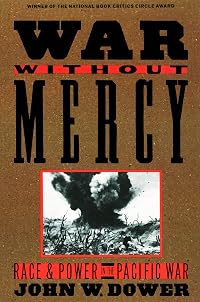
War Without Mercy: Race and Power in the Pacific War
by John W. Dower
On This Page
Description
Describes the "Race" war fought in the Pacific during W.W. II and examines the propaganda which contributed to a war without mercy.Tags
Recommendations





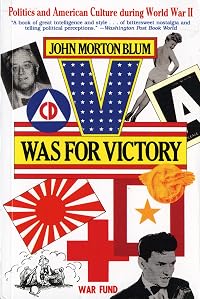
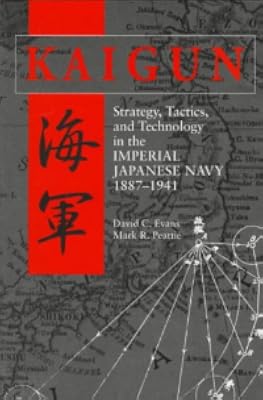
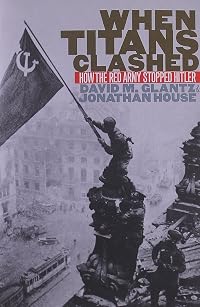


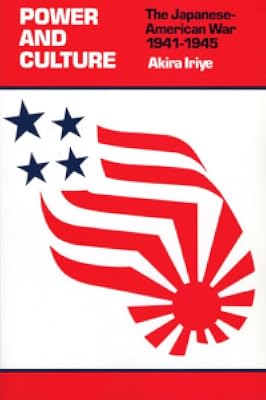
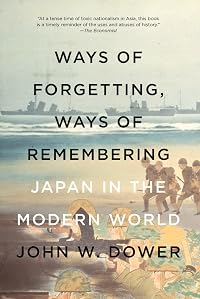

Member Reviews
Dower investigates how the racial beliefs of Americans and Japanese contributed to the ferocity of WWII in the Pacific. Both sides committed atrocities, often aided by the belief that the other was a savage race. The Japanese portrayed the Americans, British, Chinese and Dutch as venal, brutish, and impure; Americans saw the Japanese as vicious animals in need of extermination (with an interlude in which the Japanese were also frightening supermen, cunning and free of individual desire for life). Japanese soldiers massacred civilians and mistreated prisoners of war, and treated other Asians terribly because of an official ideology that the Japanese were to be the master/father race, while American soldiers took souvenirs of bones, show more teeth, and even skulls from the Japanese they killed—a picture of a woman with the skull her fiance sent her appeared in Life, and then reappeared in Japanese propaganda to demonstrate that Japan was in a fight to the death. Dower argues that the racial ideology of both sides was highly similar (though Japanese propagandists didn’t consistently use the animal imagery of the Americans, and focused more on Japanese purity/superiority than American inferiority). He also suggests that the war shows both how easily race hate can be stirred up and how it can, at least for a time, be ratcheted down, given how readily most Japanese accepted American occupation. show less
Dower labels WWII a race war, and notes that apart from the genocide of the Jews, "racism remains one of the great neglected subjects of World War Two." He sets out to remedy that omission in this National Book Critics Circle Award book. Dower documents racism on both sides: he claims that in the West, Japanese were saddled with racial stereotypes that Europeans and Americans had applied to nonwhites for centuries. The Japanese as well, he writes, elabored notions of "purity" and outsiders into "a parable of Japanese destiny and a paradigm of race relations." Dower gives interesting examples of how prejudice and racial stereotyping on both sides frequently distorted evaluations of each other's intentions and strengths or weaknesses. show more Also, he points out, race hate fed atrocities, which in turned fanned the fires of race hatred. As Dower suggests, "[t]he dehumanization of the Other contributed immeasurably to the psychological distancing that facilitates killing, not only on the battlefield but also in the plans adopted by strategists far removed from the actual scene of combat." Unfortunately, the lessons Dower tries to impart remain timely, and undigested.
(JAF) show less
(JAF) show less
Race and Power in the Pacific War: Pulitzer Prize-winning historian John Dower begins "War Without Mercy" with an amusing account of his inspiration for the book: While working on a history of postwar Japan, Dower wrote a sentence noting how quickly and easily the virulent race hatred of the war years dissipated during the American occupation. Of course, he then had to include another sentence explaining the racial aspects of the war itself, which quickly became a paragraph, then a section, then a chapter, and finally this book, "War Without Mercy". The original history of postwar Japan, meanwhile, sat unfinished on a shelf.
The main criticism of "War Without Mercy" given by other reviewers is that it is too narrow to serve as a show more comprehensive history of the war -- in particular that it tries to explain the entire conflict only through race and does not devote enough attention to Japanese atrocities and war crimes. This criticism unfortunately misses the point of Dower's book: he is studying racism itself, but for some reason many of his critics seem to think he is trying to use it to explain all and sundry. "War Without Mercy" is not and makes no pretense of being a book about the Pacific War in general or even about atrocities and war crimes themselves. Instead it started as a mere tangent in a larger work and focuses on racial aspects of the war between Japan and the United States, especially the images each side used to describe the other and the war itself, along with some study of how they evolved after the fighting stopped.
As a history of race and power in the Pacific War, "War Without Mercy" is superb: well-organized, clearly written and offering interesting insights. It is divided into four sections, the first of which establishes the importance of the subject by showing how it contributed to the unique ferocity of the war in the Pacific: "Race hate fed atrocities, and atrocities in turn fanned the fires of race hate" (11). The second section studies American images of their Asian enemy, as apes, primitives, children, and 'little yellow savages', and of the war itself as a racial war between white and colored, while the third does the same for the Japanese side. Although the Japanese portrayed Europeans and Americans as decadent, impure, and downright demonic, they viewed their Asian neighbors in much the same contemptuous way as did Western imperialists. The final section explores the transition from war to peace, and the ways in which images and symbols were transformed: the apes became pets and the children became students, while on the other side the western demons shared their secret knowledge. At the same time, the negative images used during the war were transferred to the Soviet Union and (especially) Maoist China.
Meticulously documented, "War Without Mercy" reveals many fascinating aspects of the Pacific War commonly overlooked in more comprehensive studies. I was especially interested to read about contemporary concerns that American rhetoric of racial war would drive Chiang Kai-shek into an alliance with the Japanese (166-169), and that such language caused fully 18% of African-Americans to express "pro-Japanese inclinations" in a confidential poll conducted by black interviewers (174). "War Without Mercy" isn't a comprehensive history of the Pacific War, nor is it for everybody. It is, however, the best explanation I have seen of the merciless nature of the war itself and the psychology of the societies involved. If you have even the slightest interest in that subject, "War Without Mercy" will not disappoint. show less
The main criticism of "War Without Mercy" given by other reviewers is that it is too narrow to serve as a show more comprehensive history of the war -- in particular that it tries to explain the entire conflict only through race and does not devote enough attention to Japanese atrocities and war crimes. This criticism unfortunately misses the point of Dower's book: he is studying racism itself, but for some reason many of his critics seem to think he is trying to use it to explain all and sundry. "War Without Mercy" is not and makes no pretense of being a book about the Pacific War in general or even about atrocities and war crimes themselves. Instead it started as a mere tangent in a larger work and focuses on racial aspects of the war between Japan and the United States, especially the images each side used to describe the other and the war itself, along with some study of how they evolved after the fighting stopped.
As a history of race and power in the Pacific War, "War Without Mercy" is superb: well-organized, clearly written and offering interesting insights. It is divided into four sections, the first of which establishes the importance of the subject by showing how it contributed to the unique ferocity of the war in the Pacific: "Race hate fed atrocities, and atrocities in turn fanned the fires of race hate" (11). The second section studies American images of their Asian enemy, as apes, primitives, children, and 'little yellow savages', and of the war itself as a racial war between white and colored, while the third does the same for the Japanese side. Although the Japanese portrayed Europeans and Americans as decadent, impure, and downright demonic, they viewed their Asian neighbors in much the same contemptuous way as did Western imperialists. The final section explores the transition from war to peace, and the ways in which images and symbols were transformed: the apes became pets and the children became students, while on the other side the western demons shared their secret knowledge. At the same time, the negative images used during the war were transferred to the Soviet Union and (especially) Maoist China.
Meticulously documented, "War Without Mercy" reveals many fascinating aspects of the Pacific War commonly overlooked in more comprehensive studies. I was especially interested to read about contemporary concerns that American rhetoric of racial war would drive Chiang Kai-shek into an alliance with the Japanese (166-169), and that such language caused fully 18% of African-Americans to express "pro-Japanese inclinations" in a confidential poll conducted by black interviewers (174). "War Without Mercy" isn't a comprehensive history of the Pacific War, nor is it for everybody. It is, however, the best explanation I have seen of the merciless nature of the war itself and the psychology of the societies involved. If you have even the slightest interest in that subject, "War Without Mercy" will not disappoint. show less
A powerful case for the argument that racism played as big a role in the Pacific theater as it did in the European, but Dower devotes more of his resources to detailing American racism, leaving the Japanese sections more vaguely sketched out (we never get the perspective of the men on the ground as we do with the Americans). This may be because he's got to overcome the preconceptions of his primary readership (i.e., most Americans think of WWII as "the good war"), but it makes his argument seem a bit lopsided.
This book relates the emotional and psychological environment of the Pacific war between the Allies and Japan. What it shows is that Japan and the US were/are the same: racist, using many of the same symbols, images and stories. However, the devil is in the details. Because Japan's metaphor of the Enemy was the demon, who could be benevolent or malevolent, there was a flexibility in defeat that allowed the former antagonists to form a new alliance in the face of a new demon: Communism. Recommended.
When thinking of "The Greatest Generation," as the veterans of WWII have been cast of late in the popular media (largely due to Tom Brocaw's prize-winning book by this title), I too wax a bit nostalgic. I think of the watercolor portrait of my Uncle Art in his Naval uniform and remember the pictures my mother showed me as a child of him going off to war. Like the war babies described by Tuttle in his Daddy's Gone to War, she watched him leave and worried about him while he was in combat. When he came back, there were the tensions over being re-united with loved ones which Tuttle captures so well. In one episode which has entered family legend, he unceremoniously placed the plaster bust of General Douglas MacArthur in the fireplace of my show more grandparents' home. He was a navy man, my mother explained, and the navy hated MacArthur. Ironically, Art survived combat in the Pacific to die 30 years later of lung cancer. As the last of this generation passes, we are all reminded that these veterans did sacrifice a great deal to preserve American liberty. As we wage a war on terrorism today, we have something of a kinship with that generation in that America had indeed been attacked. Peal Harbor and the World Trade Center stand as markers in the public memory. Can history serve as a guide in this new war?
When thinking of the veterans of WWII I am also haunted by the image one of my staff members painted for me at the time of the 9-11 attack on the World Trade Center of a veteran of the Pacific Theater who had recently passed. He told me how much he admired this dear old man because he "hated everything that was not American, especially the Japanese." In fact, he had kept a huge Japanese flag in a chest in his bedroom for 50 years after the war. The flag, as I was told by this reverent admirer, was soaked in the blood of "Japs" he had killed fighting in the Pacific. The much loved veteran had even showed him the flag once, and explained how he had cut the "Japs'" throats and soaked the flag in their blood. The most amazing thing about the story to me then, as it is now, was that the person relating the story was of middle eastern descent. One wonders how soon it will be before he will fall victim to the same racial biases in our current war on terrorism as the Japanese felt in the wake of Pearl Harbor. But that was a long time ago, and we have come a long way since then ... or have we? Good old fashioned race hatred is as American as apple pie.
To the racist wars against Native Americans portrayed by Francis Jennings in The Invasion of America and Richard Drinnon in Facing Westward, John Dower has added the racial warfare of the American War in the Pacific against the Japanese. Unlike the dynamic of the white American conflict with the American native populations, Dower's conflict is fueled by racial hatreds on both sides. The Americans characterized their yellow enemies at times as animalistic and racially inferior, at times characterizing them as superman and at other times infantilizing them. The Japanese for their part drew upon traditions of xenophobia and hatred for outsiders to cast the Americans as devils and racial enemies of the Yamato Race. On both sides, the racial hatreds lead to intelligence failures and to atrocities in a "war without mercy." Less than four years after the attack on Pearl Harbor, the United States was dropping atomic bombs on Hiroshima and Nagasaki. Though the firebombing of Dresden was certainly atrocious, we reserved the atomic bomb for our race enemies.
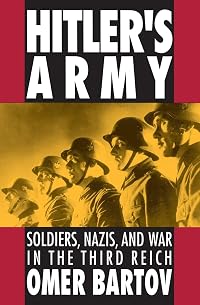
Dower certainly does us a service by cataloging these mutual racially-inspired hatreds. Unfortunately, like David Stannard's American Holocaust, which drew upon Jennings and added further considerations of Christian moralism, this work tends to be repetitive and can be a rather depressing read (as Alvin Coox of San Diego State pointed out in his review for the AHR). In terms reminiscent both of both the German war against the Jews (see Robert Proctor's Racial Hygiene) and that on the Eastern Front against the Bolshevist Reds (on the Eastern Front see O. Bartov's Hitler's Army), the exterrninationist violence is more than merely a bland reminder of man's inhumanity to man. It is a testimony to the ways in which pre-existing racial prejudices were transformed in WWII into exterminationist rage in many quarters.
If history serves as any kind of guide to the challenges that lay ahead, we have a great deal to be concerned about as troops mobilize again headed for the Persian Gulf. Arab Americans will likely be the target of racial hatreds at home if major conflict occurs over Iraqi possession of NBC arms. A war waged under UN auspices holds out the possibility of avoiding a war without mercy ... show less
When thinking of the veterans of WWII I am also haunted by the image one of my staff members painted for me at the time of the 9-11 attack on the World Trade Center of a veteran of the Pacific Theater who had recently passed. He told me how much he admired this dear old man because he "hated everything that was not American, especially the Japanese." In fact, he had kept a huge Japanese flag in a chest in his bedroom for 50 years after the war. The flag, as I was told by this reverent admirer, was soaked in the blood of "Japs" he had killed fighting in the Pacific. The much loved veteran had even showed him the flag once, and explained how he had cut the "Japs'" throats and soaked the flag in their blood. The most amazing thing about the story to me then, as it is now, was that the person relating the story was of middle eastern descent. One wonders how soon it will be before he will fall victim to the same racial biases in our current war on terrorism as the Japanese felt in the wake of Pearl Harbor. But that was a long time ago, and we have come a long way since then ... or have we? Good old fashioned race hatred is as American as apple pie.
To the racist wars against Native Americans portrayed by Francis Jennings in The Invasion of America and Richard Drinnon in Facing Westward, John Dower has added the racial warfare of the American War in the Pacific against the Japanese. Unlike the dynamic of the white American conflict with the American native populations, Dower's conflict is fueled by racial hatreds on both sides. The Americans characterized their yellow enemies at times as animalistic and racially inferior, at times characterizing them as superman and at other times infantilizing them. The Japanese for their part drew upon traditions of xenophobia and hatred for outsiders to cast the Americans as devils and racial enemies of the Yamato Race. On both sides, the racial hatreds lead to intelligence failures and to atrocities in a "war without mercy." Less than four years after the attack on Pearl Harbor, the United States was dropping atomic bombs on Hiroshima and Nagasaki. Though the firebombing of Dresden was certainly atrocious, we reserved the atomic bomb for our race enemies.
Dower certainly does us a service by cataloging these mutual racially-inspired hatreds. Unfortunately, like David Stannard's American Holocaust, which drew upon Jennings and added further considerations of Christian moralism, this work tends to be repetitive and can be a rather depressing read (as Alvin Coox of San Diego State pointed out in his review for the AHR). In terms reminiscent both of both the German war against the Jews (see Robert Proctor's Racial Hygiene) and that on the Eastern Front against the Bolshevist Reds (on the Eastern Front see O. Bartov's Hitler's Army), the exterrninationist violence is more than merely a bland reminder of man's inhumanity to man. It is a testimony to the ways in which pre-existing racial prejudices were transformed in WWII into exterminationist rage in many quarters.
If history serves as any kind of guide to the challenges that lay ahead, we have a great deal to be concerned about as troops mobilize again headed for the Persian Gulf. Arab Americans will likely be the target of racial hatreds at home if major conflict occurs over Iraqi possession of NBC arms. A war waged under UN auspices holds out the possibility of avoiding a war without mercy ... show less
A very detailed analysis of racial bias on both sides in the Pacific war. My Japanese girlfriend gifted it to me as a must-read recommended by her historian dad. I fully agree. It doesn't sugar-coat but exposes the vicious propaganda and atrocities of both sides.
Members
- Recently Added By
Lists

r/History Recommended Reading List
603 works; 12 members

r/AskHistorians' Recommended Books
1,068 works; 18 members
Author Information

20+ Works 3,062 Members
John W. Dower is professor emeritus of history at Massachusetts Institute of Technology. He is the author of several books, including War Without Mercy, and Embracing Defeat, which received the Pulitzer and the National Book Award.
Awards and Honors
Awards
Series
Belongs to Publisher Series
Heibonsha Library (419)
Common Knowledge
- Canonical title
- War Without Mercy: Race and Power in the Pacific War
- Original publication date
- 1986
- People/Characters
- Winston Churchill; Douglas MacArthur; Franklin Delano Roosevelt
- Important places
- Pacific Ocean; East Asia; Japan; USA; Burma; China
- Important events
- World War II (1939 | 1945); World War II, Pacific Theater (1941-12-07 | 1945-09-02); Attack on Pearl Harbor (1941-12-07); Atomic Bombings of Hiroshima and Nagasaki (1945)
- First words
- Some five years ago, while drafting the opening chapter to a projected book about the occupation of Japan that followed World War Two, I found myself mentioning in passing the race hates and merciless fighting that had been s... (show all)o conspicuous in the war in Asia and the Pacific. [Preface]
World War Two meant many things to many people. [Chapter One] - Last words
- (Click to show. Warning: May contain spoilers.)In whatever way, World War Two in Asia has become central to our understanding not only of the past, but of the present as well.
- Original language
- English
Classifications
- Genres
- History, Nonfiction, General Nonfiction
- DDC/MDS
- 940.531 — History & geography History of Europe History of Europe 1918- World War II, 1939-1945 Social, political, economic history; Holocaust
- LCC
- D767.9 .D69 — History of Europe, Asia, Africa and Oceania History (General) World War II (1939-1945)
- BISAC
Statistics
- Members
- 910
- Popularity
- 29,503
- Reviews
- 15
- Rating
- (4.13)
- Languages
- English, Japanese
- Media
- Paper, Audiobook, Ebook
- ISBNs
- 10
- ASINs
- 5