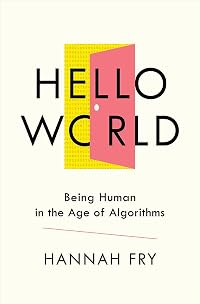
Hello World: Being Human in the Age of Algorithms
by Hannah Fry
On This Page
Description
If you were accused of a crime, who would you rather decide your sentence--a mathematically consistent algorithm incapable of empathy or a compassionate human judge prone to bias and error? What if you want to buy a driverless car and must choose between one programmed to save as many lives as possible and another that prioritizes the lives of its own passengers? And would you agree to share your family's full medical history if you were told that it would help researchers find a cure for show more cancer? These are just some of the dilemmas that we are beginning to face as we approach the age of the algorithm, when it feels as if the machines reign supreme. Already, these lines of code are telling us what to watch, where to go, whom to date, and even whom to send to jail. But as we rely on algorithms to automate big, important decision--in crime, justice, healthcare, transportation, and money--they raise questions about what we want our world to look like. What matters most: Helping doctors with diagnosis or preserving privacy? Protecting victims of crime or preventing innocent people being falsely accused? Hello World takes us on a tour through the good, the bad, and the downright ugly of the algorithms that surround us on a daily basis. Mathematician Hannah Fry reveals their inner workings, showing us how algorithms are written and implemented, and demonstrates the ways in which human bias can literally be written into the code. By weaving in relatable, real-world stories with accessible explanations of the underlying mathematics that power algorithms, Hello World helps us to determine their power, expose their limitations, and examine whether they really are an improvement on the human systems they replace. -- From Dust jacket flaps. show lessTags
Recommendations





Member Reviews
Great read! This caught my eye as it was passing through the library on its way to fill a patron’s hold. I think I had algorithms Sorry, Brittany. Not really. on my mind because of the class I’m taking this semester. I can’t say the cover or title is anything that would fill me with excitement—although once she explained the title, it made me smile and say, “Ohhh”—but for whatever reason, I placed a hold for myself.
From start to finish, I loved this book. It’s accessible for scientific/mathematical Muggles (among whom I humbly count myself), and it’s fascinating.
Fry has a giant brain. I started following her on Twitter while I was reading this, and I could not make heads or tails of the first tweet of hers I saw show more (except for the part that said “FFS”—I learned what that meant earlier this year). So I appreciated the fact that she wrote this book at a level I could follow and enjoy. Her many examples and sense of humor made the subject matter more interesting to me than it already was.
Each chapter discusses how algorithms are used in a specific area of our lives: medicine, cars, crime, justice, etc. The implications of how prevalent and trusted they can be is discussed in both positive and negative terms. It’s not a watch-out-the-computers-are-going-to-take-over-and-destroy-us kind of book, but she does take a hard look at what can go wrong with this technology.
It’s threaded throughout the book, but her conclusion is not based on a one-or-the-other mentality, like humans vs. technology. It’s more exploring an idea of the two complementing each other—“The algorithm and the human work together in partnership, exploiting each other’s strengths and embracing each other’s flaws.”
This was a fun book to read. I felt like I learned a lot, and it didn’t hurt one bit. show less
From start to finish, I loved this book. It’s accessible for scientific/mathematical Muggles (among whom I humbly count myself), and it’s fascinating.
Fry has a giant brain. I started following her on Twitter while I was reading this, and I could not make heads or tails of the first tweet of hers I saw show more (except for the part that said “FFS”—I learned what that meant earlier this year). So I appreciated the fact that she wrote this book at a level I could follow and enjoy. Her many examples and sense of humor made the subject matter more interesting to me than it already was.
Each chapter discusses how algorithms are used in a specific area of our lives: medicine, cars, crime, justice, etc. The implications of how prevalent and trusted they can be is discussed in both positive and negative terms. It’s not a watch-out-the-computers-are-going-to-take-over-and-destroy-us kind of book, but she does take a hard look at what can go wrong with this technology.
It’s threaded throughout the book, but her conclusion is not based on a one-or-the-other mentality, like humans vs. technology. It’s more exploring an idea of the two complementing each other—“The algorithm and the human work together in partnership, exploiting each other’s strengths and embracing each other’s flaws.”
This was a fun book to read. I felt like I learned a lot, and it didn’t hurt one bit. show less
Fantástico repaso al creciente papel que los algoritmos van cobrando en más y más aspectos de nuestras vidas. El libro empieza con una introducción sobre cómo hay muchas cosas, objetos, creaciones humanas, que tienen gran influencia sobre la gente, y pone un ejemplo que no conocía sobre los puentes racistas de Long Island:
Y la tesis central de la autora es que al igual que hay objetos que se construyeron con una clara intención, los algoritmos, algos, pueden tener ese mismo efecto si no los controlamos. Aunque la definición de algoritmo es bastante insulsa,
Y nos da una breve pátina sobre los tipos de algoritmos que hay, clasificados por funcionalidad:
Y por método de funcionamiento:
Y hace una advertencia de sentido común que me encanta:
Tras la introducción, vienen los seis capítulos en que se centra al autora (podría haber elegido más): Datos, Justicia, Medicina, Transporte, Crimen y Arte.
DATOS
De éste hemos oído hablar muchos, empezando por la ya clásica historia de cómo Target, la cadena norteamericana, descubrió que cuando una mujer joven comenzaba a comprar desodorante sin perfume, normalmente a los pocos meses s se apuntaba a las ofertas de productos para recién nacido. Habían encontrado una señal en los datos. Operaron sobre esa señal y comenzaron a mandar publicidad de productos de recién nacido a las mujeres que cambiaban a desodorante sin fragancia. Y apareció un padre cabreadísimo porque a su hija de 15 años le estaban mandando cosas de bebés y le parecía una vergüenza , hasta que un par de meses después descubrió que su hija estaba embarazada.
Pero el uso de la información que dejamos por Internet, como hemos podido comprobar recientemente con el escándalo de Cambridge Analytica (que mostraba anuncios a medida a gente cuyas características conocía con la intención de cambiar el sentido de su voto) va mucho más allá:
Hay mil casos en este capítulo, algunos más inquietantes que otros. Como conclusión, una reflexión y una recomendación:
JUSTICIA
Este capítulo me da mucho miedo. En EE.UU. están usando algos que predicen, dadas las características del criminal (edad, residencia, crimen cometido, etc... ) la probabilidad de reincidencia yo la probabilidad de saltarse la libertad bajo fianza. Y basándose en esas recomendaciones muchos jueces dictan la sentencia simplemente siguiendo lo que diga el algo. La autora repasa un montón de casos y nos habla de cómo es imposible reducir el número de falsos negativos (dejar libre a un culpable) sin aumentar el de falsos positivos (condenar a un inocente) y viceversa:
Y de cómo, por supuesto, aunque la raza del reo no es un input del sistema, los algos tienden a condenarlos más, porque los negros tienden a vivir en zonas peores con más índice de criminalidad y salen más condenados a igualdad de delito.
Cuando se les piden cuentas a las empresas que diseñan estos algos sobre el sesgo racial, se niegan a dar información:
Y al mismo tiempo, los psicólogos muestran que las condenas de jueces que no usan asistencia algorítmica sufren de sesgos.
Ejemplo de efecto ancla en otro contexto:
MEDICINA
Los algos aquí se usan en un contexto más técnico: detección de células cancerígenas en muestras de anatomopatología, por ejemplo. Hubo un experimento MUY interesante hace tiempo:
¡Se me acaban los caracteres de la crítica!
La conclusión a la que llega la autora es que los algos son una maravillosa herramienta cuando se les considera una ayuda al humano que debe seguir al mando. Deben proporcionar datos que ayuden al humano a tomar la decisión, no tomarla ellos. La unión humano máquina es mucho más poderosa que las partes por separado.
El libro es fantástico, muy recomendable. Proporciona tanto historias curiosas como cultura y elementos de juicio. show less
ANYONE WHO HAS ever visited Jones Beach on Long Island, New York, will have driven under a series of bridges on their way to the ocean. These bridges, primarily built to filter people on and off the highway, have an unusual feature. As they gently arc over the traffic, they hang extraordinarily low, sometimes leaving as little as 9 feet of clearance from the tarmac. There’s a reason for this strange design. Inshow more
the 1920s, Robert Moses, a powerful New York urban planner, was keen to keep his newly finished, award- winning state park at Jones Beach the preserve of white and wealthy Americans. Knowing that his preferred clientele would travel to the beach in their private cars, while people from poor black neighbourhoods would get there by bus, he deliberately tried to limit access by building hundreds of low- lying bridges along the highway. Too low for the 12- foot buses to pass under. Racist bridges aren’t the only inanimate objects that have had a quiet, clandestine control over people.
Y la tesis central de la autora es que al igual que hay objetos que se construyeron con una clara intención, los algoritmos, algos, pueden tener ese mismo efecto si no los controlamos. Aunque la definición de algoritmo es bastante insulsa,
algorithm (noun): A step- by- step procedure for solving a problem or accomplishing some end especially by a computer., la autora la desarrolla un poco más en el contexto en el que la va a tratar en el libro:
Usually, algorithms refer to something a little more specific. They still boil down to a list of step- by- step instructions, but these algorithms are almost always mathematical objects. They take a sequence of mathematical operations– using equations, arithmetic, algebra, calculus, logic and probability– and translate them into computer code. They are fed with data from the real world, given an objective and set to work crunching through the calculations to achieve their aim.
Y nos da una breve pátina sobre los tipos de algoritmos que hay, clasificados por funcionalidad:
But broadly speaking, it can be useful to think of the real- world tasks they perform in four main categories:
*Prioritization: making an ordered list (Google Search)
*Classification: picking a category. As soon as I hit my late twenties, I was bombarded by adverts for diamond rings on Facebook.
*Association: finding links Association is all about finding and marking relationships between things. Dating algorithms such as OKCupid have association at their core, looking for connections between members and suggesting matches based on the findings.
*Filtering: isolating what’s important Algorithms often need to remove some information to focus on what’s important, to separate the signal from the noise. Sometimes they do this literally: speech recognition algorithms, like those running inside Siri, Alexa and Cortana, first need to filter out your voice from the background noise before they can get to work on deciphering what you’re saying.
The vast majority of algorithms will be built to perform a combination of the above. Take UberPool, for instance, which matches prospective passengers with others heading in the same direction. Given your start point and end point, it has to filter through the possible routes that could get you home, look for connections with other users headed in the same direction, and pick one group to assign you to– all while prioritizing routes with the fewest turns for the driver, to make the ride as efficient as possible.
Y por método de funcionamiento:
Rule- based algorithms The first type are rule- based. Their instructions are constructed by a human and are direct and unambiguous. You can imagine these algorithms as following the logic of a cake recipe. Step one: do this. Step two: if this, then that. That’s not to imply that these algorithms are simple– there’s plenty of room to build powerful programs within this paradigm. Machine- learning algorithms The second type are inspired by how living creatures learn. To give you an analogy, think about how you might teach a dog to give you a high five. You don’t need to produce a precise list of instructions and communicate them to the dog. As a trainer, all you need is a clear objective in your mind of what you want the dog to do and some way of rewarding her when she does the right thing. It’s simply about reinforcing good behaviour, ignoring bad, and giving her enough practice to work out what to do for herself. The algorithmic equivalent is known as a machine- learning algorithm, which comes under the broader umbrella of artificial intelligence or AI. You give the machine data, a goal and feedback when it’s on the right track– and leave it to work out the best way of achieving the end.
Y hace una advertencia de sentido común que me encanta:
Although AI has come on in leaps and bounds of late, it is still only ‘intelligent’ in the narrowest sense of the word. It would probably be more useful to think of what we’ve been through as a revolution in computational statistics than a revolution in intelligence. I know that makes it sound a lot less sexy (unless you’re really into statistics), but it’s a far more accurate description of how things currently stand. For the time being, worrying about evil Artificial Intelligence is a bit like worrying about overcrowding on Mars.
Tras la introducción, vienen los seis capítulos en que se centra al autora (podría haber elegido más): Datos, Justicia, Medicina, Transporte, Crimen y Arte.
DATOS
De éste hemos oído hablar muchos, empezando por la ya clásica historia de cómo Target, la cadena norteamericana, descubrió que cuando una mujer joven comenzaba a comprar desodorante sin perfume, normalmente a los pocos meses s se apuntaba a las ofertas de productos para recién nacido. Habían encontrado una señal en los datos. Operaron sobre esa señal y comenzaron a mandar publicidad de productos de recién nacido a las mujeres que cambiaban a desodorante sin fragancia. Y apareció un padre cabreadísimo porque a su hija de 15 años le estaban mandando cosas de bebés y le parecía una vergüenza , hasta que un par de meses después descubrió que su hija estaba embarazada.
Pero el uso de la información que dejamos por Internet, como hemos podido comprobar recientemente con el escándalo de Cambridge Analytica (que mostraba anuncios a medida a gente cuyas características conocía con la intención de cambiar el sentido de su voto) va mucho más allá:
[Palantir] was founded in 2003 by Peter Thiel (of PayPal fame), and at the last count was estimated to be worth a staggering $ 20 billion. That’s about the same market value as Twitter, although chances are you’ve never heard of it. And yet– trust me when I tell you– Palantir has most certainly heard of you.
[...] every time you sign up for a newsletter, or register on a website, or enquire about a new car, or fill out a warranty card, or buy a new home, or register to vote– every time you hand over any data at all– your information is being collected and sold to a data broker. Remember when you told an estate agent what kind of property you were looking for? Sold to a data broker. Or those details you once typed into an insurance comparison website? Sold to a data broker. In some cases, even your entire browser history can be bundled up and sold on.
Hay mil casos en este capítulo, algunos más inquietantes que otros. Como conclusión, una reflexión y una recomendación:
That was the deal that we made. Free technology in return for your data and the ability to use it to influence and profit from you. The best and worst of capitalism in one simple swap.
Whenever we use an algorithm– especially a free one– we need to ask ourselves about the hidden incentives. Why is this app giving me all this stuff for free? What is this algorithm really doing? Is this a trade I’m comfortable with? Would I be better off without it? That is a lesson that applies well beyond the virtual realm, because the reach of these kinds of calculations now extends into virtually every aspect of society. Data and algorithms don’t just have the power to predict our shopping habits. They also have the power to rob someone of their freedom.
JUSTICIA
Este capítulo me da mucho miedo. En EE.UU. están usando algos que predicen, dadas las características del criminal (edad, residencia, crimen cometido, etc... ) la probabilidad de reincidencia yo la probabilidad de saltarse la libertad bajo fianza. Y basándose en esas recomendaciones muchos jueces dictan la sentencia simplemente siguiendo lo que diga el algo. La autora repasa un montón de casos y nos habla de cómo es imposible reducir el número de falsos negativos (dejar libre a un culpable) sin aumentar el de falsos positivos (condenar a un inocente) y viceversa:
Let’s assume our murderer- detection algorithm has a prediction rate of 75 per cent. That is to say, three- quarters of the people the algorithm labels as high risk are indeed Darth Vaders. Eventually, after stopping enough strangers, you’ll have 100 people flagged by the algorithm as potential murderers. To match the perpetrator statistics, 96 of those 100 will necessarily be male. Four will be female. There’s a picture below to illustrate. The men are represented by dark circles, the women shown as light grey circles. Now, since the algorithm predicts correctly for both men and women at the same rate of 75 per cent, one- quarter of the females, and one- quarter of the males, will really be Luke Skywalkers: people who are incorrectly identified as high risk, when they don’t actually pose a danger. Once you run the numbers, as you can see from the second image here, more innocent men than innocent women will be incorrectly accused, just by virtue of the fact that men commit more murder than women. This has nothing to do with the crime itself, or with the algorithm: it’s just a mathematical certainty. The outcome is biased because reality is biased. More men commit homicides, so more men will be falsely accused of having the potential to murder.
Y de cómo, por supuesto, aunque la raza del reo no es un input del sistema, los algos tienden a condenarlos más, porque los negros tienden a vivir en zonas peores con más índice de criminalidad y salen más condenados a igualdad de delito.
Legally, race, gender and class should not influence a judge’s decision. (Justice is supposed to be blind, after all.) And yet, while the vast majority of judges want to be as unbiased as possible, the evidence has repeatedly shown that they do indeed discriminate. Studies within the US have shown that black defendants, on average, will go to prison for longer, are less likely to be awarded bail, are more likely to be given the death penalty, and once on death row are more likely to be executed. Other studies have shown that men are treated more severely than women for the same crime, and that defendants with low levels of income and education are given substantially longer sentences. Just as with the algorithm, it’s not necessarily explicit prejudices that are causing these biased outcomes, so much as history repeating itself.
Cuando se les piden cuentas a las empresas que diseñan estos algos sobre el sesgo racial, se niegan a dar información:
Any company that profits from analysing people’s data has a moral responsibility (if not yet a legal one) to come clean about its flaws and pitfalls. Instead, Equivant (formerly Northpointe), the company that makes COMPAS, continues to keep the insides of its algorithm a closely guarded secret, to protect the firm’s intellectual property.
Y al mismo tiempo, los psicólogos muestran que las condenas de jueces que no usan asistencia algorítmica sufren de sesgos.
Ejemplo de efecto ancla en otro contexto:
Like those signs in supermarkets that say ‘Limit of 12 cans of soup per customer’. They aren’t designed to ward off soup fiends from buying up all the stock, as you might think. They exist to subtly manipulate your perception of how many cans of soup you need. The brain anchors with the number 12 and adjusts downwards. One study back in the 1990s showed that precisely such a sign could increase the average sale per customer from 3.3 tins of soup to 7.52
MEDICINA
Los algos aquí se usan en un contexto más técnico: detección de células cancerígenas en muestras de anatomopatología, por ejemplo. Hubo un experimento MUY interesante hace tiempo:
They gave 16 testers a touch- screen monitor and tasked them with sorting through images of breast tissue. The pathology samples had been taken from real women, from whom breast tissue had been removed by a biopsy, sliced thinly and stained with chemicals to make the blood vessels and milk ducts stand out in reds, purples and blues. All the tester had to do was decide whether the patterns in the image hinted at cancer lurking among the cells. After a short period of training, the testers were set to work, with impressive results. Working independently, they correctly assessed 85 per cent of samples. But then the researchers realized something remarkable. If they started pooling answers– combining votes from the individual testers to give an overall assessment on an image– the accuracy rate shot up to 99 per cent. What was truly extraordinary about this study was not the skill of the testers. It was their identity. These plucky lifesavers were not oncologists. They were not pathologists. They were not nurses. They were not even medical students. They were pigeons. Pathologists’ jobs are safe for a while yet– I don’t think even the scientists who designed the study were suggesting that doctors should be replaced by plain old pigeons. But the experiment did demonstrate an important point: spotting patterns hiding among clusters of cells is not a uniquely human skill. So, if a pigeon can manage it, why not an algorithm?
¡Se me acaban los caracteres de la crítica!
La conclusión a la que llega la autora es que los algos son una maravillosa herramienta cuando se les considera una ayuda al humano que debe seguir al mando. Deben proporcionar datos que ayuden al humano a tomar la decisión, no tomarla ellos. La unión humano máquina es mucho más poderosa que las partes por separado.
El libro es fantástico, muy recomendable. Proporciona tanto historias curiosas como cultura y elementos de juicio. show less
A very clear exploration of what algorithms can and cannot do. And the answer is "it's complicated" however, despite the issues with algorithms, we shouldn't kid ourselves that human decision-making is flawless. Algorithms are biased but so are human beings. The goal should therefore be to make algorithms more transparent and assistant to human decisions rather than abdicate decision-making to algorithms uncritically.
I especially liked this bit: "Whenever you see a story about an algorithm, see if you can swap out any of the buzzwords, like ‘machine learning’, ‘artificial intelligence’ and ‘neural network’, and swap in the word ‘magic’. Does everything still make grammatical sense? Is any of the meaning lost? If not, show more I’d be worried that it’s all nonsense.".
This is a book that gives a lot to think about that is also pleasant to read and full of insightful examples. show less
I especially liked this bit: "Whenever you see a story about an algorithm, see if you can swap out any of the buzzwords, like ‘machine learning’, ‘artificial intelligence’ and ‘neural network’, and swap in the word ‘magic’. Does everything still make grammatical sense? Is any of the meaning lost? If not, show more I’d be worried that it’s all nonsense.".
This is a book that gives a lot to think about that is also pleasant to read and full of insightful examples. show less
I read this book upon recommendation from a highly regarded colleague of mine. I liked the idea of the book but something about the execution of it left a sour taste in my mouth.
I feel very uncomfortable confronted with the idea that my entire life is being tracked and quantified and sold. I feel even more uncomfortable with the fact that this all happens behind closed doors. And I feel even worse when people say: 🤷🏻♀️ that's just the way things are going to be! As if this was something that I had any say in. (It's like when people say that consumers are why corporations can't pay their employees money, diverting the focus from the CEOs making out like gilded age barons.)
So yeah, algorithms are going to perpetuate the worst show more biases of society, and even more so when they take place behind closed doors. I would have preferred a thesis less geared toward "this is how it is! sometimes it sucks but it's OK otherwise!" and more geared towards: let's regulate these algorithms, make sure they are open to everyone, let's make sure there are checks and balances, and treat them very skeptically. show less
I feel very uncomfortable confronted with the idea that my entire life is being tracked and quantified and sold. I feel even more uncomfortable with the fact that this all happens behind closed doors. And I feel even worse when people say: 🤷🏻♀️ that's just the way things are going to be! As if this was something that I had any say in. (It's like when people say that consumers are why corporations can't pay their employees money, diverting the focus from the CEOs making out like gilded age barons.)
So yeah, algorithms are going to perpetuate the worst show more biases of society, and even more so when they take place behind closed doors. I would have preferred a thesis less geared toward "this is how it is! sometimes it sucks but it's OK otherwise!" and more geared towards: let's regulate these algorithms, make sure they are open to everyone, let's make sure there are checks and balances, and treat them very skeptically. show less
An excellent overview of the past, present and future of how computational algorithms shape our world, from the estimable Dr Hannah Fry.
In seven sections - Power, Data, Justice, Medicine, Cars, Crime & Art - Fry give examples, background, threats and potentials of this incredibly powerful IT tool. The examples are well chosen - some I knew, some were new to me - and she uses each as a jumping-off point to discuss the effect not only of the technology itself, but of the cultural, societal and intellectual ways we interact with it. Is what we expect from it realistic or, indeed, desirable?
She uses the well-known example of Idaho Medicaid recipients being stripped of essential benefits by an 'algorithm' that eventually was revealed to be show more nothing more than a badly constructed Excel spreadsheet to discuss how much we should (or shouldn't) trust the Black Box, of how facial recognition and crime-prediction software is so often racially biased and skewed toward false-positives (it constantly amazes me how little the general populace are aware of the effect of false positives vs false negatives, and how little the media does to educate them), but balanced with positives examples of the effectiveness of algorithms.
This, as a popular science book, does an superb job of covering the main issues and philosophical and social questions of our increasing reliance on algorithms - from everything from shopping preferences to medicine, from security to self-driving cars an autopilot - leaving the reader with a solid base of knowledge and many questions about how we, as a society, use this powerful tool. I could easily have had the book be twice as long and deep (especially in the area of social media and news preferences, although perhaps that is too big a topic for a single chapter) but, for the general popular science audience, this is a brilliant overview with some very thoughtful insights.
One point which is an observation rather than a criticism is that, for the most part, I didn't 'hear' Dr Fry's voice in the writing. This isn't to say there was any problem with the writing or the pacing but, knowing her voice from her radio work - especially the marvellous Curios Cases of Rutherford and Fry that she presents with [a:Adam Rutherford|88617|Adam Rutherford|https://images.gr-assets.com/authors/1544078679p2/88617.jpg] (which, for those not blessed with access to the BBC is available as a podcast and I HIGHLY recommend you seek it out) - the only place I heard Dr Fry was in the short conclusion. I understand she reads the audiobook, so I am intrigued how different it would be to listen to it.
Highly recommended. show less
In seven sections - Power, Data, Justice, Medicine, Cars, Crime & Art - Fry give examples, background, threats and potentials of this incredibly powerful IT tool. The examples are well chosen - some I knew, some were new to me - and she uses each as a jumping-off point to discuss the effect not only of the technology itself, but of the cultural, societal and intellectual ways we interact with it. Is what we expect from it realistic or, indeed, desirable?
She uses the well-known example of Idaho Medicaid recipients being stripped of essential benefits by an 'algorithm' that eventually was revealed to be show more nothing more than a badly constructed Excel spreadsheet to discuss how much we should (or shouldn't) trust the Black Box, of how facial recognition and crime-prediction software is so often racially biased and skewed toward false-positives (it constantly amazes me how little the general populace are aware of the effect of false positives vs false negatives, and how little the media does to educate them), but balanced with positives examples of the effectiveness of algorithms.
This, as a popular science book, does an superb job of covering the main issues and philosophical and social questions of our increasing reliance on algorithms - from everything from shopping preferences to medicine, from security to self-driving cars an autopilot - leaving the reader with a solid base of knowledge and many questions about how we, as a society, use this powerful tool. I could easily have had the book be twice as long and deep (especially in the area of social media and news preferences, although perhaps that is too big a topic for a single chapter) but, for the general popular science audience, this is a brilliant overview with some very thoughtful insights.
One point which is an observation rather than a criticism is that, for the most part, I didn't 'hear' Dr Fry's voice in the writing. This isn't to say there was any problem with the writing or the pacing but, knowing her voice from her radio work - especially the marvellous Curios Cases of Rutherford and Fry that she presents with [a:Adam Rutherford|88617|Adam Rutherford|https://images.gr-assets.com/authors/1544078679p2/88617.jpg] (which, for those not blessed with access to the BBC is available as a podcast and I HIGHLY recommend you seek it out) - the only place I heard Dr Fry was in the short conclusion. I understand she reads the audiobook, so I am intrigued how different it would be to listen to it.
Highly recommended. show less
The idea of artificial intelligence, particularly the application of artificial intelligence algorithms in the service of human activities that have always been human based both scare and fascinates us, that idea being a fecund field to harvest for popular literature and films. We humans, with some of us relying on overdeveloped imaginations, dreams of AI as the solution for everything that ails us. While for other humans, those with an overdramatic sense of pessimism, have nightmares about how human society will be conquered by droids who will eventually destroy us.
The truth I believe, is somewhere in between. One of the problems is that the general layperson has no idea what AI entails and how it works, not how well or how badly it show more works in real life. The popular media is of no help as they are wont to lean towards the sensational, in both the optimistic and pessimistic directions to enable the selling of papers or website subscriptions.
Fortunately for us, there are people like Hannah Fry, a mathematician, and a hell of a good writer to explain it to us, if not the nuts and bolts of AI, then the results of existing experimental results and how the algorithms are applied to real world problems. To get Prof. Fry’s credentials out of the way, she is an associate professor in mathematics at the University College of London. I am a fan of her writing in the New Yorker, as she has a way of explaining the details and nuances of mathematical topics with great clarity and ease.
The subtitle of the book is: Being Human in the Age of Algorithms. It is both somewhat comforting and a touch menacing at the same time. I took it to be comforting. The title Hello World comes from an example in rudimentary programming classes, the very first program any neophyte programmer writes are programs that outputs: ‘Hello World’ onto the screen. I too, have had the excitement of having those two words present themselves in my computers. So, it is a welcoming sign, it is also a foreshadowing of what is in store for the reader in the succeeding pages.
The book is divided simply into nine total chapters; an Introduction and Conclusion bookends the middle chapters named after seven distinct parts of the human existence as we know it in the 21st century. They are: Power, Data, Justice, Medicine, Cars, Crime, and Art. While the structure of the book is simple enough, the intent of the book is quite ambitious. Prof. Fry lays out the present and past excursions we humans have made into the realm of using artificial intelligence to alleviate human based computational efforts. Some reasoning which drove us to evolving our decision-making advances along this route involves the perceived and many times a real need for faster and more accurate computations. The faster part is won handily by computers, and most of the time the accuracy part is also won by the computers. What people forget is that first, the computer’s cogitations is only as good as the data and to a much larger degree, the algorithm that it is given. It is garbage in, and you get garbage out. The parallel effect is that if you have garbage logic cooked into the algorithm, then garbage out as well. The more egregious result then is that garbage analysis and interpretation of the results mean even worse garbage out.
Prof. Fry goes through each of the seven topics and demonstrates where the human propensity for bias creates disastrous errors in inference and in computing the wrong numbers or asking the wrong questions. On the other hand, she also takes great pains to explain why computers are much better suited to not just doing the computations quickly but to also make decisions quickly and at times more accurately. One would think that the main arguments in a book such as this are all along the lines of: it is game over, let the silicon-based lifeform govern our existence, but that is not the case. Prof. Fry explores and negotiates the complex and nonlinear landscape of what we humans have done in experimentation with designing and allowing algorithms to make decisions for us in order to get at the clearest picture yet of what AI can do for and against us.
She tells us stories of how Gary Kasparov, chess master, the very epitome of human decision-making prowess, became seduced by the idea of the AI, after having been beaten by Big Blue. She tells us about how a self-driving car is supposed to navigate our highways and byways, but still can not do so safely. She, most disturbingly, tells us how our government, in their attempts to simplify and creating accurate decision-making processes had wreaked havoc in our society, thereby creating equality issues in how justice is dealt out to us. Indeed, I found the chapters on Data, Justice, Medicine, and Crime the scariest and the most fascinating because those chapters hit the closest to home. The idea that our faceless bureaucracy places their trust on unrealistic, biased, and logically error ridden algorithms to handle our privacy data, decide on long term guilt and innocence of our fellow humans, cure what ails us, and solve problems due to human proclivity to trespass on our fellow beings is decidedly unsettling to say the least.
In every chapter, however, Prof. Fry collects and organizes the stories in easily digestible and logically intuitive chunks, giving us cogent arguments for her opinions. In the Conclusion, she lays out her case, buttressed by the facts and gave me quite a bit to think about, after of course, educating me on the nuances of the intricate and logically confounding sequence of action, reaction, and unintended consequences, which we are not very able to predict a priori.
My belief is that this is a must read for all cogent human beings who live in todays’ world of technological abundance. We can not live without fully understanding how decisions are made by algorithms, most importantly, we need to understand how those decisions can be wrong. In addition, we must also learn how we can leverage the algorithms so that the computational tools can be used in conjunction with those areas of cogitation where we human have an advantage and succeed in creating a more perfect society. show less
The truth I believe, is somewhere in between. One of the problems is that the general layperson has no idea what AI entails and how it works, not how well or how badly it show more works in real life. The popular media is of no help as they are wont to lean towards the sensational, in both the optimistic and pessimistic directions to enable the selling of papers or website subscriptions.
Fortunately for us, there are people like Hannah Fry, a mathematician, and a hell of a good writer to explain it to us, if not the nuts and bolts of AI, then the results of existing experimental results and how the algorithms are applied to real world problems. To get Prof. Fry’s credentials out of the way, she is an associate professor in mathematics at the University College of London. I am a fan of her writing in the New Yorker, as she has a way of explaining the details and nuances of mathematical topics with great clarity and ease.
The subtitle of the book is: Being Human in the Age of Algorithms. It is both somewhat comforting and a touch menacing at the same time. I took it to be comforting. The title Hello World comes from an example in rudimentary programming classes, the very first program any neophyte programmer writes are programs that outputs: ‘Hello World’ onto the screen. I too, have had the excitement of having those two words present themselves in my computers. So, it is a welcoming sign, it is also a foreshadowing of what is in store for the reader in the succeeding pages.
The book is divided simply into nine total chapters; an Introduction and Conclusion bookends the middle chapters named after seven distinct parts of the human existence as we know it in the 21st century. They are: Power, Data, Justice, Medicine, Cars, Crime, and Art. While the structure of the book is simple enough, the intent of the book is quite ambitious. Prof. Fry lays out the present and past excursions we humans have made into the realm of using artificial intelligence to alleviate human based computational efforts. Some reasoning which drove us to evolving our decision-making advances along this route involves the perceived and many times a real need for faster and more accurate computations. The faster part is won handily by computers, and most of the time the accuracy part is also won by the computers. What people forget is that first, the computer’s cogitations is only as good as the data and to a much larger degree, the algorithm that it is given. It is garbage in, and you get garbage out. The parallel effect is that if you have garbage logic cooked into the algorithm, then garbage out as well. The more egregious result then is that garbage analysis and interpretation of the results mean even worse garbage out.
Prof. Fry goes through each of the seven topics and demonstrates where the human propensity for bias creates disastrous errors in inference and in computing the wrong numbers or asking the wrong questions. On the other hand, she also takes great pains to explain why computers are much better suited to not just doing the computations quickly but to also make decisions quickly and at times more accurately. One would think that the main arguments in a book such as this are all along the lines of: it is game over, let the silicon-based lifeform govern our existence, but that is not the case. Prof. Fry explores and negotiates the complex and nonlinear landscape of what we humans have done in experimentation with designing and allowing algorithms to make decisions for us in order to get at the clearest picture yet of what AI can do for and against us.
She tells us stories of how Gary Kasparov, chess master, the very epitome of human decision-making prowess, became seduced by the idea of the AI, after having been beaten by Big Blue. She tells us about how a self-driving car is supposed to navigate our highways and byways, but still can not do so safely. She, most disturbingly, tells us how our government, in their attempts to simplify and creating accurate decision-making processes had wreaked havoc in our society, thereby creating equality issues in how justice is dealt out to us. Indeed, I found the chapters on Data, Justice, Medicine, and Crime the scariest and the most fascinating because those chapters hit the closest to home. The idea that our faceless bureaucracy places their trust on unrealistic, biased, and logically error ridden algorithms to handle our privacy data, decide on long term guilt and innocence of our fellow humans, cure what ails us, and solve problems due to human proclivity to trespass on our fellow beings is decidedly unsettling to say the least.
In every chapter, however, Prof. Fry collects and organizes the stories in easily digestible and logically intuitive chunks, giving us cogent arguments for her opinions. In the Conclusion, she lays out her case, buttressed by the facts and gave me quite a bit to think about, after of course, educating me on the nuances of the intricate and logically confounding sequence of action, reaction, and unintended consequences, which we are not very able to predict a priori.
My belief is that this is a must read for all cogent human beings who live in todays’ world of technological abundance. We can not live without fully understanding how decisions are made by algorithms, most importantly, we need to understand how those decisions can be wrong. In addition, we must also learn how we can leverage the algorithms so that the computational tools can be used in conjunction with those areas of cogitation where we human have an advantage and succeed in creating a more perfect society. show less
Thought-provoking well written
I enjoyed reading this, the author writes well about a complex topic without trite simplification or boring detail. The conclusion is great: algorithms need to be contestable and transparent, as already know all human decisions need to be, because all make mistakes.
I enjoyed reading this, the author writes well about a complex topic without trite simplification or boring detail. The conclusion is great: algorithms need to be contestable and transparent, as already know all human decisions need to be, because all make mistakes.
Members
- Recently Added By
Published Reviews
ThingScore 100
With refreshing simplicity, Fry explains what AI, machine learning and complicated algorithms really mean, providing some succinct explanations of the Cambridge Analytica scandal, driverless cars and many other unnerving modern phenomena. She asks the reader to consider some difficult questions: would you hand over your medical records to a faceless company if doing so might improve treatment show more for everyone? Should a driverless car prioritise protecting its owner, or the child she is about to run over? Should a judge or a computer calculate whether a prisoner is likely to reoffend? And in each case, who gets to make the rules? [...]
Fry makes a convincing case for "the urgent need for algorithmic regulation", and wants the public to understand the compromises we are making. And, in the case of Facebook and users' data, "how cheaply we were bought". This book illustrates why good science writers are essential. "We have a tendency to overtrust anything we don't understand," Fry says. And if we don't understand it, those difficult questions will be answered by those who do – pharmaceutical companies, malign governments and the like. It's time to pull back the curtain on the algorithms that shape our lives. Because, as Fry says, "the future doesn't just happen. We create it." show less
Fry makes a convincing case for "the urgent need for algorithmic regulation", and wants the public to understand the compromises we are making. And, in the case of Facebook and users' data, "how cheaply we were bought". This book illustrates why good science writers are essential. "We have a tendency to overtrust anything we don't understand," Fry says. And if we don't understand it, those difficult questions will be answered by those who do – pharmaceutical companies, malign governments and the like. It's time to pull back the curtain on the algorithms that shape our lives. Because, as Fry says, "the future doesn't just happen. We create it." show less
added by Llyfryddwr
Lists

W. W. Norton & Company
47 works; 2 members

Books Read in 2020
4,379 works; 124 members
Author Information

12 Works 1,317 Members
Hannah Fry is an associate professor in the mathematics of cities at the Centre for Advanced Spatial Analysis at University College London. A regular presenter for the BBC, she lives in London and tweets @FryRsquared.
Awards and Honors
Common Knowledge
- Alternate titles
- Hello World: How to be Human in the Age of the Machine (UK) (UK); Hello World: Being Human in the Age of Algorithms (US) (US)
- Original publication date
- 2018
- Dedication
- For Marie Fry.
Thank you for never taking no for an answer. - First words
- Anyone who has ever visited Jones Beach on Long Island, New York, will have driven under a series of bridges on their way to the ocean.
- Last words
- (Click to show. Warning: May contain spoilers.)In the age of the algorithm, humans have never been more important.
- Blurbers
- Rutherford, Adam; O'Neil, Cathy; Harford, Tim; Strogatz, Steven; Ellenberg, Jordan
- Original language
- English
Classifications
Statistics
- Members
- 727
- Popularity
- 38,957
- Reviews
- 25
- Rating
- (4.00)
- Languages
- 9 — Dutch, English, Finnish, German, Italian, Polish, Portuguese, Spanish, Vietnamese
- Media
- Paper, Audiobook, Ebook
- ISBNs
- 22
- ASINs
- 7