
Adam Rutherford (1)
Author of A Brief History of Everyone Who Ever Lived: The Human Story Retold Through Our Genes
For other authors named Adam Rutherford, see the disambiguation page.
About the Author
Adam Rutherford, PhD, studied genetics at University College London and was part of a team that identified the first genetic cause of a form of childhood blindness. He has written and presented award-winning BBC programs and writes on science for the Guardian. His hook Creation was shortlisted for show more the Wellcome Book Prize. show less
Works by Adam Rutherford
A Brief History of Everyone Who Ever Lived: The Human Story Retold Through Our Genes (2016) 1,444 copies, 36 reviews
The Complete Guide to Absolutely Everything (Abridged): Adventures in Math and Science (2021) 180 copies, 2 reviews
Associated Works
Tagged
Common Knowledge
- Birthdate
- 1974/75
- Gender
- male
- Education
- Ipswich School, Ipswich, Suffolk, England, UK
University College London - Occupations
- geneticist
author
broadcaster - Organizations
- Nature
The Guardian
British Humanist Association (president |2022) - Nationality
- UK
- Birthplace
- Ipswich, Suffolk, England, UK
- Places of residence
- Ipswich, Suffolk, England, UK
London, England, UK - Associated Place (for map)
- England, UK
Members
Reviews
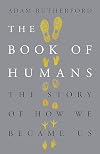
The effort to distinguish humans from the rest of the animals has filled volumes since before Darwin took his fated voyage on the HMS Beagle: tools, war, sex habits, language. In his latest book, The Book of Humans: The Story of How We Became Us, geneticist Adam Rutherford looks at each of these things and how our behaviour is different to and often surprisingly similar to other animals. The use of tools eg. was once seen as the main distinguishing factor that made us unique but scientists show more have documented many cases of animals using tools, monkeys using twigs to get at hidden insects and, as recently as 2017, some birds of prey were seen picking up sticks from brush fires and dropping them in dry grass to drive small animals into the open for easy pickings. As to sex habits, it has been argued in the past that humans were the only animals that had sex for reasons other than procreation but that is no longer the case. As Rutherford points out, there are few sexual habits of humans that haven't been observed in other species - here, I will freely admit I now know more than I ever I thought I needed or wanted to know about the sex habits of dolphins and otters - turns out they can be really big jerks in the sack.
In the end, Rutherford shows we really aren't that much different from other animals except in our ability, not only to learn but to teach and not just our closest kin but strangers. He also shows how we haven't really evolved genetically from our ancient Homo Sapiens ancestors or even likely Neanderthal or Denisovans - they had a capacity for language, for art, for symbolism just as we do now. He posits that it was increased population rather than genetics that is responsible for the rise of civilization, that as populations increase, so does our knowledge and skill-sharing.
Adam Rutherford has become one of my favourite science writers - he not only makes the science accessible to the scientifically illiterate like myself but, thanks to his use of humour, he makes it fun to read. The Book of Humans is no exception. It is well-written, well-documented, clearly explained and interesting. I would even call it entertaining, a word I'm sure most would agree is rarely used to describe a book of science.
Thanks to Netgalley and The Experiment for the opportunity to read this book in exchange for an honest review show less
In the end, Rutherford shows we really aren't that much different from other animals except in our ability, not only to learn but to teach and not just our closest kin but strangers. He also shows how we haven't really evolved genetically from our ancient Homo Sapiens ancestors or even likely Neanderthal or Denisovans - they had a capacity for language, for art, for symbolism just as we do now. He posits that it was increased population rather than genetics that is responsible for the rise of civilization, that as populations increase, so does our knowledge and skill-sharing.
Adam Rutherford has become one of my favourite science writers - he not only makes the science accessible to the scientifically illiterate like myself but, thanks to his use of humour, he makes it fun to read. The Book of Humans is no exception. It is well-written, well-documented, clearly explained and interesting. I would even call it entertaining, a word I'm sure most would agree is rarely used to describe a book of science.
Thanks to Netgalley and The Experiment for the opportunity to read this book in exchange for an honest review show less

If you're concerned that in picking up this book you're going to be subjected to a polemic, rest assured, you are. Don't worry though, it'll mostly be good for you. This is as Rutherford first takes you through the dubious history of Eugenics, its rise and fall as a philosophy, the international links between the enthusiasts of the concept, and how it produced bad social policy before that fall. Rutherford dryly notes that the resulting mess is still being cleaned up.
This takes you to the show more "present" dealt with in the second half of this work, as Rutherford considers how advances in genetic science, and the technology for manipulating genes, have led to people with more power than sense speculating on whether one could now make good on the "promise" of Eugenics. As a working geneticist Rutherford is highly dubious about the whole notion, emphasizing that the study of genetics in general, and human genetics in particular, merely serves to illustrate how little we do know, particularly when one gets into dealing health conditions that are influenced by dozens of genes. Never mind the vast impact of actually existing in a given environment conditions the expression of genetic heritage. Much of this I was already aware of, having picked it up by broad reading, but Rutherford ties all these issues together with a good bit of flair. As always, the sad thing is that the people who really do need to read this book probably won't be; or they'll be trying to get it banned because it doesn't respect their pet prejudices. show less
This takes you to the show more "present" dealt with in the second half of this work, as Rutherford considers how advances in genetic science, and the technology for manipulating genes, have led to people with more power than sense speculating on whether one could now make good on the "promise" of Eugenics. As a working geneticist Rutherford is highly dubious about the whole notion, emphasizing that the study of genetics in general, and human genetics in particular, merely serves to illustrate how little we do know, particularly when one gets into dealing health conditions that are influenced by dozens of genes. Never mind the vast impact of actually existing in a given environment conditions the expression of genetic heritage. Much of this I was already aware of, having picked it up by broad reading, but Rutherford ties all these issues together with a good bit of flair. As always, the sad thing is that the people who really do need to read this book probably won't be; or they'll be trying to get it banned because it doesn't respect their pet prejudices. show less
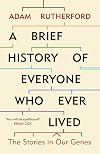
Really strong. Couldn't put it down at first. Got to around 92% before I flagged. This actually explained a few genetics concepts that I obviously hadn't fully "got" (during my, er... biology degree and project on genetics) so effectively that I'll be giving this to everyone as Christmas presents. Debunks racial "science", loads of interesting stuff on human origins (with the Neanderthals and Denisovans etc.), some history of science, and evolution. The only part I wasn't so sure of was the show more "defending science" bit at the end, but that's partly because I don't need convincing as I've seen evidence with my own eyes.
There was recently a trial* showing that teaching genetics before evolution improves understanding, and I think this book would serve very well as the general introduction a layperson needs to both get interested in the subject and lay a foundation for accurately comprehending how evolution works.
*Mead R, Hejmadi M, Hurst LD (2017) Teaching genetics prior to teaching evolution improves evolution understanding but not acceptance. PLoS Biol 15(5): e2002255. https://doi.org/10.1371/journal.pbio.2002255 show less
There was recently a trial* showing that teaching genetics before evolution improves understanding, and I think this book would serve very well as the general introduction a layperson needs to both get interested in the subject and lay a foundation for accurately comprehending how evolution works.
*Mead R, Hejmadi M, Hurst LD (2017) Teaching genetics prior to teaching evolution improves evolution understanding but not acceptance. PLoS Biol 15(5): e2002255. https://doi.org/10.1371/journal.pbio.2002255 show less
How to argue with a racist : what our genes do (and don't) say about human difference by Adam Rutherford
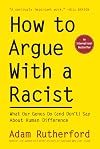
My answer, heretofore, to the titular question would have been “Don’t bother.” But I picked up this book because I figured that the brilliant Dr. Adam Rutherford, author of the runaway bestseller A Brief History of Everyone Who Ever Lived: The Stories in Our Genes, would have an answer if there was one to be had. And we in the West, especially in the United States, desperately need an answer if there is one to be had.
Alas, Dr. Rutherford does not have an answer to this question; show more indeed, he’s the first to admit he does not because arguing with racists is a waste of time. But what Dr. Rutherford provides is scientific proof that racism — despite what racists might say — has no scientific basis. Rutherford, a geneticist, exhaustively chronicles how there are much more variations within groups — however you define them — than between them.
Dr. Rutherford also provides the perfect refutation for conspiracy theorists of all stripes who claim that the science backs up their particular strain of tomfoolery but is being hidden by political correctness or some shadowy world-controlling cabal.
If you doubt that, ask yourself what downside there has been for a radiologist, an adulterous lady preacher and a literally dripping lawyer who tell a mad president what he wants to hear. It was the Koch brothers, not George Soros, who established nearly 70 fake think-tanks to grind out whatever “science” was needed.
You would not think that a scientific tome like this would be spellbinding, but this one is; I read it in two days. And let me give Dr. Rutherford the final say from the last chapter of this amazing book:
Alas, Dr. Rutherford does not have an answer to this question; show more indeed, he’s the first to admit he does not because arguing with racists is a waste of time. But what Dr. Rutherford provides is scientific proof that racism — despite what racists might say — has no scientific basis. Rutherford, a geneticist, exhaustively chronicles how there are much more variations within groups — however you define them — than between them.
Dr. Rutherford also provides the perfect refutation for conspiracy theorists of all stripes who claim that the science backs up their particular strain of tomfoolery but is being hidden by political correctness or some shadowy world-controlling cabal.
The idea that we are hiding some truth from the public for political reasons is absurd. As with equally mad antiscientific ideas such as creationism, if I could demonstrate that Darwin was wrong or that race is a scientifically valid and useful description of human variation, I would be the most famous biologist in history, and the riches that would follow would surely be magnificent.
If you doubt that, ask yourself what downside there has been for a radiologist, an adulterous lady preacher and a literally dripping lawyer who tell a mad president what he wants to hear. It was the Koch brothers, not George Soros, who established nearly 70 fake think-tanks to grind out whatever “science” was needed.
You would not think that a scientific tome like this would be spellbinding, but this one is; I read it in two days. And let me give Dr. Rutherford the final say from the last chapter of this amazing book:
The sweet irony is that the whole science of human genetics was founded by racists in a time of racism, and singularly has become the field that has demonstrated the scientific falsity of race…. If you are racist, you are asking for a fight. But science is my ally, not yours, and your fight is not just with me, but with reality.show less
Lists
Awards


You May Also Like


Associated Authors
Statistics
- Works
- 11
- Also by
- 1
- Members
- 2,923
- Popularity
- #8,762
- Rating
- 3.9
- Reviews
- 74
- ISBNs
- 120
- Languages
- 15
- Favorited
- 1