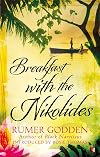
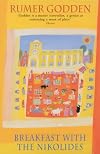
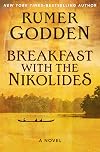
Breakfast with the Nikolides
by Rumer Godden
On This Page
Description
A troubled European family struggles to make a life in India during WWII in this "absorbing" novel from a New York Times -bestselling author ( Kirkus Reviews ). Eight years ago, Louise Pool left her husband, Charles, in India, fleeing a marriage marked by anger, disillusion, and mistrust. Now, with Europe engulfed in the flames of World War II and Germany's Nazi juggernaut rolling through occupied France, Louise is reluctantly returning to East Bengal, where Charles runs a government farm show more that hosts an Indian agricultural school. Back to this oppressive land she brings with her their two young daughters, who barely remember their father. For plain, awkward, eleven-year-old Emily, the "homecoming" offers both an exciting change from cosmopolitan Paris and a harsh immersion into the adult world. Intrigued by the sights, sounds, and smells of her exotic new home, she's left free to explore-and enjoy the hospitality and kindness of their glamorous neighbors, the Nikolides. Emily's already contentious relationship with her mother is only worsened, however, by Louise's intense hatred of rural India and its people and her continued unhappiness with the marriage she insists is temporary. The faults and foibles of both parents and the irreparable cracks in their union become all too apparent from a daughter's close-up perspective. But it is an extreme act of thoughtless cruelty that will ultimately shatter the tenuous bonds of family, violently disrupting the lives of the Pools and the community at large. Fans of the Masterpiece show Indian Summers will enjoy this poignant novel of betrayal, lost innocence, and fragile family ties, which represents the bestselling author of In This House of Brede and Kingfishers Catch Fire at her best. This ebook features an illustrated biography of the author including rare images from the Rumer Godden Literary Estate. show lessTags
Recommendations




















Member Reviews
Well, I jumped the gun a bit with my previous post about Rumer Godden's The River, but this time I'm on schedule for #RumerGoddenReadingWeek at Brona's This Reading Life...
Breakfast with the Nikolides is, according to Rosie Thomas who wrote the Introduction for this Virago edition, one of three early novels that reflect the themes and settings that are central to [Godden's] works.
The central character of Breakfast with the Nikolides is Emily Pool, taken by her mother from India when young but brought back in panic because of the Nazi invasion of France. Her mother hates India and everything about it, and although there are hints that Emily glimpsed something of her mother's trauma, the novel is an uncompromising depiction of a child who feels torn between her warring parents, and who judges her mother harshly. Louise's faults are many, and Emily is aware of them all, especially Louise's blatant preference for the younger child, Binnie, who is pretty and biddable (and surprisingly, given Louise's preference for this child) the product of marital rape). The characterisation of Louise, from the child's point of view—even when Louise is the narrator—is vivid and entirely unsympathetic.
Emily's father treats his problematic wife with indifference, salted by occasional acts of spite. Louise has two Pekingese lap dogs, but he gives Emily a dog of her own called, Don.
There is an authenticity about this dialogue that suggests auto-fiction, from Godden's own disastrous marriage.
To read the rest of my review please visit https://anzlitlovers.com/2021/12/04/breakfast-with-the-nikolides-by-rumer-godden... show less
Breakfast with the Nikolides is, according to Rosie Thomas who wrote the Introduction for this Virago edition, one of three early novels that reflect the themes and settings that are central to [Godden's] works.
Godden was a writer who continually drew on her own life experiences, frugally mixing and recasting the elements to give them fresh significance, but always relating her work back to the the people, places, human passions and frailties that she knew and understood best. Here, the place is Northern India, the people are pre-Partition British and the Indians theyshow more
governed, and the themes are sexual desire, treachery, the conflict of cultures and the loss of innocence. (p.vii)
The central character of Breakfast with the Nikolides is Emily Pool, taken by her mother from India when young but brought back in panic because of the Nazi invasion of France. Her mother hates India and everything about it, and although there are hints that Emily glimpsed something of her mother's trauma, the novel is an uncompromising depiction of a child who feels torn between her warring parents, and who judges her mother harshly. Louise's faults are many, and Emily is aware of them all, especially Louise's blatant preference for the younger child, Binnie, who is pretty and biddable (and surprisingly, given Louise's preference for this child) the product of marital rape). The characterisation of Louise, from the child's point of view—even when Louise is the narrator—is vivid and entirely unsympathetic.
Emily's father treats his problematic wife with indifference, salted by occasional acts of spite. Louise has two Pekingese lap dogs, but he gives Emily a dog of her own called, Don.
I asked Charles not to give the children a dog. I asked him not to give them Don. He gave them Don...
He gave him to Emily.
'Why Emily? Why not Binnie? Why Emily?'
'I think,' he said, 'that that little girl needs love.'
In her surprise Louise had stared. 'Emily! Why, Emily won't have love. That shows how little you know of her. She is hard. She is completely oblivious of everyone but herself. She doesn't care an atom for anyone. She is almost unnatural.'
'You don't like her, do you?'
She answered icily, 'I love Emily more than you could begin to understand.'
'You may love her, you don't like her.'
'I love her and I know her better than she knows herself.' And she said, 'I must ask you not to interfere with the children.' (p.63)
There is an authenticity about this dialogue that suggests auto-fiction, from Godden's own disastrous marriage.
To read the rest of my review please visit https://anzlitlovers.com/2021/12/04/breakfast-with-the-nikolides-by-rumer-godden... show less
Breakfast with the Nikolides is a peculiar little story – but it is one that packs something of a punch. The setting is East Bengal in a small agricultural town by a river. Charles Poole is in charge of the government farm of Amorra, on the same site is the agricultural college, where students work under the principle Sir Monmatha Ghose. Having lived in Amorra alone for eight years – Charles stuns the community with the sudden and inexplicable appearance of a wife and two daughters who have fled the war in Paris. Louise, Charles’s wife, is a complex damaged woman, she hates India, and she hates everything about it – is suspicious of it, and dislikes the people. Their eldest daughter is Emily an angry dreamer on the brink of show more adolescence has a very difficult relationship with her mother, but instantly adores the father she barely knows. Emily’s younger sister, Binnie, is the child born after the parents separated. Emily quickly falls in love with India, for her it is an exotic exciting place that she loves to explore. Emily and Binnie are enchanted by their glamorous neighbours the Nikolides, with whose children they occasionally play. Charles gives Emily a spaniel, that she names Don, he becomes a constant companion. One day Don is killed, and it is the deceit that surrounds this one incident that serves to unravel the fragile truths of their family life, and culminates in drawing in the whole community in violent uprising.
“Mother was clever. She knew how I felt about the Nikolides, she knew I would forget everything for them… And it seemed to Emily sheer treachery that Louise should have used them against her. One thing – said Emily – I shall never go blind like that again. I shall never be blind…And even to so young a girl as Emily there was something pitiable in the loss of heedlessness. Breakfast with the Nikolides was always to be the last hour of her childhood.”
We also meet young vet Narayan Das struggling to reconcile his young wife’s Hindu traditions with the modern westernised world he is trying to fit into. Narayan’s friend and student Anil working towards his final exams is also drawn into the drama that unfolds.
Breakfast with the Nikolides explores the dark and complex relationship between Charles and Louise – the truth of which is slowly revealed. Charles is something of an enigma, Louise a cold beauty who constantly misunderstands her eldest daughter – she is using Charles as an escape from German occupied France and can’t wait to return to Paris. The novel also examines loss of innocence and betrayal. Rumer Godden’s sense of place is excellent, a small Indian town on the banks of a river, young idealised students and modern thinking men juxtaposed with traditional beliefs and suspicions. show less
“Mother was clever. She knew how I felt about the Nikolides, she knew I would forget everything for them… And it seemed to Emily sheer treachery that Louise should have used them against her. One thing – said Emily – I shall never go blind like that again. I shall never be blind…And even to so young a girl as Emily there was something pitiable in the loss of heedlessness. Breakfast with the Nikolides was always to be the last hour of her childhood.”
We also meet young vet Narayan Das struggling to reconcile his young wife’s Hindu traditions with the modern westernised world he is trying to fit into. Narayan’s friend and student Anil working towards his final exams is also drawn into the drama that unfolds.
Breakfast with the Nikolides explores the dark and complex relationship between Charles and Louise – the truth of which is slowly revealed. Charles is something of an enigma, Louise a cold beauty who constantly misunderstands her eldest daughter – she is using Charles as an escape from German occupied France and can’t wait to return to Paris. The novel also examines loss of innocence and betrayal. Rumer Godden’s sense of place is excellent, a small Indian town on the banks of a river, young idealised students and modern thinking men juxtaposed with traditional beliefs and suspicions. show less
Emily Pool, her mother Louise, and sister Binnie are recently arrived in India to join her father Charles. He has been working in India for several years; the family only decides to join him when war seizes Europe (hmm, what’s that about? why the separation? keep reading …) Emily and Binnie are fascinated by the Nikolides, the only other European family in town, and it’s a treat to be given an opportunity to visit them for the day. But while they are away something awful happens at home, which has a huge emotional impact on Emily. Louise glosses over the details of this event and fails to admit her own part in it. Things between Emily and Louise begin to unravel, and the nature of Louise & Charles’ relationship is also exposed. show more The family’s interactions with Indian nationals reveal their ignorance and arrogance, and this, too, has its consequences. This is a dark but compelling novel of emotions and relationships. show less
Reminiscent of Virginia Woolf and Molly Keane, and very akin to Forster's A Passage to India. Deep, dark; with a gossamer plot that slowly tightens around you like a spiderweb; packs an emotional wallop. Touches on all the best empire-builders-among-the-natives themes.
Started: Winter 2002
I read the first 50 pages over and over I still couldn't figure out what was happening and where it was going. Maybe I'll try again someday.
I read the first 50 pages over and over I still couldn't figure out what was happening and where it was going. Maybe I'll try again someday.
Ratings
Members
- Recently Added By
Lists

Books Read in 2015
3,299 works; 129 members
Author Information

89+ Works 15,358 Members
Margaret Rumer Godden was born Dec. 10, 1907, in Sussex, England. She was nine months old when her family moved to India, where her father ran a shipping line. She returned to London at age 20 to learn how to teach dance to children, and opened a school back in India. Returning to England while she was pregnant, she wrote her first book, "Chinese show more Puzzle," published in 1936. Her marriage to a stockbroker, Laurence Sinclair Foster, ended in 1941, leaving her penniless. In an effort to pay off her former husband's debts, Godden moved her family into a mountain cottage where she ran a school, made herbal teas for sale, and wrote books. Another novel of India, "The River," published in 1949, was one of her most acclaimed books and was made into a film by Jean Renoir in 1951. She returned to England to stay in 1945. Rumer Godden was the author of more than 60 books, including novels, short story collections, poetry, plays and non-fiction. She published her 21st novel, "Cromartie vs. the God Shiva," in 1997. Rumer Godden died a year later on November 8, 1998, in Thornhill, Scotland, at the age of 90. (Bowker Author Biography) show less
Some Editions
Series
Belongs to Publisher Series
Virago Modern Classics (573)
Work Relationships
Common Knowledge
- Canonical title
- Breakfast with the Nikolides
- Original title
- Breakfast with the Nikolides
- Original publication date
- 1942
- People/Characters
- Emily Pool; Charles Pool; Sir Monmatha Ghose; Yorgo Nikolides; Louise Pool; Binnie Pool (show all 14); Narayan Das; Mahomed Shah; Tarala; Shila; Anil Banerjee; Mrs Nikolides; Alexandra Nikolides; Jason Nikolides
- Important places
- Amorra, East Bengal, India
- Dedication
- To the families of Mangos and Elethriades - now in Athens - who were once, for me, the Nikolides
My thanks are due to Kumar Krishna Das for his courtesy and help.
I should like to thank Kumar Krishna Das
for his courtesy and help. - First words
- It was in the little agricultural town of Amorra, East Bengal, India.
In the decades since they were written, Rumer Godden's India novels have floated in and out of fashion, yet whatever tidal shifts have affected current tastes in fiction these distinctive, delicately poised and entirely unsen... (show all)timental books have never lost a shred of their almost hypnotic appeal. (Introduction) - Last words
- (Click to show. Warning: May contain spoilers.)Emily's burned steadily as it floated away.
(Click to show. Warning: May contain spoilers.)They have repaid rereading from an adult perspective, and they will continue to reward both returning readers and new ones: such is their narrative grip, clothed in its silken dress of delicacy, subtlety and understanding of the human state. (Introduction) - Original language
- English
Classifications
Statistics
- Members
- 161
- Popularity
- 204,561
- Reviews
- 5
- Rating
- (3.73)
- Languages
- English, French
- Media
- Paper, Ebook
- ISBNs
- 12
- ASINs
- 9