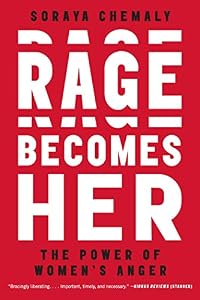
Rage Becomes Her: The Power of Women's Anger
by Soraya Chemaly
On This Page
Description
***A BEST BOOK OF 2018 SELECTION***NPR * The Washington Post * Book Riot * Autostraddle * Psychology Today
***A BEST FEMINIST BOOK SELECTION***
Refinery 29, Book Riot, Autostraddle, BITCH
Rage Becomes Her is an "utterly eye opening" (Bustle) book that gives voice to the causes, expressions, and possibilities of female rage.
As women, we've been urged for so long to bottle up our anger, letting it corrode our bodies and minds in ways we don't even realize. Yet there are so, so many show more legitimate reasons for us to feel angry, ranging from blatant, horrifying acts of misogyny to the subtle drip, drip drip of daily sexism that reinforces the absurdly damaging gender norms of our society.
In Rage Becomes Her, Soraya Chemaly argues that our anger is not only justified, it is also an active part of the solution. We are so often encouraged to resist our rage or punished for justifiably expressing it, yet how many remarkable achievements would never have gotten off the ground without the kernel of anger that fueled them? Approached with conscious intention, anger is a vital instrument, a radar for injustice and a catalyst for change. On the flip side, the societal and cultural belittlement of our anger is a cunning way of limiting and controlling our power—one we can no longer abide.
"A work of great spirit and verve" (Time), Rage Becomes Her is a validating, energizing read that will change the way you interact with the world around you. show less
Tags
Recommendations

























Member Recommendations
Member Reviews
A little over halfway through this book, the author asks a question to the effect of: can you read a book about anger without becoming enraged? At least for me, the answer is no. Now, to be honest, I picked up this book in part because I was already annoyed, frustrated, and angry. What was great about this book was the validation it provided: it's amazing how powerful it is to have someone acknowledge your feelings and say the problems you struggle with are real and justified. This book also didn't shrink away from pointing out intersectional problems with women's anger, that some women are angry with each other, and that women can be angry about different things. I was worried when I started this book that it's relevance would be muted show more in the post-Trump era, but a certain New York governor proved that this book and topic are likely to be around and relevant for quite some time. show less
I read Eloquent Rage, Rage Becomes Her, and Good and Mad sequentially over about a week, and I highly recommend doing so. They're very complementary. Rage Becomes Her is a sociological book with an incredible amount of research on everything that is making women angry and why that's not a problem; Good and Mad is a narrative journalistic account of the many times in history and the present day that women's anger has changed society for the better; Eloquent Rage is a memoir and account of feminism and anger in the life of one black feminist. They nicely span the range between global to personal, make a sincere effort to be intersectional, and if these don't put a fire in your belly on women's issues it's very likely nothing ever show more will.
Here's a quote from the end of Rage Becomes Her that encapsulates her book's arguments and really could be put on a motivational poster or a t-shirt (or a meme, if it were a little shorter):
If you feel right now like you have a lot of rage, and don't know whether or not that's a good thing, and have no idea what to do with it all, these are three great books to read. I got to the end and felt about a million times better (though no less angry) and ready to make a lot of noise. show less
Here's a quote from the end of Rage Becomes Her that encapsulates her book's arguments and really could be put on a motivational poster or a t-shirt (or a meme, if it were a little shorter):
Anger is an assertion of rights and worth. It is communication, equality and knowledge. It is intimacy, acceptance, fearlessness, embodiment, revolt, and reconciliation. Anger is memory and rage. It is rational thought and irrational pain. Anger is freedom, independence, expansiveness, and entitlement. It is justice, passion, clarity, and motivation. Anger is instrumental, thoughtful, complicated, and resolved. In anger, whether you like it or not, there is truth.
Anger is the demand of accountability. It is evaluation, judgement, and refutation. It is reflective, visionary and anticipatory. It's a speech act, a social statement, an intention, and a purpose. It's a risk and a threat. A confirmation and a wish. It is both powerlessness and power, palliative and a provocation. In anger, you will find both ferocity and comfort, vulnerability and hurt. Anger is the expression of hope.
If you feel right now like you have a lot of rage, and don't know whether or not that's a good thing, and have no idea what to do with it all, these are three great books to read. I got to the end and felt about a million times better (though no less angry) and ready to make a lot of noise. show less
Anger is a Gift
(Full disclosure: I received a free e-ARC for review through NetGalley. Trigger warning for discussions of sexism and misogyny, including sexual assault.)
“Ask yourself, why would a society deny girls and women, from cradle to grave, the right to feel, express, and leverage anger and be respected when we do? Anger has a bad rap, but it is actually one of the most hopeful and forward thinking of all of our emotions. It begets transformation, manifesting our passion and keeping us invested in the world. It is a rational and emotional response to trespass, violation, and moral disorder. It bridges the divide between what ‘is and what ‘ought’ to be, between a difficult past and an improved possibility. Anger warns us show more viscerally of violation, threat, and insult. By effectively severing anger from ‘good womanhood,’ we choose to sever girls and women from the emotion that best protects us against danger and injustice.”
“Anger is usually about saying ‘no’ in a world where women are conditioned to say almost anything but “’no.’”
“Because the truth is that anger isn’t what gets in our way—it is our way. All we have to do is own it.”
-- 3.5 stars --
After nearly ten years of marriage, and more than fifteen years together, my husband suddenly and unexpectedly passed away last year - leaving me a widow at the ripe old age of thirty-eight. The grief and shock quickly gave way to anger; in the process of reconciling his estate, I discovered secrets he'd been hiding from me. These were like a steady drip-drip-drip of awfulness that continued to pummel me in the weeks and months following his death.
My aunt - one of the relatives who came out for an extended stay as part of "Kelly Duty," and who had a front seat to the dumpster fire that my life had become - said something that will always stick with me, and not in a good way. She was reading some paranormal/urban fantasy book at the time, and apparently the MC was not a fan of anger. She proceeded to give me this long speech about how anger poisons you from the inside out, and the only way to move on is through forgiveness. I'm sure she meant well, but the whole thing came off as insensitive, clueless, even manipulative. (I'm already feeling powerless, like I have zero control over anything in my life; now I don't even get to decide how I feel about things?) I was still in the thick of things then, with bad news coming at me on the daily. Even a year and a half on, I am absolutely seething with anger.
Anyway, I didn't know quite how to answer her at the time - probably I didn't even have the energy for a rebuttal, and just let it go - but today, I am highly tempted to send her a copy of Soraya Chemaly's book (possibly in conjunction with Mark Oshiro's Anger Is a Gift, from which I borrowed the title for this review). Except I can't hardly afford it, which is the source of some of my anger. This isn't unusual, either, as I've learned from reading Rage Becomes Her: poverty, powerlessness, and a lack of authority are all associated with unexpressed anger. My continued rumination? Also par for the course.
Rage Becomes Her is an interesting mix. Chemaly both explores the sources of women's anger (rape culture, the wage gap, the caring mandate, unpaid/undervalued care work - described as "the single greatest wealth transfer in today’s global economy" - sexualization and objectification, discrimination against pregnant or potentially pregnant women, the denial of women's physical pain, etc. etc. etc., so on and so forth), as well as the effects that unexpressed anger can have on a body, a psyche, a relationship, and a society (depression, anxiety, heart failure, physical pain, abuse, divorce, inequality, authoritarianism).
In some ways, this reads a lot like Everyday Sexism, and similar books that catalog, interrogate, and challenge sexism and misogyny in modern culture. (In fact, Laura Bates and the Everyday Sexism Project do get a shout-out here. If you do any amount of feminist reading online, no doubt you'll recognize some of the activists mentioned in this book.) However, there's an added dimension that makes Rage Becomes Her unique: anger. In contrast to a lifetime's worth of social conditioning that teaches girls to smile and be nice, Chemaly encourages women and girls to acknowledge and embrace our anger, harnessing it in a constructive way, as a tool of social change.
At least this is what Chemaly seems to be going for. I would've like to have seen more information on anger itself - examples of how activists have channeled it for positive change, for example - and less background information, for lack of a better word, on why women should be angry in the first place. Let's face it: most of the folks picking up a book provocatively titled Rage Becomes Her probably have a good enough grasp of feminism 101, right? (But I do really appreciate her emphasis on intersectionality, which is something all of us could use a continued refresher in.)
Of course, as Chemaly herself points out, there's a dearth of research on the mediating effects of gender (and race and class) on emotions, particularly anger (not to be confused with assertiveness and aggression, which are behaviors) - so that book might be difficult to write, at least at this point in time. As it is, Rage Becomes Her is a good enough place to start.
Fwiw, I read this book as an ARC. While I assume that it was thoroughly researched - as evidenced by a bibliography that comprises 21% of the Kindle file - the review copy did not contain footnotes, or even a suggestion of where they might go. This threw me for a loop since I'm the kind of dork that reads those things. I'm trying not to hold it against the finished copy, but it's a struggle.
http://www.easyvegan.info/2018/09/11/rage-becomes-her-by-soraya-chemaly/ show less
(Full disclosure: I received a free e-ARC for review through NetGalley. Trigger warning for discussions of sexism and misogyny, including sexual assault.)
“Ask yourself, why would a society deny girls and women, from cradle to grave, the right to feel, express, and leverage anger and be respected when we do? Anger has a bad rap, but it is actually one of the most hopeful and forward thinking of all of our emotions. It begets transformation, manifesting our passion and keeping us invested in the world. It is a rational and emotional response to trespass, violation, and moral disorder. It bridges the divide between what ‘is and what ‘ought’ to be, between a difficult past and an improved possibility. Anger warns us show more viscerally of violation, threat, and insult. By effectively severing anger from ‘good womanhood,’ we choose to sever girls and women from the emotion that best protects us against danger and injustice.”
“Anger is usually about saying ‘no’ in a world where women are conditioned to say almost anything but “’no.’”
“Because the truth is that anger isn’t what gets in our way—it is our way. All we have to do is own it.”
-- 3.5 stars --
After nearly ten years of marriage, and more than fifteen years together, my husband suddenly and unexpectedly passed away last year - leaving me a widow at the ripe old age of thirty-eight. The grief and shock quickly gave way to anger; in the process of reconciling his estate, I discovered secrets he'd been hiding from me. These were like a steady drip-drip-drip of awfulness that continued to pummel me in the weeks and months following his death.
My aunt - one of the relatives who came out for an extended stay as part of "Kelly Duty," and who had a front seat to the dumpster fire that my life had become - said something that will always stick with me, and not in a good way. She was reading some paranormal/urban fantasy book at the time, and apparently the MC was not a fan of anger. She proceeded to give me this long speech about how anger poisons you from the inside out, and the only way to move on is through forgiveness. I'm sure she meant well, but the whole thing came off as insensitive, clueless, even manipulative. (I'm already feeling powerless, like I have zero control over anything in my life; now I don't even get to decide how I feel about things?) I was still in the thick of things then, with bad news coming at me on the daily. Even a year and a half on, I am absolutely seething with anger.
Anyway, I didn't know quite how to answer her at the time - probably I didn't even have the energy for a rebuttal, and just let it go - but today, I am highly tempted to send her a copy of Soraya Chemaly's book (possibly in conjunction with Mark Oshiro's Anger Is a Gift, from which I borrowed the title for this review). Except I can't hardly afford it, which is the source of some of my anger. This isn't unusual, either, as I've learned from reading Rage Becomes Her: poverty, powerlessness, and a lack of authority are all associated with unexpressed anger. My continued rumination? Also par for the course.
Rage Becomes Her is an interesting mix. Chemaly both explores the sources of women's anger (rape culture, the wage gap, the caring mandate, unpaid/undervalued care work - described as "the single greatest wealth transfer in today’s global economy" - sexualization and objectification, discrimination against pregnant or potentially pregnant women, the denial of women's physical pain, etc. etc. etc., so on and so forth), as well as the effects that unexpressed anger can have on a body, a psyche, a relationship, and a society (depression, anxiety, heart failure, physical pain, abuse, divorce, inequality, authoritarianism).
In some ways, this reads a lot like Everyday Sexism, and similar books that catalog, interrogate, and challenge sexism and misogyny in modern culture. (In fact, Laura Bates and the Everyday Sexism Project do get a shout-out here. If you do any amount of feminist reading online, no doubt you'll recognize some of the activists mentioned in this book.) However, there's an added dimension that makes Rage Becomes Her unique: anger. In contrast to a lifetime's worth of social conditioning that teaches girls to smile and be nice, Chemaly encourages women and girls to acknowledge and embrace our anger, harnessing it in a constructive way, as a tool of social change.
At least this is what Chemaly seems to be going for. I would've like to have seen more information on anger itself - examples of how activists have channeled it for positive change, for example - and less background information, for lack of a better word, on why women should be angry in the first place. Let's face it: most of the folks picking up a book provocatively titled Rage Becomes Her probably have a good enough grasp of feminism 101, right? (But I do really appreciate her emphasis on intersectionality, which is something all of us could use a continued refresher in.)
Of course, as Chemaly herself points out, there's a dearth of research on the mediating effects of gender (and race and class) on emotions, particularly anger (not to be confused with assertiveness and aggression, which are behaviors) - so that book might be difficult to write, at least at this point in time. As it is, Rage Becomes Her is a good enough place to start.
Fwiw, I read this book as an ARC. While I assume that it was thoroughly researched - as evidenced by a bibliography that comprises 21% of the Kindle file - the review copy did not contain footnotes, or even a suggestion of where they might go. This threw me for a loop since I'm the kind of dork that reads those things. I'm trying not to hold it against the finished copy, but it's a struggle.
http://www.easyvegan.info/2018/09/11/rage-becomes-her-by-soraya-chemaly/ show less
Rage Becomes Her is at once the worst and best book to have started in the midst of the Brett Kavanaugh confirmation. I was already enraged and this book has so much more to make me angry, but it also puts it into context. Of course, the best thing Soraya Chemaly does with Rage Becomes Her is encouraging us to see our anger as healthy.
Chemaly begins by reclaiming anger. Women are supposed to be sad, not angry. We are not supposed to have the power of anger. Anger is a demand, sorrow is acceptance. Then she spends several chapters reminding us why we should be angry, from pay differentials, the women tax, sexual assault, health care inequities, and the flat-out misogyny that impinges so much on our lives. I would read a bit and then have show more to get up and chop onions VERY HARD or take a short walk just to walk off some of the anger so I could read some more.
It’s not that I didn’t know a lot of this, but concentrating it is an intense experience. However, Chemaly does us the service of ending with a chapter on turning our anger into more than a fiery furnace so that it is instead, the optimistic demand for justice that righteous anger can be.
It took me far longer than usual to read Rage Becomes Her. This is not because this is not a good book, it’s because it is so very intense. Seriously, if you could measure injustice per column-inch, this book is near the saturation point. In spite of bringing all the scholarly receipts, Rage Becomes Her is a very readable narrative. Chemaly brings herself and her family into the narrative, telling of seeing her mother’s evident, but unexpressed rage and finding herself falling into the trap of perpetuating the ‘good girl” socialization with her own daughter who was being bullied. This kind of honest self-reflection reifies many of the broader themes.
This is not a happy book and it will make you angry, but you should read it anyway. We really need to see the bigger picture. We really do need our anger and we need to employ that anger to make the world less unfair and better for women, not just for us, but for the next generations.
I received a copy of Rage Becomes Her from the publisher through NetGalley.
Rage Becomes Her from Atria Books
Soraya Chemaly at Women’s Media Center
https://tonstantweaderreviews.wordpress.com/2018/10/15/rage-becomes-her-by-soray... show less
Chemaly begins by reclaiming anger. Women are supposed to be sad, not angry. We are not supposed to have the power of anger. Anger is a demand, sorrow is acceptance. Then she spends several chapters reminding us why we should be angry, from pay differentials, the women tax, sexual assault, health care inequities, and the flat-out misogyny that impinges so much on our lives. I would read a bit and then have show more to get up and chop onions VERY HARD or take a short walk just to walk off some of the anger so I could read some more.
It’s not that I didn’t know a lot of this, but concentrating it is an intense experience. However, Chemaly does us the service of ending with a chapter on turning our anger into more than a fiery furnace so that it is instead, the optimistic demand for justice that righteous anger can be.
It took me far longer than usual to read Rage Becomes Her. This is not because this is not a good book, it’s because it is so very intense. Seriously, if you could measure injustice per column-inch, this book is near the saturation point. In spite of bringing all the scholarly receipts, Rage Becomes Her is a very readable narrative. Chemaly brings herself and her family into the narrative, telling of seeing her mother’s evident, but unexpressed rage and finding herself falling into the trap of perpetuating the ‘good girl” socialization with her own daughter who was being bullied. This kind of honest self-reflection reifies many of the broader themes.
This is not a happy book and it will make you angry, but you should read it anyway. We really need to see the bigger picture. We really do need our anger and we need to employ that anger to make the world less unfair and better for women, not just for us, but for the next generations.
I received a copy of Rage Becomes Her from the publisher through NetGalley.
Rage Becomes Her from Atria Books
Soraya Chemaly at Women’s Media Center
https://tonstantweaderreviews.wordpress.com/2018/10/15/rage-becomes-her-by-soray... show less
Disclaimer: I received an Advanced Reader Copy of this book from Goodreads Giveaways in exchange for an honest review.
9/26/18 - I'll write a more thorough review later, but my first thought is...wow. I won't lie, I started this book with trepidation. When I get angry, I cry. I actively avoid any and all confrontation. I've even been known to walk out of a room when an argument erupts, even if I'm not personally contributing to it. You get the picture.
I was blown away by Rage Becomes Her. The blood, sweat, and tears that Chemaly placed in this work is astounding. Her knowledge and passion are remarkable. Her words invoked in me the desire to reflect on every righteously angry moment I've ever had and to absolve myself of the guilt I show more didn't even realize I was feeling.
Thank you, Soraya Chemaly. Thank you for reminding me that my anger matters. Women (and men) of the world, please read this book and take it seriously. I promise you'll be a better person for it. show less
9/26/18 - I'll write a more thorough review later, but my first thought is...wow. I won't lie, I started this book with trepidation. When I get angry, I cry. I actively avoid any and all confrontation. I've even been known to walk out of a room when an argument erupts, even if I'm not personally contributing to it. You get the picture.
I was blown away by Rage Becomes Her. The blood, sweat, and tears that Chemaly placed in this work is astounding. Her knowledge and passion are remarkable. Her words invoked in me the desire to reflect on every righteously angry moment I've ever had and to absolve myself of the guilt I show more didn't even realize I was feeling.
Thank you, Soraya Chemaly. Thank you for reminding me that my anger matters. Women (and men) of the world, please read this book and take it seriously. I promise you'll be a better person for it. show less
The author disputes the idea that there is something wrong with women being angry. She discusses the ways in which women have had their anger suppressed, or have suppressed it themselves, including the policing of women by other women. She suggests that anger is a powerful force, but unexpressed anger has a negative effect on women's health and wellbeing. The book is lucid and well written, though there are a few places where the use of sentence fragments jarred. The main reason this book does not get five stars is the constant insistence of dealing with things that are not about women, per se, but about other ways in which people are oppressed; while intersectionality is a valid concept and should be considered in many feminist show more actions, there are times when it pushes the main topic, women, out of the way in favor of other axes of oppression. Also, the author insists against all evidence that trans women are subject to the same levels of oppression that women are, and uses the godawful term ciswomen once or twice. Not awful, possibly just enough to cool the fires from activists that might target her otherwise. The main complaint is that there are a few interesting pieces of data she throws out there but leaves unexplored. One of these is the research that discovered white women tend to have more unexpressed anger and lower self-esteem than women of color...why is this? There is little to indicate the author knows, or cares. She breezes by that, introducing it as an interesting statistic that then goes away, never to be mentioned again. This is sort of like going to a movie and only getting to see the trailer. Perhaps since she is not a white woman herself, she felt she was not qualified to explain that, though my best guess is that no one is asking that question, so research on the whys has not been done. Otherwise, a book I would highly recommend, and not only to women who need to know that it's okay to be angry, but also to men who need to know that women's anger is justified in many cases, and that it is no more invalid than men's anger. show less
A meticulously researched, illuminating and timely read about the social constraints placed upon women to stifle and erase their anger. This book covers not only the stigma against women's anger but the reasons for women's anger. Why are women mad? And why is the open expression of this rage so threatening to traditional society?
There is a lot here. It's a rich resource and beautiful text. A valuable read for any audience.
There is a lot here. It's a rich resource and beautiful text. A valuable read for any audience.
Members
- Recently Added By
Lists

Feminism
167 works; 4 members
Author Information

3+ Works 665 Members
Some Editions
Awards and Honors
Distinctions
Notable Lists
Common Knowledge
- Canonical title
- Rage Becomes Her: The Power of Women's Anger
Classifications
- Genres
- Sexuality and Gender Studies, General Nonfiction, Nonfiction
- DDC/MDS
- 155.3 — Philosophy and Psychology Psychology Differential and developmental psychology Sexuality and Gender
- LCC
- HQ1206 .C455 — Social sciences The family. Marriage, Women and Sexuality The Family. Marriage. Women Women. Feminism
- BISAC
Statistics
- Members
- 611
- Popularity
- 47,508
- Reviews
- 15
- Rating
- (4.22)
- Languages
- 6 — Dutch, English, French, German, Italian, Spanish
- Media
- Paper, Audiobook, Ebook
- ISBNs
- 17
- ASINs
- 5