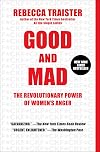
Good and Mad: How Women's Anger Is Reshaping America
by Rebecca Traister
On This Page
Description
In the year 2018, it seems as if women's anger has suddenly erupted into the public conversation. But long before Pantsuit Nation, before the Women's March, and before the #MeToo movement, women's anger was not only politically catalytic but politically problematic. The story of female fury and its cultural significance demonstrates the long history of bitter resentment that has enshrouded women's slow rise to political power in America, as well as the ways that anger is received when it show more comes from women as opposed to when it comes from men. Rebecca Traister tracks the history of female anger as political fuel--from suffragettes chaining themselves to the White House to office workers vacating their buildings after Clarence Thomas was confirmed to the Supreme Court. Here Traister explores women's anger at both men and other women; anger between ideological allies and foes; the varied ways anger is perceived based on its owner; as well as the history of caricaturing and delegitimizing female anger; and the way women's collective fury has become transformative political fuel, as is most certainly occurring today. She deconstructs society's (and the media's) condemnation of female emotion (notably, rage) and the impact of their resulting repercussions. Highlighting a double standard perpetuated against women by all sexes, and its disastrous, stultifying effect, Traister offers a glimpse into the galvanizing force of women's collective anger, which, when harnessed, can change history. show lessTags
Recommendations


















Member Reviews
Wow, this was exactly what I needed to read right now. Using the political nightmare we're all living through right now as her launching point, Traister traces all the ways that women's righteous anger at their status has been systematically diminished, derided and degraded by those who are unwilling to share power — yep, I'm afraid white men don't fare well here. It was striking to me how Traister clearly takes no pleasure in pointing out the ways that even men who believe they are allies undermine the work women are doing, which makes the indictment all the more powerful.
The examples and situations of women's anger being dismissed or turned against them, both historical and contemporary, are as infuriating as they are endless, but show more she also recounts times when women have persisted and used their anger to effect real social change. It's powerful stuff. I appreciated how Traister didn't shy away from discussing the ways that the righteous anger of women has been undermined by other women, and the frustration and resentment felt by women of color, who have often been vocally agitating on particular issues long before they are "discovered" by white women. There were a number of times that I felt uncomfortable and had to examine some of my own assumptions and behaviors, recognizing that despite my best efforts I have sometimes been complicit in such "whitewashing" and erasure of the important work done by black women.
This book is "hot off the presses," so to speak, covering events that happened as recently as this past spring and summer. Even so, as I was reading it in the run-up to and immediate aftermath of the recent election, I wished I could have read what Traister thought about the historic numbers of women who were elected to both federal, state and local offices this week, and the racial and cultural diversity that they represent.
The book closes with Traister cautioning that while the fury women felt following the 2016 election has compelled many of them to become politically active for the first time, that level of commitment and action will need to be sustained for a long time if the goal of a better society is to be met. It's a marathon, not a sprint, but there may be no one better to run it than all the "moms in tennis shoes" who are learning how not to use their indoor voices. show less
The examples and situations of women's anger being dismissed or turned against them, both historical and contemporary, are as infuriating as they are endless, but show more she also recounts times when women have persisted and used their anger to effect real social change. It's powerful stuff. I appreciated how Traister didn't shy away from discussing the ways that the righteous anger of women has been undermined by other women, and the frustration and resentment felt by women of color, who have often been vocally agitating on particular issues long before they are "discovered" by white women. There were a number of times that I felt uncomfortable and had to examine some of my own assumptions and behaviors, recognizing that despite my best efforts I have sometimes been complicit in such "whitewashing" and erasure of the important work done by black women.
This book is "hot off the presses," so to speak, covering events that happened as recently as this past spring and summer. Even so, as I was reading it in the run-up to and immediate aftermath of the recent election, I wished I could have read what Traister thought about the historic numbers of women who were elected to both federal, state and local offices this week, and the racial and cultural diversity that they represent.
The book closes with Traister cautioning that while the fury women felt following the 2016 election has compelled many of them to become politically active for the first time, that level of commitment and action will need to be sustained for a long time if the goal of a better society is to be met. It's a marathon, not a sprint, but there may be no one better to run it than all the "moms in tennis shoes" who are learning how not to use their indoor voices. show less
I read Eloquent Rage, Rage Becomes Her, and Good and Mad sequentially over about a week, and I highly recommend doing so. They're very complementary. Rage Becomes Her is a sociological book with an incredible amount of research on everything that is making women angry and why that's not a problem; Good and Mad is a narrative journalistic account of the many times in history and the present day that women's anger has changed society for the better; Eloquent Rage is a memoir and account of feminism and anger in the life of one black feminist. They nicely span the range between global to personal, make a sincere effort to be intersectional, and if these don't put a fire in your belly on women's issues it's very likely nothing ever show more will.
Traister's argument is that women's anger is not only justified, but is essential: it is what will fuel and propel us through the necessary changes to make a better world. That this is what has changed the world before, and it can change the world again. And that allowing ourselves to feel the anger we have, rather than suppressing it or trying to change or ignore it, is way better for us psychologically and even physically.
If you feel right now like you have a lot of rage, and don't know whether or not that's a good thing, and have no idea what to do with it all, these are three great books to read. I got to the end and felt about a million times better (though no less angry) and ready to make a lot of noise. show less
Traister's argument is that women's anger is not only justified, but is essential: it is what will fuel and propel us through the necessary changes to make a better world. That this is what has changed the world before, and it can change the world again. And that allowing ourselves to feel the anger we have, rather than suppressing it or trying to change or ignore it, is way better for us psychologically and even physically.
'It's so powerful and kind of reminds me that the other side of the anger is the hope,' Morales wrote to me. 'We wouldn't be angry if we didn't still believe that it could be better.'
And if it gets better in part because of women's ability and willingness and need to feel their anger and to let it out into the world, then what we would be living through right now would not be a trend or a fad or a witch hunt, but an insurrection--a righteous revolution, led by angry women.
If you feel right now like you have a lot of rage, and don't know whether or not that's a good thing, and have no idea what to do with it all, these are three great books to read. I got to the end and felt about a million times better (though no less angry) and ready to make a lot of noise. show less
This book was, in some respects, hard to listen to. Early sections of it plunged me right back into what I was feeling in late 2016 and early 2017, and those were not good feelings.
It is, though, a very good, enlightening, informative, and useful look at the women's movement, and its roots and antecedents. Traister examines the ways in which women's anger is both dangerous and useful--and even healthy, which is not something many sources will say about anger. Yet we do know that bottling up anger with no outlet is unhealthy, and it should be obvious that finding useful and productive outlets for it can only be good for us.
But this isn't mainly a book about emotions. It's about the ways the we have had to fight the same battles over and show more over again, and yet each time making a little bit more progress, with a bit more freedom, a bit more bodily autonomy, a bit closer approach to equality.
And it's about the different experiences that white and black women have, and always have had in this country. African-Americans have never really been able to lapse into complacency, while white women, if they have good relationships with the men in their lives, often can for long periods. One result of this is that African-American women know a great deal about organizing, resistance, and the risks that white women have had to relearn every time another boiling up of resistance against white male patriarchy emerges.
Yet the same social forces that let white women forget about the problems for long periods also mean that white women have valuable resources to bring to the struggle, when social forces remind us that it's our struggle, too.
Traister doesn't put it quite this way, but we need to not get distracted into resenting and fighting too much with each other, but rather learn from each other, learn to collaborate, and focus on what this is really all about.
Parts of this book are very difficult. Not everyone will be in a mental and emotional place where they can read it. But if you can, it's well worth doing.
Recommended.
I borrowed this audiobook from my local library. show less
It is, though, a very good, enlightening, informative, and useful look at the women's movement, and its roots and antecedents. Traister examines the ways in which women's anger is both dangerous and useful--and even healthy, which is not something many sources will say about anger. Yet we do know that bottling up anger with no outlet is unhealthy, and it should be obvious that finding useful and productive outlets for it can only be good for us.
But this isn't mainly a book about emotions. It's about the ways the we have had to fight the same battles over and show more over again, and yet each time making a little bit more progress, with a bit more freedom, a bit more bodily autonomy, a bit closer approach to equality.
And it's about the different experiences that white and black women have, and always have had in this country. African-Americans have never really been able to lapse into complacency, while white women, if they have good relationships with the men in their lives, often can for long periods. One result of this is that African-American women know a great deal about organizing, resistance, and the risks that white women have had to relearn every time another boiling up of resistance against white male patriarchy emerges.
Yet the same social forces that let white women forget about the problems for long periods also mean that white women have valuable resources to bring to the struggle, when social forces remind us that it's our struggle, too.
Traister doesn't put it quite this way, but we need to not get distracted into resenting and fighting too much with each other, but rather learn from each other, learn to collaborate, and focus on what this is really all about.
Parts of this book are very difficult. Not everyone will be in a mental and emotional place where they can read it. But if you can, it's well worth doing.
Recommended.
I borrowed this audiobook from my local library. show less
I was a big fan of All The Single Ladies, but I was a bit reticent to start this one. I was worried it would be a celebration of only very recent feminism, and I wasn't feeling very celebratory. I'm glad I read it, though. Rebecca Traister does an admirable job of reconciling feminism's transgressions with its victories, as well as in recognizing where we - my "we" meaning "white feminists" specifically - could be doing better. In particular, I would suggest this book to second-wave feminists who are feeling the urge to return to the fray.
Good and Mad delves into the history of women's anger throughout history. Women have been given countless reasons through injustice, inequality, belittling, etc. to be angry. To add insult to injury, women are not even allowed to be angry. History shows that women's anger has been treated without the respect and validity afforded to men and their anger. Traister brings forth examples and shows her readers that their own ingrained biases, whether they identify as male or female.
Reading Traister's books has been enlightening. Good and Mad confirmed for me that the reflections and feelings I experience everyday are no less valid and justified because I lack the ability to put them into words. Traister puts into words the thoughts that so show more many women (and men) struggle to conceptualize and voice. Over the years I have shied away from political writings due to frustration and dearth of understanding. Traister has made politics approachable for me. Even if you do not agree with all of the viewpoints or political leanings, Traister leaves her readers better educated on any topic she tackles. I highly recommend Good and Mad, as well as all of Rebecca Traister's writings. show less
Reading Traister's books has been enlightening. Good and Mad confirmed for me that the reflections and feelings I experience everyday are no less valid and justified because I lack the ability to put them into words. Traister puts into words the thoughts that so show more many women (and men) struggle to conceptualize and voice. Over the years I have shied away from political writings due to frustration and dearth of understanding. Traister has made politics approachable for me. Even if you do not agree with all of the viewpoints or political leanings, Traister leaves her readers better educated on any topic she tackles. I highly recommend Good and Mad, as well as all of Rebecca Traister's writings. show less
I’ve always considered myself to be a strong feminist, and I’m a political liberal. So Rebecca Traister’s “Good and Mad: The Revolutionary Power of Women’s Anger” should have been right in my wheelhouse. The truth is, I had a terrible time finishing it, and after several days of grinding through this disorganized, one-note (okay, two-note) howl, my husband asked me “What is that book about?” And I couldn’t answer him. Oh, I could – “Men are shits”. But there’s more than that, and less, in this 250-page screed arising largely from the upwelling of women’s anger at the 2016 elections, given a second wind by the 2017 revival of the #MeToo movement, and fueled by a whole lot of stuff about race-based and show more class-based schisms within the movement.
See what I mean?
Traister wants to talk about the women’s movement in America, going all the way back to First Lady Abigail Adams’ cautionary advice that “if particular care and attention is not paid to the ladies, we are determined to foment a rebellion, and will not hold ourselves bound by any laws in which we have no voice, or representation”, skimming over the Declaration of Rights and Sentiments of 1848 and the fight for women’s suffrage, but at the same time noting that women of color have often been excluded by the movement’s upper-class white leaders who are themselves the recipients of many of the rights and privileges granted them by their affiliation with the very white patriarchal power structure that the movement wants to dismantle.
(And incidentally, that 124-word single-sentence paragraph above is mine, but could have been dropped anywhere into Traister’s manuscript and been indistinguishable from her own prose.)
There’s just too much going on here. Too many “yes, but” moments. Too much roll-calling of powerful men who have been revealed as guilty of everything from thoughtless sexism right up to criminal rape. Too many diatribes by women within the movement calling out others for not being angry enough, supportive enough, politically active enough. And not enough, really, of what to do with your anger beyond “vote, run, and knock on doors for your candidate”.
I saw a review on Amazon.com that rated it “5 stars if you are mad; 1 star if you are tired of mad”. I guess if you’re tired of mad after reading this book but feel guilty about that, you’d have to split the difference. So … 2.5 stars. show less
See what I mean?
Traister wants to talk about the women’s movement in America, going all the way back to First Lady Abigail Adams’ cautionary advice that “if particular care and attention is not paid to the ladies, we are determined to foment a rebellion, and will not hold ourselves bound by any laws in which we have no voice, or representation”, skimming over the Declaration of Rights and Sentiments of 1848 and the fight for women’s suffrage, but at the same time noting that women of color have often been excluded by the movement’s upper-class white leaders who are themselves the recipients of many of the rights and privileges granted them by their affiliation with the very white patriarchal power structure that the movement wants to dismantle.
(And incidentally, that 124-word single-sentence paragraph above is mine, but could have been dropped anywhere into Traister’s manuscript and been indistinguishable from her own prose.)
There’s just too much going on here. Too many “yes, but” moments. Too much roll-calling of powerful men who have been revealed as guilty of everything from thoughtless sexism right up to criminal rape. Too many diatribes by women within the movement calling out others for not being angry enough, supportive enough, politically active enough. And not enough, really, of what to do with your anger beyond “vote, run, and knock on doors for your candidate”.
I saw a review on Amazon.com that rated it “5 stars if you are mad; 1 star if you are tired of mad”. I guess if you’re tired of mad after reading this book but feel guilty about that, you’d have to split the difference. So … 2.5 stars. show less
Another entry in the books about women's anger. The author makes a lot of good points, but the book is an excellent demonstration of why feminism has not succeeded as well as some of the other movements, why we still haven't gotten to the point of being considered equal. I don't know of any other movement where it is claimed the movement is for everyone; most are for the group they are supporting. This book seems more concerned with racism and homophobia at times. These are important issues, but there are dozens of groups out there devoted to these issues, and in feminism, they should be addressed only where they are relevant to feminism specifically. Feminism needs to be for women, all women, but women. I will say one thing: reading show more this book did at times make me good and mad. Unfortunately, not at the injustices being done but at the author for smugly laying everything at the hands of white women, a common tactic with white women, to blame the "other" white women. At times you would think she is the only white woman in the world who has ever seen the light and embraced anti-racism and anti-homophobia. This would be a better book if she kept to the subject of women's anger. show less
Members
- Recently Added By
Lists

Top Five Books of 2018
802 works; 264 members

Top Five Books of 2021
604 works; 181 members

Top Five Books of 2019
387 works; 111 members

Feminism
167 works; 4 members

Angry Women Reading List
17 works; 2 members

Litsy Awards 2018
248 works; 9 members
Author Information

3+ Works 1,987 Members
Rebecca Traister is a writer based in New York. Her work has been published in New York magazine, Elle, The New Republic, Salon, The Nation, The New York Observer, The New York Times, The Washington Post, Vogue, Glamour and Marie Claire. She is the author of All the Single Ladies, Big Girls Don't Cry, and Good and Mad: The Revolutionary Power of show more Women's Anger. (Bowker Author Biography) show less
Awards and Honors
Common Knowledge
- Canonical title
- Good and Mad: The Revolutionary Power of Women's Anger; Good and Mad: How Women's Anger Is Reshaping America
- Alternate titles
- Good and Mad: How Women's Anger Is Reshaping America
- Original publication date
- 2018
- Epigraph
- Do not put such unlimited power into the hands of the husbands. Remember, all men would be tyrants if they could. If particular care and attention is not paid to the ladies, we are determined to foment a rebellion, and will n... (show all)ot hold ourselves bound by any laws in which we have no voice or representation.
—Abigail Adams
The Feminine
Is not
Dead
Nor is she
Sleeping
Angry, yes,
Seething, yes.
Biding her time;
Yes.
Yes.
—Alice Walker - Dedication
- For Bella and Rosie
- First words
- "Get your fucking hands off me, goddamn it!" bellowed Florynce Kennedy, enormous peace sign earrings flying, her head wrapped in a red turban.
- Last words
- (Click to show. Warning: May contain spoilers.)Don't ever let them talk you out of being mad again.
- Blurbers
- Gornick, Vivian
- Canonical DDC/MDS
- 305.4209730905
- Canonical LCC
- HQ1421
Classifications
- Genres
- Sexuality and Gender Studies, General Nonfiction, Nonfiction, History
- DDC/MDS
- 305.4209730905 — Society, government, & culture Social sciences, sociology & anthropology Social group - Age, Gender, Ethnicity Women Social role and status of women Standard subdivisions History, geographic treatment, biography North America
- LCC
- HQ1421 — Social sciences The family. Marriage, Women and Sexuality The Family. Marriage. Women Women. Feminism
- BISAC
Statistics
- Members
- 794
- Popularity
- 35,017
- Reviews
- 27
- Rating
- (4.26)
- Languages
- English, Spanish
- Media
- Paper, Audiobook, Ebook
- ISBNs
- 11
- ASINs
- 5