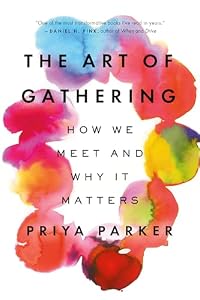
The Art of Gathering: How We Meet and Why It Matters
by Priya Parker
On This Page
Description
"Hosts of all kinds, this is a must-read!" —Chris Anderson, owner and curator of TEDFrom the host of the New York Times podcast Together Apart, an exciting new approach to how we gather that will transform the ways we spend our time together—at home, at work, in our communities, and beyond.
In The Art of Gathering, Priya Parker argues that the gatherings in our lives are lackluster and unproductive—which they don't have to be. We rely too much on routine and the conventions of show more gatherings when we should focus on distinctiveness and the people involved. At a time when coming together is more important than ever, Parker sets forth a human-centered approach to gathering that will help everyone create meaningful, memorable experiences, large and small, for work and for play.
Drawing on her expertise as a facilitator of high-powered gatherings around the world, Parker takes us inside events of all kinds to show what works, what doesn't, and why. She investigates a wide array of gatherings—conferences, meetings, a courtroom, a flash-mob party, an Arab-Israeli summer camp—and explains how simple, specific changes can invigorate any group experience.
The result is a book that's both journey and guide, full of exciting ideas with real-world applications. The Art of Gathering will forever alter the way you look at your next meeting, industry conference, dinner party, and backyard barbecue—and how you host and attend them. show less
Tags
Recommendations





Member Reviews
The Art of Gathering: How We Meet and Why It Matters by Priya Parker wasn't exactly what I expected. It took me several pages to reconcile that the book wasn't what I thought it was going to be, but once I did I found it very interesting and rather helpful. It reminded me a lot of my days as part of a committee organizing a writers and readers conference. I couldn't help but compare and contrast our efforts with her recommendations. Parker made me alternately wish I'd read this book back then and feel proud of the work we did. That said, I could imagine how some of the things Parker suggests would feel contrived to guests and even to hosts even those who were genuine in their efforts, particularly at parties. Maybe this comes from my show more upbringing where gatherings, or get-together as we called them, were much less formal by design and people appreciated that informality. It also reminded me of parties I attended where there was so much structure, no one seemed to have any fun. Everyone was too busy making sure they followed the rules. While Parker presents her ideas on gatherings complete with fun and interesting examples to prove her point, I often wondered just how well they would work among the people I know. I thoroughly enjoyed The Art of Gathering and the different methods of gathering Parker explored, but I kept feeling this little tug in the back of my mind reminding me of how many parties I've thrown and how the best ones were always the ones where we dropped the pretenses aka formalities and allowed people to be themselves in the moment while the ones with strict activities and/or rules never went quite as well. That said, I loved some of the ideas in the book about keeping things flowing and getting people interacting. All in all, The Art of Gathering is definitely worth the read if one is looking to be a better organizer of or participant in meetings, conferences, and other formal gatherings. show less
In The Art of Gathering: How We Meet and Why it Matters Priya Parker makes an impassioned case for creating more meaningful gatherings and walks you through each step, from having a purpose to the closing, and everything in between. Using myriad examples from her own life and professional practice, Parker illustrates the ways in which you as the host can create a memorable occasion, whether it's your next business meeting or a social hour with friends.
Almost anyone can get something out of this book. If you're human and not a hermit, you most likely gather in some way over some occasion at some point - weddings, funerals, hosting a few friends to dinner - these are all gatherings. In business, a meeting, a conference - these are show more gatherings too. Parker takes general principles that you can apply in almost any situation. She talks about having a specific purpose to the gathering, and using that to make decisions about where it is located and how you structure the event. From there, she uses her expertise to explain ways in which you can make a more meaningful, memorable gathering: but unlike most books on gatherings, she's less interested in logistics than in people. I liked that she includes examples of times she didn't get it right. She's not setting herself up as a perfect person who's got it all down; she's learning too, and she's here to explain what she's learned and why she believes in doing things the way she lays it out. I'm hoping to put some of this into practice in some of the gatherings I'm involved in personally and professionally. show less
Almost anyone can get something out of this book. If you're human and not a hermit, you most likely gather in some way over some occasion at some point - weddings, funerals, hosting a few friends to dinner - these are all gatherings. In business, a meeting, a conference - these are show more gatherings too. Parker takes general principles that you can apply in almost any situation. She talks about having a specific purpose to the gathering, and using that to make decisions about where it is located and how you structure the event. From there, she uses her expertise to explain ways in which you can make a more meaningful, memorable gathering: but unlike most books on gatherings, she's less interested in logistics than in people. I liked that she includes examples of times she didn't get it right. She's not setting herself up as a perfect person who's got it all down; she's learning too, and she's here to explain what she's learned and why she believes in doing things the way she lays it out. I'm hoping to put some of this into practice in some of the gatherings I'm involved in personally and professionally. show less
How many awful meetings have you attended? Disoriented business planning sessions that end with no plan; bloviating academic conferences and charity galas; empty rituals of religious services and family feasts. Don't you owe it to your community and yourself to stop wasting time and do better?
Parker is a professional facilitator specializing in dialogue across fraught groups, and this book is a distillation of her wisdom and experience. It is fantastic, a 21st century version of Carnegie's How to Win Friends & Influence People, and absolutely critical reading for anybody who plans to host an event of any sort. I'd place it next to Wiggins and McTighe Understanding by Design for most impactful professional advice I've show more encountered.
Parker's method is fairly straight forward, with a few counter-intuitive wrinkles. The first thing to do is to figure out the real purpose of an event, which may not be obvious. A couple might want to throw a dinner party to repay a prior invitation, build new friendships, and catch up with old friends, but odds are that the dinner which tries to do all three will be a flop. Similarly, an organization like a business or an academic disciplinary network, should figure out what its goals actually are. A corporate offsite with a goal like "have fun in a different setting" is pointless. Ending the feud between sales and marketing is worth trying.
Having figured out the what of your event, the next step is the 'who'. Parker advocates for four reasonable scales of events (6, 15, 30, and 150 people), and considered inclusion and exclusion. The best events aren't just "everybody who shows up", but the right people. And while there is a natural urge to add more people, especially for an existing group the goals and well-being of the group should be balanced against the tendency for unconsidered expansion.
Next is getting the guests in the right mood. A host should use their generous authority to protect, equalize, and connect guests. Do this, and people will feel special and invested. Abdicating authority in the interest of being chill does not erase power, it simply lets the most strong-willed guests bend the event to their own ends, with harm to the experience as a whole and to other guests. And similarly, don't go mad with power. If the purpose of your event is to gather audiences to celebrate you and your organization, perhaps try something different.
Parker is a big fan of temporary rules to create special circumstances at an event. Traditional codes of etiquette are a double edge blade, which excludes those who haven't been raised to the unspoken rules, while also serving to blunt realness in the spirit of 19th century nicety. "No phones" is a simple liminal rule, while odd dress codes and focused limits on conversation like "no work talk" can avoid overly rehearsed stump speeches and elevator pitches in favor of weirder sprout speeches. Sharing personal stories is a favored ploy to build human connections which can be leveraged to make cognitive and social breakthroughs later on.
And finally, the little stuff, like logistics. Events begin and end with a certain energy, and that energy should never be dissipated on details like travel arrangements or what's for dinner. There's a good ritual element to closing down an event, which a host should attend to with equal care as to the beginning.
For all my griping, I have been to some good events, and Parker's advice resonates with the ones that succeeded. Coming from a game studies and tabletop gaming background, much of the advice cross-applies for running an immersive game session. Now that we're emerging from our featureless voids, it'll be good to have some structure to the things we're going back to. Try this book, I promise that it can't hurt the thing that you're planning. show less
Parker is a professional facilitator specializing in dialogue across fraught groups, and this book is a distillation of her wisdom and experience. It is fantastic, a 21st century version of Carnegie's How to Win Friends & Influence People, and absolutely critical reading for anybody who plans to host an event of any sort. I'd place it next to Wiggins and McTighe Understanding by Design for most impactful professional advice I've show more encountered.
Parker's method is fairly straight forward, with a few counter-intuitive wrinkles. The first thing to do is to figure out the real purpose of an event, which may not be obvious. A couple might want to throw a dinner party to repay a prior invitation, build new friendships, and catch up with old friends, but odds are that the dinner which tries to do all three will be a flop. Similarly, an organization like a business or an academic disciplinary network, should figure out what its goals actually are. A corporate offsite with a goal like "have fun in a different setting" is pointless. Ending the feud between sales and marketing is worth trying.
Having figured out the what of your event, the next step is the 'who'. Parker advocates for four reasonable scales of events (6, 15, 30, and 150 people), and considered inclusion and exclusion. The best events aren't just "everybody who shows up", but the right people. And while there is a natural urge to add more people, especially for an existing group the goals and well-being of the group should be balanced against the tendency for unconsidered expansion.
Next is getting the guests in the right mood. A host should use their generous authority to protect, equalize, and connect guests. Do this, and people will feel special and invested. Abdicating authority in the interest of being chill does not erase power, it simply lets the most strong-willed guests bend the event to their own ends, with harm to the experience as a whole and to other guests. And similarly, don't go mad with power. If the purpose of your event is to gather audiences to celebrate you and your organization, perhaps try something different.
Parker is a big fan of temporary rules to create special circumstances at an event. Traditional codes of etiquette are a double edge blade, which excludes those who haven't been raised to the unspoken rules, while also serving to blunt realness in the spirit of 19th century nicety. "No phones" is a simple liminal rule, while odd dress codes and focused limits on conversation like "no work talk" can avoid overly rehearsed stump speeches and elevator pitches in favor of weirder sprout speeches. Sharing personal stories is a favored ploy to build human connections which can be leveraged to make cognitive and social breakthroughs later on.
And finally, the little stuff, like logistics. Events begin and end with a certain energy, and that energy should never be dissipated on details like travel arrangements or what's for dinner. There's a good ritual element to closing down an event, which a host should attend to with equal care as to the beginning.
For all my griping, I have been to some good events, and Parker's advice resonates with the ones that succeeded. Coming from a game studies and tabletop gaming background, much of the advice cross-applies for running an immersive game session. Now that we're emerging from our featureless voids, it'll be good to have some structure to the things we're going back to. Try this book, I promise that it can't hurt the thing that you're planning. show less
First, I should say this is not the type of book I typically pick up. I read it because it was a recommendation from a learning network newsletter I am subscribed to at work as a good leadership book.
I got more out of the first part of the book than the latter part. The first several chapters I found to be super helpful, as they discussed pretty thoroughly the importance of choosing the purpose for your gathering and allowing it to be what guides your decisions as you plan the event/meeting/gathering.
As the book went on, though, Parker spent more time talking about personal stories of gatherings she had been to or had been told about instead of continuing to discuss various important elements of gatherings.
I definitely took some things show more away from the book, but not nearly as much as I had been hoping. show less
I got more out of the first part of the book than the latter part. The first several chapters I found to be super helpful, as they discussed pretty thoroughly the importance of choosing the purpose for your gathering and allowing it to be what guides your decisions as you plan the event/meeting/gathering.
As the book went on, though, Parker spent more time talking about personal stories of gatherings she had been to or had been told about instead of continuing to discuss various important elements of gatherings.
I definitely took some things show more away from the book, but not nearly as much as I had been hoping. show less
There were a few good tidbits; but, overall, the book was repetitive/excessive. I'm not drinking the Kool-Aid on some of the rules for social gatherings. Sometimes, my purpose really is just to eat/drink/visit with my friends in a casual setting and that's OK! [But, what do I know? I'm only almost an entire adult older than the author. 😂]
When you’re still thinking about applying lessons learned several months after reading a book, you know the book is a winner—which perfectly describes “Priya Parker’s The Art of Gathering” and how it will transform anyone interested in making each gathering/meeting/training-teaching-learning offering as engaging and memorable as it can be.
Described (by its subtitle) as a book on “how we meet and why it matters,” it might not immediately catch the attention of those of us involved in training-teaching-learning—which is a real shame, for in adjusting our thinking so that “lessons,” “workshops,” “courses,” and “panel discussions” are seen through the powerful lens of “gatherings,” we find magnificent show more ways to liberate ourselves and our learners from the “tedium of learning” and find new ways to turn those lessons/workshops/courses/panel discussions into engaging, transformative gatherings with long-term impact.
The initial chapters of this engagingly-written book focus on social gatherings and the gatherings that occur when, for example, students and senior citizens living together in a retirement community interact over a long period of time. She offers concise reminders that successful gatherings grow out of myriad up-front decisions about the purpose of the gathering, the location in which it will be held, the duration of the gathering, and even the number of people who will be included in the gathering—all of which, of course, are elements considered and decisions made as we design and facilitate effective, memorable, transformative learning opportunities.
One of the sections where she tremendously inspires us in our lifelong-learning environments is in her discussion, near the middle of the book (pp. 172-173), on the importance of providing a memorable opening to any gathering. She reminds us that we have plenty of adaptable models for providing stimulating, memorable openings for our gatherings—including the formats common today in movies and television programs through what she refers to as “the cold open…the practice of starting a TV show directly with a scene rather than with opening credits.” Applying the cold open and its storytelling roots to my own work has completely changed the way I approach the learning opportunities I design and facilitate. And if you take the time to read Parker’s book, you may find it inspiring you in equally positive ways. show less
Described (by its subtitle) as a book on “how we meet and why it matters,” it might not immediately catch the attention of those of us involved in training-teaching-learning—which is a real shame, for in adjusting our thinking so that “lessons,” “workshops,” “courses,” and “panel discussions” are seen through the powerful lens of “gatherings,” we find magnificent show more ways to liberate ourselves and our learners from the “tedium of learning” and find new ways to turn those lessons/workshops/courses/panel discussions into engaging, transformative gatherings with long-term impact.
The initial chapters of this engagingly-written book focus on social gatherings and the gatherings that occur when, for example, students and senior citizens living together in a retirement community interact over a long period of time. She offers concise reminders that successful gatherings grow out of myriad up-front decisions about the purpose of the gathering, the location in which it will be held, the duration of the gathering, and even the number of people who will be included in the gathering—all of which, of course, are elements considered and decisions made as we design and facilitate effective, memorable, transformative learning opportunities.
One of the sections where she tremendously inspires us in our lifelong-learning environments is in her discussion, near the middle of the book (pp. 172-173), on the importance of providing a memorable opening to any gathering. She reminds us that we have plenty of adaptable models for providing stimulating, memorable openings for our gatherings—including the formats common today in movies and television programs through what she refers to as “the cold open…the practice of starting a TV show directly with a scene rather than with opening credits.” Applying the cold open and its storytelling roots to my own work has completely changed the way I approach the learning opportunities I design and facilitate. And if you take the time to read Parker’s book, you may find it inspiring you in equally positive ways. show less
I was expecting this to be about gatherings with friends, but was surprised to see a much wider view of adding value to get togethers in any setting. I found myself thinking of ways I could incorporate the 15 Toasts or specific rules to some of the work events I plan. I loved the idea of making people step out of their comfort zones in order to be vulnerable and make deeper connections. Her attitude can be jarring at time as she suggests shaking things up, but I can see how successful it could be.
Members
- Recently Added By
Lists

Top Five Books of 2018
802 works; 265 members

Books for Educators
164 works; 6 members

Phi Beta Kappa reading list
260 works; 8 members
Author Information
2+ Works 1,231 Members
Priya Parker is a master facilitator, strategic advisor, and author. She is the founder of Thrive Labs, at which she helps activists, elected officials, corporate executives, educators, and philanthropists create transformative gatherings. Trained in the field of conflict resolution, Parker has worked on race relations on American college campuses show more and on peace processes in the Arab world, southern Africa, and India. She studied organizational design at M.I.T., public policy at the Harvard Kennedy School and political and social thought at the University of Virginia. She lives in Brooklyn in Brooklyn New York. show less
Some Editions
Awards and Honors
Awards
Distinctions
Notable Lists
Classifications
Statistics
- Members
- 1,230
- Popularity
- 19,955
- Reviews
- 30
- Rating
- (3.76)
- Languages
- Dutch, English, Japanese, Spanish
- Media
- Paper, Audiobook, Ebook
- ISBNs
- 15
- ASINs
- 4
