
Kate Murphy (1)
Author of You're Not Listening: What You're Missing and Why It Matters
For other authors named Kate Murphy, see the disambiguation page.
About the Author
Kate Murphy is a Houston, Texas-based journalist who has written for The New York Times, The Wall Street Journal, The Economist, Agence France-Presse, and Texas Monthly.
Works by Kate Murphy
Tagged
Common Knowledge
- Birthdate
- 20th century
- Gender
- female
- Occupations
- journalist
pilot - Nationality
- USA
- Places of residence
- Houston, Texas, USA
- Associated Place (for map)
- Texas, USA
Members
Reviews

Listening is an often-overlooked skill in today’s society heavily geared around marketing and self-expression. It involves asking probing questions and interpreting each word, expression, and pause that a speaker makes. It’s critical for jobs in journalism, intelligence, leadership, and social work. In this book, journalist Kate Murphy explores how listening works and how you can make better use of its science.
For source material, Murphy interviewed hundreds of people from all walks of show more life along with interviewing experts from several academic disciplines, like neuroscience, business, and the social sciences. Her compiled product represents a comprehensive work that illuminates almost every life sector of this fundamental human trait. It applies equally to many disparate activities, such as organizational leadership, spying, and interrogation.
The contrast with the world of social media is stark. The communications revolution of the Internet has facilitated a huge growth in an individual’s ability to broadcast oneself widely. However, as research notes, society’s collective ability to listen and to learn has probably diminished. We lack appropriate self-discipline to expand our attention spans. This book offers a specific path to improve. The self-help does not consist of trite adages but instead explores the deep science of an all-too-human art form.
This book’s genre and audience are difficult to place. While applying to many sectors, it broadly reaches to a general audience. There’s hardly a part of modern life – say, politics, religion, or neighborly relations – that could not benefit from better human relationships. Better relationships start with listening to each other. Effective leadership anywhere is impossible without good ears and appropriate, targeted responses. (It helps to listen to this book about listening in an audiobook format, too!) Through personal insights and scientific research, Murphy lights a path to overcome social obstacles to solving big problems. show less
For source material, Murphy interviewed hundreds of people from all walks of show more life along with interviewing experts from several academic disciplines, like neuroscience, business, and the social sciences. Her compiled product represents a comprehensive work that illuminates almost every life sector of this fundamental human trait. It applies equally to many disparate activities, such as organizational leadership, spying, and interrogation.
The contrast with the world of social media is stark. The communications revolution of the Internet has facilitated a huge growth in an individual’s ability to broadcast oneself widely. However, as research notes, society’s collective ability to listen and to learn has probably diminished. We lack appropriate self-discipline to expand our attention spans. This book offers a specific path to improve. The self-help does not consist of trite adages but instead explores the deep science of an all-too-human art form.
This book’s genre and audience are difficult to place. While applying to many sectors, it broadly reaches to a general audience. There’s hardly a part of modern life – say, politics, religion, or neighborly relations – that could not benefit from better human relationships. Better relationships start with listening to each other. Effective leadership anywhere is impossible without good ears and appropriate, targeted responses. (It helps to listen to this book about listening in an audiobook format, too!) Through personal insights and scientific research, Murphy lights a path to overcome social obstacles to solving big problems. show less
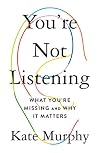
When was the last time you felt like someone truly listened to you? And when was the last time you gave someone your full attention?
Much of our world exists in a constant state of distraction, with phones in hands, laptops at coffee shops, and multitasking at work and at home. We shout our opinions on social media and hit 'like' on the posts with which we agree. We hear each other, but we aren't listening. And because of this, we're lonelier than we've ever been.
Kate Murphy has given us a show more gift with this book. The writing is conversational, as she shares facts alongside anecdotes. She shows us all the ways in which we don't listen, and then offers guidance on all the ways in which we could do better.
A person in my life told me, "I'm a great listener," as she interrupted me to talk about herself. Don't be that person. Within the pages of this book, Kate Murphy shows us just how much we're missing out on when we don't listen to one another.
I honestly wish everyone would read this book. The world would be a far better place if we all took the time to listen.
*I received an advance copy from the publisher.* show less
Much of our world exists in a constant state of distraction, with phones in hands, laptops at coffee shops, and multitasking at work and at home. We shout our opinions on social media and hit 'like' on the posts with which we agree. We hear each other, but we aren't listening. And because of this, we're lonelier than we've ever been.
Kate Murphy has given us a show more gift with this book. The writing is conversational, as she shares facts alongside anecdotes. She shows us all the ways in which we don't listen, and then offers guidance on all the ways in which we could do better.
A person in my life told me, "I'm a great listener," as she interrupted me to talk about herself. Don't be that person. Within the pages of this book, Kate Murphy shows us just how much we're missing out on when we don't listen to one another.
I honestly wish everyone would read this book. The world would be a far better place if we all took the time to listen.
*I received an advance copy from the publisher.* show less
How many individuals do you know who listen attentively? What are the characteristics of a good listener? Why do so many people talk more and listen less these days? What price do we pay when we are out to lunch during significant conversations? When you are conversing with someone, what should you look for beyond the ideas that are being expressed? For the answers to these and other provocative questions, read Kate Murphy's excellent work of non-fiction, "You're Not Listening." In it, she show more lucidly, intelligently, and eloquently addresses the subject of how to communicate more effectively, with an emphasis on improving your listening skills.
To illustrate the art of listening, the author, who is an accomplished journalist, interviews seventy-six-year-old Naomi Henderson, an accomplished woman who has moderated focus groups for nearly fifty years, as well as a former interrogator for the CIA who shares some of the strategies that made him successful at his job. Murphy also speaks with a star furniture salesman, bartender, hairdresser, air-traffic controller, and priest, all of whom are proficient listeners. "You're Not Listening" has eye-opening studies on everything from the mechanics of hearing to how device-free family dinners, in which there is a great deal of give and take, can help kids function better in school and develop such qualities as resilience and self-esteem.
Murphy warns us that when we are distracted by our cell phones or preoccupied with preparing biting and witty rejoinders, we cannot truly absorb what someone else is telling us. A person's body language, tone of voice, genuine curiosity, patience, courtesy, and ability to convey compassion, sincerity, and interest can lead others to open up in a way that is meaningful and poignant. Whether we are talking to our spouse, children, colleagues, supervisors, friends, or acquaintances, we can enrich our lives immeasurably by practicing the type of active listening that Kate Murphy describes. To sum up: "It is only by listening that we engage, understand, connect, empathize, and develop as human beings." show less
To illustrate the art of listening, the author, who is an accomplished journalist, interviews seventy-six-year-old Naomi Henderson, an accomplished woman who has moderated focus groups for nearly fifty years, as well as a former interrogator for the CIA who shares some of the strategies that made him successful at his job. Murphy also speaks with a star furniture salesman, bartender, hairdresser, air-traffic controller, and priest, all of whom are proficient listeners. "You're Not Listening" has eye-opening studies on everything from the mechanics of hearing to how device-free family dinners, in which there is a great deal of give and take, can help kids function better in school and develop such qualities as resilience and self-esteem.
Murphy warns us that when we are distracted by our cell phones or preoccupied with preparing biting and witty rejoinders, we cannot truly absorb what someone else is telling us. A person's body language, tone of voice, genuine curiosity, patience, courtesy, and ability to convey compassion, sincerity, and interest can lead others to open up in a way that is meaningful and poignant. Whether we are talking to our spouse, children, colleagues, supervisors, friends, or acquaintances, we can enrich our lives immeasurably by practicing the type of active listening that Kate Murphy describes. To sum up: "It is only by listening that we engage, understand, connect, empathize, and develop as human beings." show less
“Technology does not so much interfere with listening as make it seem unnecessary. Our devices indulge our fear of intimacy by fooling us into thinking that we are socially connected even when we are achingly alone. We avoid the messiness and imperfections of others, retreating into the relative safety of our devices, swiping and deleting with abandon. The result is a loss of richness and nuance in our social interactions, and we suffer from a creeping sense of dissatisfaction.”
Lists
Awards


You May Also Like


Associated Authors
Statistics
- Works
- 1
- Members
- 653
- Popularity
- #38,651
- Rating
- 3.9
- Reviews
- 29
- ISBNs
- 49
- Languages
- 12