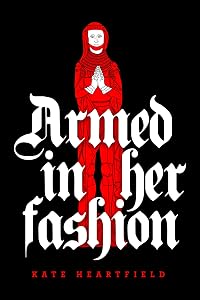
Armed in Her Fashion
by Kate Heartfield 
On This Page
Description
"In 1328, Bruges is under siege by the Chatelaine of Hell and her army of chimeras-humans mixed with animals or armour, forged in the deep fires of the Hellbeast. At night, revenants crawl over the walls and bring plague and grief to this city of widows. Margriet de Vos learns she's a widow herself when her good-for-nothing husband comes home dead from the war. He didn't come back for her. The revenant who was her husband pulls a secret treasure of coins and weapons from under his show more floorboards and goes back through the mouth of the beast called Hell. Margriet killed her first soldier when she was 11. She's buried six of her seven children. She'll do anything for her daughter, even if it means raiding Hell itself to get her inheritance back. Margriet's daughter is haunted by a dead husband of her own, and blessed, or cursed, with an enchanted distaff that allows her to control the revenants and see the future. Together with a transgender man-at-arms who has unfinished business with the Chatelaine, a traumatized widow with a giant waterpowered forgehammer at her disposal, and a wealthy alderman's wife who escapes Bruges with her children, Margriet and Beatrix forge a raiding party like Hell has never seen."-- show lessTags
Recommendations















Member Reviews
Surreal fantasy, set in Bruges under siege in the Middle Ages, set in a Bruegel painting, where all the grotesques are characters, and the regular folks are just trying to survive.
Both bizarre and utterly compelling, with strong, stubborn female characters, an interesting depiction of politics at the time, and a trans soldier who keeps getting misgendered. Fascinating. I’m not sure exactly who to recommend this to, but I’ll start with my Middle Ages loving friends, who can appreciate the rich setting as much as the adventure.
Advanced readers copy provided by edelweiss.
Both bizarre and utterly compelling, with strong, stubborn female characters, an interesting depiction of politics at the time, and a trans soldier who keeps getting misgendered. Fascinating. I’m not sure exactly who to recommend this to, but I’ll start with my Middle Ages loving friends, who can appreciate the rich setting as much as the adventure.
Advanced readers copy provided by edelweiss.
I want to say this is a well-thought-out historical novel, and it definitely dovetails nicely with history, but let's face it: It's Hell on Earth.
In a lot of great stylistic ways, I'm reminded favorably of Peter Newman's [b:The Vagrant|23559647|The Vagrant (The Vagrant, #1)|Peter Newman|https://images.gr-assets.com/books/1419775822s/23559647.jpg|43159288], only it's right here and the minions of hell all speak French.
The novel is very female-centric, making this all kinds of awesome. Not all men are jerks, but all the revenant men definitely are. Add that to the laws which disenfranchise the lot of women, a cool attempt at bringing Justice to Hell, and a big smackdown when that doesn't pan out.
These mothers, widows, and even a show more non-identified transgender warrior all do everything they can to survive and secure their place in the world filled with dead-but-still-being-assholes husbands.
Don't assume this is just a fast-paced and bloody-minded fantasy with the minions of hell pouring out of the Earth. I mean, it is absolutely that, but it's also about doing the right thing... or not. :) :)
I very much enjoyed this. I'm gonna keep my eyes on this author. :) show less
In a lot of great stylistic ways, I'm reminded favorably of Peter Newman's [b:The Vagrant|23559647|The Vagrant (The Vagrant, #1)|Peter Newman|https://images.gr-assets.com/books/1419775822s/23559647.jpg|43159288], only it's right here and the minions of hell all speak French.
The novel is very female-centric, making this all kinds of awesome. Not all men are jerks, but all the revenant men definitely are. Add that to the laws which disenfranchise the lot of women, a cool attempt at bringing Justice to Hell, and a big smackdown when that doesn't pan out.
These mothers, widows, and even a show more non-identified transgender warrior all do everything they can to survive and secure their place in the world filled with dead-but-still-being-assholes husbands.
Don't assume this is just a fast-paced and bloody-minded fantasy with the minions of hell pouring out of the Earth. I mean, it is absolutely that, but it's also about doing the right thing... or not. :) :)
I very much enjoyed this. I'm gonna keep my eyes on this author. :) show less
First, a content warning: this book has a trans character who is misgendered by friends and enemies and, as a trans man, is forced to wear women's clothing. But I will say that the trans character's identity is not a plot twist; he is who he is from his first introduction. He asserts himself against both enemies and friends. He is also given a happy ending and he does not experience any sort of sexualized violence. In fact there is little sexual violence in this book as a whole, which is more than a lot of medieval fantasies can say.
Wow this book was A WILD RIDE.
In the best way possible! You have ferocious chimeras, a massive beast that may literally be Hell, duplicitous kings and legal drama, plague-spreading zombies, and best of all, show more a small bedraggled group of widows standing firm against all the powers of hell and earth.
Medieval fantasy gets a bad rap that, for the most part, it deserves. It tends to tell the same stories over and over again, with the same sort of characters fighting the same sort of battles against the same sort of enemies. This goes against everything the Middle Ages in Europe actually WAS. It was a deeply weird era where peasants rebelled, clergy debated the natures of humanity and the divine, and there was far more diversity than most gritty beard-filled epics ever touch.
This book however is diverse. You have characters who are mostly women. The only main male character is trans. You have characters of color, showcasing that medieval Europe was far from all white. You have queer characters--the aforementioned trans gay man-at-arms. You have disabled characters and older women and all of them are given the same sort of heroic presence a noble knight might have gotten in a different story.
Heartfield writes about war and about the weapons left to those who are marginalized by a patriarchal society. Children fighting with bricks and stones. Women fighting with their words, with enchanted distaffs and giant hammers. Women fighting hell and earth to get what is rightfully theirs. Women fighting for each other, alongside one another, sacrificing for their children, their friends. Widows who are terrified but stand up to the Chatelaine of Hell and the King of France to secure their rights as best they can.
This book is as weird as the Middle Ages were. Giant water snakes, exploding chimeras....that's only part of the wonderful weirdness. If you're tired of the same old knights and swords stories, I highly recommend this book. show less
Wow this book was A WILD RIDE.
In the best way possible! You have ferocious chimeras, a massive beast that may literally be Hell, duplicitous kings and legal drama, plague-spreading zombies, and best of all, show more a small bedraggled group of widows standing firm against all the powers of hell and earth.
Medieval fantasy gets a bad rap that, for the most part, it deserves. It tends to tell the same stories over and over again, with the same sort of characters fighting the same sort of battles against the same sort of enemies. This goes against everything the Middle Ages in Europe actually WAS. It was a deeply weird era where peasants rebelled, clergy debated the natures of humanity and the divine, and there was far more diversity than most gritty beard-filled epics ever touch.
This book however is diverse. You have characters who are mostly women. The only main male character is trans. You have characters of color, showcasing that medieval Europe was far from all white. You have queer characters--the aforementioned trans gay man-at-arms. You have disabled characters and older women and all of them are given the same sort of heroic presence a noble knight might have gotten in a different story.
Heartfield writes about war and about the weapons left to those who are marginalized by a patriarchal society. Children fighting with bricks and stones. Women fighting with their words, with enchanted distaffs and giant hammers. Women fighting hell and earth to get what is rightfully theirs. Women fighting for each other, alongside one another, sacrificing for their children, their friends. Widows who are terrified but stand up to the Chatelaine of Hell and the King of France to secure their rights as best they can.
This book is as weird as the Middle Ages were. Giant water snakes, exploding chimeras....that's only part of the wonderful weirdness. If you're tired of the same old knights and swords stories, I highly recommend this book. show less
What a weird book.
A trans man-at-arms, a shrewish old wet nurse, and a spinster with a magic distaff march on the gates of Hell to reclaim a stolen inheritance. Also features a debate on whether zombies are legally dead.
It could be fantasy, it could be alternate history, it could be philosophy. It was definitely strongly feminist, in a somewhat similar way to Women Talking, where the worth of women is always defined in relation to the men.
But it did discuss that women are expected to give and give and give, and it is a blemish on their womanly character if they ever want to take. Margriet, Beatrix, and the Chatelaine all experience this in some form. Also, how a man and a woman can hear the same conversation and make radically different show more conclusions.I couldn’t help thinking of Margriet’s accidental invitation to her husband was very like those vampiric legends, but also a case of willful misinterpretation.
And there are so many allegories for Hell. In the afterword, the author says the book was based on Dull Gret by Pieter Brueghel- I thought it useful for envisioning some of the crazier scenes (but again, all of this book was batshit).
There are more discussions of Hell, about how horrible and inescapable marriage can be, how the injustices a man can bring on his wife are the worst thing in the world (The beast was Hell because it was home to her husband, the antagonist laments at some point). Other good phrases: It is right that a wife should die, when her husband has no further need of her (if indeed he ever had need of her, even if he never provided for her while he was alive). If Judas and Caesar cannot be found in Hell, is it really Hell? It brings suffering and monstrosities, but it doesn’t match a Christian definition.
There were some Book of the New Sun-type asides that seemed to make reference to how horrible the modern world would be to a thirteenth century peasant. I thought those were pretty funny. They discuss how glasses and prosthetics are kind of chimera-ish, if you think about it.
Margriet was an interesting protagonist. She wasn’t very sympathetic or relateable, but her strong sense of justice was pretty indisputable by modern standards. She wasn’t a very loving mother to her adult daughter, but you could see how she knew better than to share her bitterness with children (unlike certain characters in An Unkindness of Ghosts, cough cough). There was love in her, but certainly not for any man.
The setting in general was really excellently researched. It was incredibly and specifically tied to its setting. I had to look up a lot of terms (especially clothing and different types of nunneries), but it was a good thing. It tied me more closely to Bruges in 1328.
I didn't really love this book, but I thought it was interesting. show less
A trans man-at-arms, a shrewish old wet nurse, and a spinster with a magic distaff march on the gates of Hell to reclaim a stolen inheritance. Also features a debate on whether zombies are legally dead.
It could be fantasy, it could be alternate history, it could be philosophy. It was definitely strongly feminist, in a somewhat similar way to Women Talking, where the worth of women is always defined in relation to the men.
But it did discuss that women are expected to give and give and give, and it is a blemish on their womanly character if they ever want to take. Margriet, Beatrix, and the Chatelaine all experience this in some form. Also, how a man and a woman can hear the same conversation and make radically different show more conclusions.
And there are so many allegories for Hell. In the afterword, the author says the book was based on Dull Gret by Pieter Brueghel- I thought it useful for envisioning some of the crazier scenes (but again, all of this book was batshit).
There are more discussions of Hell, about how horrible and inescapable marriage can be, how the injustices a man can bring on his wife are the worst thing in the world (The beast was Hell because it was home to her husband, the antagonist laments at some point). Other good phrases: It is right that a wife should die, when her husband has no further need of her (if indeed he ever had need of her, even if he never provided for her while he was alive). If Judas and Caesar cannot be found in Hell, is it really Hell? It brings suffering and monstrosities, but it doesn’t match a Christian definition.
There were some Book of the New Sun-type asides that seemed to make reference to how horrible the modern world would be to a thirteenth century peasant. I thought those were pretty funny. They discuss how glasses and prosthetics are kind of chimera-ish, if you think about it.
Margriet was an interesting protagonist. She wasn’t very sympathetic or relateable, but her strong sense of justice was pretty indisputable by modern standards. She wasn’t a very loving mother to her adult daughter, but you could see how she knew better than to share her bitterness with children (unlike certain characters in An Unkindness of Ghosts, cough cough). There was love in her, but certainly not for any man.
The setting in general was really excellently researched. It was incredibly and specifically tied to its setting. I had to look up a lot of terms (especially clothing and different types of nunneries), but it was a good thing. It tied me more closely to Bruges in 1328.
I didn't really love this book, but I thought it was interesting. show less
Pros: very feisty women, lots of history, clever integration of the hellbeast
Cons: writing was a little dry at times
When her revenant husband returns to the besieged city of Bruges and reveals he’s hidden a fortune, Margriet de Vos demands her rights: a third of that wealth belongs to her, the rest to their daughter. Her husband now serves the Chatelaine of Hell, and intends to give her this gold. But Margriet won’t be deterred. Neither war, the King of France, nor Hell itself will keep her from getting her due.
Meanwhile, Claude a transgender man-at-arms and former guest of the Hellbeast also wants the de Vos treasure, or rather, a mace he unwisely sold to Margriet’s husband and now needs back.
The story is mostly told from show more Margriet’s point of view, though there are a few scenes from her daughter and Claude’s viewpoints as well. Margriet is very feisty, willing to fight over a sou if she feels she’s owed it. Her daughter’s much kinder but has little agency, as her mother’s overprotective and often overbearing. Margriet supported the family by working as a wet nurse, which isn’t something that comes up often, though historically it was a common thing. It was also nice seeing a middle aged woman as the protagonist, especially one who is near-sighted in an age where glasses can only be afforded by the elite.
Claude was a great character. It’s awesome to see often overlooked people in history and, while misgendered through a good part of the story, the author always maintains his understanding of who he really is. Though they were short scenes, I really enjoyed the revelations regarding aspects of womanhood he’s missed (like breast binding) and how he survived in a soldier’s camp.
The author cleverly integrated her mythological aspects into actual history. At the end of the book she cites a Flemish painting that was her inspiration for the book, and it added an entire new layer to the story itself.
The writing can be a bit dry at times, in that it’s not a particularly fast paced or adventurous tale. There’s a lot of sitting around and talking or walking between cities.
If you like medieval history or want a historical fantasy that’s different from the norm, this is an interesting read. show less
Cons: writing was a little dry at times
When her revenant husband returns to the besieged city of Bruges and reveals he’s hidden a fortune, Margriet de Vos demands her rights: a third of that wealth belongs to her, the rest to their daughter. Her husband now serves the Chatelaine of Hell, and intends to give her this gold. But Margriet won’t be deterred. Neither war, the King of France, nor Hell itself will keep her from getting her due.
Meanwhile, Claude a transgender man-at-arms and former guest of the Hellbeast also wants the de Vos treasure, or rather, a mace he unwisely sold to Margriet’s husband and now needs back.
The story is mostly told from show more Margriet’s point of view, though there are a few scenes from her daughter and Claude’s viewpoints as well. Margriet is very feisty, willing to fight over a sou if she feels she’s owed it. Her daughter’s much kinder but has little agency, as her mother’s overprotective and often overbearing. Margriet supported the family by working as a wet nurse, which isn’t something that comes up often, though historically it was a common thing. It was also nice seeing a middle aged woman as the protagonist, especially one who is near-sighted in an age where glasses can only be afforded by the elite.
Claude was a great character. It’s awesome to see often overlooked people in history and, while misgendered through a good part of the story, the author always maintains his understanding of who he really is. Though they were short scenes, I really enjoyed the revelations regarding aspects of womanhood he’s missed (like breast binding) and how he survived in a soldier’s camp.
The author cleverly integrated her mythological aspects into actual history. At the end of the book she cites a Flemish painting that was her inspiration for the book, and it added an entire new layer to the story itself.
The writing can be a bit dry at times, in that it’s not a particularly fast paced or adventurous tale. There’s a lot of sitting around and talking or walking between cities.
If you like medieval history or want a historical fantasy that’s different from the norm, this is an interesting read. show less
This was a unique and interesting story. The historical aspects seem well researched (at least to my layman's eyes) and the characters are interesting and well rounded. It is a story full of strong women without them feeling like stereotypes or feeling like they are modern characters in a historical setting. I especially liked the character of Claude, a transgender man. His story was especially well done. I still would have liked to know more about the Chatelaine's backstory, but it is the sign of a good story that keeps the reader wanting more.
Kate Heartfield's Armed in Her Fashion is a dark, gritty fantasy set in well-researched 1328 Bruges and environs. Not only does she realistically portray a transgender character within the period, but her entire cast feels real, from her near-sighted wet nurse protagonist to the very chatelaine of Hell. This is a fantastic read.
Members
- Recently Added By
Lists

Scary Stories for the Season
160 works; 94 members
Author Information

23+ Works 876 Members
Kate Heartfield is a LibraryThing Author, an author who lists their personal library on LibraryThing.
Some Editions
Awards and Honors
Awards
Work Relationships
Is expanded in
Common Knowledge
- Original publication date
- 2018
- People/Characters
- Margriet de Vos; Claude Jouvenal; Jacquemine Ooste; Chatelaine of Hell; Beatrix [Armed in Her Fashion]; Monoceros (show all 10); Chaerephon; Willem de Vos; Baltazar [Armed in Her Fashion]; Philip VI, King of France (King Philippe)
- Important places
- Bruges, Belgium; Hell
- Important events
- Battle of Cassel (1328)
- Epigraph
- But tel me this: why hydestow, with sorwe,
The keyes of thy cheste awey from me?
It is my good as wel as thyn, pardee!
—Chaucer, The Wife of Bath’s Tale - Dedication
- For Xavier, who loves history.
- First words
- Margriet de Vos peered at a horizon smudged with the smoke of small fires.
- Quotations*
- That goddamn drunkard in the street. May he life to be flayed alive. With a dull knife. And she would use his skin for a book, and write all her accounts in it with ink of gall and wormwood.
A woman may put on a mask of a man but it does not turn her into one. The law is the law.
She did envy Gertrude after all—not her grief, which must be greater than Beatrix could even imagine, but her boisterous presence in the world. Gertrude took up space; Beatrix was always watching from the corners.
He did not like the king’s smell, perfumed and oily. Claude had known men like him before. Vainglorious. There was a kind of violence that went with such vanity, an unwillingness to let anything else in the world be beautif... (show all)ul.
She was such a kind-hearted woman, really. She just husbanded that kindness, as if it would run out.
ULTIMA RATIO MULIERUM - Last words
- (Click to show. Warning: May contain spoilers.)The wicked say that this beast must have emerged from time to time in the story of the world, and that it might one day rise again to trouble us.
- Original language
- English
*Some information comes from Common Knowledge in other languages. Click "Edit" for more information.
Classifications
Statistics
- Members
- 91
- Popularity
- 352,777
- Reviews
- 7
- Rating
- (4.05)
- Languages
- English
- Media
- Paper, Ebook
- ISBNs
- 3
- ASINs
- 1