On This Page
Description
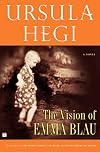
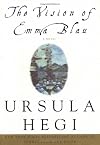
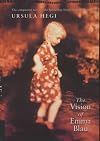
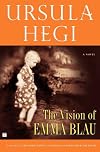
A novel of immigration and love follows a German man who flees to the U.S. at the start of the century and makes a life for himself, spawning four generations of descendants.Tags
Recommendations

























Member Reviews
My review from July 13, 2003:
Ursula Hegi is a truly gifted writer with a magical ability to bring a story to life vividly. STONES FROM THE RIVER, my first literary encounter with Ms. Hegi's work, was one of my favorite books so naturally I was looking forward to reading THE VISION OF EMMA BLAU, which is a spin-off of the previously mentioned novel. Stefan Blau was the son of 2 of the villagers in Trudi Montag's hometown in Germany who ran away to America when he was 13 years old - this is the story of his American legacy.
The consistent "character" throughout the century spanned in this novel was not a person but a place...actually a hotel known as the Wasserburg, which Stefan Blau built in New Hampshire in the early-20th century. The show more hotel became representative of human growth, opulence and deterioration as it reflected the lives of those who made it their home. I couldn't help but think of several other literary works in which a place played such a major role in plot development ...Our Town by Thornton Wilder and Standing in the Rainbow by Fannie Flagg, for example. I also couldn't help compare Emma's attachment to the Wasserburg to that of Scarlet O'Hara's to Tara ...land/property, in both cases, is what endured and remained important as time marched on.
I really like the beginning of this book better than the end. I enjoyed reading about the German-American immigrant experiences of both Stefan Blau and Helene Montag Blau and I also happily revisited Trudi and Leo when Helene visited with her son Robert (I remember that whole sequence of events in STONES FROM THE RIVER from Trudi's perspective). I found their 2nd - 4th generation American descendants, however, somewhat depressing to read about. So many of the main characters were unable to find happiness within themselves and it sort of made me wonder what type of legacy Stefan ended up leaving his progeny after all!
Anyway, I still enjoy Ursula Hegi and am planning to read some of her other works. show less
Ursula Hegi is a truly gifted writer with a magical ability to bring a story to life vividly. STONES FROM THE RIVER, my first literary encounter with Ms. Hegi's work, was one of my favorite books so naturally I was looking forward to reading THE VISION OF EMMA BLAU, which is a spin-off of the previously mentioned novel. Stefan Blau was the son of 2 of the villagers in Trudi Montag's hometown in Germany who ran away to America when he was 13 years old - this is the story of his American legacy.
The consistent "character" throughout the century spanned in this novel was not a person but a place...actually a hotel known as the Wasserburg, which Stefan Blau built in New Hampshire in the early-20th century. The show more hotel became representative of human growth, opulence and deterioration as it reflected the lives of those who made it their home. I couldn't help but think of several other literary works in which a place played such a major role in plot development ...Our Town by Thornton Wilder and Standing in the Rainbow by Fannie Flagg, for example. I also couldn't help compare Emma's attachment to the Wasserburg to that of Scarlet O'Hara's to Tara ...land/property, in both cases, is what endured and remained important as time marched on.
I really like the beginning of this book better than the end. I enjoyed reading about the German-American immigrant experiences of both Stefan Blau and Helene Montag Blau and I also happily revisited Trudi and Leo when Helene visited with her son Robert (I remember that whole sequence of events in STONES FROM THE RIVER from Trudi's perspective). I found their 2nd - 4th generation American descendants, however, somewhat depressing to read about. So many of the main characters were unable to find happiness within themselves and it sort of made me wonder what type of legacy Stefan ended up leaving his progeny after all!
Anyway, I still enjoy Ursula Hegi and am planning to read some of her other works. show less
Another fantastic book by Hegi. Her writing captures my attention from the first word to the last. You get to know each and every character, no matter how large their part in the story. It was intiriguing to read about Stefan and Trudi from Stones From the River. This is truly an epic family drama crossing many generations and cultures. Hegi approaches immigrants with raw truth and their feelings, hopes, and dreams come to life. I would recommend Hegi to anyone who likes epic dramas filled with great character development and lifelike imagery. I look forward to reading my next Hegi novel.
Put simply, I think this book is worthless. The author seems to have set out to make the reader cry, and gives them just enough character mixed into the multiple tragedies to do so. I would never recommend this book to anyone, and I'd add also that in the class I read this for, only two people(out of around eighteen) actually enjoyed it on any level at all. The rest of us felt it a waste of time, for the most part. The writing is strong, but as far as I'm concerned, that makes it all the worse that the author couldn't come up with something better to do with her talents besides break readers' hearts. There is nothing here that is not done better and with more finess by other writers, whether you look to Gabriel Garcia Marquez, show more Steinbeck, or Dickens. Simply, don't bother. show less
I struggled with this. Ursula Hegi is a gifted writer. Stones from the River is one of my favorite books. As someone before me wrote, none of the people in the story are happy with their lot in life. Some of them if they only would have communicated their unhappiness, their problems would have been solved, but then maybe there would not be a story.
Having just finished Sacred Time, where I was intrigued with how the author handled all of the accents of the characters, I was amazed to listen to her read this novel with her own lovely German accent, realizing how incredible it was that she could write a story about an Italian family in New York City(Sacred Time). This novel was just beautiful and I loved the way the words flowed as she read them. There is so much tenderness and emotion in her writing. The time span meant that you could see what happened to the characters as they aged. She presented a fascinating picture of the multitude of problems that any immigrants face, no matter how much money they may have. How do you ever feel that you belong somewhere.
Stefan Blau runs away from his home in Germany when he is a young man. He's always dreamed of living in America. He eventually finds himself in New Hampshire, building a beautiful apartment building, running a restaurant, and doing his best to provide for his family.
Honestly, this book might have suffered from too many interruptions. My review is definitely suffering from allowing too much time to go by between finishing the book and reviewing it.
I mostly enjoyed this, my problem was that I felt a little too distanced from the characters. An immigrant acclimating to America, German-Americans living through WWII, love, loss, family, strange neighbors--any of these should have made a book that I loved. The third-person narration felt so show more very distant from the action though that I just couldn't click with anyone. Also, this family is just desperately unhappy. The narration changes from Stefan to Helene to Robert to Emma and not one of them is happy. I just can't take that.
The meaning of the title just dawned on me. I was understanding it as "Emma Blau's Vision," and it has a little to do with that, but mostly it's about "Stefan's Vision of Emma." If that had clicked earlier, I might have gotten a little more out of this. I kept waiting for Emma to show up and she didn't make her appearance until page 268. That's a lot of waiting.
Once Emma did appear, she was actually my least favorite character. She's so very pushy and clingy, I felt a little smothered just reading about her. As an adult, she makes horrible choices in her life and doesn't really understand why she's unhappy. She's terrified of change and fights it however she can. She's one character in a line that takes care of the inheritance of the apartment house in a less-than-optimal way.
I honestly feel like there was a deeper meaning to this book that I just didn't understand. Without that, I just feel lost writing this review, so I'm just going to stop here. show less
Honestly, this book might have suffered from too many interruptions. My review is definitely suffering from allowing too much time to go by between finishing the book and reviewing it.
I mostly enjoyed this, my problem was that I felt a little too distanced from the characters. An immigrant acclimating to America, German-Americans living through WWII, love, loss, family, strange neighbors--any of these should have made a book that I loved. The third-person narration felt so show more very distant from the action though that I just couldn't click with anyone. Also, this family is just desperately unhappy. The narration changes from Stefan to Helene to Robert to Emma and not one of them is happy. I just can't take that.
The meaning of the title just dawned on me. I was understanding it as "Emma Blau's Vision," and it has a little to do with that, but mostly it's about "Stefan's Vision of Emma." If that had clicked earlier, I might have gotten a little more out of this. I kept waiting for Emma to show up and she didn't make her appearance until page 268. That's a lot of waiting.
Once Emma did appear, she was actually my least favorite character. She's so very pushy and clingy, I felt a little smothered just reading about her. As an adult, she makes horrible choices in her life and doesn't really understand why she's unhappy. She's terrified of change and fights it however she can. She's one character in a line that takes care of the inheritance of the apartment house in a less-than-optimal way.
I honestly feel like there was a deeper meaning to this book that I just didn't understand. Without that, I just feel lost writing this review, so I'm just going to stop here. show less
After a solid opening foundation, the novel deteriorates along with the Wasserburg.
Members
- Recently Added By
Lists

Houses and Buildings as Characters in Fiction
182 works; 28 members

Books Read in 2018
4,360 works; 110 members
Author Information

17 Works 8,750 Members
Ursula Hegi (born May 23, 1946) spent the first 18 years of her life in post-World War II Germany. When she tried to ask questions about the war, she received only vague answers and heard little about the Holocaust. Hegi immigrated to the United States in 1964. Now an award-winning novelist, Hegi is best known for her book Stones from the River. show more Picked by Oprah Winfrey as a selection for Oprah's highly successful book club, the prequel to Hegi's highly-praised Floating In My Mother's Palm traces the path of average Germans during the turbulent wartime years from 1915 to 1952. Narrated by a dwarf who eventually learned that being different is a secret that all humans share, Stones from the River was nominated for a PEN Faulkner Award and received the Governor's Writer's Award. Also the author of the books Intrusions, Unearned Pleasures and Other Stories, and Salt Dancers, Hegi is the recipient of more than two dozen grants and awards, including an NEA Fellowship and five awards from PEN Syndicated Fiction Awards. She has also written over 100 reviews for the New York Times, the Los Angeles Times, and the Washington Post. (Bowker Author Biography) Ursula Hegi is the author of eight critically acclaimed books. She lives in New York State. (Publisher Provided) show less
Some Editions
Series

Work Relationships
Is contained in
Common Knowledge
- Canonical title
- The Vision of Emma Blau
- Original publication date
- 2000
- People/Characters
- Stefan Blau; Helene Montag Blau; Greta Blau; Tobias Blau; Robert Blau; Yvonne Blau (show all 18); Caleb Blau; Emma Blau; Pearl Bloom; Nate Bloom; Margret Blau; Elizabeth Flynn Blau; Leo Montag; Homer Wilson; Irene Wilson; Danny Wilson; Miss Garland; Sara Penn Blau
- Important places
- Winnipesaukee, New Hampshire, USA; Burgdorf, Lower Saxony, Germany; USA; New Hampshire, USA
- Dedication
- For my grandmother Gertrud Maas
- First words
- It didn't look like the kind of house that would carry a curse.
- Last words
- (Click to show. Warning: May contain spoilers.)And when her brother answered, she told him who she was.
- Blurbers
- Clark, Robert; Stephenson, Anne; Weeks, Linton; Hershman, Marcie; Adams, Phoebe-Lou; Hegger, Susan C. (show all 8); Patchett, Ann; Williams, Lorna
Classifications
Statistics
- Members
- 758
- Popularity
- 36,902
- Reviews
- 11
- Rating
- (3.41)
- Languages
- Dutch, English, German, Italian
- Media
- Paper, Audiobook, Ebook
- ISBNs
- 16
- ASINs
- 5