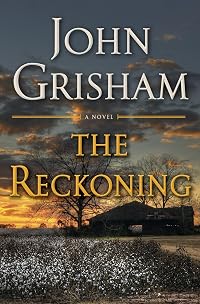
The Reckoning
by John Grisham
On This Page
Description
Pete Banning was Clanton's favorite son, a returning war hero, the patriarch of a prominent family, a farmer, father, neighbor, and a faithful member of the Methodist church. Then one cool October morning in 1946. he rose early, drove into town, walked into the church, and calmly shot and killed the Reverend Dexter Bell. As if the murder wasn't shocking enough, it was even more baffling that Pete's only statement about it - to the sheriff, to his defense attorney, to the judge, to his family show more and friends, and to the people of Clanton - was 'I have nothing to say'. And so the murder of the esteemed Reverend Bell became the most mysterious and unforgettable crime Ford County had ever known. show lessTags
Recommendations




Member Reviews
I started reading Grisham recently and it seems like I can't put down one of his books, but with this one I wish I had. This was one of the most depressing books I've read. Grisham's writing was excellant as usual and kept me reading hoping for an ending that was different from the overall feeling the book gave me. I won't stop reading his books because he's such a good writer, but I will read more reviews to try to avoid his other books like this one.
I read the first half of this book, but when the second half opened by going back deep into the past and retelling much of what we’d already learnt, I bailed and skimmed ahead to where the story resumed. Even so, for a thriller it wasn’t very thrilling and for a suspense novel it didn’t have nearly enough suspense to last for a whole book.
I found it difficult to remember the name of the book. Starts with RE. Reiteration? Re-enactment? Regurgitation? Repetition!
It’s not a bad book, just very much not exciting. Grisham does a commendable job of depicting the relationship between the races in postwar Mississippi, and that’s a good reason to read at least some of the book.
I found it difficult to remember the name of the book. Starts with RE. Reiteration? Re-enactment? Regurgitation? Repetition!
It’s not a bad book, just very much not exciting. Grisham does a commendable job of depicting the relationship between the races in postwar Mississippi, and that’s a good reason to read at least some of the book.
On the surface it doesn’t seem like there should be much mystery or suspense or action in The Reckoning. Pete Banning is a war hero, one day he shoots and kills the local pastor, he won’t speak in his own defense, so he is facing the death penalty. He placed his wife in an insane asylum, but he won’t talk about that, either. So it all seems pretty cut and dried. All the action has happened in the past or is a foregone conclusion, and although it might be very interesting, it probably won’t be very exciting.
Wrong. John Grisham is a master and this is another masterpiece. It is full of suspense and mystery and dread, first page to last. It was haunting. I couldn’t put it down. Even as I read about things that I knew for a fact show more had happened, I found myself hoping for another conclusion.
The Reckoning says a lot about the time it is set in, people’s place in society in that time, and their belief in the structure of that society. It also says a lot about how experiences change people, and even when they are loving and caring they can be hard. Very, very hard. And sometimes when forgiveness is needed, love is just not enough to make it happen. show less
Wrong. John Grisham is a master and this is another masterpiece. It is full of suspense and mystery and dread, first page to last. It was haunting. I couldn’t put it down. Even as I read about things that I knew for a fact show more had happened, I found myself hoping for another conclusion.
The Reckoning says a lot about the time it is set in, people’s place in society in that time, and their belief in the structure of that society. It also says a lot about how experiences change people, and even when they are loving and caring they can be hard. Very, very hard. And sometimes when forgiveness is needed, love is just not enough to make it happen. show less
Clanton, Mississippi’s favorite son, a decorated hero of the Second World War, is the patriarch of a prominent family. He’s a father, a brother, a neighbor, a farmer, a faithful member of the Methodist church. Yet, one October morning he walks into the church where he shoots and kills Reverend Dexter Bell, a man he claimed as both his friend and his pastor.
Pete Banning’s only response? “I have nothing to say.”
Separated into three sections, this compelling narrative offers readers, along with the legal intrigues, a family drama filled with mystery and anguish. Moving from the 1946 present of the story back to the Philippines and the Bataan Death March of the Second World War, it concludes with Pete’s family dealing with the show more aftermath of his actions and, in a twist that readers may not see coming, finally divulges the mysterious reason that Pete so steadfastly refused to reveal himself.
The narrative’s racist rhetoric and odious treatment of some townspeople would never be acceptable today but it is spot-on for 1946 Mississippi. The southern setting is a perfect fit for the unfolding of the tale; the characters are multifaceted and believable. The story itself is riveting and complex. As the suspense builds, readers will find it difficult to set this one aside before turning the final page. Don’t miss this one.
Highly recommended. show less
Pete Banning’s only response? “I have nothing to say.”
Separated into three sections, this compelling narrative offers readers, along with the legal intrigues, a family drama filled with mystery and anguish. Moving from the 1946 present of the story back to the Philippines and the Bataan Death March of the Second World War, it concludes with Pete’s family dealing with the show more aftermath of his actions and, in a twist that readers may not see coming, finally divulges the mysterious reason that Pete so steadfastly refused to reveal himself.
The narrative’s racist rhetoric and odious treatment of some townspeople would never be acceptable today but it is spot-on for 1946 Mississippi. The southern setting is a perfect fit for the unfolding of the tale; the characters are multifaceted and believable. The story itself is riveting and complex. As the suspense builds, readers will find it difficult to set this one aside before turning the final page. Don’t miss this one.
Highly recommended. show less
Many years ago I read my first Grisham, A time to kill and followed that with The Firm, The Pelican Brief, The Client, The Chamber and The Runaway Jury. I began to feel that later novels were losing the impact that those earlier thrillers so brilliantly portrayed. A Painted House proved somewhat of a disappointment and so my reading journey into the legal mind of John Grisham came to a close…...until now. By pure luck I picked up “The Reckoning” in a charity shop, liked the synopsis on the back cover and started reading, and could not stop! The Reckoning is nothing short of brilliant; it combines the qualities of a thriller with vivid courtroom scenes that Grisham is renowned for.
Pete Banning returns home to Clanton Mississippi, a show more war hero, a man respected and loved dearly in his community. One morning in October 1946 he rises early, drives into town, attends the local Methodist Church and shoots dead the popular Reverend Dexter Bell. He refuses to speak or comment on the killing and seems content to have a trial that will surely find him guilty and death by electrocution. The first part of the book deals with the murder followed by the trial and then the author tells the back story of Pete Manning his heroic war record, his capture, escape and fight back against the Japanese. In the final part we are observers to the repercussions that the murder has on Manning’s family; the children Joel and Stella and his wife Liza confined to a mental hospital. The writing is taut, the story brilliantly executed and I found it impossible to put down until completed, until the final question was answered….What happened on that October day that caused Pete Manning to act in the way he did and by doing so altered the lives and futures of so many. Welcome back Mr Grisham what a fantastic read...highly highly recommended. show less
Pete Banning returns home to Clanton Mississippi, a show more war hero, a man respected and loved dearly in his community. One morning in October 1946 he rises early, drives into town, attends the local Methodist Church and shoots dead the popular Reverend Dexter Bell. He refuses to speak or comment on the killing and seems content to have a trial that will surely find him guilty and death by electrocution. The first part of the book deals with the murder followed by the trial and then the author tells the back story of Pete Manning his heroic war record, his capture, escape and fight back against the Japanese. In the final part we are observers to the repercussions that the murder has on Manning’s family; the children Joel and Stella and his wife Liza confined to a mental hospital. The writing is taut, the story brilliantly executed and I found it impossible to put down until completed, until the final question was answered….What happened on that October day that caused Pete Manning to act in the way he did and by doing so altered the lives and futures of so many. Welcome back Mr Grisham what a fantastic read...highly highly recommended. show less
THIS was one very long John Grisham novel and I have read almost all of them. It really did come to an ending, and a surprising one at that, at least to me. This was less of a legal novel and more of an almost memoir of horrible parts (what WASN'T horrible) of World War II. Yes, I too, would like to know if this was something that actually happened or really just a story---as Grisham, telling it, wonders. Grisham knows how to give you a powerful picture in words...his continuing talent.
The author's description of struggles of Americans captured in the Philippines in WWII was well done, but its mix with the murder by the ex-soldier from this war just didn't add up. The main story - the murder in the small southern town - seemed to go nowhere and ended in whimper.
Members
- Recently Added By
Lists

Litsy Awards 2018
248 works; 9 members
Amazon best fictional genre picks monthly for 2018
418 works; 9 members

Books Read in 2018
4,360 works; 110 members

Books Read in 2019
4,052 works; 110 members

To Read
617 works; 7 members
Author Information

323+ Works 291,413 Members
John Grisham was born in Jonesboro, Arkansas on February 8, 1955. He received a bachelor's degree in accounting from Mississippi State University. He was admitted to the bar in Mississippi in 1981 after receiving a law degree from the University of Mississippi, specializing in criminal law. While a lawyer in private practice in Southaven, show more Mississippi, Grisham served as a Democrat in the Mississippi House of Representatives from 1983 until 1990. He left the law and politics to become a full-time author. His first novel, A Time to Kill, was published in 1989. His other novels include The Partner, The Street Lawyer, The Testament, The Brethren, The Summons, The King of Torts, Bleachers, The Last Juror, The Broker, Playing for Pizza, The Appeal, Calico Joe, The Racketeer, Gray Mountain, Rogue Lawyer, The Confession, The Litigators, The Whistler, Camino Island, The Rooster Bar, and the Theodore Boone series. Several of his novels were adapted into films including The Firm, The Pelican Brief, The Client, A Time to Kill, The Rainmaker, The Chamber, A Painted House, The Runaway Jury, and Skipping Christmas. (Bowker Author Biography) show less
Some Editions
Awards and Honors
Distinctions
Common Knowledge
- Canonical title
- The Reckoning
- Original title
- The Reckoning
- Original publication date
- 2018
- People/Characters
- Pete Banning; Liza Banning; Joel Banning; Stella Banning; Florry; Nineva (show all 18); Amos; Jupiter "Jupe"; Marietta; Buford; John Wilbanks; Russell Wilbanks; Nix Gridley; Dexter Bell; Jackie Bell; Errol McLeish; Burch Dunlap; Miss Twyla
- Important places
- Mississippi, USA; Clanton, Mississippi, USA; Ford County, Mississippi, USA; New Orleans, Louisiana, USA; Memphis, Tennessee, USA; Biloxi, Mississippi, USA (show all 9); Washington, D.C., USA; Philippines; Bataan Death March
- Important events
- World War II; Bataan Death March
- Epigraph
- Píše sa rok 1946. Vojnový hrdina a vážený farmár Pete Banning zastrelí rovnako rešpektovaného a obľúbeného metodistického kazateľa Dextera Bella. Napriek snahe rodinného právnika odmieta svoj čin vysvetliť.... (show all) Naliehanie nezaberá, jeho reakcia je stále rovnaká: „Nemám čo povedať.“
Pete Banning patrí k veteránom, ktorí počas druhej svetovej vojny na Filipínach prežili neslávne známy Bataansky pochod smrti. Viac ako sedemdesiattisíc vojakov vtedy prinútili kráčať v horúčave celé dni bez jedla a vody, čo si vyžiadalo tisíce obetí. Ostatných čakalo niekoľkoročné peklo v japonskom zajateckom tábore.
Petov syn Joel sa s následkami otcovho mlčania nedokáže zmieriť a pátra po motíve nezmyselného činu. Napokon sa rozuzlenia dočká. A je viac než prekvapivé. - First words
- On a cold morning in early October of 1946, Pete Banning awoke before sunrise and had no thoughts of going back to sleep.
- Last words
- (Click to show. Warning: May contain spoilers.)"What a family," he said softly.
- Blurbers
- Follett, Ken
- Original language
- English US
Classifications
Statistics
- Members
- 2,834
- Popularity
- 6,403
- Reviews
- 97
- Rating
- (3.45)
- Languages
- 11 — Dutch, English, Finnish, French, German, Italian, Polish, Portuguese, Spanish, Swedish, Turkish
- Media
- Paper, Audiobook, Ebook
- ISBNs
- 60
- ASINs
- 14