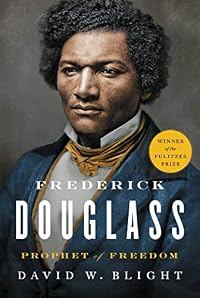
Frederick Douglass: Prophet of Freedom
by David W. Blight
On This Page
Description
"The definitive, dramatic biography of the most important African-American of the nineteenth century: Frederick Douglass, the escaped slave who became the greatest orator of his day and one of the leading abolitionists and writers of the era. As a young man Frederick Douglass (1818-1895) escaped from slavery in Baltimore, Maryland. He was fortunate to have been taught to read by his slave owner mistress, and he would go on to become one of the major literary figures of his time. He wrote show more three versions of his autobiography over the course of his lifetime and published his own newspaper. His very existence gave the lie to slave owners: with dignity and great intelligence he bore witness to the brutality of slavery. Initially mentored by William Lloyd Garrison, Douglass spoke widely, often to large crowds, using his own story to condemn slavery. He broke with Garrison to become a political abolitionist, a Republican, and eventually a Lincoln supporter. By the Civil War and during Reconstruction, Douglass became the most famed and widely traveled orator in the nation. He denounced the premature end of Reconstruction and the emerging Jim Crow era. In his unique and eloquent voice, written and spoken, Douglass was a fierce critic of the United States as well as a radical patriot. He sometimes argued politically with younger African-Americans, but he never forsook either the Republican party or the cause of black civil and political rights. In this remarkable biography, David Blight has drawn on new information held in a private collection that few other historians have consulted, as well as recently discovered issues of Douglass's newspapers. Blight tells the fascinating story of Douglass's two marriages and his complex extended family. Douglass was not only an astonishing man of words, but a thinker steeped in Biblical story and theology. There has not been a major biography of Douglass in a quarter century. David Blight's Frederick Douglass affords this important American the distinguished biography he deserves"-- "An acclaimed historian's definitive biography of the most important African-American figure of the 19th century, Frederick Douglass, who was to his century what Martin Luther King, Jr. was to the 20th century"-- show lessTags
Recommendations






Member Reviews
If there is a more thoroughly researched, well-written account of Frederick Douglass's life I cannot imagine what it would be. Prior to reading this, I was aware of him but only just. Now I feel as though I've met the man. Congratulations and appreciation to author David Blight for that.
Frederick Douglass! What an extraordinary individual!
Born a slave of mixed blood (his white owner fathered him with his black slave mother), he taught himself to read and self-educated himself far beyond what most of us ever achieve. He escaped his owner and literally fought his way to freedom. At least freedom of sorts because prejudice, hate, and bigotry followed him the rest of his life. His career became speaking out against slavery and I doubt show more there was anyone more prolific or better at it in 19th century America than Frederick Douglass.
Most of us know the Civil War ended slavery and was followed by the Reconstruction Period, a time meant to rebuild the defeated south. I never thought much about that; the war ended, the north won, slaves were freed, the union saved, time to rebuild the south. That's not at all how things went.
Another name for the post Civil War period could easily be the Lynching Period, certainly in the southern states where vengeance for having lost the war was the reaction of many whites. Even today there is no accurate account of how many blacks, and whites who dared to support blacks, were lynched by white mobs, but the number is conservatively in the thousands.
Here we are now in the 21st century when all of this nastiness of our history is just a distant memory, right? Nothing could be further from the truth. Our time of slavery right up to today, including the current administration, is a loud echo of all that happened over 150 years ago. You don't think so? Read this book!
This was a Christmas gift last year. The fact that I am just now adding it to my list of books read should tell you something about how fast I read, how much I read each time I read, how often I read, and/or the length of this book. It's a little bit of all four.
I read a couple of hours every night at an average speed; books, magazines, newspapers, and news feeds. That leaves this book's length to be considered. Just under 850 pages. I mention this only to prepare you for what lay ahead should you choose to take this on. I hope you do. show less
Frederick Douglass! What an extraordinary individual!
Born a slave of mixed blood (his white owner fathered him with his black slave mother), he taught himself to read and self-educated himself far beyond what most of us ever achieve. He escaped his owner and literally fought his way to freedom. At least freedom of sorts because prejudice, hate, and bigotry followed him the rest of his life. His career became speaking out against slavery and I doubt show more there was anyone more prolific or better at it in 19th century America than Frederick Douglass.
Most of us know the Civil War ended slavery and was followed by the Reconstruction Period, a time meant to rebuild the defeated south. I never thought much about that; the war ended, the north won, slaves were freed, the union saved, time to rebuild the south. That's not at all how things went.
Another name for the post Civil War period could easily be the Lynching Period, certainly in the southern states where vengeance for having lost the war was the reaction of many whites. Even today there is no accurate account of how many blacks, and whites who dared to support blacks, were lynched by white mobs, but the number is conservatively in the thousands.
Here we are now in the 21st century when all of this nastiness of our history is just a distant memory, right? Nothing could be further from the truth. Our time of slavery right up to today, including the current administration, is a loud echo of all that happened over 150 years ago. You don't think so? Read this book!
This was a Christmas gift last year. The fact that I am just now adding it to my list of books read should tell you something about how fast I read, how much I read each time I read, how often I read, and/or the length of this book. It's a little bit of all four.
I read a couple of hours every night at an average speed; books, magazines, newspapers, and news feeds. That leaves this book's length to be considered. Just under 850 pages. I mention this only to prepare you for what lay ahead should you choose to take this on. I hope you do. show less
(37 ) Oh. dear. Never, ever has a book taken me so long to read. Honestly over a month. I'm ashamed. My few years ago reading self would be very disdainful. But the new realities of my life leave me less time for reading and more incentive to doze off. I dozed off at night after a mere 2-3 pages... And for a 750+ page biography... umm that's going to take me a long time. And so it did. Is it just me; or is there some aspect to this book or the genre that is not compelling. I am not sure - but I cannot give a book that moves so slowly for me a much higher rating.
That being said - I don't think I appreciated what an iconic figure Douglass was in the 19th century. I loved the photographs. Especially the "candid" at the Chicago fair. In show more some ways I have never felt the people of the 19th century were actually real proximate humans until I read this book. What a strong amazing man. He remained fiery, hard-working, and dedicated - well beyond the point where you would figure someone would rest on their laurels. It seems in some ways that he was an "influencer" - writing pamphlets and giving endless talks. Dealing with intense gossip regarding his family, love life, quarrels int he press. The more things change...
It is amazing to me he could be such a successful and effective autodidact in the face of the OG systemic oppression. An escaped slave. The book also made me realize what the term 'legacy of slavery' really means. It 100% echoes today - The Bible Belt Republicans are the Southern Democrats of yesteryear. I am sure Douglass continues to roll over in his grave.
So the man and the story were surely interesting - I am not sure about the author's execution. Surely, the work is lauded, but at times it was just dry. There is no other word I can think of. I especially got bogged down after the Civil War. Reconstruction and post-Reconstruction was not very clearly rendered, nor was Douglas' role in that time well described.
I am a lightweight biography reader I think - not very experienced. I loved Chernow's Hamilton. But this may have put me off reaching for another bio for quite some time. show less
That being said - I don't think I appreciated what an iconic figure Douglass was in the 19th century. I loved the photographs. Especially the "candid" at the Chicago fair. In show more some ways I have never felt the people of the 19th century were actually real proximate humans until I read this book. What a strong amazing man. He remained fiery, hard-working, and dedicated - well beyond the point where you would figure someone would rest on their laurels. It seems in some ways that he was an "influencer" - writing pamphlets and giving endless talks. Dealing with intense gossip regarding his family, love life, quarrels int he press. The more things change...
It is amazing to me he could be such a successful and effective autodidact in the face of the OG systemic oppression. An escaped slave. The book also made me realize what the term 'legacy of slavery' really means. It 100% echoes today - The Bible Belt Republicans are the Southern Democrats of yesteryear. I am sure Douglass continues to roll over in his grave.
So the man and the story were surely interesting - I am not sure about the author's execution. Surely, the work is lauded, but at times it was just dry. There is no other word I can think of. I especially got bogged down after the Civil War. Reconstruction and post-Reconstruction was not very clearly rendered, nor was Douglas' role in that time well described.
I am a lightweight biography reader I think - not very experienced. I loved Chernow's Hamilton. But this may have put me off reaching for another bio for quite some time. show less
Having just read the lauded 1991 biography of Frederick Douglass by William S. McFeely, I wanted to read the award-winning recent biography, 2018, by David W. Blight.
Blight's book is better because it is lengthier, more in-depth, and more extensive. It has more pictures, too. The more extensive coverage of events is welcome. It is great to read two biographies of a subject back-to-back. You get different perspectives, different quotes, different analyses. For instance, McFeely spends far more time on Douglass's fight with Covey than Blight. Blight spends more time discussing Douglass's relationships with women not his wife, post-war lynching, etc. Interesting perspectives. Blight's in-depth accounting of Douglass's use of the Old show more Testament prophets, their language, and their righteous indignation, is eye-opening, stunning, and important.
It is a good look at Douglass's life, his works, and his meaning to America. It reads well, there are many interesting images. The only blight is that Blight (see what I did there?), several times, bemoans, bewails, and bemocks present-day Republicans who champion Douglass as a Republican and a proponent of self-help and individualism. It's grating. Take, for instance, the authorial intrusion at p. 559: "...current Republicans, some of whom love to appropriate Douglass, lifting him out of context to use him in service to causes he would abhor." Of course, it is Blight who miscontextualizes, both Douglass and present-day conservatism. And, one should always be wary of authors who try to claim a historical figure would feel this way or that way about present-day politics. How does Blight know Douglass would "abhor," a very strong word, say: low income taxes (which didn't exist back then)? how does Blight know what Douglass would think of affirmative action, Medicaid, or what have you? Blight doesn't know. In point of fact, the very next page, p. 560 in the book, Douglass rattles off feelings and beliefs that would put him squarely in late-1800s political Republicanism, many of the same ideas which were current in conservative Republican thought in the late-twentieth and early-twenty-first centuries! Douglass's ideas, on just this one page!, on labor unions, private property, and "faulty political institutions" do not sound out of place on conservative talk radio or in the conservative blogosphere!
But Blight wants to score points for his political side and punish the other political side. Blight is probably a liberal, a Democrat, so he can't let Douglass be claimed by the Republicans. Several times in the text, Blight interrupts the narrative flow to make an aside about how present-day Republicans are wrong about Douglass. But, Blight is wrong. Blight claims that because Douglass demands that the federal government vigorously use its power to secure the 14th and 15th Amendment rights of African Americans, then Douglass can not be used by the Republicans. As if Republicans don't want to use federal power to secure the rights of the people. Republicans, like Douglass, wanted an equal playing field, and then leave people alone. This is conservative Republican to the core, in the 1800s and today. But Blight seems to think Douglass's desire for federal power is somehow at odds with his "leave 'em alone" policy, and a desire for the federal government to prop up, to not ensure equality of opportunity, but to ensure equality of outcome. Blight's insinuations here, for without any words from Douglass they are Blight's insinuations, are wrong. Douglass only ever wanted equality of opportunity, not equality of outcome. To portray him as some sort of tax-and-spend, welfare-state-loving liberal Democrat is abhorrent and unhistorical. Blight's desire to score points for his side and smack Republicans knock down an otherwise accomplished and wonderful biography a couple of pegs.
Wonderful, lucid text. Great images. Extensive notes in the dumb, modern page-number style (i.e., not proper endnotes), no bibliography, illustration credits, index. show less
Blight's book is better because it is lengthier, more in-depth, and more extensive. It has more pictures, too. The more extensive coverage of events is welcome. It is great to read two biographies of a subject back-to-back. You get different perspectives, different quotes, different analyses. For instance, McFeely spends far more time on Douglass's fight with Covey than Blight. Blight spends more time discussing Douglass's relationships with women not his wife, post-war lynching, etc. Interesting perspectives. Blight's in-depth accounting of Douglass's use of the Old show more Testament prophets, their language, and their righteous indignation, is eye-opening, stunning, and important.
It is a good look at Douglass's life, his works, and his meaning to America. It reads well, there are many interesting images. The only blight is that Blight (see what I did there?), several times, bemoans, bewails, and bemocks present-day Republicans who champion Douglass as a Republican and a proponent of self-help and individualism. It's grating. Take, for instance, the authorial intrusion at p. 559: "...current Republicans, some of whom love to appropriate Douglass, lifting him out of context to use him in service to causes he would abhor." Of course, it is Blight who miscontextualizes, both Douglass and present-day conservatism. And, one should always be wary of authors who try to claim a historical figure would feel this way or that way about present-day politics. How does Blight know Douglass would "abhor," a very strong word, say: low income taxes (which didn't exist back then)? how does Blight know what Douglass would think of affirmative action, Medicaid, or what have you? Blight doesn't know. In point of fact, the very next page, p. 560 in the book, Douglass rattles off feelings and beliefs that would put him squarely in late-1800s political Republicanism, many of the same ideas which were current in conservative Republican thought in the late-twentieth and early-twenty-first centuries! Douglass's ideas, on just this one page!, on labor unions, private property, and "faulty political institutions" do not sound out of place on conservative talk radio or in the conservative blogosphere!
But Blight wants to score points for his political side and punish the other political side. Blight is probably a liberal, a Democrat, so he can't let Douglass be claimed by the Republicans. Several times in the text, Blight interrupts the narrative flow to make an aside about how present-day Republicans are wrong about Douglass. But, Blight is wrong. Blight claims that because Douglass demands that the federal government vigorously use its power to secure the 14th and 15th Amendment rights of African Americans, then Douglass can not be used by the Republicans. As if Republicans don't want to use federal power to secure the rights of the people. Republicans, like Douglass, wanted an equal playing field, and then leave people alone. This is conservative Republican to the core, in the 1800s and today. But Blight seems to think Douglass's desire for federal power is somehow at odds with his "leave 'em alone" policy, and a desire for the federal government to prop up, to not ensure equality of opportunity, but to ensure equality of outcome. Blight's insinuations here, for without any words from Douglass they are Blight's insinuations, are wrong. Douglass only ever wanted equality of opportunity, not equality of outcome. To portray him as some sort of tax-and-spend, welfare-state-loving liberal Democrat is abhorrent and unhistorical. Blight's desire to score points for his side and smack Republicans knock down an otherwise accomplished and wonderful biography a couple of pegs.
Wonderful, lucid text. Great images. Extensive notes in the dumb, modern page-number style (i.e., not proper endnotes), no bibliography, illustration credits, index. show less
Why should one read this almost 900-page biography of this American hero? Douglass penned several autobiographies of his own. Why is this work needed and important enough to be read in its entirety?
First, the writing and depth of research are marvelous. Blight considers and presents detailed arguments about the finer points of Douglass’ life. Each chapter is replete with scores of endnotes for further reading.
Second, the topic is timely, especially to America. Race is still an issue that haunts us. The nineteenth century – Douglass’ century – was haunted by slavery. The twentieth century was haunted by racial inequity. The twenty-first century saw its first black president followed by an openly racist president. Douglass’ show more struggle continues. It continued immediately through Booker Washington and W.E.B. DuBois, and it follows us to this day. Douglass’ yearning for freedom connects with the Hebrew prophets and connects today with all of those who question whether today’s social order is just and fair – whether America is living up to her grand ideals.
Third, this book is well-put together. Receiving the 2018 Pulitzer Prize for History, it has been exceptionally well-received by critics. It contains a pantheon of camera-pictures, artistic renderings, and daguerrotypes. Although we do not have any recordings of Douglass’ voice (as the phonograph was coming into existence just before Douglass’ death), copious presentations of the well-groomed Douglass alongside majestic texts of his speeches enliven the reader’s imagination to hear this great man contemplate a new American order in booming oratory. All of these elements conspire to bring Douglass alive again – and so to bring his struggle to speak freedom into existence to the fore.
I write this review on the day after Congressman Elijah Cummings’ death. Both Cummings and Douglass were born in Maryland. Both struggled for justice for their people and led journeys that expanded freedom’s call for all humans. Save for Lincoln, no one represented freedom’s call from slavery like Douglass did. His story, at least in my circles, is not told in all its grandiosity and particular splendor. This book communicates that in a way that allows us to see its common human struggle in contemporary life, all the way to Cummings’ struggle.
I also write in the context of the American South, where many freely intertwine American conservatism and evangelical Christianity. Often, it is claimed, liberalism is God-less and denigrates the writ of Christian Scripture. To that accusation, a great liberal voice – the deep, liberal, Republican voice of Frederick Douglass – answers. Liberalism – that is, the call for universal human freedom in its many forms – is historically grounded in the call of the ancient Hebrew prophets. Indeed, as the title of this book intimates, Douglass’ life represents a prophetic call. Though never a minister, he earned the title as “the Moses of American blacks.” Privileged white preachers who want to hold onto an old order need to remember that Scripture points us to the impassioned suffering of Jesus Christ for our freedom. Like many (all?) slaves, Douglass, unjustly whipped by tyrannical white men, shared such stripes, and by such stripes – by recognizing the holiness of their call for freedom – we as Americans and as humans are healed.
That’s why more people should read about Frederick Douglass, and that’s why this 900-page book deserves your time. show less
First, the writing and depth of research are marvelous. Blight considers and presents detailed arguments about the finer points of Douglass’ life. Each chapter is replete with scores of endnotes for further reading.
Second, the topic is timely, especially to America. Race is still an issue that haunts us. The nineteenth century – Douglass’ century – was haunted by slavery. The twentieth century was haunted by racial inequity. The twenty-first century saw its first black president followed by an openly racist president. Douglass’ show more struggle continues. It continued immediately through Booker Washington and W.E.B. DuBois, and it follows us to this day. Douglass’ yearning for freedom connects with the Hebrew prophets and connects today with all of those who question whether today’s social order is just and fair – whether America is living up to her grand ideals.
Third, this book is well-put together. Receiving the 2018 Pulitzer Prize for History, it has been exceptionally well-received by critics. It contains a pantheon of camera-pictures, artistic renderings, and daguerrotypes. Although we do not have any recordings of Douglass’ voice (as the phonograph was coming into existence just before Douglass’ death), copious presentations of the well-groomed Douglass alongside majestic texts of his speeches enliven the reader’s imagination to hear this great man contemplate a new American order in booming oratory. All of these elements conspire to bring Douglass alive again – and so to bring his struggle to speak freedom into existence to the fore.
I write this review on the day after Congressman Elijah Cummings’ death. Both Cummings and Douglass were born in Maryland. Both struggled for justice for their people and led journeys that expanded freedom’s call for all humans. Save for Lincoln, no one represented freedom’s call from slavery like Douglass did. His story, at least in my circles, is not told in all its grandiosity and particular splendor. This book communicates that in a way that allows us to see its common human struggle in contemporary life, all the way to Cummings’ struggle.
I also write in the context of the American South, where many freely intertwine American conservatism and evangelical Christianity. Often, it is claimed, liberalism is God-less and denigrates the writ of Christian Scripture. To that accusation, a great liberal voice – the deep, liberal, Republican voice of Frederick Douglass – answers. Liberalism – that is, the call for universal human freedom in its many forms – is historically grounded in the call of the ancient Hebrew prophets. Indeed, as the title of this book intimates, Douglass’ life represents a prophetic call. Though never a minister, he earned the title as “the Moses of American blacks.” Privileged white preachers who want to hold onto an old order need to remember that Scripture points us to the impassioned suffering of Jesus Christ for our freedom. Like many (all?) slaves, Douglass, unjustly whipped by tyrannical white men, shared such stripes, and by such stripes – by recognizing the holiness of their call for freedom – we as Americans and as humans are healed.
That’s why more people should read about Frederick Douglass, and that’s why this 900-page book deserves your time. show less
Summary: Perhaps the definitive biography of this escaped slave who became one of the most distinguished orators and writers in nineteenth century America as he for abolition and Reconstruction and civil rights for Blacks.
There is no simple way to summarize this magnificent biography of Frederick Douglass. Douglass lived an amazingly full life captured admirably in these 764 pages from his birth, likely conceived by a white plantation owner, to the attempts to break him on Covey's plantation, his quest to learn to read, and discovery of the power of words, his escape, and rise as an orator and writer, advocating first for abolition using the narrative of his own slavery, and later for full rights of blacks, even after the failed promise show more of Reconstruction and the rise of Jim Crow. He traveled relentlessly on speaking tours throughout his life, and was walking out the door of his home to speak when he collapsed and died of a heart attack. He wrote prodigiously, editing two newspapers and authoring his autobiography in three successive versions.
We could explore his oratorical greatness. Blight liberally quotes excerpts of his most famous speeches giving us a sense of the power of his rhetoric. We could trace the growing fault line between William Lloyd Garrison and Douglass, who differed on whether abolition would come through moral suasion or violence. We could explore his efforts to launch his own newspaper, struggling along for many years until closure. Blight uncovered editions of previously lost copies that enabled him to render a fuller account of the paper than previous biographers.
His later career reflected the tensions of trying to support Republican efforts at Reconstruction, only to condemn the eventual compromises and erosion of protections under the 13th, 14th, and 15th amendments that exposed Blacks to lynching, suppression of voting rights. It exposed him to criticism from younger activists. At one point late in his life, he serves as an honorary representative of Haiti, a country in which Africans had thrown off the yoke of their white French oppressors.
Blight also traces the familial struggles Douglass faced. Wanting a family when he had been stripped of one in childhood, he married Anna, a free woman, who did not share his love of words and the public limelight. She made a household in Rochester that sheltered fugitive slaves, radicals like John Brown, and eventually, her children's families, as well as Frederick's sophisticated white women friends Julia Griffiths Crofts, and later Ottilie Assing, who may have been something more to than that to Douglass. Assing even stayed for months at a time. Awkward? Perhaps, but we hear nothing of it from Anna, Awkward and distressing as well were the failures of their children, including his daughter's husband. Part of the reason for Frederick Douglass's unremitting lecture tours was the necessity to support this growing brood unable to be self supporting. This was an irony for one who prided himself on his self-sufficiency.
Frederick Douglass was a fighter, from the plantation to the Baltimore docks to the lecture and convention circuit. No one fought more passionately for Black civil rights. He fought until the day he died. The fact that the fight has had to be picked up by Ida B. Wells, W.E.B. Dubois, Howard Thurman, Martin Luther King, Jr., and Barack Obama, and still endures makes the case that it is not for lack of fighting and arduous effort that we still seek King's dream. Rather we need to pay attention to a larger American story of a country that has continued to struggle and fail to live up to its ideal of "liberty and justice for all." To read this biography of Douglass is both to marvel at the vision and drive and relentless fight for freedom of this man, and to grieve for the generations of compromises and lost opportunities that are the story of this country. It suggests that progress can only occur when Black prophets of freedom like Douglass are joined, generation after generation, by Whites who advocate for the nation's ideals with the relentlessness of Douglass. Douglass never gave up on the possibility of liberty and justice for all, including his own people. And neither should we. show less
There is no simple way to summarize this magnificent biography of Frederick Douglass. Douglass lived an amazingly full life captured admirably in these 764 pages from his birth, likely conceived by a white plantation owner, to the attempts to break him on Covey's plantation, his quest to learn to read, and discovery of the power of words, his escape, and rise as an orator and writer, advocating first for abolition using the narrative of his own slavery, and later for full rights of blacks, even after the failed promise show more of Reconstruction and the rise of Jim Crow. He traveled relentlessly on speaking tours throughout his life, and was walking out the door of his home to speak when he collapsed and died of a heart attack. He wrote prodigiously, editing two newspapers and authoring his autobiography in three successive versions.
We could explore his oratorical greatness. Blight liberally quotes excerpts of his most famous speeches giving us a sense of the power of his rhetoric. We could trace the growing fault line between William Lloyd Garrison and Douglass, who differed on whether abolition would come through moral suasion or violence. We could explore his efforts to launch his own newspaper, struggling along for many years until closure. Blight uncovered editions of previously lost copies that enabled him to render a fuller account of the paper than previous biographers.
His later career reflected the tensions of trying to support Republican efforts at Reconstruction, only to condemn the eventual compromises and erosion of protections under the 13th, 14th, and 15th amendments that exposed Blacks to lynching, suppression of voting rights. It exposed him to criticism from younger activists. At one point late in his life, he serves as an honorary representative of Haiti, a country in which Africans had thrown off the yoke of their white French oppressors.
Blight also traces the familial struggles Douglass faced. Wanting a family when he had been stripped of one in childhood, he married Anna, a free woman, who did not share his love of words and the public limelight. She made a household in Rochester that sheltered fugitive slaves, radicals like John Brown, and eventually, her children's families, as well as Frederick's sophisticated white women friends Julia Griffiths Crofts, and later Ottilie Assing, who may have been something more to than that to Douglass. Assing even stayed for months at a time. Awkward? Perhaps, but we hear nothing of it from Anna, Awkward and distressing as well were the failures of their children, including his daughter's husband. Part of the reason for Frederick Douglass's unremitting lecture tours was the necessity to support this growing brood unable to be self supporting. This was an irony for one who prided himself on his self-sufficiency.
Frederick Douglass was a fighter, from the plantation to the Baltimore docks to the lecture and convention circuit. No one fought more passionately for Black civil rights. He fought until the day he died. The fact that the fight has had to be picked up by Ida B. Wells, W.E.B. Dubois, Howard Thurman, Martin Luther King, Jr., and Barack Obama, and still endures makes the case that it is not for lack of fighting and arduous effort that we still seek King's dream. Rather we need to pay attention to a larger American story of a country that has continued to struggle and fail to live up to its ideal of "liberty and justice for all." To read this biography of Douglass is both to marvel at the vision and drive and relentless fight for freedom of this man, and to grieve for the generations of compromises and lost opportunities that are the story of this country. It suggests that progress can only occur when Black prophets of freedom like Douglass are joined, generation after generation, by Whites who advocate for the nation's ideals with the relentlessness of Douglass. Douglass never gave up on the possibility of liberty and justice for all, including his own people. And neither should we. show less
Perhaps my aging memory simply fails me now, but I strongly suspect that the American history textbooks in my 1950s and 60s high school and college classes, both conducted well south of the Mason-Dixon Line, gave little if any mention of Frederick Augustus Washington Bailey, aka Frederick Douglass. Oh, I have seen references to Douglass in other sources and in later years, but I cannot claim to have had anything approaching an accurate understanding of the man. More damning still, the southern American culture in which I was raised left me with a somewhat sanitized comprehension of 19th century U.S. history, society, and race relations, and let us not even mention a thoroughly accurate understanding of the causation of the Civil War or show more of the nature (and failure) of Reconstruction.
Finally, however, a few decades after my formal student days ended, two books have done much to enhance my understanding of that era in my nation's history: The Field of Blood: Violence in Congress and the Road to Civil War by Joanne Freemen and Frederick Douglass: Prophet of Freedom by David Blight. Both books deal with the same period in history from different but complementary foci, and I highly recommend both.
Blight's meticulously researched tome is by no means a quick read. Disregarding the acknowledgements, notes, and index sections, Prophet of Freedom stretches over 764 pages. I have never been particularly attracted to biography, and had I known the length of this book before hinting for a copy, I might well have foregone it—and that would have been a terrible mistake on my part.
A truly useful biography can hardly treat its protagonist (if I may use such a word in a non-fiction context) in isolation. It must explicate its character (again, if I may be allowed such a term) in light of the historical events surrounding him (or her as the case may be). What events drove the subject to become the man (or woman) he (or she) did become? Blight's biography not only gives today's reader a remarkable insight into a remarkable man but also illuminates the America into which Douglass was born and which he, in turn, influenced. Prophet of Freedom is not “just” biography; it is a well-told history of a fateful period of U.S. history, a period which continues to echo and reverberate into the 21st century. To a very great extent, both Freeman's The Field of Blood and Blight's Prophet of Freedom explain “where we have been” and “how we got here.”
It is rather disheartening to recognize the fact that many of Douglass's devils still pervade U.S. culture, and one can only wonder how the great orator would keep despair at bay could he know that so much of the racism, white supremacy, discrimination, disenfranchisement, economic imbalance, and kleptocratic government against which he railed still characterize domestic affairs and how the strong-arming and attempted intimidation of Haiti in 1889 and 1890 was hardly the last time the U.S. felt privileged to meddle forcibly in the affairs of other sovereign nations.
Judging by Prophet of Freedom, I would say that Blight is both a thorough and perceptive historian and an engaging writer. Some reviews have said that this book has too many details—is simply too long—but I say that the details are important and are a part of our history. Approach this lengthy book as an engaging and informative read not only about an influential and, in his time, well known black American but also about the events and beliefs that have done much to form contemporary U.S. society. show less
Finally, however, a few decades after my formal student days ended, two books have done much to enhance my understanding of that era in my nation's history: The Field of Blood: Violence in Congress and the Road to Civil War by Joanne Freemen and Frederick Douglass: Prophet of Freedom by David Blight. Both books deal with the same period in history from different but complementary foci, and I highly recommend both.
Blight's meticulously researched tome is by no means a quick read. Disregarding the acknowledgements, notes, and index sections, Prophet of Freedom stretches over 764 pages. I have never been particularly attracted to biography, and had I known the length of this book before hinting for a copy, I might well have foregone it—and that would have been a terrible mistake on my part.
A truly useful biography can hardly treat its protagonist (if I may use such a word in a non-fiction context) in isolation. It must explicate its character (again, if I may be allowed such a term) in light of the historical events surrounding him (or her as the case may be). What events drove the subject to become the man (or woman) he (or she) did become? Blight's biography not only gives today's reader a remarkable insight into a remarkable man but also illuminates the America into which Douglass was born and which he, in turn, influenced. Prophet of Freedom is not “just” biography; it is a well-told history of a fateful period of U.S. history, a period which continues to echo and reverberate into the 21st century. To a very great extent, both Freeman's The Field of Blood and Blight's Prophet of Freedom explain “where we have been” and “how we got here.”
It is rather disheartening to recognize the fact that many of Douglass's devils still pervade U.S. culture, and one can only wonder how the great orator would keep despair at bay could he know that so much of the racism, white supremacy, discrimination, disenfranchisement, economic imbalance, and kleptocratic government against which he railed still characterize domestic affairs and how the strong-arming and attempted intimidation of Haiti in 1889 and 1890 was hardly the last time the U.S. felt privileged to meddle forcibly in the affairs of other sovereign nations.
Judging by Prophet of Freedom, I would say that Blight is both a thorough and perceptive historian and an engaging writer. Some reviews have said that this book has too many details—is simply too long—but I say that the details are important and are a part of our history. Approach this lengthy book as an engaging and informative read not only about an influential and, in his time, well known black American but also about the events and beliefs that have done much to form contemporary U.S. society. show less
Finished this thanks to a second library checkout and some recent time on a plane. And it was absolutely worth those 912 pages for the comprehensive overview not only of Douglass's fascinating life but of the period and the very fraught courses of abolition and reconstruction (both of which are commonly defined to sound like contained processes, and both of which were anything but). Blight paints a thorough picture of the politics of the day—not simple, to say the least, but really worth taking the complex, deep dive. I'd venture to say that there's really no way to drive home the nationwide (and beyond) horror of slavery and the multiple ways it was embedded in the culture, economy, and political and personal life of the day without show more going into that kind of depth, and even if Blight waxed a little purple here and there, it was overall a very nuanced, empirical examination of a hugely knotty movement. I came out of this enormously well informed about so many facets of abolition—just the factions within the Abolitionist movement alone were eye-opening—and I highly recommend this. Plus for once I'm right on the literary prize trend—this just won a Pulitzer and a Bancroft (and a Christopher) prize.
I finally finished [Frederick Douglass: Prophet of Freedom] thanks to a second library checkout and some recent time on a plane. And it was absolutely worth those 912 pages for the comprehensive overview not only of Douglass's fascinating life but of the period and the very fraught courses of abolition and reconstruction (both of which are commonly defined to sound like contained processes, and both of which were anything but). Blight paints a thorough picture of the politics of the day—not simple, to say the least, but really worth taking the complex, deep dive. I'd venture to say that there's really no way to drive home the nationwide (and beyond) horror of slavery and the multiple ways it was embedded in the culture, economy, and political and personal life of the day without going into that kind of depth, and even if Blight waxed a little purple here and there, it was overall a very nuanced, empirical examination of a hugely knotty movement. I came out of this enormously well informed about so many facets of abolition—just the factions within the Abolitionist movement alone were eye-opening—and I highly recommend this. Plus for once I'm right on the literary prize trend—this just won a Pulitzer and a Bancroft (and a Christopher) prize.
nb: I would very much like to see someone take on a biographical novel about his German friend/supporter/colleague/(OK, let's just say it) groupie Ottilie Assing—what a fabulous character, ripe for some good fictionalizing. show less
I finally finished [Frederick Douglass: Prophet of Freedom] thanks to a second library checkout and some recent time on a plane. And it was absolutely worth those 912 pages for the comprehensive overview not only of Douglass's fascinating life but of the period and the very fraught courses of abolition and reconstruction (both of which are commonly defined to sound like contained processes, and both of which were anything but). Blight paints a thorough picture of the politics of the day—not simple, to say the least, but really worth taking the complex, deep dive. I'd venture to say that there's really no way to drive home the nationwide (and beyond) horror of slavery and the multiple ways it was embedded in the culture, economy, and political and personal life of the day without going into that kind of depth, and even if Blight waxed a little purple here and there, it was overall a very nuanced, empirical examination of a hugely knotty movement. I came out of this enormously well informed about so many facets of abolition—just the factions within the Abolitionist movement alone were eye-opening—and I highly recommend this. Plus for once I'm right on the literary prize trend—this just won a Pulitzer and a Bancroft (and a Christopher) prize.
nb: I would very much like to see someone take on a biographical novel about his German friend/supporter/colleague/(OK, let's just say it) groupie Ottilie Assing—what a fabulous character, ripe for some good fictionalizing. show less
Members
- Recently Added By
Lists

Best Biographies
216 works; 26 members

2019 Notable Books for Adults
26 works; 3 members

Top Five Books of 2019
387 works; 111 members

Obama Reads
181 works; 3 members

Books recommended by Barack Obama
295 works; 28 members

Shaykh Hamza's Book Recommendations
439 works; 3 members

NYT 100 best books of 21st C
100 works; 31 members
Barack Obama's Favorite Books of 2018
29 works; 2 members

.
184 works; 1 member

In Our Time books
4,934 works; 2 members
Author Information

David W. Blight is Sterling Professor of History at Yale University and Director of the Gilder Lehrman Center for the Study of Slavery, Resistance, and Abolition at Yale. He is the author of annotated editions of two of Frederick Douglass's autobiographies, The Narrative of the Life of Frederick Douglass and My Bondage and My Freedom. He is also show more the author of A Slave No More: Two Men Who Escaped to Freedom, Including Their Own Narratives of Emancipation and the prize-winning Race and Reunion: The Civil War in American Memory, among other works. Visit David W. Blight at www.davidwblight.com. show less
Some Editions
Awards and Honors
Awards
Distinctions
Amazon.com Best Books (Top 20 – 2018)
Common Knowledge
- Canonical title
- Frederick Douglass: Prophet of Freedom
- Original publication date
- 2018-10-16
- People/Characters
- Frederick Douglass
- Important events
- American Civil War; 19th century
- Epigraph
- There is a prophet within us, forever whispering that behind the seen lies the immeasurable unseen.
- Frederick Douglass, 1862 - Dedication
- To Walter O. Evans and Linda J. Evans and
to Jeffrey Brown Ferguson, 1964-2018 - First words
- (Introduction) In his speech at the dedication of the National Museum of African American History and Culture in Washington, DC, September 24, 2016, President Barack Obama delivered what he termed a "clear-eyed view" of a tra... (show all)gic and triumphant history of black Americans in the United States.
Throughout the spring morning of April 14, 1876, a huge crowd, largely African American, began to assemble in the vicinity of Seventh and Kevin Streets in Washington, DC. - Last words
- (Click to show. Warning: May contain spoilers.)Then he dropped his arms and bowed.
(Click to show. Warning: May contain spoilers.)(Epilogue) Douglass's life, and especially his words, may forever serve as our watch-warnings in our unending search for the beautiful, needful thing. - Blurbers
- Branch, Taylor; Lewis, David Levering; Gordon-Reed, Annette; McPherson, James M.; Faust, Drew Gilpin; Gates, Henry Louis, Jr. (show all 13); Hodes, Martha; Wilentz, Sean; Bunch, Lonnie G. III; Warren, Wendy; Oakes, James; Delbanco, Andrew; Burns, Ken
Classifications
- Genres
- Biography & Memoir, History, General Nonfiction, Nonfiction
- DDC/MDS
- 973.8092 — History & geography History of North America United States The Gilded Age (1865-1901)
- LCC
- E449 .D75 .B557 — History of the United States United States Revolution to the Civil War, 1775/1783-1861 Slavery in the United States. Antislavery
- BISAC
Statistics
- Members
- 1,518
- Popularity
- 15,083
- Reviews
- 29
- Rating
- (4.28)
- Languages
- English
- Media
- Paper, Audiobook, Ebook
- ISBNs
- 9
- ASINs
- 3