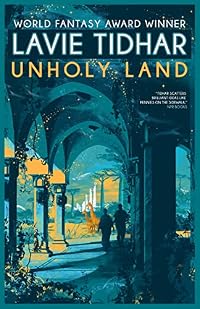
Unholy Land
by Lavie Tidhar
On This Page
Description
When pulp-fiction writer Lior Tirosh returns to his homeland in East Africa, much has changed. Palestina-a Jewish state established in the early 20th century-is constructing a massive border wall to keep out African refugees. Unrest in the capital, Ararat, is at fever pitch.While searching for his missing niece, Tirosh begins to act as though he is a detective from one of his own novels. He is pursued by ruthless members of the state's security apparatus while unearthing deadly conspiracies show more and impossible realities. For if it is possible for more than one Palestina to exist, the barriers between the worlds are beginning to break. show lessTags
Recommendations













Member Reviews
I closed the book--or rather swiped to the last page on my iPad--and my first thought was, I want to read this again. Now.
Because Unholy Land by Lavie Tidhar took me on a crazy ride across genres and space and time and I want to do it all over again.
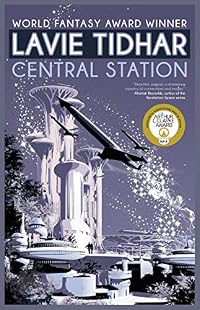
I read Tidhar's Central Station last year after my son raved about it. So I was expecting Science Fiction. But Unholy Land transcends genre, encompassing alternative history, noir mystery, and time-travel sci-fi, with social and political commentary (not so unusual in sci-fi, of course), so in the end, it transports the reader into an imagined alternative reality AND reflects on contemporary world politics. Add the "wink wink" self-referential nods and existential discussions on the nature show more of reality, we also get humor and philosophy.
In one work of fiction. And I think I missed some things.
So, yes, I want to read it AGAIN.
Tidhar was inspired by a true story of forgotten history. In 1904, the Zionist movement leader Theodor Herzl was offered land in Uganda as a Jewish homeland. Three men went on an expedition to survey the territory. One became separated and at journey's end, reported fertile land and while the other a saw desert. The idea was abandoned. Tidhar's novel considers the implications of establishing a Jewish homeland predating the Nazi regime.
The main character Lior Tirosh (note the character's name, so like Lavie Tidhar) slips through to an alternative reality. He doesn't realize what has happened, but he is tracked by two people who have been through the portal and lived in other worlds. He becomes embroiled in a battle to control the portal and prevent overlaps in realities.
Tirosh questions, what is history if not an attempt to impose order on a series of meaningless events, just as a detective must piece together a story from conflicting tales.
Don't expect escapist genre fiction, readers, for in Unholy Land we learn in all the worlds possible walls will be built and some will be cast into the outer darkness.
"Lavie Tidhar is a clever bastard, and this book is a box of little miracles." Warren Ellis, Afterword Unholy Land
I received a free ebook from the publisher through NetGalley in exchange for a fair and unbiased review. show less
Because Unholy Land by Lavie Tidhar took me on a crazy ride across genres and space and time and I want to do it all over again.
I read Tidhar's Central Station last year after my son raved about it. So I was expecting Science Fiction. But Unholy Land transcends genre, encompassing alternative history, noir mystery, and time-travel sci-fi, with social and political commentary (not so unusual in sci-fi, of course), so in the end, it transports the reader into an imagined alternative reality AND reflects on contemporary world politics. Add the "wink wink" self-referential nods and existential discussions on the nature show more of reality, we also get humor and philosophy.
In one work of fiction. And I think I missed some things.
So, yes, I want to read it AGAIN.
Tidhar was inspired by a true story of forgotten history. In 1904, the Zionist movement leader Theodor Herzl was offered land in Uganda as a Jewish homeland. Three men went on an expedition to survey the territory. One became separated and at journey's end, reported fertile land and while the other a saw desert. The idea was abandoned. Tidhar's novel considers the implications of establishing a Jewish homeland predating the Nazi regime.
The main character Lior Tirosh (note the character's name, so like Lavie Tidhar) slips through to an alternative reality. He doesn't realize what has happened, but he is tracked by two people who have been through the portal and lived in other worlds. He becomes embroiled in a battle to control the portal and prevent overlaps in realities.
Tirosh questions, what is history if not an attempt to impose order on a series of meaningless events, just as a detective must piece together a story from conflicting tales.
Don't expect escapist genre fiction, readers, for in Unholy Land we learn in all the worlds possible walls will be built and some will be cast into the outer darkness.
"Lavie Tidhar is a clever bastard, and this book is a box of little miracles." Warren Ellis, Afterword Unholy Land
I received a free ebook from the publisher through NetGalley in exchange for a fair and unbiased review. show less
I’ve never visited the Jewish homeland, but I know people who’ve been changed by it: the first sight of Ararat City, the vast waters of Lake Victoria, the grim fact of attacks by displaced Africans, the beauty of this tropical haven that kept Jews out of the war between the British Empire and the German Reich.
Wait. I’m getting confused. That’s the other world, the one Israeli author Lavie Tidhar weaves in his reality-bending novel “Unholy Land.” If the idea of a Jewish state in Africa seems bonkers, it shouldn’t. The British did offer to sponsor a Jewish colony in Kenya, and the Zionists did dispatch an expedition to report on the suitability of the land for settlement.
Ultimately the Zionists rejected the offer, but Tidhar show more nudges history down a different branch to a place where the Holocaust never happened, but where Jews still live in a state of siege, from wars with Idi Amin’s Uganda to bus bombings by African refugees living in the camps of the Disputed Territories.
If Tidhar just transplanted modern Israeli politics into the jungle, this would be nothing but an obvious morality play. But there’s more (or less?) to this world than meets the eye. Lior Tirosh, mediocre author and disappointing son of General Tirosh, is coming home from Berlin — but not this world’s Berlin.
Tirosh’s slip from one reality to another catches the attention of security services across the sephirot, services already tracking a pattern that may signal catastrophe. As bodies pile up and agents close in, lines between reality and fantasy thin, forcing Tirosh to face all of his pasts before it’s too late.
Tidhar was raised on a kibbutz but now resides in London after living in far-flung corners of Africa, Asia, and the Pacific. His novel, as the work of a homegrown Israeli turned international Jewish author, feels deeply autobiographical. The existence of modern Israel poses questions no one can answer, and many an Israeli who has traveled widely and lived abroad surely feels those tensions.
Beneath the trappings of alternate history and multiversal travel, this novel is a lush meditation of what it means to be an Israeli: always an outsider whether at home or abroad, never secure, never certain if you’re the oppressed or the oppressor, and always one breach away from the collapse of a fantasy you built to escape inescapable sorrows. show less
Wait. I’m getting confused. That’s the other world, the one Israeli author Lavie Tidhar weaves in his reality-bending novel “Unholy Land.” If the idea of a Jewish state in Africa seems bonkers, it shouldn’t. The British did offer to sponsor a Jewish colony in Kenya, and the Zionists did dispatch an expedition to report on the suitability of the land for settlement.
Ultimately the Zionists rejected the offer, but Tidhar show more nudges history down a different branch to a place where the Holocaust never happened, but where Jews still live in a state of siege, from wars with Idi Amin’s Uganda to bus bombings by African refugees living in the camps of the Disputed Territories.
If Tidhar just transplanted modern Israeli politics into the jungle, this would be nothing but an obvious morality play. But there’s more (or less?) to this world than meets the eye. Lior Tirosh, mediocre author and disappointing son of General Tirosh, is coming home from Berlin — but not this world’s Berlin.
Tirosh’s slip from one reality to another catches the attention of security services across the sephirot, services already tracking a pattern that may signal catastrophe. As bodies pile up and agents close in, lines between reality and fantasy thin, forcing Tirosh to face all of his pasts before it’s too late.
Tidhar was raised on a kibbutz but now resides in London after living in far-flung corners of Africa, Asia, and the Pacific. His novel, as the work of a homegrown Israeli turned international Jewish author, feels deeply autobiographical. The existence of modern Israel poses questions no one can answer, and many an Israeli who has traveled widely and lived abroad surely feels those tensions.
Beneath the trappings of alternate history and multiversal travel, this novel is a lush meditation of what it means to be an Israeli: always an outsider whether at home or abroad, never secure, never certain if you’re the oppressed or the oppressor, and always one breach away from the collapse of a fantasy you built to escape inescapable sorrows. show less
When Warren Ellis in his afterword invokes Michael Moorcock in relation to this conspiratorial tale of cross-dimensional intervention, the jumping off point being the real one-time notion of a possible Jewish homeland in East Africa, this about hits the nail on the head on the flavor of the whole story; phantasmagorical but based in hard realities and choices. As we follow the adventures of one Lior Tirosh it's also quite obvious that we're also following Tidhar's own doubts about the whole project of Israel and the prospect for redemptive solutions. I'm much more impressed with this novel than I was with "The Bookman" (my only other exposure to Tidhar) and it would seem that I'm going to have to find time for Tidhar's writing in the show more future. show less
I had wanted to buy a copy of this at the Worldcon in Dublin last August, but the handful of copies available in the dealers’ room had gone by the time I went to buy one. Fortunately, I recently found a copy in The English Bookshop here in Uppsala (albeit for somewhat more money). I’ve read most of Tidhar’s fiction – perhaps not all of the short stories, but there are so many of them, but certainly the longer works, especially the novels. So the self-referential elements of Unholy Land came as no real surprise, although the extent of them does feel greater than usual. So much so, in fact, that one important plot point, I think, is based on the first Tidhar story I ever read, some fifteen years ago, and whose title escapes me, show more but it was about a person browsing Hebrew pulp novels and stumbling across a novel which should not exist, or something. Which is, sort of, a fair description of Unholy Land itself. The starting premise is that Europe’s Jews accepted the British government’s offer of a homeland in east Africa (an actual historical suggestion, but the Zionist Congress rejected it in favour of historical Israel, although the first Aliyah to Palestine took place forty years prior to the Balfour Declaration). The novel is set in the 1980s, and the Jewish homeland, Palestina, is under constant attack by the African tribes who once lived in the territory it now occupies. The irony is thick here. A Jewish writer of pulp detective novels, resident in Berlin, returns to his home in Palestina on a visit. Except he has not been living in the Berlin of the same history as Palestina, and there is in fact a multiverse of alternate realities which can be accessed by certain people – in the writer’s case, unconsciously – and something is happening which jeopardises Palestina’s alternate reality… Not only does Unholy Land offer some seriously good worldbuilding and alternate history, but it also goes all meta and begins to deconstruct its own story from within its narrative. That’s so cool I’ve even done it myself. Tidhar has said he considers Unholy Land one of the best piece of work he has produced – so far – and though I take everything he says with a pinch of salt, having known him for several years, he may well be right in this case. It’s surprising how few awards picked up on Unholy Land. Well, no, it’s not really surprising – popular vote genre awards these days are entirely tribal and no longer fit for purpose, and Unholy Land is a genuinely good book. show less
As he did with his marvelous Osama, Tidhar has written an alternative history that is more than a gimmick. As complicated as the plot threads are--and as much Jewish mysticism or whatever (I'm not Jewish) they invoke--the story succeeds because of its characterizations. At the center of the story is a writer, who is obviously Tidhar's alter ego. In fact, one of his previous books was named Osama. But he is basically a writer of pulp fiction on a journey from his Berlin home to the Jewish homeland in Africa called Palestina, between Uganda and Kenya. This is a neat, history-based setting, as it was actually considered just after the start of the 20th century by Jews who did not believe that the Jewish state had to be in the Holy show more Land--thus, Tidhar's title for this book. We learn, however, that there are various threads of history, and that a few people can move between them. The second main character, is a ruthless security agent in Palestina who will stop at nothing to preserve his state. The third is a woman from an alternate timeline, also an agent, who is sent to track down the writer, who is suspected of being up to no good--or perhaps just being used by others to do no good. (Yes, it's complicated, but as I said, the key here is that you follow the characters and you care about them. There are others as well, and they are all interesting.)
In the end, this is a very serious book. Tidhar is obviously commenting, and not very obliquely, on the current situation in Israel, as Palestina faces bombings and insurrection from its native African population, who are now being fenced off by an enormous wall. Tidhar's sympathies seem clear, although he portrays each character's motivations so well that you can sympathize with each. The book has a satisfying, even moving conclusion. And makes you realize that our own world--even if it is just one world--could use some explaining too. show less
In the end, this is a very serious book. Tidhar is obviously commenting, and not very obliquely, on the current situation in Israel, as Palestina faces bombings and insurrection from its native African population, who are now being fenced off by an enormous wall. Tidhar's sympathies seem clear, although he portrays each character's motivations so well that you can sympathize with each. The book has a satisfying, even moving conclusion. And makes you realize that our own world--even if it is just one world--could use some explaining too. show less
Lior Tirosh, the main character in Lavie Tidhar's novel, may as well be the author. I mean, the author certainly seems to think so, both being more or less a self-described semi-successful pulp-fiction writer of SF, and like writers being in their own stories, they tend to go absolutely nuts on the imagination bits.
Well, at least, the good ones do. And guess what? He's one of the good ones. :)
This book wears several hats and unlike a normal hat-trick, this one does it gently enough that we barely even realize we've gone from a noir mystery in an alternate history to jump headlong into an existential crisis across multiple Earths where neither memory, history, or selfhood is set in stone.
Add to that the wonderful little twist where this show more is a history where Isreal never happened, where the grand refuge takes place in Africa... a thing that really and truly MIGHT have happened... throw in the Zohar and wonderfully interesting quasi-religious ideas that drive the Qabbalah, including the words of God and reading the Torah from a prism of different experiences and world-building viewpoints, and we've got a much deeper reading experience than anyone might assume from a first glance.
In fact, even tho the actual tale is fun to follow and only gets more and more interesting even as it amps up the bloodshed and deeper mystery, it deserves another read-through for the subtext. It's not just about the Jewish condition although that is a big part. It's about identity on a much deeper level.
I only read Central Station before this and both are very different beasts, but neither of them is lightweight or pulp in nature. Indeed, I'm rather thrilled at how many levels both succeeded.
Unholy Land is probably BETTER than Michael Chabon's Yiddish Policeman's Union, by the by. The other had them all retreat to Alaska and this one had them wind up in Africa, but the true joy isn't in the location. It's in everything. :) show less
Well, at least, the good ones do. And guess what? He's one of the good ones. :)
This book wears several hats and unlike a normal hat-trick, this one does it gently enough that we barely even realize we've gone from a noir mystery in an alternate history to jump headlong into an existential crisis across multiple Earths where neither memory, history, or selfhood is set in stone.
Add to that the wonderful little twist where this show more is a history where Isreal never happened, where the grand refuge takes place in Africa... a thing that really and truly MIGHT have happened... throw in the Zohar and wonderfully interesting quasi-religious ideas that drive the Qabbalah, including the words of God and reading the Torah from a prism of different experiences and world-building viewpoints, and we've got a much deeper reading experience than anyone might assume from a first glance.
In fact, even tho the actual tale is fun to follow and only gets more and more interesting even as it amps up the bloodshed and deeper mystery, it deserves another read-through for the subtext. It's not just about the Jewish condition although that is a big part. It's about identity on a much deeper level.
I only read Central Station before this and both are very different beasts, but neither of them is lightweight or pulp in nature. Indeed, I'm rather thrilled at how many levels both succeeded.
Unholy Land is probably BETTER than Michael Chabon's Yiddish Policeman's Union, by the by. The other had them all retreat to Alaska and this one had them wind up in Africa, but the true joy isn't in the location. It's in everything. :) show less
Lavie Tidhar typically mixes genres in his fiction. Unholy Land starts as a mix of thriller, mystery and alternate worlds stories but by the time he finishes, he has thrown in African adventures and spy elements as well. Magically, he makes of all of these elements a moving and meaningful story which by its end is much more than an entertaining mash-up of genres, it becomes a meditation (and lament) over what might have been, what has been lost, and the meaning of home.
Members
- Recently Added By
Lists

Best Science Fiction Novels
816 works; 430 members

2019 Hugo Eligible Novels
40 works; 12 members

2018 New SF Releases
24 works; 1 member
Author Information

187+ Works 5,313 Members
Some Editions
Awards and Honors
Awards
Distinctions
Common Knowledge
- Original title
- Unholy Land
- Original publication date
- 2018
- Dedication
- To Eliot
- First words
- Years ago, prompted by the vague recollection of a childhood story, I visited the Wiener Library in London. [preface]
The flight from Berlin was delayed. [story] - Last words
- (Click to show. Warning: May contain spoilers.)Sometimes I can't even tell which Palestine it is: their one or ours. [story]
(Click to show. Warning: May contain spoilers.)Lavie Tidhar is a clever bastard, and this book is a box of little miracles. [afterword] - Blurbers
- Ellis, Warren; McDonald, Ian; Moreno-Garcia, Silvia; Hossain, Saad Z.; Morrow, James; Horner, Bradley
Classifications
Statistics
- Members
- 291
- Popularity
- 109,993
- Reviews
- 18
- Rating
- (3.89)
- Languages
- English
- Media
- Paper, Audiobook, Ebook
- ISBNs
- 9
- ASINs
- 4