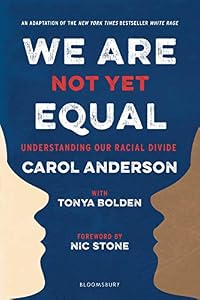
We Are Not Yet Equal: Understanding Our Racial Divide
by Carol Anderson, Tonya Bolden
On This Page
Description
This young adult adaptation of the New York Times bestselling White Rage is essential antiracist reading for teens.An NAACP Image Award finalist
A Kirkus Reviews Best Book of the Year
A NYPL Best Book for Teens
History texts often teach that the United States has made a straight line of progress toward Black equality. The reality is more complex: milestones like the end of slavery, school integration, and equal voting rights have all been met with racist legal and political maneuverings show more meant to limit that progress. We Are Not Yet Equal examines five of these moments: The end of the Civil War and Reconstruction was greeted with Jim Crow laws; the promise of new opportunities in the North during the Great Migration was limited when blacks were physically blocked from moving away from the South; the Supreme Court's landmark 1954 Brown v. Board of Education decision was met with the shutting down of public schools throughout the South; the Civil Rights Act of 1964 and Voting Rights Act of 1965 led to laws that disenfranchised millions of African American voters and a War on Drugs that disproportionally targeted blacks; and the election of President Obama led to an outburst of violence including the death of Black teen Michael Brown in Ferguson, Missouri as well as the election of Donald Trump.
Including photographs and archival imagery and extra context, backmatter, and resources specifically for teens, this book provides essential history to help work for an equal future. show less
Tags
Recommendations



Member Reviews
“It is time to rethink America.”
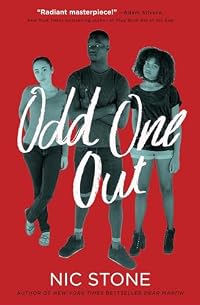
Adapted from Anderson’s bestselling White Rage (2016), this book summons young people to bear witness to the devastatingly expansive strategies white citizens have taken up to preserve the racialized violence that emerged from the founding of the nation. What is white rage? White rage works “subtly, almost imperceptibly” in American halls of power, utilizing an array of policy assaults, legal contortions, and physical violence to punish black resolve and block efforts toward full and equal citizenship. Anderson writes in an accessible narrative form, showing young people through pivotal historical events the ways in which white rage has been able to effectively undermine black-led social show more movements for equality and justice. It begins with the rise of the 19th-century Black Codes and the emergence of Jim Crow during the betrayal of Reconstruction. It continues into the Great Migration, when many black families chose to move North for opportunities and were met with extreme racist violence from white hate groups. The text carries us up to the current president and is enhanced by archival photographs. In her foreword, celebrated young adult author Nic Stone (Odd One Out, 2018, etc.) reminds us that it’s not just about exposing the roots of American racism, but what we do about it now.
Revealing our racialized past and arguing that we must refashion our nation in pursuit of a new, beloved, and just society. (discussion guide, sources, resources, index) (Nonfiction. 12-18)
-Kirkus Review show less
Adapted from Anderson’s bestselling White Rage (2016), this book summons young people to bear witness to the devastatingly expansive strategies white citizens have taken up to preserve the racialized violence that emerged from the founding of the nation. What is white rage? White rage works “subtly, almost imperceptibly” in American halls of power, utilizing an array of policy assaults, legal contortions, and physical violence to punish black resolve and block efforts toward full and equal citizenship. Anderson writes in an accessible narrative form, showing young people through pivotal historical events the ways in which white rage has been able to effectively undermine black-led social show more movements for equality and justice. It begins with the rise of the 19th-century Black Codes and the emergence of Jim Crow during the betrayal of Reconstruction. It continues into the Great Migration, when many black families chose to move North for opportunities and were met with extreme racist violence from white hate groups. The text carries us up to the current president and is enhanced by archival photographs. In her foreword, celebrated young adult author Nic Stone (Odd One Out, 2018, etc.) reminds us that it’s not just about exposing the roots of American racism, but what we do about it now.
Revealing our racialized past and arguing that we must refashion our nation in pursuit of a new, beloved, and just society. (discussion guide, sources, resources, index) (Nonfiction. 12-18)
-Kirkus Review show less
I keep starting this review only to delete what I wrote and start over because I can't find the words that are right to start this off. Instead of allowing myself to get caught in an endless loop of rewritten intros, let's start with a quote from the epilogue of this book.
"Imagine if, instead of continually refighting the Civil War, we had actually moved on to rebuilding..."
This quote basically sums up the entire book. Every chapter is full of examples of (white) people going out of their way to keep people of color down, even though doing so hurts everyone. Where could we be as a country if we built everyone up and let people succeed instead of letting racism run unchecked and tearing people down for our own bigoted amusement?
There was show more so much in the early chapters of this book that I had never heard before, and it's depressing to realize how much of history has been whitewashed and retaught as something less shameful than what it actually was. It's equally frustrating to read about the presidencies immediately following the Civil War and realize...things are basically the same today. The idea that equal treatment of minorities is somehow favoritism, for instance. The attitude of, "Fine, we'll grant you these rights so you can be 'equal', but do you really need to exercise all of them? Can't you just be happy with the scraps we already gave you?" Definitely still going on. Ugh.
This book is well-researched, well-written, and a great adaptation of White Rage. If you're wondering whether you should read it, the answer is yes, you should. Full disclosure: it will make you mad. Hopefully we can all use that anger to make things better. show less
"Imagine if, instead of continually refighting the Civil War, we had actually moved on to rebuilding..."
This quote basically sums up the entire book. Every chapter is full of examples of (white) people going out of their way to keep people of color down, even though doing so hurts everyone. Where could we be as a country if we built everyone up and let people succeed instead of letting racism run unchecked and tearing people down for our own bigoted amusement?
There was show more so much in the early chapters of this book that I had never heard before, and it's depressing to realize how much of history has been whitewashed and retaught as something less shameful than what it actually was. It's equally frustrating to read about the presidencies immediately following the Civil War and realize...things are basically the same today. The idea that equal treatment of minorities is somehow favoritism, for instance. The attitude of, "Fine, we'll grant you these rights so you can be 'equal', but do you really need to exercise all of them? Can't you just be happy with the scraps we already gave you?" Definitely still going on. Ugh.
This book is well-researched, well-written, and a great adaptation of White Rage. If you're wondering whether you should read it, the answer is yes, you should. Full disclosure: it will make you mad. Hopefully we can all use that anger to make things better. show less
We Are Not Yet Equal is a condensed history of the post-Civil War struggles to combat racism and protect the civil rights of African Americans and the resistance to that struggle by white supremacists of all kinds, from those in sheets to those in business suits to those in the White House. As soon as the War was over, racists in the North and the South and in both parties set to work to get things back to their normal, the white supremacist normal, with Black Codes and new laws that effectively reestablished slavery, this time through forced labor for debt and petty offenses like vagrancy.
Many sought relief by moving north, though the South’s demand for cheap labor led to laws and strategies designed to keep Black families from show more leaving. Seriously, they went so far as to kidnap trains and hold them, refusing to let them leave if they carried Black people north despite the fact we were in the middle of World War I.
The Massive Resistance to Brown vs. Bd. of Education is somewhat familiar to Americans. We’ve seen the Norman Rockwell painting, after all. However, it lasted far longer and was far more extreme and costly than is usually recognized. Some places simply shut down education completely for years. It’s not only they would rather be poor than equal, they also would rather be uneducated than integrated. If we are honest, the Massive Resistance to integrated education continues to the day with charter schools and the ongoing attacks on public education.
Anderson and Bolden also cover mass incarceration, the war on drugs, including the Reagan era policy of promoting crack cocaine to fund the Contras. It’s depressing, particularly how effectively the gains of the Civil Rights Movement have been undercut by the Supreme Court who is now working hard to eviscerate the Voting Rights Act.
We Are Not Yet Equal is an excellent primer on systemic racism. The people who wrote this know it really doesn’t matter whether there is a tape of Trump saying a racist fighting word because, through policy, Trump’s Administration has undone progress on criminal justice reform, okayed segregated housing and schools, and attacked voting rights. They are not wasting their time on personal racism because it is the laws, policies, and structures that enforce racism that have the greatest impact and, frankly, perpetuated personal racism.
This is a short book that is clear and easy to understand that sometimes vibrates with outrage and a passion for justice. This is less about the search for equality and more about white resistance to equality and the extreme ends to which white people will go to enforce white supremacy and how that is achieved through courts and legislation, not so much through protest and unrest–because if you’re in power, you can use the tools of power.
This would be a great book for people to read in high school or junior high. It would be fabulous if everyone was exposed to this history because as a country, we need it.
We Are Not Yet Equal will be published on September 11th. I received an ARC from the publisher through Shelf Awareness.
We Are Not Yet Equal at Bloomsbury
Carol Anderson faculty site
Tonya Bolden author site
https://tonstantweaderreviews.wordpress.com/2018/08/20/9781547600762/ show less
Many sought relief by moving north, though the South’s demand for cheap labor led to laws and strategies designed to keep Black families from show more leaving. Seriously, they went so far as to kidnap trains and hold them, refusing to let them leave if they carried Black people north despite the fact we were in the middle of World War I.
The Massive Resistance to Brown vs. Bd. of Education is somewhat familiar to Americans. We’ve seen the Norman Rockwell painting, after all. However, it lasted far longer and was far more extreme and costly than is usually recognized. Some places simply shut down education completely for years. It’s not only they would rather be poor than equal, they also would rather be uneducated than integrated. If we are honest, the Massive Resistance to integrated education continues to the day with charter schools and the ongoing attacks on public education.
Anderson and Bolden also cover mass incarceration, the war on drugs, including the Reagan era policy of promoting crack cocaine to fund the Contras. It’s depressing, particularly how effectively the gains of the Civil Rights Movement have been undercut by the Supreme Court who is now working hard to eviscerate the Voting Rights Act.
We Are Not Yet Equal is an excellent primer on systemic racism. The people who wrote this know it really doesn’t matter whether there is a tape of Trump saying a racist fighting word because, through policy, Trump’s Administration has undone progress on criminal justice reform, okayed segregated housing and schools, and attacked voting rights. They are not wasting their time on personal racism because it is the laws, policies, and structures that enforce racism that have the greatest impact and, frankly, perpetuated personal racism.
This is a short book that is clear and easy to understand that sometimes vibrates with outrage and a passion for justice. This is less about the search for equality and more about white resistance to equality and the extreme ends to which white people will go to enforce white supremacy and how that is achieved through courts and legislation, not so much through protest and unrest–because if you’re in power, you can use the tools of power.
This would be a great book for people to read in high school or junior high. It would be fabulous if everyone was exposed to this history because as a country, we need it.
We Are Not Yet Equal will be published on September 11th. I received an ARC from the publisher through Shelf Awareness.
We Are Not Yet Equal at Bloomsbury
Carol Anderson faculty site
Tonya Bolden author site
https://tonstantweaderreviews.wordpress.com/2018/08/20/9781547600762/ show less
Despite some accurate but misleadingly presented information (eg, on p 124, data about PhDs in the natural sciences), this book presents a compelling and accessible argument that systemic racism exists in the US and that it is intentional. I'm left with a few ideas for action, including supporting causes that seek to increase voter registration and turnout and promoting more equitable resource allocation in my area's public schools. I look forward to talking about this one with my teen and my middle schooler.
(The section I mention from page 124 reads, "In 2004, fifty years after Brown, the Journal of Blacks in Higher Education reported that not one black person earned a PhD in astronomy or astrophysics, for example. In fact, of the show more 2,100 PhDs awarded in forty-three different fields in the natural sciences, not one went to a black person."
This quote, while accurate according to the source cited in the Notes, makes it sound as though no black students earned PhDs in the natural sciences because it leaves out two paragraphs of data from the source---https://www.jbhe.com/news_views/50_black_doctoraldegrees.html:
Anderson's argument stands even with the more complete information because if there were racial equity in the upper levels of science education, black students awarded PhDs should at least match the percentage of black people in the population and the actual percentages are much, much lower, but the way it's written reminds me of the ways that data can be employed and omitted to make an argument seem stronger and that I need to be more careful about looking up an author's sources if I want a more complete picture.) show less
(The section I mention from page 124 reads, "In 2004, fifty years after Brown, the Journal of Blacks in Higher Education reported that not one black person earned a PhD in astronomy or astrophysics, for example. In fact, of the show more 2,100 PhDs awarded in forty-three different fields in the natural sciences, not one went to a black person."
This quote, while accurate according to the source cited in the Notes, makes it sound as though no black students earned PhDs in the natural sciences because it leaves out two paragraphs of data from the source---https://www.jbhe.com/news_views/50_black_doctoraldegrees.html:
"A major weakness is that blacks earned 13, or about 1 percent, of the nearly 1,200 doctorates in physics. In computer science, blacks won 0.7 percent of all Ph.D. awards. In the atmospheric sciences, less than 1 percent of all doctorates went to blacks. In chemistry, only 2.3 percent of Ph.D.s went to blacks. In the earth sciences such as geology, oceanography, and the atmospheric sciences, blacks were 1.3 percent of all doctoral recipients, down from 2.3 percent in 2003. In the ocean and marine sciences, only one of the 190 Ph.D.s in the discipline was awarded to an African American. In 2004, 148 African Americans were awarded a Ph.D. in the biological sciences. But they were only 2.5 percent of all doctorates awarded in the discipline. Black Ph.D. awards in the biological sciences did increase by 37 percent from 2003. That year, blacks were awarded 1.9 percent of all doctorates in the biological sciences.
The field of engineering also shows serious weakness in black doctoral student participation. Blacks also trail whites by a large margin in Ph.D.s in engineering. In 2004, 7.0 percent of all white doctorates were earned in the field of engineering. For African Americans, only 4.5 percent of all their doctorates were in engineering. In 2004 blacks earned a mere 1.6 percent of all engineering Ph.D.s. This was a slight improvement over 2003. The huge shortfall in engineering is serious because engineering is a field in which hundreds of thousands of Americans achieve high-income status and middle to upper social status."
Anderson's argument stands even with the more complete information because if there were racial equity in the upper levels of science education, black students awarded PhDs should at least match the percentage of black people in the population and the actual percentages are much, much lower, but the way it's written reminds me of the ways that data can be employed and omitted to make an argument seem stronger and that I need to be more careful about looking up an author's sources if I want a more complete picture.) show less
A young adult version of Carol Anderson’s 2017 White Rage, We Are Not Yet Equal traces the roots of systematic racism in the United States. Tonya Bolden does a nice job of simplifying the original text without losing the point, and the addition of photographs and some clarifying documents adds to the context. I really enjoyed reading this and did not find the “dumbing down” often seen in YA versions, and having recently finished Anderson’s original book I found the themes and intent very much intact. I think teens looking for anti-racist historical works will definitely enjoy We Are Not Yet Equal.
Carol Anderson's White Rage took the world by storm, landing on the New York Times bestseller list and best book of the year lists from New York Times, Washington Post, Boston Globe, and Chicago Review of Books. It launched her as an in-demand commentator on contemporary race issues for national print and television media and garnered her an invitation to speak to the Democratic Congressional Caucus. This compelling young adult adaptation brings her ideas to a new audience.
When America achieves milestones of progress toward full and equal black participation in democracy, the systemic response is a consistent racist backlash that rolls back those wins. We Are Not Yet Equal examines five of these moments: The end of the Civil War and show more Reconstruction was greeted with Jim Crow laws; the promise of new opportunities in the North during the Great Migration was limited when blacks were physically blocked from moving away from the South; the Supreme Court's landmark 1954 Brown v. Board of Education decision was met with the shutting down of public schools throughout the South; the Civil Rights Act of 1964 and Voting Rights Act of 1965 led to laws that disenfranchised millions of African American voters and a War on Drugs that disproportionally targeted blacks; and the election of President Obama led to an outburst of violence including the death of black teen Michael Brown in Ferguson, Missouri as well as the election of Donald Trump.
This YA is written in an approachable narrative style that provides teen readers with additional context to these historic moments and includes photographs and additional backmatter and resources for teens. show less
When America achieves milestones of progress toward full and equal black participation in democracy, the systemic response is a consistent racist backlash that rolls back those wins. We Are Not Yet Equal examines five of these moments: The end of the Civil War and show more Reconstruction was greeted with Jim Crow laws; the promise of new opportunities in the North during the Great Migration was limited when blacks were physically blocked from moving away from the South; the Supreme Court's landmark 1954 Brown v. Board of Education decision was met with the shutting down of public schools throughout the South; the Civil Rights Act of 1964 and Voting Rights Act of 1965 led to laws that disenfranchised millions of African American voters and a War on Drugs that disproportionally targeted blacks; and the election of President Obama led to an outburst of violence including the death of black teen Michael Brown in Ferguson, Missouri as well as the election of Donald Trump.
This YA is written in an approachable narrative style that provides teen readers with additional context to these historic moments and includes photographs and additional backmatter and resources for teens. show less
RGG: Well-written, clear, and revealing travesty.
Members
- Recently Added By
Lists

Books recommended by Calgary Public Library staff
1,588 works; 4 members
Author Information

7+ Works 2,770 Members
Carol Anderson is the Charles Howard Candler Professor and Chair of African American Studies at Emory University. The author of White Rage, which won the National Book Critics Circle Award, Bourgeois Radicals, and Eyes off the Prize, she was named a Guggenheim Fellow in constitutional studies. She lives in Atlanta, Georgia.

51+ Works 4,313 Members
Tonya Bolden is the author of ten books, including "Strong Men Keep Coming", "The Family Heirloom Cookbook", & "33 Things Every Girl Should Know". She lives in Brooklyn, New York. (Bowker Author Biography)
All Editions
Awards and Honors
Awards
Distinctions
Common Knowledge
- Original language
- English
Classifications
- Genres
- Nonfiction, Teen
- DDC/MDS
- 323.1196 — Social sciences Political science Civil and political rights Minority Politics Specific Groups Biography And History African Origin
- LCC
- E185.61 .A5437 — History of the United States United States Elements in the population Afro-Americans Status and development since emancipation
- BISAC
Statistics
- Members
- 220
- Popularity
- 147,523
- Reviews
- 9
- Rating
- (3.96)
- Languages
- English
- Media
- Paper, Audiobook, Ebook
- ISBNs
- 8
- ASINs
- 2