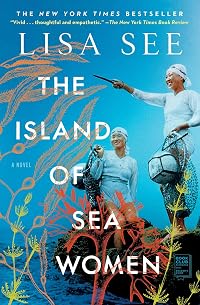
The Island of Sea Women
by Lisa See
On This Page
Description
"A new novel from Lisa See, the New York Times bestselling author of The Tea Girl of Hummingbird Lane, about female friendship and family secrets on a small Korean island. Mi-ja and Young-sook, two girls living on the Korean island of Jeju, are best friends that come from very different backgrounds. When they are old enough, they begin working in the sea with their village's all-female diving collective, led by Young-sook's mother. As the girls take up their positions as baby divers, they show more know they are beginning a life of excitement and responsibility but also danger. Despite their love for each other, Mi-ja and Young-sook's differences are impossible to ignore. The Island of Sea Women is an epoch set over many decades, beginning during a period of Japanese colonialism in the 1930s and 1940s, followed by World War II, the Korean War and its aftermath, through the era of cell phones and wet suits for the women divers. Throughout this time, the residents of Jeju find themselves caught between warring empires. Mi-ja is the daughter of a Japanese collaborator, and she will forever be marked by this association. Young-sook was born into a long line of haenyeo and will inherit her mother's position leading the divers in their village. Little do the two friends know that after surviving hundreds of dives and developing the closest of bonds, forces outside their control will push their friendship to the breaking point. This beautiful, thoughtful novel illuminates a world turned upside down, one where the women are in charge, engaging in dangerous physical work, and the men take care of the children. A classic Lisa See story--one of women's friendships and the larger forces that shape them--The Island of Sea Women introduces readers to the fierce and unforgettable female divers of Jeju Island and the dramatic history that shaped their lives"-- show lessTags
Recommendations
















Member Reviews
Taken captive by Lisa See's Haenyeo saga!
What can I say? I am once more blown away by a Lisa See novel.
See exceeded my expectations with this epic narrative centered around the female divers of Jeju Island, Korea. Set from the 1930's on at the time of the Japanese Occupation and later under the United States care-taking forces.
Told across time from the viewpoint of an older woman, Young-sook as she grapples with the twists her life has taken over these years, confronting her successes, failings and betrayals.
Her friendship with Mi-ja, the daughter of a collaborator and the breakdown of that closeness, leaves us with Young-Sook's anger which is hard bitten and understandable. Her inability to forgive is tangible.
Amongst the brightest show more moments are the scenes of the haenyeo (the women divers) collective as they commence diving accompanied by their rituals, patter and traditional comments.
The picture of Young-Sook and Mi-ja making rubbings of things to remember is just delightful, with moments of humor, joy and sorrow.
Another funny side is the popularity of the story of Heidi amongst the Jeju Islanders. The dark side is the massacres of the islanders by both Japanese and US troops. Both atrocious and both shameful.
A magnificent heartfelt story that begins with two young girls who become friends, whose lives are entwined for years, who face the worst, causing them to cease any comminication and then finally redemption that comes from a surprising quarter in an unexpected way. The treatment of the Haenyeo by various occupying governments and the Korean government, putting men in charge of them is a travesty against their culture and traditions. And the struggle to keep those teams and the culture of the Haenyeo alive in face of an ever changing and encroaching dispirit worldview is the challenge all indigenous populations face, and the answers are few.
The author's notes are extensive and well worth a read, demonstrating See's attention to the historical and traditional aspects surrounding the Island of Jeju and in particular the culture of the Haenyo.
A NetGalley ARC show less
What can I say? I am once more blown away by a Lisa See novel.
See exceeded my expectations with this epic narrative centered around the female divers of Jeju Island, Korea. Set from the 1930's on at the time of the Japanese Occupation and later under the United States care-taking forces.
Told across time from the viewpoint of an older woman, Young-sook as she grapples with the twists her life has taken over these years, confronting her successes, failings and betrayals.
Her friendship with Mi-ja, the daughter of a collaborator and the breakdown of that closeness, leaves us with Young-Sook's anger which is hard bitten and understandable. Her inability to forgive is tangible.
Amongst the brightest show more moments are the scenes of the haenyeo (the women divers) collective as they commence diving accompanied by their rituals, patter and traditional comments.
The picture of Young-Sook and Mi-ja making rubbings of things to remember is just delightful, with moments of humor, joy and sorrow.
Another funny side is the popularity of the story of Heidi amongst the Jeju Islanders. The dark side is the massacres of the islanders by both Japanese and US troops. Both atrocious and both shameful.
A magnificent heartfelt story that begins with two young girls who become friends, whose lives are entwined for years, who face the worst, causing them to cease any comminication and then finally redemption that comes from a surprising quarter in an unexpected way. The treatment of the Haenyeo by various occupying governments and the Korean government, putting men in charge of them is a travesty against their culture and traditions. And the struggle to keep those teams and the culture of the Haenyeo alive in face of an ever changing and encroaching dispirit worldview is the challenge all indigenous populations face, and the answers are few.
The author's notes are extensive and well worth a read, demonstrating See's attention to the historical and traditional aspects surrounding the Island of Jeju and in particular the culture of the Haenyo.
A NetGalley ARC show less
The Island of Sea Women is a difficult book. The writing is beautiful, the emotions and bonds between family and friends are clearly explained and felt. At its core it is a story of pain, anger, and loss.
But this is all set in a place, culture, and historical time I knew little or nothing of. I’d only heard of Jeju recently because a friend’s son was assigned to work there. Jeju is an island of South Korea known today as a tourist destination. In the 1940s - 1970s (when most of the story takes place) it is a remote island with many struggles. The sea women are haenyeo: deep divers who support and lead their families by fishing in deep waters. This matriarchal society is unique in the world.
The most difficult aspect of the book show more involves political upheaval following World War II. Jeju was interested in a united Korea but the leaders and American supporters were determined to wipe out communism. The book portrays fictionalized examples of an historical event - the Bukchon massacre. This reading was difficult. I spent a lot of time on google and was horrified by the details and cover up of this era.
This is not an easy read but it captured me and is surely going to be remembered. show less
But this is all set in a place, culture, and historical time I knew little or nothing of. I’d only heard of Jeju recently because a friend’s son was assigned to work there. Jeju is an island of South Korea known today as a tourist destination. In the 1940s - 1970s (when most of the story takes place) it is a remote island with many struggles. The sea women are haenyeo: deep divers who support and lead their families by fishing in deep waters. This matriarchal society is unique in the world.
The most difficult aspect of the book show more involves political upheaval following World War II. Jeju was interested in a united Korea but the leaders and American supporters were determined to wipe out communism. The book portrays fictionalized examples of an historical event - the Bukchon massacre. This reading was difficult. I spent a lot of time on google and was horrified by the details and cover up of this era.
This is not an easy read but it captured me and is surely going to be remembered. show less
“You should be more careful out there,” the doctor says. “You have a dangerous job. I mean, do you see men doing it?”
“Of course not!” Young-sook exclaims. “The world knows that the cold water will cause their penises to shrivel and die.”
This is my fourth Lisa See book...and the second one that made my all-time favorite list (Snow Flower and the Secret Fan is the first). Lisa is an amazing author, goddess of research, and master of character development.
I've gotten a glimpse of the horrific treatment of Koreans by the Japanese (Pachinko) and the U.S. (The Peoples' History of the United States), but this story was an intimate and personal journey into the lives of those living on the island of Jeju. Wow, just wow...as I show more close the cover of what feels like every book I read these days, my faith in humanity lessens. The ability of one "tribe's" ability to completely disassociate and commit horrors against "outsiders" is mind boggling.
The story also cemented a personal opinion that I've been pondering for some time now, one based both on my own life experiences and the thousands of books I've read.
Women are, in general and by far, the stronger sex.
In the face of poverty, war, and other intense hardships, I've observed (personally or literally) many a man fall apart and their women carry them (as well as their children). The haenyo divers of Jeju took this to a whole other level as they were not only capable of carrying their men emotionally, but physically as well.
A week after closing the back cover of this book and I still find myself thinking about the perfectly imperfect heroines of this story and replaying many of the scenes in my mind. Add this to the fact that I have a more complete knowledge about history (so I can do what I can to stop it from repeating) and it's no wonder it's an all-time favorite. show less
“Of course not!” Young-sook exclaims. “The world knows that the cold water will cause their penises to shrivel and die.”
This is my fourth Lisa See book...and the second one that made my all-time favorite list (Snow Flower and the Secret Fan is the first). Lisa is an amazing author, goddess of research, and master of character development.
I've gotten a glimpse of the horrific treatment of Koreans by the Japanese (Pachinko) and the U.S. (The Peoples' History of the United States), but this story was an intimate and personal journey into the lives of those living on the island of Jeju. Wow, just wow...as I show more close the cover of what feels like every book I read these days, my faith in humanity lessens. The ability of one "tribe's" ability to completely disassociate and commit horrors against "outsiders" is mind boggling.
The story also cemented a personal opinion that I've been pondering for some time now, one based both on my own life experiences and the thousands of books I've read.
Women are, in general and by far, the stronger sex.
In the face of poverty, war, and other intense hardships, I've observed (personally or literally) many a man fall apart and their women carry them (as well as their children). The haenyo divers of Jeju took this to a whole other level as they were not only capable of carrying their men emotionally, but physically as well.
A week after closing the back cover of this book and I still find myself thinking about the perfectly imperfect heroines of this story and replaying many of the scenes in my mind. Add this to the fact that I have a more complete knowledge about history (so I can do what I can to stop it from repeating) and it's no wonder it's an all-time favorite. show less
This book was the choice of my book club. It is probably not a book I would have picked up on my own, but it turned out to be a good one. It tells the story of the women divers of Jeju, a Korean island. It starts in the 1930's when Korea was occupied by Japanese colonizers and continues to 2008. The culture of Jeju island was unique and "matrifocal," where the mother was considered the head of the household. Due to unusual historical circumstances, the women were the ones who went diving for seafood, the work that supported their families. It was difficult and dangerous work.
At the heart of the story is the friendship between two of the women, and the events that happened to break the friendship. We also see the progress of history and show more the world events that affected the island. It begins with the hated Japanese colonizers who are eventually replaced by mainland Korean and American occupiers after WWII. As much as the Japanese were despised, the post-war era is worse, with much unrest, fears of communism, and persecution of opposition leading to a massacre, known as the 4.3 Incident, which is a turning point for the story. We see how modernization impacts the unique culture of the island and how a way of life is lost. This story of lost culture is different from what we usually see, where colonizing Europeans disrupt native American/Eskimo culture or, as in the case of Chinua Achebe's Things Fall Apart, Africa. In this case, it is their countrymen, Koreans from the mainland, who are the primary agents of the change.
Lisa See does a beautiful job of showing us the way of life on Jeju and the relationships between the women and their families. There are a number of tragedies that befall the inhabitants of Jeju, and some of this is difficult to read. But the story was very engrossing, and I learned about a place and way of life that I had no idea existed. show less
At the heart of the story is the friendship between two of the women, and the events that happened to break the friendship. We also see the progress of history and show more the world events that affected the island. It begins with the hated Japanese colonizers who are eventually replaced by mainland Korean and American occupiers after WWII. As much as the Japanese were despised, the post-war era is worse, with much unrest, fears of communism, and persecution of opposition leading to a massacre, known as the 4.3 Incident, which is a turning point for the story. We see how modernization impacts the unique culture of the island and how a way of life is lost. This story of lost culture is different from what we usually see, where colonizing Europeans disrupt native American/Eskimo culture or, as in the case of Chinua Achebe's Things Fall Apart, Africa. In this case, it is their countrymen, Koreans from the mainland, who are the primary agents of the change.
Lisa See does a beautiful job of showing us the way of life on Jeju and the relationships between the women and their families. There are a number of tragedies that befall the inhabitants of Jeju, and some of this is difficult to read. But the story was very engrossing, and I learned about a place and way of life that I had no idea existed. show less
I borrowed this book from my local library. It's a book club read for April 2024.
Haenyeo are the sea women of Jeju Island, a large isle off the coast of South Korea and near Japan. They are deep sea divers, a role traditionally given to women in the matrifocal society: the women are seen as physically superior in the water and therefore earn the family income, while men tend to the children and do housework (and often seem to become alcoholics). This book follows two best friends in a small village as they grow up in the 1930s and 1940s. Marriage and the Korean War bring devastating events to their families, tearing the two women apart, but the narrative continues up to the present day, when the haenyeo numbers are greatly diminished show more and regulated.
The subject matter of this book was absolutely new to me, and fascinating. I'm not so fond of books about drama between people who just aren't paying attention, so I found that frustrating. The book goes quite dark as it addresses atrocities during the Korean War--it truly depicts the horrors of war. I was disgusted, but unsurprised, to discover America's role in it.
I wouldn't have picked this up if not for the book club, and I feel like I learned a lot. show less
Haenyeo are the sea women of Jeju Island, a large isle off the coast of South Korea and near Japan. They are deep sea divers, a role traditionally given to women in the matrifocal society: the women are seen as physically superior in the water and therefore earn the family income, while men tend to the children and do housework (and often seem to become alcoholics). This book follows two best friends in a small village as they grow up in the 1930s and 1940s. Marriage and the Korean War bring devastating events to their families, tearing the two women apart, but the narrative continues up to the present day, when the haenyeo numbers are greatly diminished show more and regulated.
The subject matter of this book was absolutely new to me, and fascinating. I'm not so fond of books about drama between people who just aren't paying attention, so I found that frustrating. The book goes quite dark as it addresses atrocities during the Korean War--it truly depicts the horrors of war. I was disgusted, but unsurprised, to discover America's role in it.
I wouldn't have picked this up if not for the book club, and I feel like I learned a lot. show less
I was surprised at how good this book was. I’ve never read any of the author’s other books; to be honest, I was a bit afraid that it would be kind of a voyeuristic look at a quaintly isolated community. Let me just say: it’s not that. I don’t know about the cultural authenticity—it’s probably about 80%; wouldn’t that be typical? But beyond that, it’s a very human story about deep, lasting relationships. It’s also about some really challenging, jolting experiences. It’s about the ways we connect with our community and its history. It’s about the ways we dehumanize other people, and the terrible danger of doing so.
I’ll note that I’ve read some reviews that say the book is overly shocking, but I disagree. Some show more things are meant to be shocking, and it would be disrespectful to treat them any other way. This book does not flinch, and it’s better for it. show less
I’ll note that I’ve read some reviews that say the book is overly shocking, but I disagree. Some show more things are meant to be shocking, and it would be disrespectful to treat them any other way. This book does not flinch, and it’s better for it. show less
This is just about perfect historical fiction - comprehensively researched on the history side, combined with a story well told, and populated with characters that are complex, believabe and compelling.
Set around women sea divers in Korea in the era 1930s to 2000s, the book delivers an awareness of the amazing lives of these women, set against a background of the horrors faced by Korean residents in that era.
The writing is crisp and clear. The author avoids over-telling the story, and "shows" the reader what is happening. And, most pleasingly, the author has avoided "dumbing down" the story for those unfamiliar with the era, and has delivered an absolute gem of a book.
I don't normally gush in my reviews, but this book invites no other show more response. show less
Set around women sea divers in Korea in the era 1930s to 2000s, the book delivers an awareness of the amazing lives of these women, set against a background of the horrors faced by Korean residents in that era.
The writing is crisp and clear. The author avoids over-telling the story, and "shows" the reader what is happening. And, most pleasingly, the author has avoided "dumbing down" the story for those unfamiliar with the era, and has delivered an absolute gem of a book.
I don't normally gush in my reviews, but this book invites no other show more response. show less
Members
- Recently Added By
Lists

Top Five Books of 2020
982 works; 348 members

Sense of place
156 works; 13 members

Pleasant Surprises: Books That Exceeded Our Expectations
418 works; 143 members

Literature About Women and Girls
394 works; 39 members

Mothers and Daughters
114 works; 11 members

Books Read in 2020
4,379 works; 123 members

Netgalley Reads
460 works; 3 members

Global Reads: Books Set in East Asia
139 works; 12 members

Books Read in 2021
5,361 works; 114 members

Books With Water Words in the Title
186 works; 12 members

Asian American Literature
46 works; 6 members

Books recommended by Calgary Public Library staff
1,588 works; 4 members

Books That Changed Our Perspective
423 works; 168 members

Books We Couldn't Put Down
443 works; 197 members

Governerds Insider
32 works; 1 member
Author Information

20+ Works 33,115 Members
Lisa See was born in Paris but grew up in Los Angeles, spending much of her time in Chinatown. She is of Chinese decent. Her first book, On Gold Mountain: The One Hundred Year Odyssey of My Chinese-American Family (1995), was a national bestseller and a New York Times Notable Book. The book traces the journey of Lisa's great-grandfather, Fong See. show more Her first fiction novel, Flower Net (1997) was a national bestseller, a New York Times Notable Book, and on the Los Angeles Times Best Books List for 1997. Flower Net was also nominated for an Edgar award for best first novel. In addition to writing books, Ms. See was the Publishers Weekly West Coast Correspondent for 13 years. Her bestselling novels, all inspired by her Chinese heritage, include Snow Flower and the Secret Fan, A Peony in Love, Shanghi Girls, Dreams of Joy and China Dolls. Among her awards and recognitions are the Organization of Chinese Americans Women's 2001 award as National Woman of the Year and the 2003 History Makers Award presented by the Chinese American Museum. See serves as a Los Angeles City Commissioner. (Bowker Author Biography) show less
Awards and Honors
Awards
Common Knowledge
- Canonical title
- The Island of Sea Women
- Original title
- The Island of Sea Women
- Original publication date
- 2019-03
- People/Characters
- Mi-ja Han; Young-sook Kim; Sun-sil Kim; Do-saeng Yang; Gu-ja Kang; Gu-sun Kang (show all 22); Yu-ri Yang; Sang-mun Lee; Lee-ok; Him-chan; Han-Bong Lee; Jun-bu Yang; In-ha Kim; Yo-chan Lee; Min-lee Yang; Sung-soo Yang; Clara; Kyung-soo Yang; Joon-lee Yang; Wan-soon; Yang-gin; Ji-young (Janet)
- Important places
- Hado, Jeju Island, Korea; Vladivostok, Russia; Jeju City, Korea; Bukchon, Korea; Hamdeok, Korea
- Important events
- World War II; Korean War
- First words
- An old woman sits on the beach, a cushion strapped to her bottom, sorting algae that's washed ashore.
- Quotations
- No one picks a friend for us; we come together by choice. We are not tied together through ceremony or the responsibility to create a son; we tie ourselves together through moments. The spark when we first meet. Laughter and ... (show all)tears shared. Secrets packed away to be treasured, hoarded, and protected. The wonder that someone can be so different from you and yet still understand your heart in a way no one else ever will.
"Every woman who goes into the sea carries a coffin on her back. In this world, in the undersea world, we tow the burdens of this hard life."
Sometimes you must experience heartache to have a treasured result.
For a tree that has many branches, even a small breeze will shake some loose. - Last words
- (Click to show. Warning: May contain spoilers.)A breath,
a breath,
a breath... - Blurbers
- Picoult, Jodi; Kidd, Sue Monk; Hannah, Kristin
Classifications
Statistics
- Members
- 2,353
- Popularity
- 8,337
- Reviews
- 122
- Rating
- (4.15)
- Languages
- 7 — Catalan, Czech, English, French, Italian, Korean, Spanish
- Media
- Paper, Audiobook, Ebook
- ISBNs
- 32
- ASINs
- 10