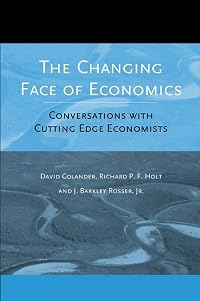
The Changing Face of Economics: Conversations with Cutting Edge Economists
by David Colander
On This Page
Description
The Changing Face of Economics gives the reader a sense of the modern economics profession and how it is changing. The volume does so with a set of nine interviews with cutting edge economists, followed by interviews with two Nobel Prize winners, Paul Samuelson and Kenneth Arrow, reflecting on the changes that are occurring. What results is a clear picture of today's economics--and it is no longer standard neoclassical economics. The interviews and commentary together demonstrate that show more economics is currently undergoing a fundamental shift in method and is moving away from traditional neoclassical economics into a dynamic set of new methods and approaches. These new approaches include work in behavioral economics, experimental economics, evolutionary game theory and ecological approaches, complexity and nonlinear dynamics, methodological analysis, and agent-based modeling. David E. Colander is Professor of Economics, Middlebury College. J. Barkley Rosser, Jr., is Professor of Economics and Kirby L. Kramer Jr. Professor of Business Administration, James Madison University. Richard P. F. Holt is Professor of Churchill Honors and Economics, Southern Oregon University. show lessTags
Recommendations
Member Recommendations
Member Reviews
It's an unfortunate (though, to some degree, unavoidable) fact of undergrad education that introductory courses in economics focus on core theory that's at least a few decades old. (The bulk of what's taught in a typical "ECON 101" course was state-of-the-art some 50-100 years ago!) Even first-year PhD courses seldom stray close to the "cutting edge". So this book, which gives a snapshot of some of the most interesting work in economics circa 2002 through interviews with a dozen economists, provides a valuable service to potential and current grad students. It may also be a useful antidote to straw man attacks on economic science, though those with no background in economics might gain more from reading one of the many recent popular show more books on economics.
The authors interview ten working economists: Deirdre McCloskey, Ken Binmore, Herb Gintis, Robert Frank, Matthew Rabin, William Brock, Duncan Foley, Richard Norgaard, Robert Axtell, and H. Peyton Young. These "cutting edge" economists aren't necessarily young (most earned their PhD in the 60s or 70s); indeed, all are in the midst of well-established research programs, with plenty of publications on their CVs. Interviews with two Nobel laureates, Ken Arrow and Paul Samuelson, provide additional perspective.
The selection of interviewees is representative, not comprehensive or definitive. I could probably come up with a list of ten equally-interesting interview subjects (Leigh Tesfatsion, Al Roth, Ernst Fehr, Steven Durlauf, Larry Blume, Oded Galor, and Sam Bowles spring to mind immediately), but the authors seem to have chosen a sample that's about the right size. Perhaps within a few years it will be time for a sequel to this volume with a new sample of economists. If so, it would be interesting to hear from a few economists earlier in their careers. Macroeconomists are also underrepresented in the current book, but perhaps the authors were wise not to duplicate the work in Conversations With Leading Economists : Interpreting Modern Macroeconomics, not to mention the classic Conversations With Economists: New Classical Economists and Opponents Speak Out on the Current Controversy in Macroeconomics.
I recommend this book to anyone thinking about a career in economics and unsure whether there are open areas of research they'd find interesting. I also recommend it to anyone mired in their first year of study toward the PhD, as a reminder that there's life beyond their core coursework. show less
The authors interview ten working economists: Deirdre McCloskey, Ken Binmore, Herb Gintis, Robert Frank, Matthew Rabin, William Brock, Duncan Foley, Richard Norgaard, Robert Axtell, and H. Peyton Young. These "cutting edge" economists aren't necessarily young (most earned their PhD in the 60s or 70s); indeed, all are in the midst of well-established research programs, with plenty of publications on their CVs. Interviews with two Nobel laureates, Ken Arrow and Paul Samuelson, provide additional perspective.
The selection of interviewees is representative, not comprehensive or definitive. I could probably come up with a list of ten equally-interesting interview subjects (Leigh Tesfatsion, Al Roth, Ernst Fehr, Steven Durlauf, Larry Blume, Oded Galor, and Sam Bowles spring to mind immediately), but the authors seem to have chosen a sample that's about the right size. Perhaps within a few years it will be time for a sequel to this volume with a new sample of economists. If so, it would be interesting to hear from a few economists earlier in their careers. Macroeconomists are also underrepresented in the current book, but perhaps the authors were wise not to duplicate the work in Conversations With Leading Economists : Interpreting Modern Macroeconomics, not to mention the classic Conversations With Economists: New Classical Economists and Opponents Speak Out on the Current Controversy in Macroeconomics.
I recommend this book to anyone thinking about a career in economics and unsure whether there are open areas of research they'd find interesting. I also recommend it to anyone mired in their first year of study toward the PhD, as a reminder that there's life beyond their core coursework. show less
Members
- Recently Added By
Author Information
41 Works 473 Members
David Colander is the Christian A. Johnson Distinguished Professor of Economics at Middlebury College
Classifications
Statistics
- Members
- 10
- Popularity
- 2,141,183
- Reviews
- 1
- Rating
- (4.50)
- Languages
- English
- Media
- Paper, Ebook
- ISBNs
- 5