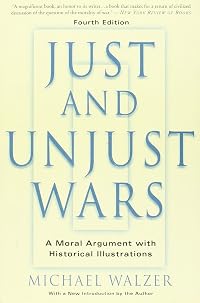
Just and Unjust Wars
by Michael Walzer
On This Page
Description
"This classic work of political ethics has radically reconfigured the way that we think about war. From the Athenian attack on Melos to the My Lai Massacre, from the wars in the Balkans through the first war in Iraq, Michael Walzer examines the moral issues surrounding military theory, war crimes, and the spoils of war. He studies a variety of conflicts over the course of history, as well as the testimony of those who have been most directly involved--participants, decision makers, and show more victims. In his introduction to this new edition, Walzer specifically addresses the moral issues surrounding the war in and occupation of Iraq, reminding us once again that "the argument about war and justice is still a political and moral necessity"--Back cover. show lessTags
Recommendations



Member Reviews
This book probably deserves 4 stars. So why only 3? Because I'm not a moral philosopher, lawyer, military historian, etc. and this was a very long read for me. That said, I did 'like' it and, moreover, it was worth slogging through.
Pros: Good questions (What *are* the morals of war? What is just war? What is justice *in* war?), and clear explanation of the viewpoint of the author.
Cons: There is a recurring "rights vs. utilitarianism" argument/tension throughout the book with the greater weight going to rights. Specifically the rights of non-combatants. This seems obvious... and yet I keep finding myself wondering...
There is a great (real-life) example in the book: soldiers clearing a village in WWII. Before throwing grenades into show more cellars the soldier in question shouts a warning down, taking on the risk of e.g. getting shot by hiding Germans soldiers. He shouts this warning in order to protect potential civilian victims. As it turns out there is a French family in one cellar, who come out at the last minute and are saved, essentially, by the risk taken by -the right action of- the soldier.
The book argues this is correct because the soldier has to take on soldierly risks (getting shot/surprised) to protect civilians even though it would be safer for him to just toss a grenade in each cellar without warning. The reason the soldier is required to do this is because... he's a soldier. When he picked up a gun, he took on this extra responsibility; the civilians, not having picked up guns, retain their peace-time rights (not to get shot, blown up, etc.) So long as the soldier holds his gun (figuratively, somewhat) he has lost some rights (namely, the right to not be shot) AND taken on extra responsibilities. (He gets his rights back, more or less, as soon as he puts down his gun.)
I think I see a problem in this because it creates a kind of perverse moral reward for not fighting. Those people who choose not to fight (say, the Nazis) offload moral duty to those who do "choose" to fight. The author goes through a lot of contortions dealing with this. Which is fine; he is not leaving it unaddressed, even if I don't think he ever calls it out in just this way. But all the discussion of "immoral means in moral causes" and such didn't leave me feeling that this has been satisfactorily addressed.
Which may be because there isn't a good, clean, simple answer. show less
Pros: Good questions (What *are* the morals of war? What is just war? What is justice *in* war?), and clear explanation of the viewpoint of the author.
Cons: There is a recurring "rights vs. utilitarianism" argument/tension throughout the book with the greater weight going to rights. Specifically the rights of non-combatants. This seems obvious... and yet I keep finding myself wondering...
There is a great (real-life) example in the book: soldiers clearing a village in WWII. Before throwing grenades into show more cellars the soldier in question shouts a warning down, taking on the risk of e.g. getting shot by hiding Germans soldiers. He shouts this warning in order to protect potential civilian victims. As it turns out there is a French family in one cellar, who come out at the last minute and are saved, essentially, by the risk taken by -the right action of- the soldier.
The book argues this is correct because the soldier has to take on soldierly risks (getting shot/surprised) to protect civilians even though it would be safer for him to just toss a grenade in each cellar without warning. The reason the soldier is required to do this is because... he's a soldier. When he picked up a gun, he took on this extra responsibility; the civilians, not having picked up guns, retain their peace-time rights (not to get shot, blown up, etc.) So long as the soldier holds his gun (figuratively, somewhat) he has lost some rights (namely, the right to not be shot) AND taken on extra responsibilities. (He gets his rights back, more or less, as soon as he puts down his gun.)
I think I see a problem in this because it creates a kind of perverse moral reward for not fighting. Those people who choose not to fight (say, the Nazis) offload moral duty to those who do "choose" to fight. The author goes through a lot of contortions dealing with this. Which is fine; he is not leaving it unaddressed, even if I don't think he ever calls it out in just this way. But all the discussion of "immoral means in moral causes" and such didn't leave me feeling that this has been satisfactorily addressed.
Which may be because there isn't a good, clean, simple answer. show less
I thought the initial portion of the book asks some good questions and contains some thought provoking analysis.
However, towards the latter part of the book I found myself disagreeing with the author about the WWII strategic bombing campaign and the use of nuclear devices in Japan. Two general things I did not feel he took into account are the differences in total war vs limited engagement (World war with entire nations using all elements of society to support the war effort vs a fraction of society committed to the war effort). The second issue is the judgment of the past by the standards of the present.
I wanted more info on the WWII bombing campaign from the position of the people who defended it. He mentions those people but I show more don't feel he gave me good info on why they felt the strategic bombing campaign was appropriate. He gives his opinion early in the discussion by calling the allied bombing campaign "terror bombing" over and over.
A specific issue I didn't agree with the author was his dismissiveness of the evil of the WWII era Japanese empire. He feels there is no comparison between the Japanese and the Germans from a moral standpoint and considers the Germans infinitely worse. My great-grandparents fled Indonesia to go back to Holland because they felt the Germans in general were not as evil as the Japanese. A review of the atrocities by the Japanese reveal a terrifying record of genocide and death that earns them a ranking among the worst in the WWII axis of evil.
I recommend Paul Tibbets book on his life and dropping the bomb titled (The Return of the Enola Gay) for a defense of dropping the bomb from someone who was part of the situation. show less
However, towards the latter part of the book I found myself disagreeing with the author about the WWII strategic bombing campaign and the use of nuclear devices in Japan. Two general things I did not feel he took into account are the differences in total war vs limited engagement (World war with entire nations using all elements of society to support the war effort vs a fraction of society committed to the war effort). The second issue is the judgment of the past by the standards of the present.
I wanted more info on the WWII bombing campaign from the position of the people who defended it. He mentions those people but I show more don't feel he gave me good info on why they felt the strategic bombing campaign was appropriate. He gives his opinion early in the discussion by calling the allied bombing campaign "terror bombing" over and over.
A specific issue I didn't agree with the author was his dismissiveness of the evil of the WWII era Japanese empire. He feels there is no comparison between the Japanese and the Germans from a moral standpoint and considers the Germans infinitely worse. My great-grandparents fled Indonesia to go back to Holland because they felt the Germans in general were not as evil as the Japanese. A review of the atrocities by the Japanese reveal a terrifying record of genocide and death that earns them a ranking among the worst in the WWII axis of evil.
I recommend Paul Tibbets book on his life and dropping the bomb titled (The Return of the Enola Gay) for a defense of dropping the bomb from someone who was part of the situation. show less
This is very much a work of Philosophy, an attempt to define the conditions required to reasonably call a war a "just war". As such it can be fairly heavy going - certainly not a light casual read. The question is certainly important, and if you are interested in it, this is worth the effort. It does need a new edition though, to deal with the types of conflicts happening in the Middle East these days.
I read a lot of history. I figure, conservatively, I have read hundreds of nonfiction histories. From my own assessment, I doubt in cost of human life (potential), wealth-"blood and treasure"-that no more human expenditure has been made than that of warring of one group upon another. To what end? Written in reaction to the Vietnam war, this considered and though-provoking work is an overview of war and war situations decided from Thucydides to Vietnam and considering the morality of each. Considering this era of Global War on Terrorism how long not only terrorism but the consideration of warring on non-state actors has been with us. None is settled, really, so I guess as it is said in Ecclesiastes 1:9 -
"What has been will be again, show more what has been done will be done again; there is nothing new under the sun." show less
"What has been will be again, show more what has been done will be done again; there is nothing new under the sun." show less
A well executed theory of justifying acts of war and what is ethically acceptable during times of war. While I did not agree with all of Walzer’s ideas I respect his work and believe his theory of just war to be a valid one. My only contention with the theory is that throughout the book Walzer explains what can and cannot be done during war, ethically and justly. At the very end he seems to throw out his theory stating that in times of emergency a state may ignore these justifications and do whatever is necessary. This seems be Walzer falling in line with a realist stance. However, Walzer presents a wonderful argument that should be taken seriously.
Solid work about the morality of war actions with many examples. Heavily left-handed, but not with a jerking left knee. Update this with Walzer's articles in "Dissent" about Gaza, South Ossetia, and Iraq II.
An interesting and only too pertinent analysis of the morality of wars. Views on states, the individual soldier, etc. Initially written as a response to Vietnam, but some can very easily compare it to Libya or Afghanistan. Good use of historical examples.
Members
- Recently Added By
Lists

Política - Clásicos
164 works; 2 members
Author Information

62+ Works 3,706 Members
Michael Walzer is professor emeritus of social science at the Institute for Advanced Study, Princeton, NJ, and the author of many widely heralded books, including Spheres of Injustice, Exodus and Revolution, and The Company of Critics. He lives in Princeton and New York.
Awards and Honors
Notable Lists
Common Knowledge
- Canonical title
- Just and Unjust Wars
- Alternate titles
- Just and Unjust Wars: A Moral Argument with Historical Illustrations
- Original publication date
- 1977
- Epigraph*
- Aux martyrs de l'Holocauste; Aux révoltés des Ghettos; Aux partisans des forêts; Aux insurgés des camps; Aux combattants de la résistance; Aux soldats des forces alliées; Aux sauveteurs des frères en péril; Aux vailla... (show all)nts de l'immigration clandestine; À l'éternité - [Inscription at Yad Va-shem Memorial, Jerusalem]
- Blurbers
- Pangle, Thomas L.
- Disambiguation notice
- Woord vooraf / René Foqué --
Verscheidenheid en continuiteit in het werk van Michael Walzer / Wouter de Been --
De grenzen van recht en politiek: een gesprek met Michael Walzer / Heikelien Verrijn Stuart --
Natie... (show all) en universum / Michael Walzer --
Mondiale en lokale rechtvaardigheid / Michael Walzer.
*Some information comes from Common Knowledge in other languages. Click "Edit" for more information.
Classifications
- Genres
- Philosophy, Politics and Government, Nonfiction, General Nonfiction, History
- DDC/MDS
- 355.02 — Society, government, & culture Public administration & military science The Military - Land, Air & Sea / Warfare War
- LCC
- U21.2 .W345 — Military Science Military science (General) War. Philosophy. Military sociology
- BISAC
Statistics
- Members
- 1,367
- Popularity
- 17,470
- Reviews
- 12
- Rating
- (3.88)
- Languages
- 8 — Dutch, English, French, Greek, Italian, Polish, Portuguese, Spanish
- Media
- Paper, Audiobook, Ebook
- ISBNs
- 23
- UPCs
- 1
- ASINs
- 16