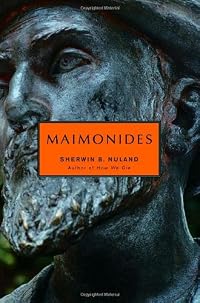
Maimonides
by Sherwin B. Nuland
On This Page
Description
Describes the twelfth-century philosopher and physician's efforts to reconcile his rationationalist thinking and scientific knowledge with a faith in God, his remarkable influence as a Jew in a Muslim world, and the lasting legacy of his teachings.Tags
Recommendations














Member Reviews
I was a bit put off at his asking whether one must be a scholar to be able to put oneself in the place and time of the Rambam, to really understand him without being emmersed in the totality of the tradition, and without being a scientist. I think this is to miss the point of what emphathy can be? Yet he poses important questions, and I think he has very valid points regarding the over three hundred year long tradition of Jewish boys being encouraged to become doctors in particular. Interesting points on the learning of Jewish and Islamic doctors versus the lack thereof in the Christian world at the time.
Where Homer uses Reason to reject Religion entirely, Maimonides uses Reason to (mostly) support and strengthen Divine Truth.
He further translates his vast medical knowledge and compassion into usable form.
Readers may wonder what he might have created with all the time and energy spent to clarify the intricate questions and problems of the Talmud.
That he survived his early life and escaped the tyranny of the Muslims creates an amazing background history.
He further translates his vast medical knowledge and compassion into usable form.
Readers may wonder what he might have created with all the time and energy spent to clarify the intricate questions and problems of the Talmud.
That he survived his early life and escaped the tyranny of the Muslims creates an amazing background history.
I was a bit put off at his asking whether one must be a scholar to be able to put oneself in the place and time of the Rambam, to really understand him without being emmersed in the totality of the tradition, and without being a scientist. I think this is to miss the point of what emphathy can be? Yet he poses important questions, and I think he has very valid points regarding the over three hundred year long tradition of Jewish boys being encouraged to become doctors in particular. Interesting points on the learning of Jewish and Islamic doctors versus the lack thereof in the Christian world at the time.
If Sherwin B. Nuland, in his Nextbook/Schocken book titled Maimonides, would only have given a detail picture of 12th century history of the Mediterranean region, including the various rulers’ rise and fall, characteristics of their empire, extending it both in space (covering Africa and Europe) and time (earlier and later centuries) … it would have been enough.
If the book would only have analyzed why so many Jews became doctors from the earliest of times, listing such reasons as medical knowledge being portable, when Jews were forced to move often; or the fact that the minds honed on Talmudic debates could easily use the same techniques for scientific/medical argumentation and produce better results, than other healers’, who were show more often uneducated … it would have been enough.
If Nuland would only have covered Rambam’s biography, including his travels and the reasons behind them, his relationships to his father, brother, students and women as much as possible; talked about his studies, positions, correspondence, alliances, and enemies … it would have been enough.
If the book would only have introduced Rambam’s major works, putting them in the context of their origin, including how the “Commentary on the Mishnah” with its combination of Greek philosophy and Rabbinic commentary manages to balance and keep scientific approach and unbending faith at their places; how the Rambam spent ten years on writing the “Mishneh Torah”’s fourteen volumes to create a reduction of Talmudic law, making its decrees available for the less educated mind; and how “The Guide for the Perplexed” created divisions between those who understood it, those who did not and those who thought they did… it would have been enough.
If Nuland, as a medical doctor and historian himself, would only have evaluated Maimonides reputation as a medical luminary, pointing out how much of his writings and practice depended on Hippocrates, Galen, Arabic and Christian sources, how Maimonides cannot be really considered an original thinker in terms of medical science, but more of a re-interpreter, similar to all of his contemporaries, but nevertheless not belittling his mental powers… it would have been enough.
If the book would only have pointed out why Rambam viewed health important (so people could devote more time to the most important duty of attaining knowledge of G-d) … it would have been enough.
But, the author also pointed out on page 190,
“The real reason that Maimonides has been an ageless icon to Jews everywhere […is the] memory of a man whose life was devoted to the continuity of the Jewish people.”
(Some of you might have recognized that the “it would have been enough” phrase is from a Pesach song. I wrote this review following that pattern in honor of the Rambam/Maimonides, who was born on the first night of Pesach in 1135.) show less
If the book would only have analyzed why so many Jews became doctors from the earliest of times, listing such reasons as medical knowledge being portable, when Jews were forced to move often; or the fact that the minds honed on Talmudic debates could easily use the same techniques for scientific/medical argumentation and produce better results, than other healers’, who were show more often uneducated … it would have been enough.
If Nuland would only have covered Rambam’s biography, including his travels and the reasons behind them, his relationships to his father, brother, students and women as much as possible; talked about his studies, positions, correspondence, alliances, and enemies … it would have been enough.
If the book would only have introduced Rambam’s major works, putting them in the context of their origin, including how the “Commentary on the Mishnah” with its combination of Greek philosophy and Rabbinic commentary manages to balance and keep scientific approach and unbending faith at their places; how the Rambam spent ten years on writing the “Mishneh Torah”’s fourteen volumes to create a reduction of Talmudic law, making its decrees available for the less educated mind; and how “The Guide for the Perplexed” created divisions between those who understood it, those who did not and those who thought they did… it would have been enough.
If Nuland, as a medical doctor and historian himself, would only have evaluated Maimonides reputation as a medical luminary, pointing out how much of his writings and practice depended on Hippocrates, Galen, Arabic and Christian sources, how Maimonides cannot be really considered an original thinker in terms of medical science, but more of a re-interpreter, similar to all of his contemporaries, but nevertheless not belittling his mental powers… it would have been enough.
If the book would only have pointed out why Rambam viewed health important (so people could devote more time to the most important duty of attaining knowledge of G-d) … it would have been enough.
But, the author also pointed out on page 190,
“The real reason that Maimonides has been an ageless icon to Jews everywhere […is the] memory of a man whose life was devoted to the continuity of the Jewish people.”
(Some of you might have recognized that the “it would have been enough” phrase is from a Pesach song. I wrote this review following that pattern in honor of the Rambam/Maimonides, who was born on the first night of Pesach in 1135.) show less
Ratings
Members
- Recently Added By
Author Information

40+ Works 4,965 Members
Dr. Sherwin B. Nuland was born Shepsel Ber Nudelman on December 8, 1930 in the Bronx, New York. He received a bachelor's degree from New York University in 1951 and a medical degree from Yale University in 1955. He decided to specialize in surgery and in 1958, became the chief surgical resident at Yale-New Haven Hospital. From 1962 to 1991, he was show more a clinical professor of surgery at Yale University, where he also taught bioethics and medical history. Before retiring to write full-time, he was a surgeon at Yale-New Haven Hospital from 1962 to 1992. His books include Doctors: The Biography of Medicine, The Wisdom of the Body, The Doctors' Plague, The Uncertain Art, and the memoir Lost in America. His book, How We Die, won the National Book Award for nonfiction in 1994. He was also a contributing editor to The American Scholar and The New Republic. He died of prostate cancer on March 3, 2014 at the age of 83. (Bowker Author Biography) show less
Series
Belongs to Publisher Series
Common Knowledge
- Canonical title
- Maimonides
- Alternate titles*
- Маймонид
- People/Characters
- Maimonides (Moses ben Maimon or Rambam, 1135-1204)
*Some information comes from Common Knowledge in other languages. Click "Edit" for more information.
Classifications
Statistics
- Members
- 302
- Popularity
- 105,719
- Reviews
- 4
- Rating
- (3.28)
- Languages
- Dutch, English
- Media
- Paper, Ebook
- ISBNs
- 4
- ASINs
- 3