We Are Grateful: Otsaliheliga
by Traci Sorell
On This Page
Description
Otsaliheliga is a Cherokee word that is used to express gratitude. Journey through the year with a Cherokee family and their tribal nation as they express thanks for celebrations big and small. A look at modern Native American life as told by a citizen of the Cherokee Nation.Tags
Recommendations




Member Reviews
The author, Traci Sorell, is a citizen of the Cherokee Nation, and in this book she shares how a Cherokee family and its community express thanks in all kinds of circumstances.
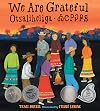
Cherokee words are included throughout, presented both phonetically and also written in the Cherokee syllabary, as you can see in the picture below. [A syllabary is a set of written symbols that represent the syllables as well as phonological units which make up words.]
For example, the book begins:
“Cherokee people say otsaliheliga to express gratitude. It is a reminder to celebrate our blessings and reflect on struggles - daily, throughout the year, and across the seasons.”
Below this paragraph, the text reads:
“Otsaliheliga - oh-jah-LEE-hay-lee-gah - [It then show more shows the Cherokee script for this phrase which you can see from the picture of the cover] - we are grateful”
Lush gouache illustrations by Frané Lessac accompany the text and depict the ways in which the community celebrates and expresses gratitude for change, growth, family members, traditions, and holidays. The first double page spread shows the arrival of the season of fall and the text informs us:
“When cool breezes blow and leaves fall, we say otsaliheliga….”
Similar examples of occasions calling for expressions of gratitude follow. Aspects of the culture, such as ceremonial foods and games, are incorporated into the pictures as well as the text.
“Every day, every season.
Otsaliheliga. We are grateful.”
Lessac often paints bright opaque colors on a dark background. The results, showing a creative application of colors not replicated in nature, are simply stunning. Art fans may be reminded of Paul Gauguin, with his experimental and non-representational use of the vivid colors he saw in French Polynesia; the influence of folk art on his style; and naivety of his figures. Lessac's work is reminiscent of that school of art.
Sorell wanted not only to convey the panoply of happy events that families and communities celebrate during all four seasons. She also covers some of life’s more somber moments that are shared and commemorated. But these inclusions are crafted from such a positive perspective - e.g., “we gather to remember an uncle who has passed on” and “we embrace a clan relative heading off to serve our country” - that it shouldn't disturb young readers in the least. On the contrary, it suggests new ways to think about upsetting things that could be seen as uplifting in a different light.
The families in the book look very diverse. Sorell and Lessac are teaching us that, as the author explained in an interview:
“The Cherokee Nation citizens cover the color spectrum, ranging from blonde hair with light skin to black hair with black skin — yet we are all from the same tribe.”
At the end of the book, there are some definitions, an Author’s Note on Cherokee culture, some background on the Cherokee syllabary, and a chart showing each symbol.
The author also refers readers to the Cherokee Nation website for more information.
Evaluation: Sorell portrays the Cherokee culture as one built on the strength of family and tradition, and on a respect for the earth that non-Indigenous people would do well to emulate. What a relief to see such a lovely alternative to the usual portrayals of Native Americans either as relics of the past or as failures of the present. This book has received a number of awards; highly recommended. show less
Cherokee words are included throughout, presented both phonetically and also written in the Cherokee syllabary, as you can see in the picture below. [A syllabary is a set of written symbols that represent the syllables as well as phonological units which make up words.]
For example, the book begins:
“Cherokee people say otsaliheliga to express gratitude. It is a reminder to celebrate our blessings and reflect on struggles - daily, throughout the year, and across the seasons.”
Below this paragraph, the text reads:
“Otsaliheliga - oh-jah-LEE-hay-lee-gah - [It then show more shows the Cherokee script for this phrase which you can see from the picture of the cover] - we are grateful”
Lush gouache illustrations by Frané Lessac accompany the text and depict the ways in which the community celebrates and expresses gratitude for change, growth, family members, traditions, and holidays. The first double page spread shows the arrival of the season of fall and the text informs us:
“When cool breezes blow and leaves fall, we say otsaliheliga….”
Similar examples of occasions calling for expressions of gratitude follow. Aspects of the culture, such as ceremonial foods and games, are incorporated into the pictures as well as the text.
“Every day, every season.
Otsaliheliga. We are grateful.”
Lessac often paints bright opaque colors on a dark background. The results, showing a creative application of colors not replicated in nature, are simply stunning. Art fans may be reminded of Paul Gauguin, with his experimental and non-representational use of the vivid colors he saw in French Polynesia; the influence of folk art on his style; and naivety of his figures. Lessac's work is reminiscent of that school of art.
Sorell wanted not only to convey the panoply of happy events that families and communities celebrate during all four seasons. She also covers some of life’s more somber moments that are shared and commemorated. But these inclusions are crafted from such a positive perspective - e.g., “we gather to remember an uncle who has passed on” and “we embrace a clan relative heading off to serve our country” - that it shouldn't disturb young readers in the least. On the contrary, it suggests new ways to think about upsetting things that could be seen as uplifting in a different light.
The families in the book look very diverse. Sorell and Lessac are teaching us that, as the author explained in an interview:
“The Cherokee Nation citizens cover the color spectrum, ranging from blonde hair with light skin to black hair with black skin — yet we are all from the same tribe.”
At the end of the book, there are some definitions, an Author’s Note on Cherokee culture, some background on the Cherokee syllabary, and a chart showing each symbol.
The author also refers readers to the Cherokee Nation website for more information.
Evaluation: Sorell portrays the Cherokee culture as one built on the strength of family and tradition, and on a respect for the earth that non-Indigenous people would do well to emulate. What a relief to see such a lovely alternative to the usual portrayals of Native Americans either as relics of the past or as failures of the present. This book has received a number of awards; highly recommended. show less
As it states in the beginning of the book "Cherokee people say Ostaliheliga to express gratitude. It is a reminder to celebrate our blessings and reflect on struggles - daily, throughout the year and across the seasons." Starting in the fall, which is the beginning of the Cherokee new year, the book continues through the seasons, telling about ceremonies, traditions, celebrations and cultural practices in which the people are grateful. Cherokee words are integrated into the text. In addition, the Cherokee words, pronunciation and words written in the Cherokee Syllabary are at the bottom of the pages. The additional author's note and Cherokee Syllabary make this a wonderful informative book to share with students during Native American show more Heritage month and for many other reasons. It's full of intriguing information and beautiful engaging illustrations. show less
First-time author Traci Sorrell, a member of the Cherokee Nation, presents a picture-book tribute to the seasons, and to the Cherokee practice of gratitude in We Are Grateful / Otsaliheliga. Set in the here and now, the simple narrative chronicles life in the Cherokee community throughout the year, from the Great New Moon Ceremony in the fall (Cherokee New Year) to the Green Corn Ceremony in the summer. At every occasion, the people are otsaliheliga (grateful)...
A lovely little book, We Are Grateful / Otsaliheliga comes recommended on the back dust-jacket by Abenaki children's author Joseph Bruchac, who is one of my favorites. Sorrell's narrative here actually mentions the Cherokee folktale about the first strawberries, which Bruchac show more has retold in picture-book form. Cherokee words are introduced and defined throughout, both in the original Cherokee syllabary and in transliteration, making this title both educational and entertaining. The accompanying artwork, done by illustrator Frané Lessac in gouache, is colorful and vibrant, with a folksy feeling that is well-suited to the text. An informative afterword provides definitions, an author's note, and an exploration of the Cherokee syllabary. Recommended to anyone looking for picture-books about gratitude and/or about Native Americans in the present day. show less
A lovely little book, We Are Grateful / Otsaliheliga comes recommended on the back dust-jacket by Abenaki children's author Joseph Bruchac, who is one of my favorites. Sorrell's narrative here actually mentions the Cherokee folktale about the first strawberries, which Bruchac show more has retold in picture-book form. Cherokee words are introduced and defined throughout, both in the original Cherokee syllabary and in transliteration, making this title both educational and entertaining. The accompanying artwork, done by illustrator Frané Lessac in gouache, is colorful and vibrant, with a folksy feeling that is well-suited to the text. An informative afterword provides definitions, an author's note, and an exploration of the Cherokee syllabary. Recommended to anyone looking for picture-books about gratitude and/or about Native Americans in the present day. show less
This book is a celebration of seasonal events of a year as told by a citizen of the Cherokee Nation. The book is primarily in English, but it includes some words in Cherokee - including the title word otsaliheliga, which means "we are grateful" - written in both the Latin alphabet and the Cherokee syllabary. The illustrations are colorful and vibrant, capturing the vitality of Cherokee life throughout the year. Readers unfamiliar with the Cherokee Nation will learn of numerous traditions and events which might have otherwise been unknown to them, while members of the Cherokee Nation will see their community presented with love and respect. I highly recommend this for any collection.
4-1/2 stars – ½ star off because there is no story that flows and I would have enjoyed the book more had there been one.
The illustrations are really special. They’re gorgeous and detailed with lots to view. I adore the art!
I learned a lot about the modern Cherokee Nation. I found it interesting that, like Jewish people, they celebrate New Year in the autumn. It makes sense to me.
There isn’t exactly a story here. The repetition will probably appeal to children though, and I did appreciate how much lifestyle information was able to be included, and loved how it showed women, men, children each participating in life and the community in a variety of ways.
I found the whole project touching, and the narrative is one that’s sorely show more needed for learning about modern Native Americans.
The additional information at the end greatly elevates the quality of the book. I appreciated the definitions list, the author’s note, the Cherokee syllabary with history and pronunciation. I think readers of all ages can get a lot out of those few final pages. I was also touched by the author’s and illustrator’s dedications and interested in their bios.
Highly recommended for readers looking for children’s picture books about gratitude, modern Native Americans/the Cherokee Nation, the seasons, written & oral languages, and beautiful illustrations. show less
The illustrations are really special. They’re gorgeous and detailed with lots to view. I adore the art!
I learned a lot about the modern Cherokee Nation. I found it interesting that, like Jewish people, they celebrate New Year in the autumn. It makes sense to me.
There isn’t exactly a story here. The repetition will probably appeal to children though, and I did appreciate how much lifestyle information was able to be included, and loved how it showed women, men, children each participating in life and the community in a variety of ways.
I found the whole project touching, and the narrative is one that’s sorely show more needed for learning about modern Native Americans.
The additional information at the end greatly elevates the quality of the book. I appreciated the definitions list, the author’s note, the Cherokee syllabary with history and pronunciation. I think readers of all ages can get a lot out of those few final pages. I was also touched by the author’s and illustrator’s dedications and interested in their bios.
Highly recommended for readers looking for children’s picture books about gratitude, modern Native Americans/the Cherokee Nation, the seasons, written & oral languages, and beautiful illustrations. show less
According to storyteller Sorell, the Cherokee people always express gratitude for the little things they are given by saying the phrase, “Otsaliheliga,” or “we are grateful.”
Raised in the Cherokee Nation, Sorell intentionally crafts a narrative that simultaneously embraces modernity and a traditional presentation of Cherokee community and way of life. Throughout, the measured text reminds readers that in all things “we say otsaliheliga.” Colorful, folk art–style illustrations show Cherokee people during ceremonies, in family gatherings large and small, and outdoors enjoying each of the four seasons, always expressing gratitude. The scenes are contemporary; one shows a father taking care of his children, engaging in a show more positive parenting role, while another depicts a family seeing off a relative who is leaving for deployment in the military, underscoring that Cherokee people serve their country. Children participate in rites and in family outings with adults, and they also play traditional games such as stickball and plant strawberries, a practice that reminds their people to embrace peace with one another. The variety of skin tones represented in the illustrations likewise depicts a present-day reflection of the diversity that exists within the Cherokee people. Occasional Cherokee words are written in Romanized form, phonetically, in Cherokee characters, and in English—a lovely grace note.
A gracious, warm, and loving celebration of community and gratitude. (glossary, author’s note, Cherokee syllabary) (Picture book. 4-8)
-Kirkus Review show less
Raised in the Cherokee Nation, Sorell intentionally crafts a narrative that simultaneously embraces modernity and a traditional presentation of Cherokee community and way of life. Throughout, the measured text reminds readers that in all things “we say otsaliheliga.” Colorful, folk art–style illustrations show Cherokee people during ceremonies, in family gatherings large and small, and outdoors enjoying each of the four seasons, always expressing gratitude. The scenes are contemporary; one shows a father taking care of his children, engaging in a show more positive parenting role, while another depicts a family seeing off a relative who is leaving for deployment in the military, underscoring that Cherokee people serve their country. Children participate in rites and in family outings with adults, and they also play traditional games such as stickball and plant strawberries, a practice that reminds their people to embrace peace with one another. The variety of skin tones represented in the illustrations likewise depicts a present-day reflection of the diversity that exists within the Cherokee people. Occasional Cherokee words are written in Romanized form, phonetically, in Cherokee characters, and in English—a lovely grace note.
A gracious, warm, and loving celebration of community and gratitude. (glossary, author’s note, Cherokee syllabary) (Picture book. 4-8)
-Kirkus Review show less
According to storyteller Sorell, the Cherokee people always express gratitude for the little things they are given by saying the phrase, “Otsaliheliga,” or “we are grateful.”
Raised in the Cherokee Nation, Sorell intentionally crafts a narrative that simultaneously embraces modernity and a traditional presentation of Cherokee community and way of life. Throughout, the measured text reminds readers that in all things “we say otsaliheliga.” Colorful, folk art–style illustrations show Cherokee people during ceremonies, in family gatherings large and small, and outdoors enjoying each of the four seasons, always expressing gratitude. The scenes are contemporary; one shows a father taking care of his children, engaging in a show more positive parenting role, while another depicts a family seeing off a relative who is leaving for deployment in the military, underscoring that Cherokee people serve their country. Children participate in rites and in family outings with adults, and they also play traditional games such as stickball and plant strawberries, a practice that reminds their people to embrace peace with one another. The variety of skin tones represented in the illustrations likewise depicts a present-day reflection of the diversity that exists within the Cherokee people. Occasional Cherokee words are written in Romanized form, phonetically, in Cherokee characters, and in English—a lovely grace note.
A gracious, warm, and loving celebration of community and gratitude. (glossary, author’s note, Cherokee syllabary) (Picture book. 4-8)
-Kirkus Review show less
Raised in the Cherokee Nation, Sorell intentionally crafts a narrative that simultaneously embraces modernity and a traditional presentation of Cherokee community and way of life. Throughout, the measured text reminds readers that in all things “we say otsaliheliga.” Colorful, folk art–style illustrations show Cherokee people during ceremonies, in family gatherings large and small, and outdoors enjoying each of the four seasons, always expressing gratitude. The scenes are contemporary; one shows a father taking care of his children, engaging in a show more positive parenting role, while another depicts a family seeing off a relative who is leaving for deployment in the military, underscoring that Cherokee people serve their country. Children participate in rites and in family outings with adults, and they also play traditional games such as stickball and plant strawberries, a practice that reminds their people to embrace peace with one another. The variety of skin tones represented in the illustrations likewise depicts a present-day reflection of the diversity that exists within the Cherokee people. Occasional Cherokee words are written in Romanized form, phonetically, in Cherokee characters, and in English—a lovely grace note.
A gracious, warm, and loving celebration of community and gratitude. (glossary, author’s note, Cherokee syllabary) (Picture book. 4-8)
-Kirkus Review show less
Members
- Recently Added By
Lists

Indigenous America Reader
145 works; 12 members

Native American Heritage
52 works; 2 members
Author Information

16+ Works 2,757 Members
All Editions
Some Editions
Awards and Honors
Classifications
Statistics
- Members
- 968
- Popularity
- 27,289
- Reviews
- 54
- Rating
- (4.32)
- Languages
- English, Spanish
- Media
- Paper, Audiobook, Ebook
- ISBNs
- 20
- ASINs
- 2