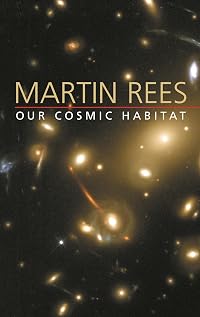
Our Cosmic Habitat
by Martin J. Rees
On This Page
Description
Our universe seems strangely ''biophilic,'' or hospitable to life. Is this happenstance, providence, or coincidence? According to cosmologist Martin Rees, the answer depends on the answer to another question, the one posed by Einstein's famous remark: ''What interests me most is whether God could have made the world differently.'' This highly engaging book explores the fascinating consequences of the answer being ''yes.'' Rees explores the notion that our universe is just a part of a vast show more ''multiverse,'' or ensemble of universes, in which most of the other universes are lifeless. What we call the laws of nature would then be no more than local bylaws, imposed in the aftermath of our own Big Bang. In this scenario, our cosmic habitat would be a special, possibly unique universe where the prevailing laws of physics allowed life to emerge. Rees begins by exploring the nature of our solar system and examining a range of related issues such as whether our universe is or isn't infinite. He asks, for example: How likely is life? How credible is the Big Bang theory? Rees then peers into the long-range cosmic future before tracing the causal chain backward to the beginning. He concludes by trying to untangle the paradoxical notion that our entire universe, stretching 10 billion light-years in all directions, emerged from an infinitesimal speck. As Rees argues, we may already have intimations of other universes. But the fate of the multiverse concept depends on the still-unknown bedrock nature of space and time on scales a trillion trillion times smaller than atoms, in the realm governed by the quantum physics of gravity. Expanding our comprehension of the cosmos, Our Cosmic Habitat will be read and enjoyed by all those--scientists and nonscientists alike--who are as fascinated by the universe we inhabit as is the author himself. show lessTags
Recommendations









Member Reviews
I picked up this book because I wanted to read Rees' book Just Six Numbers: The Deep Forces That Shape the Universe. Unfortunately the library didn't have it, so I checked this one out instead. I didn't find it all that interesting. I felt like Rees was trying to cover too much in too small a book, and didn't give enough room for some additional explanation.
He does cover a lot of topics if you're looking for a good survey of cosmology/astronomy, but just know he really only skims the surface of them. But it may catch your interest to research some of the topics further. He covers the Big Bang, and the future of the Universe. He also covers whether we live in a 'Universe' or a 'Multiverse'. (He believes the latter.) He says our best show more chance to find this out (as well as other questions, such as what happened in the first instant of the Big Bang, what are the values of lambda, and why such a simple recipe led to such a complex cosmos) is by unifying the quantum mechanics and general relativity, or the 'Theory of Everything'.
One note of interest: Rees writes "I would bet reasonable odds that by the year 2010 we will be very confident of what the dominant dark matter is, the value of lambda, and the properties of the dark energy in the vacuum." It just goes to show how very complex these aspects of cosmology are, since it is now 2010, and I don't believe we are any nearer an answer than when this book was written (2001). show less
He does cover a lot of topics if you're looking for a good survey of cosmology/astronomy, but just know he really only skims the surface of them. But it may catch your interest to research some of the topics further. He covers the Big Bang, and the future of the Universe. He also covers whether we live in a 'Universe' or a 'Multiverse'. (He believes the latter.) He says our best show more chance to find this out (as well as other questions, such as what happened in the first instant of the Big Bang, what are the values of lambda, and why such a simple recipe led to such a complex cosmos) is by unifying the quantum mechanics and general relativity, or the 'Theory of Everything'.
One note of interest: Rees writes "I would bet reasonable odds that by the year 2010 we will be very confident of what the dominant dark matter is, the value of lambda, and the properties of the dark energy in the vacuum." It just goes to show how very complex these aspects of cosmology are, since it is now 2010, and I don't believe we are any nearer an answer than when this book was written (2001). show less
Ratings
Members
- Recently Added By
Author Information

35+ Works 3,447 Members
Martin Rees is Royal Society Research Professor at Cambridge University and holds the title of Astronomer Royal.
Series
Belongs to Publisher Series
Common Knowledge
- Canonical title*
- Il nostro ambiente cosmico
- Original title
- Our Cosmic Habitat
- Important places*
- Weltall
*Some information comes from Common Knowledge in other languages. Click "Edit" for more information.
Classifications
Statistics
- Members
- 270
- Popularity
- 120,847
- Reviews
- 2
- Rating
- (3.63)
- Languages
- 8 — Czech, Dutch, English, German, Hungarian, Italian, Japanese, Spanish
- Media
- Paper, Ebook
- ISBNs
- 16
- ASINs
- 3