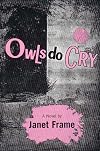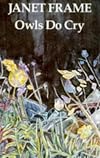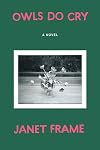
Owls Do Cry
by Janet Frame
On This Page
Description
So the day promised fair, and the sea lay like a quilt with the waves tucked under, and the trees wavering like leafless water, cut to fit from a transparent block of blue air and frost. 'Owls do cry' tells the story of the Withers family: Francie, who is twelve and about to start work at the woollen mills, hard drudgery sweetened with the thrill of riding a bike to work; Toby, who would rather play at the dump than go to school, where the dark velvet cloak of epilepsy often wraps itself show more around him; Chicks, the youngest; and Daphne, whose rich poetic way of seeing the world leads to a heartbreaking life in institutions. Janet Frame writes of hardship, poverty and tragedy with beauty and a deep sensitivity. 'Owls do cry' is a poetic masterpiece. show lessTags
Recommendations




















Member Reviews
Floating somewhere between free verse and stream of consciousness, Janet Frame's beautifully evocative, semi-autobiographical novel traces the various fortunes of the dirt poor Withers family...most notably siblings Francie, Daphne, Toby, and Teresa (nicknamed "Chicks")...as they grow up and strive to establish lives for themselves in the modern world of 1950's New Zealand. Frame uses words the way a painter uses oils (or a sculptor a chisel) giving her readers not so much a linear story but rather a carefully curated collage of memories, impressions, and emotional impacts. One marries well and turns to consumerism in order to fill an inner void; another tries to make their own way despite a severe handicap only to find Poverty show more traveling alongside them; and yet another struggles to understand the world through a mind crippled by madness. Humorous and heartbreaking in turn, "Owls Do Cry" is the closest I've come to an immersive reading experience in quite some time. show less
An unsettling and utterly original work of genius, Owls Do Cry heralded the arrival of Janet Frame on the international literary scene and kicked off a period of staggering creativity in which she would publish nine novels in fifteen years. Owls Do Cry chronicles the lives of the Withers siblings, Daphne, Chicks (Teresa), Toby and Francie. Growing up in coastal Waimaru (based on Frame’s home town of Oamaru), the children are raised by their well-meaning, unsophisticated parents in a home with few luxuries and in a time and place where Toby’s epileptic seizures are considered shameful and frightening and a sign of weakness. The first part of the novel tells of their fascination with the local rubbish dump, where they often go to show more search for treasure, and ends with a tragic accident. Subsequent sections take place “twenty years after” and follow the three remaining Withers siblings as they suffer setbacks and struggle to remain connected and yet establish independent identities and lives of their own. Most powerful is the section on Daphne, who has been committed to a mental institution and regards her surroundings through a drugged and fragmented haze. The reality of these scenes is fluid and hard to nail down—hospital staff are monsters, a wall is a mountain—but it is in this section that Frame’s prose and narrative imagery achieve the vivid and poetic heights for which she was to become famous. One cannot help reading Daphne’s scenes through the prism of what we know of the author’s life: her own institutionalization and narrow escape from brain surgery as psychiatric therapy. Though there are flashes of humour, the prevailing tone of the novel is tragic, and yet one reaches the end with a sense that hope is not entirely lost. In 1957, Owls Do Cry appeared without literary antecedents, leaving critics of the time with virtually no points of comparison. Sixty years later it remains a deeply affecting work of startling originality. The courage of its author, one of the most daring stylists of twentieth-century English prose, is undeniable. show less
Impressionistic, itinerant narration tells the story of four siblings in midcentury New Zealand. Sort of reminded me of Faulkner and Woolf, but the voices of involuntarily confined Daphne, epileptic Toby and suburban neurotic Chicks, and even those of their parents, share one or two annoying tics — “oh” and “ah” and sentence-starting “and” — that betray the presence of the author. Daphne’s sections are convincing in their insanity but not much fun to read. The whole book is ambitious but unfortunately a bit of a slog.
Disappointed not to have enjoyed this more, since I’m generally a big fan of frame stories…
Disappointed not to have enjoyed this more, since I’m generally a big fan of frame stories…
Oh, the futility of life...where the "sane" partake of what appears to be the nectar of life and the "insane" are sadly dispossessed - but perhaps nearer to the truth.
This book follows a poverty stricken family in New Zealand but could have been anywhere on earth. All family members lead individually distinct emotional lives and Janet Frame takes the reader on an exploration of the intimate musings of each. As crowded together physically and economically as they are, there is a vast distance separating them.
It occurred to me that perhaps you have to be a bit crazy to understand this book... I just might be...
I really liked this one! Very sad but insightful.
This book follows a poverty stricken family in New Zealand but could have been anywhere on earth. All family members lead individually distinct emotional lives and Janet Frame takes the reader on an exploration of the intimate musings of each. As crowded together physically and economically as they are, there is a vast distance separating them.
It occurred to me that perhaps you have to be a bit crazy to understand this book... I just might be...
I really liked this one! Very sad but insightful.
I loved this semi-autobiographical tale of Janet Frame's childhood in New Zealand, for the clear, flowing and sensitive style as well as for the description of life on the other side of the world and the characters. Reading this story of four brothers and sisters growing up, it is impossible not to be touched by Daphne, the character closest to Frame herself, and the ordeal she goes through in a psychiatric hospital. Frame, understandably, offers an alternative, more sympathetic vision of mental patients, and subtly pleads for more acceptance and understanding from mainstream society in favour of people who don't quite fit in. Frame's observations on family life and siblings relationships (both in childhood and adulthood) also ring very show more true. All in all, a rich, original novel, by no means an easy read but a rewarding one. show less
A haunting and tragic book about small-town New Zealand. I read most of it in one sitting, and actually cried real tears at the end. For that reason alone I feel obligated to give it five stars.
I did find some of Daphne's earlier scenes hard to follow. The ECT scene with all the patients "waiting in crocodile" and the crocodile becoming some sort of extended metaphor (?) I didn't really get.
Her later scenes on the other hand are really very good and give a great angle on how Daphne's "insanity" makes perfect sense from her point of view.
I did find some of Daphne's earlier scenes hard to follow. The ECT scene with all the patients "waiting in crocodile" and the crocodile becoming some sort of extended metaphor (?) I didn't really get.
Her later scenes on the other hand are really very good and give a great angle on how Daphne's "insanity" makes perfect sense from her point of view.
The interesting aspect of this book is its bringing of poetry into prose. I mean, the prose is more poetic than Alan Curnow's (prose) poems, not that that's saying much. Oh, and it doesn't work.
There is a clearness to the underlying story lines, even though the plot (of which there is effectively none) doesn't work. A real mis-mash. Like piles of windows, doors, wood, carpet, nails lying there, hinting of the great house that could have been built.... and hasn't been.
There is a clearness to the underlying story lines, even though the plot (of which there is effectively none) doesn't work. A real mis-mash. Like piles of windows, doors, wood, carpet, nails lying there, hinting of the great house that could have been built.... and hasn't been.
Members
- Recently Added By
Lists

500 Great Books by Women
507 works; 60 members
TML 200 Best Books 1950-1999
202 works; 10 members

Literary Witches
86 works; 4 members

le donne raccontano
116 works; 1 member

The Five Books That Represent Us
391 works; 150 members

The Modern Library (The Two Hundred Best Novels....
202 works; 1 member
Author Information

51+ Works 4,693 Members
Janet Frame is a writer. She was born in Dunedin, New Zealand in 1924. Frame has written eleven novels, five collections of short stories, a volume of poetry, and a children's book. She has received the Commonwealth Literature Prize, the Turnavsky Prize, a Katherine Mansfield Fellowship, a Robert Burns Fellowship, and a Sargeson Fellowship. She show more was awarded an honorary doctorate in literature from Otago University and is an honorary member of the American Academy of Arts and Letters and she is a past President of Honour of the New Zealand Society of Authors. Her three autobiographies, To the Island, An Angel at My Table, and The Envoy from Mirror City, were turned into a three-part television series, and then a 1990 motion picture directed by Jane Campion. Frame was awarded the CBE in 1983. In 2015 Janet Frame's 1957 debut novel, Owls Do Cry, topped the second annual Great Kiwi Classic poll run by the New Zealand Book Council and Auckland Writers Festival. (Bowker Author Biography) show less
Some Editions
Awards and Honors
Series
Belongs to Publisher Series
Work Relationships
Is contained in
Common Knowledge
- Original publication date
- 1957
- Original language
- English
Classifications
Statistics
- Members
- 524
- Popularity
- 57,373
- Reviews
- 11
- Rating
- (3.99)
- Languages
- 8 — Dutch, English, French, German, Hungarian, Italian, Swedish, Turkish
- Media
- Paper, Audiobook, Ebook
- ISBNs
- 44
- ASINs
- 10