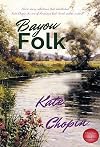
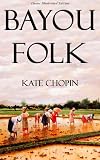
Bayou Folk
by Kate Chopin
On This Page
Description
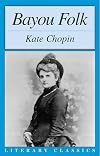
Bayou Folk (1894) is a collection of 23 short stories that tell of life in 19th century Louisiana - on the bayou, in small towns, plantations, and New Orleans. It's a kaleidoscope of locations, types of stories, and races of characters - whites, Creoles, Acadians, 'Negros', and 'Mulattoes' are all mixed together here. Most are poor and many are illiterate. The stories take place mostly after the Civil War.Tags
Recommendations
























Member Reviews
Bayou Folk (1894) is a collection of 23 short stories that tell of life in 19th century Louisiana – on the bayou, in small towns, plantations, and New Orleans. It’s a kaleidoscope of locations, types of stories, and races of characters – whites, Creoles, Acadians, ‘Negros’, and ‘Mulattoes’ are all mixed together here. Most are poor and many are illiterate. The stories take place mostly after the Civil War, but I found the strongest three to be set before (or during) it:
‘Desiree’s Baby’ – probably her best in this collection, it deals with mixed-race children, with a surprise ending which subtly questions the feelings of racial superiority.
‘La Belle Zoraide’ - about the cruelty of slaveholders in trying to show more arrange a marriage between a creole beauty and a mulatto she doesn’t love.
‘A Lady of Bayou St. John’ - about a young married woman in a lonely marriage who because attracted to another man, believes she will go “anywhere, anywhere” with him, but finds her heart changes after her husband is killed in the war. There is a great quote from this one: “That mysterious, that treacherous bond called sympathy, had revealed them to each other.”
Overall the stories are a little uneven in terms of emotional impact, and her other collections are stronger, but these clearly show her promise as an author and you could do worse. Chopin sought first and foremost to portray truth, like one of her literary heroes Guy de Maupassant, and in that she was successful. Because of the themes of poor folk in the country living in a stratified society, I was also reminded of Turgenev’s ‘Sketches From a Hunter’s Album’. show less
‘Desiree’s Baby’ – probably her best in this collection, it deals with mixed-race children, with a surprise ending which subtly questions the feelings of racial superiority.
‘La Belle Zoraide’ - about the cruelty of slaveholders in trying to show more arrange a marriage between a creole beauty and a mulatto she doesn’t love.
‘A Lady of Bayou St. John’ - about a young married woman in a lonely marriage who because attracted to another man, believes she will go “anywhere, anywhere” with him, but finds her heart changes after her husband is killed in the war. There is a great quote from this one: “That mysterious, that treacherous bond called sympathy, had revealed them to each other.”
Overall the stories are a little uneven in terms of emotional impact, and her other collections are stronger, but these clearly show her promise as an author and you could do worse. Chopin sought first and foremost to portray truth, like one of her literary heroes Guy de Maupassant, and in that she was successful. Because of the themes of poor folk in the country living in a stratified society, I was also reminded of Turgenev’s ‘Sketches From a Hunter’s Album’. show less
An intriguing & interesting series of interconnected short stories that illustrate post-Civil War Cajun & Creole society in Louisiana. - pb.
Free E-Book available at Gutenberg.org & Archive.org
Free E-Book available at Gutenberg.org & Archive.org
This edition has versions that have been "translated" into modern English, including passages originally in French. The original versions are in appendixes.
Ratings
Members
- Recently Added By
Lists

Fiction (Mostly) in Selective Bibliography of American Literature 1775-1900
431 works; 3 members
Author Information

195+ Works 21,042 Members
Kate Chopin was born Katherine O'Flaherty in St. Louis, Missouri, on February 8, 1851. Although she was brought up in a wealthy and socially elite Catholic family, Chopin's childhood was marred by tragedies. Her father was killed in a train accident when Chopin was just four years old, and in the following years she also lost her older brother, show more great-grandmother, and half-brother. In 1870, at the age of 19, she married Oscar Chopin, the son of a wealthy cotton-growing family in Louisiana. The couple had seven children together, five boys and two girls, before Oscar died of swamp fever in 1883. The following year, Chopin packed up her family and moved back to St. Louis to be with her mother, who died just a year later. To support herself and her family, Chopin started to write. Her first novel, At Fault, was published in 1890. Her most famous work, The Awakening, inspired by a real-life New Orleans woman who committed adultery, was published in 1899. The book explores the social and psychological consequences of a woman caught in an unhappy marriage in 19th century America, is now considered a classic of the feminist movement and caused such an uproar in the community that Chopin almost entirely gave up writing. Chopin did try her hand at a few short stories, most of which were not even published. Chopin died on August 22, 1904, of a brain hemorrhage, after collapsing at the World's Fair just two days before. (Bowker Author Biography) show less
Work Relationships
Common Knowledge
- Canonical title
- Bayou Folk
- Original publication date
- 1894
Classifications
- Genres
- Fiction and Literature, General Fiction
- DDC/MDS
- 813.4 — Literature & rhetoric American literature in English American fiction in English Later 19th Century 1861-1900
- LCC
- PZ3 .C456 — Language and Literature Fiction and juvenile belles lettres Fiction and juvenile belles lettres Fiction in English
- BISAC
Statistics
- Members
- 26
- Popularity
- 1,043,728
- Reviews
- 3
- Rating
- (4.07)
- Languages
- English
- Media
- Paper, Ebook
- ISBNs
- 26
- ASINs
- 1