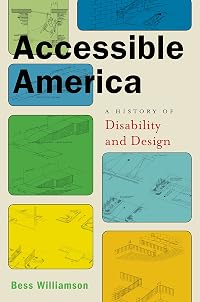
Accessible America: A History of Disability and Design (Crip, 2)
by Bess Williamson
On This Page
Description
A history of design that is often overlooked—until we need itHave you ever hit the big blue button to activate automatic doors? Have you ever used an ergonomic kitchen tool? Have you ever used curb cuts to roll a stroller across an intersection? If you have, then you’ve benefited from accessible design—design for people with physical, sensory, and cognitive disabilities. These ubiquitous touchstones of modern life were once anything but. Disability advocates fought tirelessly to ensure show more that the needs of people with disabilities became a standard part of public design thinking. That fight took many forms worldwide, but in the United States it became a civil rights issue; activists used design to make an argument about the place of people with disabilities in public life.In the aftermath of World War II, with injured veterans returning home and the polio epidemic reaching the Oval Office, the needs of people with disabilities came forcibly into the public eye as they never had before. The US became the first country to enact federal accessibility laws, beginning with the Architectural Barriers Act in 1968 and continuing through the landmark Americans with Disabilities Act in 1990, bringing about a wholesale rethinking of our built environment. This progression wasn’t straightforward or easy. Early legislation and design efforts were often haphazard or poorly implemented, with decidedly mixed results. Political resistance to accommodating the needs of people with disabilities was strong; so, too, was resistance among architectural and industrial designers, for whom accessible design wasn’t “real” design.Bess Williamson provides an extraordinary look at everyday design, marrying accessibility with aesthetic, to provide an insight into a world in which we are all active participants, but often passive onlookers. Richly detailed, with stories of politics and innovation, Williamson’s Accessible America takes us through this important history, showing how American ideas of individualism and rights came to shape the material world, often with unexpected consequences. show lessTags
Recommendations
























Member Reviews
The book traces the history of design for accessibility since the early 20th century—here moving from prostheses and designs that enabled people to drive cars to building/built environment design and finally back to wheelchairs and other objects (like OXO Good-Grips), now under the aegis of “universal design.” Williamson argues that a key issue has always been American individualism and bias against shared resources—was accessibility a way of enabling individual citizens to fulfill their productive potential, or was it coddling/harming others in order to benefit a minority? Appealing to the former conception helped disabled advocates and their allies, but also accepted the individualist premise. Likewise, using polio survivors show more and disabled war veterans as paradigmatic representatives of disabled populations allowed appeals to normative white masculinity and femininity—accessibility helped otherwise middle-class white people fulfill their appropriate roles—but didn’t challenge the normativity of those depictions. Radical interventions in the 1960s and beyond have tried to frame access as enabling individuals to choose how they want to live in the world, and to discuss inaccessibility as both literally and more-than-literally structural replication of disadvantage, but the simultaneous rise of “universal design” also made it easy for disability as a particular way of life to disappear, since designers are now supposedly designing for everyone. show less
Useful history of accessible and universal design in C20 USA. Acknowledges political forces at work; movement from charity-model “design for” to social-model “design by.” Wheelchair issues foremost while recognizing the limitations of that lens. Great spelunking on oral histories and zines.
Ratings
Members
- Recently Added By
Lists

The War on Cars podcast
108 works; 1 member
Author Information
2 Works 65 Members
Bess Williamson is Associate Professor of Art History, Theory and Criticism at the School of the Art Institute of Chicago.
Awards and Honors
Notable Lists
Series
Belongs to Publisher Series
Common Knowledge
- Original title
- Accessible America: A History of Disability and Design
- Original publication date
- 2019-01-15
- Dedication
- In Memory of Philomene Asher Gates
- Blurbers
- Lupton, Ellen; Baynton, Douglas C.; Garland-Thomson, Rosemarie; Serlin, David
- Original language
- English
Classifications
- Genres
- Nonfiction, History, General Nonfiction, Art & Design
- DDC/MDS
- 362.4 — Society, government, & culture Social problems and social services Social Welfare People with disabilites
- LCC
- HV1553 .W55 — Social sciences Social pathology. Social and public welfare. Criminology Social pathology. Social and public welfare. Protection, assistance and relief Special classes People with disabilities
- BISAC
Statistics
- Members
- 59
- Popularity
- 523,596
- Reviews
- 2
- Rating
- (3.63)
- Languages
- English
- Media
- Paper, Ebook
- ISBNs
- 3