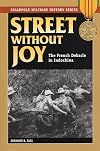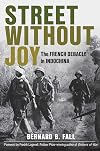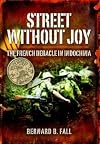
Street Without Joy: The French Debacle In Indochina
by Bernard B. Fall
On This Page
Description
In this classic account of the French war in Indochina, Bernard B. Fall vividly captures the sights, sounds, and smells of the savage eight-year conflict in the jungles and mountains of Southeast Asia from 1946 to 1954. The French fought well to the last, but even with the lethal advantages of airpower, they could not stave off the Communist-led Vietnamese nationalists, who countered with a hit-and-run campaign of ambushes, booby traps, and nighttime raids. Defeat came at Dien Bien Phu in show more 1954, setting the stage for American involvement and opening another tragic chapter in Vietnam's history. show lessTags
Recommendations




























Member Reviews
It's heartbreaking to think how differently the twentieth century might have ended had the powers that be in the U.S. read and, more importantly, paid attention to this book. Bernard Fall describes brilliantly the strategy and tactics used by Vo Nguyen Giap and the Viet Minh against the French. These tactics changed very little from one war to the next yet we, forewarned (assuming we had read this book), walked right into it.
This is a classic example of the old axiom that he who fails to learn from history is doomed to repeat it.
What I found particularly disturbing about 'Street Without Joy' is Giap's description of the evolution of his enemies' tactics; an initial offensive, slowing and turning into a defensive war with a growing show more amount of public sentiment against involvement. Does this sound familiar? show less
This is a classic example of the old axiom that he who fails to learn from history is doomed to repeat it.
What I found particularly disturbing about 'Street Without Joy' is Giap's description of the evolution of his enemies' tactics; an initial offensive, slowing and turning into a defensive war with a growing show more amount of public sentiment against involvement. Does this sound familiar? show less
Street Without Joy is the definitively account of the first Indo-China War, as France attempted to hold on to it's East Asian colony. Bernard draws on first hand experience and documentary research in Paris to describe the slow defeat of France in the "vast empty spaces" of Vietnam's jungle and highlands to the light infantry of the Viet Minh.
Fall describes the complete failure of heavy mechanized units in guerrilla warfare. Tied to the scanty road network, the Groupes Mobile were juggernauts, but ones that could be avoided and lured into ambush by the Viet Minh. The epic destruction of G.M 100 at the same time as Dien Bien Phu is the climax of the book, an account of outnumbered professionals calmly laying down their lives after the show more war is lost. Heavy units imply substantial logistics needs, and the second battle was the battle of the forts, as France distributed its forces in penny packets along the de Lattre line and strategic roads. These forts were ineffective at preventing mass Viet Minh infiltration, served as supply depots for the enemy when overrun individually and looted, and cost on average 3 to 4 men per 100 km of road per day. Multiply it out, and it comes to thousands of casualties just to hold static positions without any pacification effort. The part of the war that Fall thinks worked were the command groups, alliances of French specialists and Montagnard guerrillas to attack Viet Minh supply lines, but this force was inherently limited and difficult to scale.
Fall's book has the flaws of its strengths. The wonderful portraits of the men and women who fought are a romanticized version of the French empire. (about 30% of the soldiers were French, with the rest split between Foreign Legion, Colonial units from Africa, and local levies) Communist tactics come down to 'screaming human wave attacks' a few too many times, without much insight into the actual weakness of light infantry forces. Bernard gets the problem of what he calls Revolutionary Warfare right, and the ways in which a motivated local force fighting for its own values will beat foreign occupiers, but doesn't extend the critique to the anti-communist project broadly speaking, or how Western democracies could defeat communism without becoming a mirror image of the enemy.
Ultimately, Fall was right, but there's little satisfaction in being a Cassandra, as the American military fought the same war as the French, but faster and louder. show less
Fall describes the complete failure of heavy mechanized units in guerrilla warfare. Tied to the scanty road network, the Groupes Mobile were juggernauts, but ones that could be avoided and lured into ambush by the Viet Minh. The epic destruction of G.M 100 at the same time as Dien Bien Phu is the climax of the book, an account of outnumbered professionals calmly laying down their lives after the show more war is lost. Heavy units imply substantial logistics needs, and the second battle was the battle of the forts, as France distributed its forces in penny packets along the de Lattre line and strategic roads. These forts were ineffective at preventing mass Viet Minh infiltration, served as supply depots for the enemy when overrun individually and looted, and cost on average 3 to 4 men per 100 km of road per day. Multiply it out, and it comes to thousands of casualties just to hold static positions without any pacification effort. The part of the war that Fall thinks worked were the command groups, alliances of French specialists and Montagnard guerrillas to attack Viet Minh supply lines, but this force was inherently limited and difficult to scale.
Fall's book has the flaws of its strengths. The wonderful portraits of the men and women who fought are a romanticized version of the French empire. (about 30% of the soldiers were French, with the rest split between Foreign Legion, Colonial units from Africa, and local levies) Communist tactics come down to 'screaming human wave attacks' a few too many times, without much insight into the actual weakness of light infantry forces. Bernard gets the problem of what he calls Revolutionary Warfare right, and the ways in which a motivated local force fighting for its own values will beat foreign occupiers, but doesn't extend the critique to the anti-communist project broadly speaking, or how Western democracies could defeat communism without becoming a mirror image of the enemy.
Ultimately, Fall was right, but there's little satisfaction in being a Cassandra, as the American military fought the same war as the French, but faster and louder. show less
Military history of the French defeat in Indochina, written when American involvement was just beginning to ramp up. If you want to learn about a pointless, painful, and slow defeat, driven by French imperialist assumptions and indifference to the question of whether anybody actually wanted the French in control, this book tells that story, with plenty of grim details as the deaths mount in fives and tens, day in and day out. The seeds of the subsequent American defeat were also there, and as apparent to Fall in prospect as they are in restrospect.
I found "Street Without Joy" fascinating - a cross between the summation of after-action battle reports and a history book outlining the French debacle in Indochina. Readers clearly see that Laos and Vietnam were trying to free themselves from French colonial rule after World War II...the French, Chinese and Japanese were all defeated and kicked out during the war; the author maintains that if France would have granted both Laos and Vietnam their independence in 1945 - so many lives could have been saved.
It was obvious that the French did not have enough troops, equipment and supplies to support their mission within Indochina,and were not trained or ready to fight a guerrilla style jungle war. Conventional thinking and fighting were no show more match against an elusive enemy in the thick jungles, who chose the time and place for battle. As time went on, there were so many lessons to be learned and opportunities for change, yet the French insisted on the status quo - going so far as to train their Vietnamese allies in those same methods and tactics. As a result, almost 100,000 French soldiers lost their lives during their 8 year battle against those forces loyal to Ho Chi Minh.
When the French were defeated in 1954, Laos received sovernty and Vietnam was split at the 17th parallel; the southern half of the country still opposing those communist of the North. The United States came into the picture soon afterwards, providing advisors, equipment and funds to support the South's battle against the North Communists. However, there was no interest in studying the French battles and learning from their mistakes, so, history was to repeat itself...and so it did!
When Bernard Fall published this book in 1961, he states in it that the South had already lost the war with the North and cites examples of why it will happen - including outright lies by both the press and government to name a few.
I learned so much from reading "Street Without Joy" and feel that if the U.S. Government would have listened to this author or read his work, then acting upon the many lessons learned, I might not have had to serve in that war as an infantry soldier during 1970 and many of those 58,000+ soldiers might still be living.
I highly recommend this book to anyone wishing to learn more about Indochina and the French occupation.
John Podlaski, author
Cherries - A Vietnam War Novel show less
It was obvious that the French did not have enough troops, equipment and supplies to support their mission within Indochina,and were not trained or ready to fight a guerrilla style jungle war. Conventional thinking and fighting were no show more match against an elusive enemy in the thick jungles, who chose the time and place for battle. As time went on, there were so many lessons to be learned and opportunities for change, yet the French insisted on the status quo - going so far as to train their Vietnamese allies in those same methods and tactics. As a result, almost 100,000 French soldiers lost their lives during their 8 year battle against those forces loyal to Ho Chi Minh.
When the French were defeated in 1954, Laos received sovernty and Vietnam was split at the 17th parallel; the southern half of the country still opposing those communist of the North. The United States came into the picture soon afterwards, providing advisors, equipment and funds to support the South's battle against the North Communists. However, there was no interest in studying the French battles and learning from their mistakes, so, history was to repeat itself...and so it did!
When Bernard Fall published this book in 1961, he states in it that the South had already lost the war with the North and cites examples of why it will happen - including outright lies by both the press and government to name a few.
I learned so much from reading "Street Without Joy" and feel that if the U.S. Government would have listened to this author or read his work, then acting upon the many lessons learned, I might not have had to serve in that war as an infantry soldier during 1970 and many of those 58,000+ soldiers might still be living.
I highly recommend this book to anyone wishing to learn more about Indochina and the French occupation.
John Podlaski, author
Cherries - A Vietnam War Novel show less
An excellent read that has aged, in all, very well and retains its relevance. I particularly appreciated his acknowledgment of the role of women, not only as caregivers, but warriors too. I’ve studied this war pretty extensively over a span of decades, reading a great many books, but had never gotten around to reading this one. I’m glad I rectified the omission.
It's hard to say anything more that hasn't already been said by the other reviewers. This book basically affirms George Santayana's famous remark that "Those who cannot remember the past are condemned to repeat it." The book details the French disaster in Vietnam up to the very early days of US involvement in 1961. He details how badly flawed French strategy and tactics in Vietnam were through the 1950s up to the siege of Dien Bien Phu. He details how the French send mechanized battalions into some of the world's thickest jungles, how they deploy aircraft to support ground troops in foliage so thick that the ground can't be seen, how they drive convoy after convoy along the only and easily ambushable roads, and so on. The fatal flaws of show more the French involvement are 1) the expectation that a guerilla force will engage them in a traditional "set-piece" battle, and 2) that superior technology makes it unnecessary to have a popular cause. Basically the French brought a howitzer to a gun fight. Although on paper the howitzer possesses far greater firepower, any idiot knows that the party wielding the pistol will have filled the howitzer operator full of lead before he has had any chance at all to bring his "superior" weapon to bear.
This is not a book that's critical of foreign involvement in Vietnam. Far from it. Fall makes it clear that he has no love whatsoever for Communism in general and the Viet-Minh in particular. It is more a lament at the vast number of men who were sacrificed by the French military leadership because they were unwilling or unable to see that their strategies and tactics were absolutely self-defeating. It was also a warning to the US military and political leadership to learn from France's mistakes. I think you know how that story ends, though ... show less
This is not a book that's critical of foreign involvement in Vietnam. Far from it. Fall makes it clear that he has no love whatsoever for Communism in general and the Viet-Minh in particular. It is more a lament at the vast number of men who were sacrificed by the French military leadership because they were unwilling or unable to see that their strategies and tactics were absolutely self-defeating. It was also a warning to the US military and political leadership to learn from France's mistakes. I think you know how that story ends, though ... show less
After almost 30 years I have reread this book and together with several trips to Vietnam, including Dien Bien Phu, Hue, Route 1 and Route 9 and have enjoyed it more and value the author's insights. The book is well written and the author enjoyed first hand experience travelling with the French. When now visits Vietnam and meets the now happy and industrious people, one can only feel regret at the many years the French and then Americans futilely attempting to impose first colonial rule and then imported western political system, which itself evolved out of past revolutionary wars. The Vietnamese people can stand proudly with any in the world in the knowledge that they have justly earned their national freedom in spite of the huge show more obstacles thrown in its path. show less
Members
- Recently Added By
Lists

Read These Too
458 works; 9 members
Author Information

16+ Works 1,463 Members
Bernard Fall was born in Vienna in 1926, migrating to France in 1938. After his father was killed by the Gestapo and his mother killed at Auschwitz, he joined the French Resistance at sixteen, then the French Army. Following World War II, he was an analyst with the Nuremberg War Crimes Tribunal. Coming to the United States in the early 1950s, he show more earned a master's and a doctorate at Syracuse University. He first traveled to Indochina in 1953, returning in 1957, 1962, 1965, 1966, and 1967, when he was killed by a mine on the "street without joy," the highway he had described in his book. He also wrote Hell in a Very Small Place. show less
Series
Belongs to Publisher Series
Common Knowledge
- Canonical title
- Street Without Joy: The French Debacle In Indochina
- Original publication date
- 1961
- Important places
- Vietnam; Laos
- Important events
- Battle of Dien Bien Phu; Indochina War; Groupement Mobile (G.M.) No. 100 (G.M.); Operation Lorraine
- Dedication
- To Those Who Died There
- First words
- War came to Indochina in the wake of the crumbling of the European colonial empires in Asia during World War II.
- Quotations
- The arrival of the Air Force's B-26's also helped consolidate the situation, although not in the way it was expected. By the time they intervened, combat had reached the hand-to-hand stage in many places; the intervening aeri... (show all)al strafing froze everyone flat on the ground, enemy and friend intermingled and often only feet apart. As the silvery birds swooped down in a deafening roar of engines, the bursts of their nose guns raking the high grass like strong gusts of wind, men from both camps looked up at the sky in fear and hatred of blind fate which dealt death in almost impartial fashion. One of the radios of Headquarters Co. was heard to say, as if to settle a long-standing argument: "This goes to show you again-this whole aerial warfare business isn't quite perfected...ce n'est pas encore au point."
- Last words
- (Click to show. Warning: May contain spoilers.)And this is perhaps as good an epitaph as any for the men who had to walk down the joyless and hopeless road that was the Indochina War until 1954; and for the Americans who now have to follow their footsteps.
- Original language
- French
Classifications
- Genres
- History, Nonfiction, General Nonfiction
- DDC/MDS
- 959.7041 — History & geography History of Asia Southeast Asia: Myanmar, Thailand, Laos, Cambodia, Vietnam Vietnam 1949- 1946-1954 Indochinese War
- LCC
- DS550 .F3 — History of Europe, Asia, Africa and Oceania Asia History of Asia Southeast Asia French Indochina History
- BISAC
Statistics
- Members
- 539
- Popularity
- 54,956
- Reviews
- 14
- Rating
- (4.16)
- Languages
- English
- Media
- Paper, Audiobook, Ebook
- ISBNs
- 15
- UPCs
- 2
- ASINs
- 23